

Kettlebell Glute Workout: Sculpt Stronger, Rounder Glutes Fast
Kettlebell Glute Workout: Build Stronger, Shapelier Glutes
A strong, well-shaped glute is more than just a trend. It’s a sign of good health, power, and balance. Your glutes—the muscles in your buttocks—are among the largest and most important in your body. They help you walk, run, jump, and even stand upright.
But many people struggle to activate and build their glutes, especially if they sit for long hours. Luckily, kettlebell workouts offer an effective way to target and strengthen these muscles with dynamic movements.
Kettlebells are simple weights with a handle, but they unlock unique exercises that both challenge and sculpt your glutes. They’re easy to use at home or in the gym, and you can adjust the difficulty by changing the weight. This guide will help you understand how kettlebell training works for your glutes, which exercises give the best results, and how to build a complete routine.
You’ll also learn how to avoid common mistakes and see real progress, whether you’re a beginner or already have some fitness experience.
Why Focus On Glutes?
Your glutes are not just about appearance. They play a key role in your posture, movement, and injury prevention. Strong glutes help stabilize your hips and lower back. Weak glutes can lead to pain, poor movement, and injuries, especially in the knees and lower back.
Many daily activities—sitting, standing, climbing stairs—use your glutes. If your glutes are weak, other muscles compensate, which can lead to discomfort and imbalance. Training your glutes improves your strength, athletic performance, and confidence.
Here are some benefits of glute training:
- Better posture: Strong glutes support your spine and keep your body upright.
- Improved athletic power: Glutes drive movements like jumping, sprinting, and lifting.
- Reduced injury risk: Balanced glutes help protect your knees and lower back.
- Enhanced body shape: Well-developed glutes give your body a balanced, toned look.
Why Use Kettlebells For Glute Training?
Kettlebells are powerful tools for glute workouts. Unlike traditional weights, kettlebells allow for dynamic, swinging motions that activate your glutes in new ways. They also challenge your balance and coordination, which means your glutes—and your core—work harder.
Some advantages of kettlebell glute workouts:
- Versatility: You can do many different exercises with just one kettlebell.
- Functional movement: Kettlebell exercises mimic real-life activities, training your body to move better.
- Compact equipment: Kettlebells don’t take much space. You can use them at home, outside, or in the gym.
- Improved muscle activation: Swinging and balancing motions recruit more glute fibers.
A study published in the Journal of Strength and Conditioning Research found kettlebell swings activate the glutes as much as barbell hip thrusts, a popular glute exercise. This means kettlebells are not just convenient—they’re highly effective.
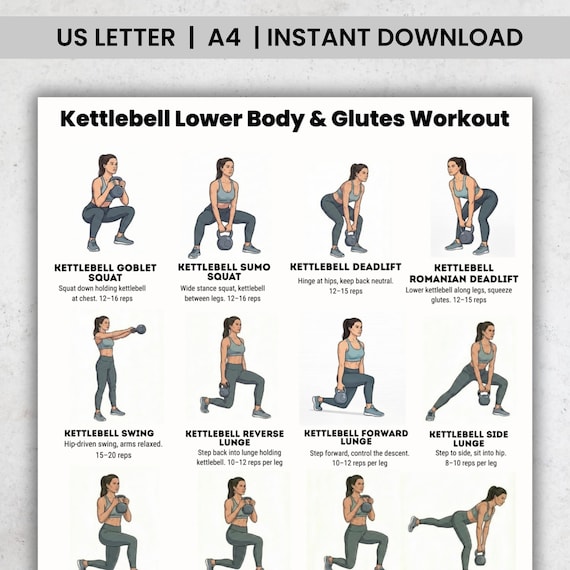
Credit: www.etsy.com
Anatomy Of The Glutes
Understanding your glutes helps you train them better. The glute area has three main muscles:
- Gluteus maximus: The largest muscle, responsible for hip extension and giving your butt its shape.
- Gluteus medius: Located on the side, it stabilizes your hips and helps with leg movement.
- Gluteus minimus: The smallest, deep inside, also helps stabilize your hips.
When you do kettlebell exercises, you target all three muscles, but some moves focus more on one than the others. For best results, include exercises that hit each part.
Essential Kettlebell Glute Exercises
A complete kettlebell glute workout uses a mix of movements. Here are the most effective exercises to build strong, shapely glutes. Each move is explained with tips and variations.
1. Kettlebell Swing
The kettlebell swing is the star of glute training. It’s a powerful move that uses hip extension to drive the kettlebell forward.
How to do it:
- Stand with feet shoulder-width apart.
- Hold the kettlebell with both hands, arms straight.
- Bend your knees slightly, push hips back.
- Swing the kettlebell between your legs, then thrust hips forward to swing it up to chest height.
- Let the kettlebell fall back down, repeating the motion.
Tips:
- Use your hips, not your arms.
- Keep your back straight.
- Start with a light kettlebell until you master the form.
Common mistake: Many beginners use their shoulders to lift the kettlebell. The movement should come from your hips and glutes.
2. Kettlebell Deadlift
The kettlebell deadlift is great for targeting the gluteus maximus.
How to do it:
- Place kettlebell on the floor between your feet.
- Stand with feet hip-width apart.
- Bend at the hips and knees, grab the kettlebell handle.
- Stand up by pushing through your heels and extending your hips.
- Lower the kettlebell back to the ground.
Tips:
- Keep your chest up and shoulders back.
- Push your hips forward as you stand.
3. Kettlebell Goblet Squat
The goblet squat works your glutes and thighs.
How to do it:
- Hold the kettlebell close to your chest with both hands.
- Stand with feet slightly wider than hip-width.
- Squat down, keeping your chest up and knees out.
- Push through your heels to stand back up.
Tips:
- Don’t let your knees cave inward.
- Keep the kettlebell close to your chest.
4. Kettlebell Bulgarian Split Squat
This single-leg squat targets the gluteus medius and maximus.
How to do it:
- Hold a kettlebell in each hand or use one kettlebell at your chest.
- Place one foot behind you on a bench or step.
- Lower your body until your front thigh is parallel to the ground.
- Push through your front heel to stand up.
Tips:
- Keep your torso upright.
- Use slow, controlled movement.
5. Kettlebell Hip Thrust
The hip thrust isolates your glutes.
How to do it:
- Sit on the ground with your upper back against a bench.
- Place the kettlebell on your hips.
- Bend your knees, feet flat.
- Push your hips up, squeezing your glutes at the top.
- Lower hips back down.
Tips:
- Don’t overextend your back.
- Focus on squeezing your glutes.
6. Kettlebell Step-up
This move works your glutes, quads, and stabilizing muscles.
How to do it:
- Hold a kettlebell in each hand or one at your chest.
- Stand in front of a bench or step.
- Step up with one foot, pushing through your heel.
- Step down and repeat.
Tips:
- Control the movement, don’t rush.
- Alternate legs for balanced strength.
7. Kettlebell Single-leg Deadlift
This advanced move targets the gluteus maximus and medius.
How to do it:
- Hold the kettlebell in one hand.
- Stand on one leg, other leg slightly bent.
- Bend forward, keeping your back straight, lowering the kettlebell toward the ground.
- Stand up, squeezing your glute.
Tips:
- Keep your hips level.
- Use light weight to start.
8. Kettlebell Curtsy Lunge
This lunge variation hits the gluteus medius.
How to do it:
- Hold a kettlebell at your chest.
- Step one leg behind and across your body.
- Lower your body, keeping chest up.
- Return to start, switch sides.
Tips:
- Focus on balance.
- Don’t let your front knee move inward.
9. Kettlebell Sumo Squat
A wider squat that emphasizes the inner thighs and glutes.
How to do it:
- Hold a kettlebell with both hands between your legs.
- Stand with feet wide, toes pointed out.
- Squat down, keeping knees over toes.
- Stand up, squeezing your glutes.
Tips:
- Don’t round your back.
- Keep movement slow and controlled.
10. Kettlebell Lateral Lunge
Targets gluteus medius and maximus.
How to do it:
- Hold a kettlebell at your chest.
- Step to the side, bending one knee.
- Push through your heel to stand up.
- Repeat on the other side.
Tips:
- Keep your chest up.
- Don’t let your knee go past your toes.
Sample Kettlebell Glute Workout Routine
Now that you know the best exercises, here’s a sample routine to build strong glutes. Adjust the weight and reps to match your fitness level.
Warm-Up (5–10 minutes):
- Bodyweight squats: 15 reps
- Glute bridges: 15 reps
- Jumping jacks: 30 seconds
Main Workout:
- Kettlebell swings: 3 sets x 15 reps
- Goblet squats: 3 sets x 12 reps
- Bulgarian split squats: 3 sets x 10 reps (each leg)
- Single-leg deadlifts: 3 sets x 8 reps (each leg)
- Hip thrusts: 3 sets x 12 reps
- Step-ups: 3 sets x 10 reps (each leg)
Cool-Down (5 minutes):
- Standing hamstring stretch: 30 seconds each leg
- Figure-four glute stretch: 30 seconds each side
Rest for 60–90 seconds between sets.
Tip: If you’re a beginner, do fewer sets and use lighter kettlebells. As you get stronger, add more weight and reps.
Choosing The Right Kettlebell
Picking the correct kettlebell is important for safety and results. If your kettlebell is too heavy, your form suffers. If it’s too light, your muscles won’t be challenged.
Here’s a quick comparison of recommended kettlebell weights for glute exercises:
| Exercise | Beginner (Women) | Beginner (Men) | Intermediate (Women) | Intermediate (Men) |
|---|---|---|---|---|
| Kettlebell Swing | 18 lbs | 26 lbs | 26 lbs | 35 lbs |
| Goblet Squat | 15 lbs | 18 lbs | 26 lbs | 35 lbs |
| Deadlift | 26 lbs | 35 lbs | 35 lbs | 44 lbs |
| Single-Leg Deadlift | 15 lbs | 18 lbs | 18 lbs | 26 lbs |
| Hip Thrust | 18 lbs | 26 lbs | 26 lbs | 35 lbs |
Tip: If you only have one kettlebell, use it for all exercises, but adjust reps as needed.

Credit: igrs.itu.edu.tr
Progressive Overload: How To Get Results
Muscles grow and get stronger by progressive overload—increasing weight, reps, or difficulty over time. If you do the same workout every week, your glutes won’t change much.
Ways to progress:
- Increase kettlebell weight
- Add more reps or sets
- Slow down the movement for more tension
- Try advanced variations, like single-leg moves
Non-obvious insight: Many people forget to track their progress. Write down your workouts and weights. Small improvements add up.
Common Mistakes In Kettlebell Glute Training
Even experienced athletes make mistakes that hurt their results. Here are pitfalls to avoid:
- Poor form: Rushing through exercises leads to weak glute activation and increases injury risk.
- Using arms instead of hips: In swings, your hips should move the kettlebell—not your arms.
- Neglecting single-leg moves: These train balance and prevent muscle imbalances.
- Skipping warm-up and cool-down: This increases injury risk and slows recovery.
- Doing only squats: Squats are great, but swings, deadlifts, and thrusts are needed for full glute development.
Pro tip: Record yourself doing exercises or ask someone to check your form. Small errors often go unnoticed but can make a big difference.
How Kettlebell Glute Workouts Compare To Other Methods
You might wonder how kettlebells stack up against other glute training tools like barbells, resistance bands, or bodyweight exercises. Here’s a quick comparison:
| Method | Glute Activation | Ease of Use | Equipment Needed | Best For |
|---|---|---|---|---|
| Kettlebells | High | Moderate | Kettlebell | Dynamic moves, home use |
| Barbells | Very High | Hard | Barbell, plates, rack | Heavy lifting, gym |
| Resistance Bands | Moderate | Easy | Bands | Light resistance, travel |
| Bodyweight | Low–Moderate | Easy | None | Beginners, no equipment |
Non-obvious insight: Kettlebells allow you to train explosively (fast and powerful), which not all methods do. This is important for athletic performance and burning calories.
Real-life Results: What To Expect
Kettlebell glute workouts can change your body and strength. Here are realistic results you can expect:
- First 2–4 weeks: Improved glute activation, better posture, and more energy.
- 4–8 weeks: Noticeable muscle tone, stronger lifts, and less lower-back pain.
- 8+ weeks: Visible glute growth, better balance, and athletic power.
Example: Many people report their jeans fitting better, easier stair climbing, and feeling “lighter” on their feet.
Stat: Research shows kettlebell swings can burn up to 20 calories per minute, combining strength and cardio for fat loss and muscle gain.
Glute Activation: Why It Matters
Doing exercises is not enough—you must activate your glutes. Many people use their quads or lower back instead. Here’s how to make sure your glutes are working:
- During exercises, focus on squeezing your glutes at the top.
- Use slower reps to feel the muscle contract.
- Try glute bridges or donkey kicks before your workout to “wake up” the muscles.
Non-obvious insight: If you don’t feel your glutes working, reduce weight and slow the movement. Quality beats quantity.
Advanced Kettlebell Glute Variations
Once you master basic moves, try these advanced exercises:
- Kettlebell swing with band resistance: Loop a band around your hips and the kettlebell. This increases tension and glute activation.
- Single-arm kettlebell swing: Swing with one arm, forcing your glutes and core to stabilize.
- Kettlebell pistol squat: Hold kettlebell at your chest, squat on one leg. Very challenging for glutes and balance.
- Kettlebell walking lunges: Hold kettlebells in each hand, lunge forward. Great for glute strength and endurance.
- Kettlebell box step-up with knee drive: Step up on a box, drive the opposite knee up. Adds balance and power.
Tip: Only try advanced moves after mastering basic form.
Glute Workout Frequency: How Often Should You Train?
Most people see best results training their glutes 2–3 times a week. Training daily is not needed. Muscles grow during rest, so give them time to recover.
Example schedule:
- Monday: Kettlebell glute workout
- Wednesday: Upper body or cardio
- Friday: Kettlebell glute workout
Stat: A study from the National Strength and Conditioning Association suggests 48–72 hours rest between intense glute workouts for best muscle growth.
Nutrition Tips For Glute Growth
Exercise is only half the equation. Nutrition helps your muscles grow and recover.
Key tips:
- Eat enough protein (chicken, eggs, beans) to repair and build muscle.
- Include healthy fats (avocado, nuts) for hormone balance.
- Hydrate well—muscles need water to function.
- Don’t skip carbs. They fuel your workouts.
Non-obvious insight: Many people focus only on protein, but carbs are just as important for energy and recovery.
Safety Tips For Kettlebell Glute Workouts
Kettlebells are safe if used correctly, but accidents can happen. Protect yourself with these guidelines:
- Warm up properly before lifting.
- Use a clear, open space to avoid hitting objects.
- Start with lighter weights and progress slowly.
- Keep your back straight and core tight during exercises.
- If you feel pain (not just muscle burn), stop and check your form.
Pro tip: If you have a history of back or knee injuries, consult a professional before starting.
Tracking Progress: How To Measure Success
Don’t just rely on the mirror. Use these methods to track your glute gains:
- Take measurements of your hips and glutes every 2–4 weeks.
- Track the weights and reps you use in a notebook.
- Record how you feel during daily activities (stairs, walking, running).
Example: If you can do more reps or heavier swings without losing form, your glutes are getting stronger.
Kettlebell Glute Workout For Different Goals
Kettlebell workouts can be customized for various goals. Here’s a comparison of routines for strength, muscle growth, and fat loss:
| Goal | Reps | Sets | Rest | Key Exercises |
|---|---|---|---|---|
| Strength | 6–8 | 4–5 | 2–3 min | Deadlift, Swing, Hip Thrust |
| Muscle Growth | 10–12 | 3–4 | 60–90 sec | Goblet Squat, Split Squat, Step-Up |
| Fat Loss | 15–20 | 2–3 | 30–60 sec | Swing, Curtsy Lunge, Lateral Lunge |
Tip: Change your routine every 4–6 weeks for continuous progress.
How To Add Kettlebell Glute Training To Your Routine
Kettlebell glute workouts can fit into any fitness plan. Here’s how:
- As a stand-alone workout: Do the full routine 2–3 times a week.
- As part of a larger program: Add 2–3 glute exercises to your leg or full-body days.
- For cardio: Use swings, lunges, and step-ups in circuit format.
Non-obvious insight: Mixing glute exercises with upper body moves improves calorie burn and keeps your workouts interesting.
Recovery And Mobility For Glute Health
Recovery is as important as training. Stretch and foam roll your glutes after workouts to reduce soreness and improve flexibility.
Best recovery moves:
- Figure-four stretch
- Pigeon pose
- Foam rolling on glutes and hips
Tip: If you feel tightness or discomfort, spend extra time on mobility.
Frequently Asked Questions
What Is The Best Kettlebell Exercise For Glutes?
The kettlebell swing is widely considered the most effective glute exercise. It uses hip extension and explosive power to activate the gluteus maximus. Swings also build endurance and burn calories.
How Heavy Should My Kettlebell Be For Glute Workouts?
For most beginners, start with a 15–26 lb kettlebell. If you can do 12–15 reps with good form, increase the weight. Heavier kettlebells build strength, but always prioritize proper technique.
Can I Train Glutes With Kettlebells At Home?
Yes, kettlebells are perfect for home workouts. They take up little space and don’t require special equipment. Just make sure you have a clear area and start with basic exercises.
How Often Should I Do Kettlebell Glute Workouts?
Aim for 2–3 sessions per week. This gives your muscles time to recover and grow. Overtraining can lead to fatigue and slow progress.
Where Can I Learn More About Kettlebell Training?
For detailed guides and research, visit the ACE Fitness website. They offer expert advice and workout ideas.
Building strong, healthy glutes is possible for anyone with the right approach. Kettlebell workouts provide a fun, effective way to train your glutes, improve your athletic power, and enhance your body shape. With consistent effort and smart planning, you’ll see real progress—both in how you move and how you look.

Credit: www.youtube.com
