

How to Do Tricep Workout at Home: Build Strong Arms Fast
How To Do Tricep Workout At Home
Building strong triceps isn’t just for bodybuilders or gym lovers. Your triceps help with daily actions—lifting, pushing, and even steadying your arms. Many people think you need expensive equipment or a gym membership for good tricep workouts. But you can get excellent results right at home, using simple tools or even just your body weight. This guide will help you understand how triceps work, why they matter, and how to create an effective tricep workout at home. You’ll learn exercises, routines, common mistakes, and practical tips to get strong, toned arms without leaving your house.
Understanding Your Triceps
The triceps brachii, or triceps, is the large muscle on the back of your upper arm. It has three heads—long, lateral, and medial—that work together to extend your arm. When you push open a door or throw a ball, your triceps are working hard. If you want strong, defined arms, training your triceps is essential. Many beginners focus only on biceps, but triceps make up about two-thirds of your upper arm muscle.
Why Triceps Matter
Strong triceps help with:
- Arm strength: You can lift heavier objects and perform better in sports.
- Joint support: Triceps stabilize the elbow, preventing injuries.
- Balanced muscle: Working both triceps and biceps gives your arms a symmetrical look.
- Functional movement: Everyday tasks like pushing, carrying, or reaching become easier.
Common Mistakes
Many people:
- Ignore triceps, focusing only on biceps
- Use poor form, risking injury
- Overtrain, leading to soreness and slow progress
Understanding these basics will help you avoid setbacks and get results faster.
Setting Up For Home Tricep Workouts
You don’t need a fancy gym. You can do tricep exercises using your body weight, household items, or simple equipment like resistance bands and dumbbells.
Essential Equipment (optional)
If you want variety, having these at home can help:
- Resistance bands
- Dumbbells (even light ones)
- Chair or sturdy bench
- Yoga mat for comfort
If you don’t have these, don’t worry. Many exercises use only your body weight.
Preparing Your Space
- Find a clear area where you can move freely.
- Place a mat or towel for comfort.
- Make sure any objects you use (like a chair) are stable and safe.
Warming Up
Never skip warm-up. It prepares your muscles and reduces injury risk. Spend 5–10 minutes doing:
- Arm circles
- Light jogging in place
- Shoulder shrugs
- Gentle stretching
This increases blood flow and flexibility.

Credit: fitasamamabear.com
Best Tricep Exercises To Do At Home
Let’s look at effective exercises for all levels. These will help you build strength, muscle, and definition.
1. Tricep Dips
A classic move using a chair or bench.
How to do it:
- Sit on the edge of a chair.
- Place hands next to hips, fingers pointing forward.
- Slide your hips forward off the chair, legs extended.
- Lower yourself by bending elbows to about 90 degrees.
- Push back up, keeping elbows close to your body.
Tip: Keep shoulders down and back. Don’t let hips sink too low.
Beginner variation: Bend knees for easier movement.
2. Diamond Push-ups
This push-up variation targets triceps more than regular push-ups.
How to do it:
- Get into push-up position.
- Place hands together under chest, forming a diamond shape with thumbs and index fingers.
- Lower chest to hands, elbows close to sides.
- Push back up.
Tip: If standard diamond push-ups are too hard, do them on knees.
3. Close-grip Push-ups
Similar to diamond push-ups but hands are shoulder-width apart.
How to do it:
- Start in push-up position.
- Place hands closer than usual, under shoulders.
- Lower yourself, elbows tight to body.
- Push up.
Tip: Focus on slow movement and full range of motion.
4. Overhead Tricep Extension (with Household Items)
You don’t need a dumbbell. Use a water bottle, backpack, or any weighted object.
How to do it:
- Stand or sit upright.
- Hold the object overhead with both hands.
- Lower the object behind your head, elbows pointing up.
- Extend arms to raise it back overhead.
Tip: Keep elbows close. Don’t arch back.
5. Resistance Band Tricep Kickbacks
If you have a resistance band, this is excellent.
How to do it:
- Stand with one foot on the band, hold the other end.
- Bend forward slightly, elbow bent at 90 degrees.
- Extend arm straight back, squeezing triceps.
- Return to start.
Tip: Keep upper arm stable, move only forearm.
6. Bench/chair Push-ups
Use a raised surface for easier push-ups.
How to do it:
- Place hands on chair or bench.
- Do push-ups, keeping elbows close.
Tip: This is easier than floor push-ups, ideal for beginners.
7. Floor Tricep Extensions
This is a unique exercise many beginners miss.
How to do it:
- Lie on your back, knees bent.
- Hold a water bottle or dumbbell in both hands, arms extended.
- Bend elbows, lower weight to forehead.
- Extend arms back up.
Tip: Start light to avoid hitting your head.
8. One-arm Tricep Push-ups
Advanced move for more challenge.
How to do it:
- Lie on your side, one arm across chest.
- Place other hand on floor by shoulder.
- Push body up using one arm.
Tip: Switch sides for balanced training.
9. Tricep Stretch And Flex
Not exactly a strength move, but important for flexibility.
How to do it:
- Raise one arm overhead.
- Bend elbow, touch upper back.
- Use other hand to gently pull elbow.
Hold for 20–30 seconds. Repeat both sides.
Building An Effective Tricep Workout Routine
Knowing the exercises is just the start. You need a plan to see progress.
Example Routine For Beginners
Start with 2–3 sets of each exercise, 10–15 reps per set.
- Tricep dips
- Diamond push-ups (knees if needed)
- Overhead extension (water bottle)
- Tricep stretch
Rest 60–90 seconds between sets.
Example Routine For Intermediate
Increase difficulty:
- Close-grip push-ups
- Resistance band kickbacks
- Floor tricep extensions
- Bench push-ups
- Tricep stretch
3–4 sets, 12–20 reps. Rest 45–60 seconds.
Example Routine For Advanced
Add challenge with one-arm moves:
- One-arm tricep push-ups
- Diamond push-ups
- Overhead extension (heavy object)
- Tricep dips (legs extended)
- Tricep stretch
4–5 sets, 15–25 reps. Rest 30–45 seconds.
Scheduling Workouts
Train triceps 2–3 times per week. Allow at least 48 hours between sessions for recovery.
Tracking Progress
Keep a notebook or use an app. Write:
- Number of sets/reps
- Exercise used
- Weight (if any)
Increase reps, sets, or resistance over time.
Comparing Equipment For Home Tricep Training
Many ask: What’s best for triceps at home—body weight, bands, or dumbbells? Here’s a quick comparison.
| Equipment | Pros | Cons | Suitable For |
|---|---|---|---|
| Body weight | Free, easy, no setup | Harder to add resistance | Beginners, no equipment |
| Resistance bands | Portable, adjustable, joint-friendly | May not feel heavy enough | All levels |
| Dumbbells | Precise weight, variety | Need to buy, storage | Intermediate/advanced |
| Household items | Accessible, creative | Can be awkward to grip | All levels |
Insight: Many beginners overlook resistance bands. They are safer for joints and allow more exercise variety. If you have wrist or elbow issues, bands are a smart choice.
Proper Form: Avoiding Injury And Maximizing Results
Good form is more important than heavy weight. Poor technique leads to injuries and slow progress.
Key Tips For Form
- Keep elbows close to your body
- Don’t lock joints at the top of movements
- Move in a slow, controlled way
- Don’t arch your back or shrug shoulders
Common Mistakes
- Using momentum, swinging body
- Letting elbows flare out
- Not completing full range of motion
- Ignoring pain signals
If you feel sharp pain, stop and rest.
Example: Diamond Push-up Form
| Form Element | Correct | Incorrect |
|---|---|---|
| Hand position | Diamond under chest | Too wide, in front of face |
| Elbow movement | Close to sides | Flared out |
| Body alignment | Straight line, core tight | Hips sag, back arched |
Practical tip: Record yourself or use a mirror. Even small changes in form can make a big difference.
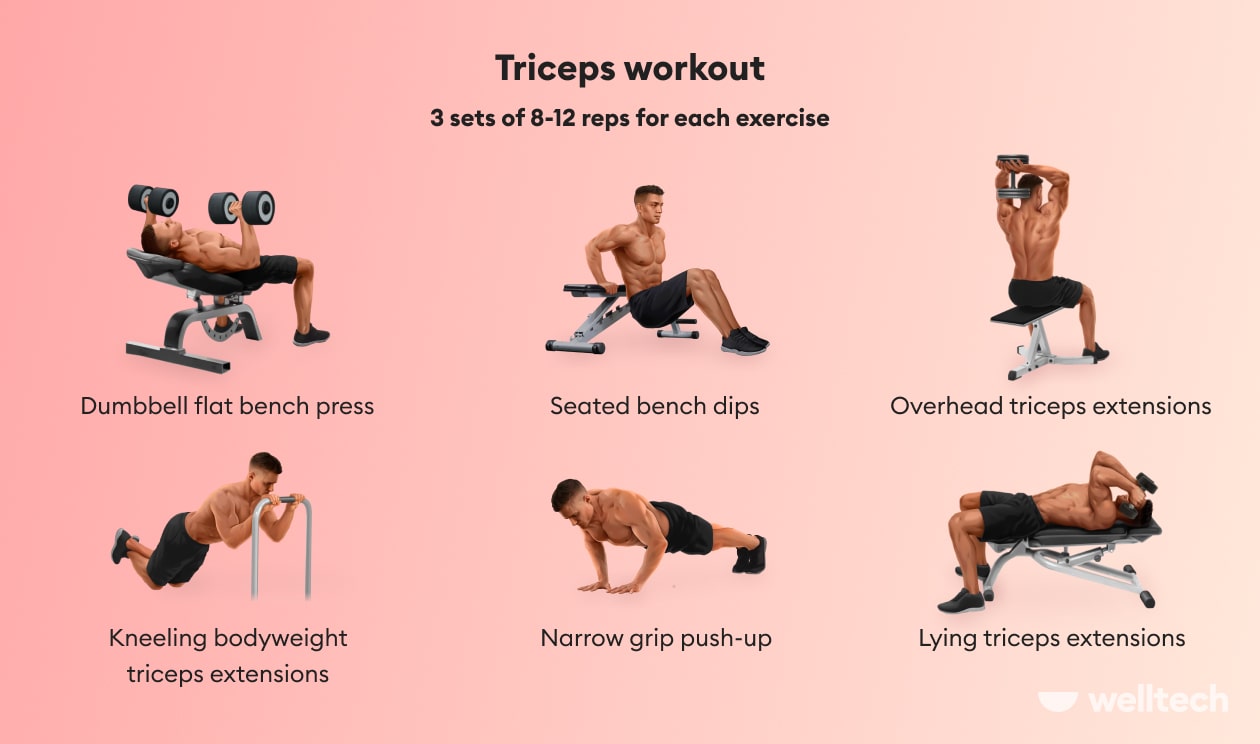
Credit: www.antillespr.edu
Tricep Workout Variations For Different Goals
Not everyone wants the same result. You might want muscle size, toned arms, or endurance.
For Muscle Growth
- Use heavy objects or resistance bands
- Do 8–12 reps per set
- Focus on slow, controlled movements
For Toning
- Use lighter weight or just body weight
- Do 15–25 reps per set
- Short rest periods
For Endurance
- Use minimal weight
- Do 25+ reps per set
- Keep moving, less rest
For Strength
- Use maximum weight you can handle safely
- Do 5–8 reps per set
- Rest longer between sets
Insight: Many beginners think more reps always mean better results. For muscle growth, it’s better to add resistance and keep reps moderate.
Overcoming Plateaus: How To Keep Progressing
After a few weeks, you might feel stuck. Your muscles adapt, and progress slows. Here’s how to push past plateaus.
Change The Routine
- Switch up exercises
- Increase resistance (heavier object, tighter band)
- Add more sets or reps
Focus On Technique
- Slow down movements
- Hold at the top for 2–3 seconds
Try Supersets
Do two tricep exercises back to back, then rest.
Example Superset
- Tricep dips + diamond push-ups, no rest between, repeat 3 sets.
Rest And Recovery
Muscles grow when you rest. Get 7–8 hours of sleep, eat enough protein, and stay hydrated.
Nutrition For Tricep Growth
Exercise is only half the battle. Muscles need fuel to grow and recover.
Protein
Helps build and repair muscle. Aim for 1.2–1.8 grams per kilogram of body weight daily.
Hydration
Drink water before, during, and after workouts.
Balanced Meals
Include:
- Lean proteins (chicken, beans)
- Complex carbs (rice, oats)
- Healthy fats (nuts, olive oil)
Mistake: Many people skip meals after a workout. Have a protein-rich snack within 30–60 minutes post-exercise.
Tracking Your Progress And Staying Motivated
Staying motivated can be tough, especially at home.
Practical Ways To Track
- Take arm measurements every 2–3 weeks
- Record reps, sets, and weights used
- Take progress photos
Setting Goals
- Set clear targets: “I want to do 20 diamond push-ups.”
- Celebrate small wins
Staying Consistent
- Schedule workouts like appointments
- Use reminders or apps
- Train with a friend or online group
Non-obvious tip: Many people forget to measure progress beyond the mirror. Tracking strength and reps is just as important.
Common Questions And Beginner Mistakes
Tricep training at home comes with its own challenges. Here are some mistakes and how to fix them.
1. Skipping Warm-up
Warm-up reduces injury and boosts performance.
2. Using Poor Form
Quality matters more than quantity. Bad form can cause elbow pain.
3. Overtraining
Training triceps every day is not better. Muscles need rest to grow.
4. Neglecting Other Arm Muscles
Balanced arms require training biceps, shoulders, and forearms too.
5. Not Tracking Progress
Without tracking, you don’t know what’s working.
Insight: Many beginners ignore pain or discomfort, thinking it’s normal. But pain is a signal. Listen to your body and adjust.
Advanced Tips For Home Tricep Training
If you’ve mastered basic moves, try these for more challenge.
Negative Reps
Slowly lower yourself in exercises (like dips), taking 3–5 seconds. This builds muscle fast.
Tempo Training
Count “1-2-3” as you lower, pause, then push up. This increases time under tension.
Isometric Holds
Hold the extended position for 5–10 seconds at the end of each set.
Combining Exercises
Mix different tricep moves in one workout for variety and faster growth.
Example Advanced Routine
- Diamond push-ups (slow tempo)
- Overhead extension (heavy object)
- Resistance band kickbacks (isometric hold)
- Tricep dips (negative reps)
Repeat 4 sets.

Credit: www.youtube.com
Comparing At-home Vs. Gym Tricep Workouts
You might wonder if home workouts can match gym results. Here’s a direct comparison.
| Feature | Home Workout | Gym Workout |
|---|---|---|
| Equipment | Limited, creative | Wide variety |
| Convenience | Anytime, no travel | Set hours, commute |
| Results | Strong if consistent | More options, faster for advanced |
| Cost | Low/free | Membership fees |
| Motivation | Needs self-drive | Community, trainers |
Insight: Most people don’t realize home workouts can be as effective as gym sessions, especially for beginners. The key is consistency and progressive overload.
Staying Safe And Injury-free
Safety should always come first.
Listen To Your Body
- Stop if you feel sharp pain
- Rest if muscles are sore
Use Stable Equipment
- Always check chairs, benches, or objects before use
Warm-up And Cool Down
- Spend 5–10 minutes warming up
- Stretch after workouts
Don’t Rush
- Quality over speed
- Focus on form
Non-obvious tip: If you feel wrist pain, use push-up handles or do exercises on fists to reduce strain.
Frequently Asked Questions
What If I Don’t Have Any Equipment?
You can use your body weight for push-ups, dips, and extensions. Common household items like water bottles, backpacks, or books can add resistance. Many effective tricep exercises require only your own body.
How Often Should I Train Triceps At Home?
Aim for 2–3 sessions per week, with at least 48 hours between workouts. Triceps need time to recover and grow. Training more often can lead to fatigue and slow progress.
Can I Get Big Triceps Without Going To The Gym?
Yes. Home workouts can build strong, defined triceps if you use progressive overload (increasing resistance, reps, or sets) and maintain good nutrition. Consistency is more important than location.
What Are Signs Of Overtraining Triceps?
Symptoms include constant soreness, decreased strength, trouble sleeping, and lack of motivation. If you notice these, take a break and let muscles recover.
Where Can I Find More Exercise Ideas?
For a wider range of exercises, check official fitness guides such as ACE Fitness. These sources offer safe, effective routines for all levels.
Closing Thoughts
You don’t need a gym or expensive equipment to build strong, toned triceps. With the right exercises, good form, and a consistent routine, you can see real progress at home. Remember to warm up, track your results, and listen to your body.
Mix up your workouts to keep them fresh and challenging. Use household items creatively and focus on quality over quantity. Triceps play a key role in daily life—so training them gives you more than just good-looking arms. Start your home tricep workout today and enjoy the benefits of strength, confidence, and health.
