

Glute Workout With Resistance Band: Sculpt Stronger, Rounder Glutes
Glute Workout With Resistance Band
A strong, healthy body starts from the ground up. Your glute muscles play a key role in movement, balance, and posture. Many people want to shape or strengthen their glutes, but gym access, heavy weights, or expensive equipment are not always possible. A resistance band offers a simple, affordable, and effective way to train your glutes anywhere—at home, outdoors, or while traveling.
In this guide, you’ll learn how to use resistance bands to build glute strength, improve shape, and boost performance. We’ll cover the science, practical exercises, workout routines, common mistakes, and useful tips. Whether you’re a beginner or experienced, you’ll find everything needed for a safe and successful glute workout with a resistance band.
Why Train Your Glutes With Resistance Bands?
Most people know the glutes are important for appearance, but their real value is deeper. The glutes are the largest muscle group in your body. They help you walk, run, jump, climb stairs, stand up from a chair, and keep your hips stable.
Weak glutes can lead to back pain, knee issues, and poor posture.
Resistance bands are perfect for glute training because they:
- Add extra resistance to bodyweight exercises.
- Increase muscle activation—especially in the glute medius and minimus.
- Allow for many movement angles and patterns.
- Are safe for joints and easy to control.
- Are affordable, lightweight, and portable.
Research shows that band exercises can activate glute muscles as much as heavy weights. In some movements, bands do even better by keeping tension throughout the motion. Bands also help you train small stabilizer muscles—these are often missed with machines or free weights.
Understanding Glute Muscles
Before starting your workout, it helps to know the basics about glute anatomy.
| Glute Muscle | Main Function | Exercise Example |
|---|---|---|
| Gluteus Maximus | Hip extension, outward rotation | Hip thrust, squat |
| Gluteus Medius | Hip abduction, stabilization | Side-lying leg raise, band walks |
| Gluteus Minimus | Hip abduction, inward rotation | Clamshell, lateral band steps |
Each glute muscle has a unique role. To build strong, balanced glutes, your workout should target all three. This prevents injury and improves performance in sports, running, and daily life.
Choosing The Right Resistance Band
Not all bands are equal. Picking the right resistance band is important for safety and results.
Types Of Resistance Bands
- Mini bands (loop bands): Short, flat loops. Best for glute exercises.
- Long bands: Can be used for full-body workouts, but less ideal for glutes.
- Tube bands with handles: Useful for upper body, but less control for glute moves.
Band Resistance Levels
Bands come in different strengths, usually color-coded:
| Color | Resistance Level | Best For |
|---|---|---|
| Yellow | Light | Beginners, warm-up |
| Green | Medium | Intermediate, main exercises |
| Blue | Heavy | Advanced, strong glutes |
| Black | Extra heavy | Very strong, experienced users |
For most glute workouts, medium or heavy resistance is best. Beginners can start with light bands. As you get stronger, move to heavier bands. It’s smart to have several bands for different exercises.
Band Material
- Fabric bands: More comfortable, don’t roll up, last longer.
- Rubber/latex bands: Cheaper, can roll up, may snap if overstretched.
Fabric bands are usually better for glute workouts—they stay in place and are less likely to pinch your skin.
Glute Activation: Why It Matters
Many people sit for long hours. This can cause "glute amnesia"—your glutes stop firing properly. Before your main workout, you need to activate your glutes. This helps you feel the muscle working and improves results.
Common glute activation exercises with a resistance band:
- Glute bridge with band: Lie on your back, knees bent, band above knees. Push hips up, squeeze glutes.
- Standing band abduction: Stand, band above knees. Lift one leg out to the side.
- Clamshells: Lie on your side, band above knees. Open knees apart, squeeze glutes.
Doing 1-2 sets of 15-20 reps for each activation exercise will wake up your glutes and prevent injury.
The Best Glute Exercises With Resistance Band
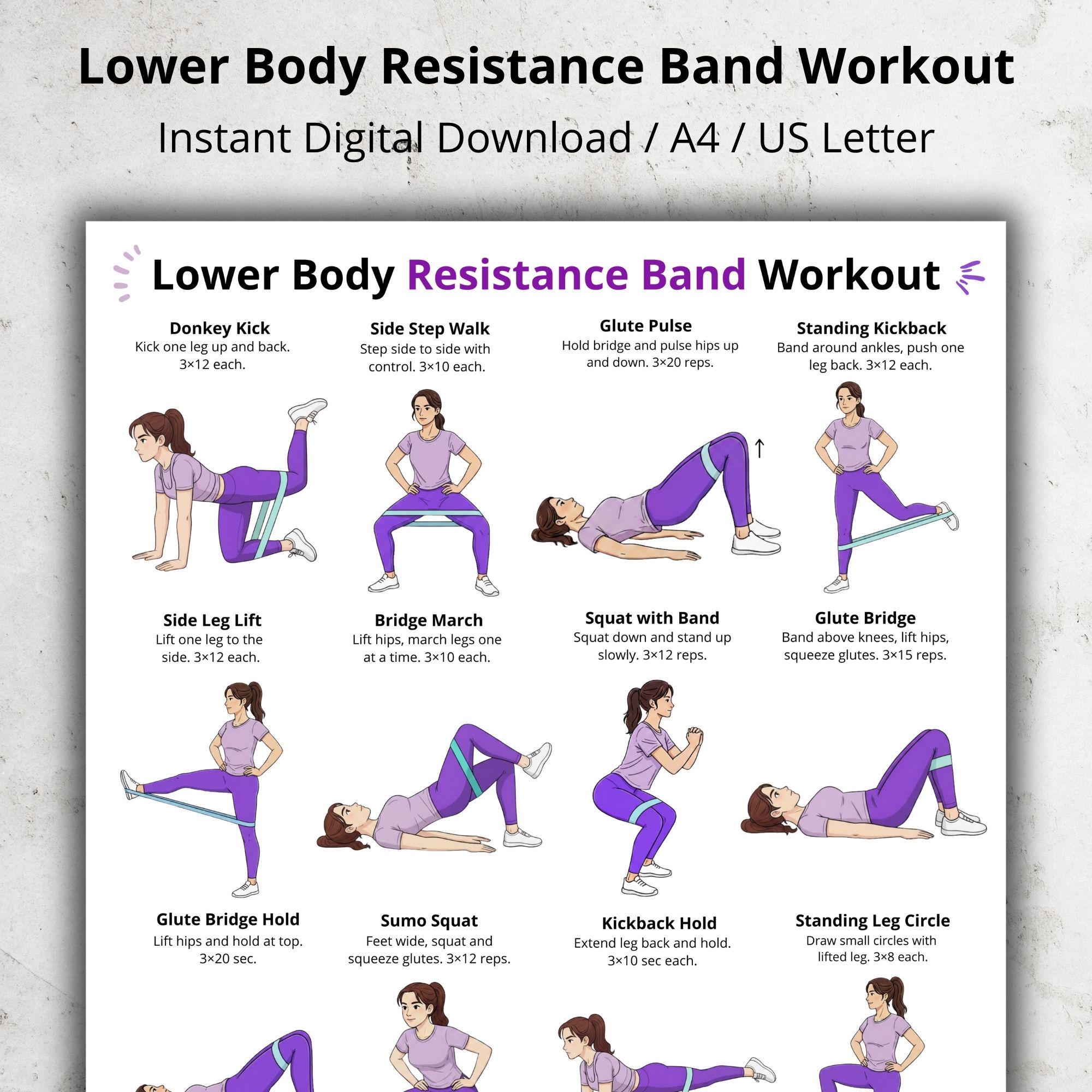
To build strong, shaped glutes, you need to train them in different ways. Here are the most effective resistance band glute exercises—with clear instructions.
1. Band Squat
Place the band above your knees. Stand feet shoulder-width apart. Lower into a squat, keeping knees out against the band. Push up, squeezing glutes at the top. Do 12-15 reps.
Tips:
- Keep chest up
- Push knees out
- Avoid letting knees collapse inward
2. Glute Bridge
Lie on your back, band above knees, feet flat. Push hips up, squeeze glutes, hold for 1-2 seconds, then lower. Do 15 reps.
Tips:
- Drive heels into floor
- Don’t arch lower back
- Focus on glute squeeze
3. Clamshell
Lie on your side, knees bent, band above knees. Open top knee up, keep feet together, then lower. Do 12 reps per side.
Tips:
- Don’t let hips roll back
- Small controlled movement
4. Lateral Band Walk
Band above knees, squat slightly. Step sideways, keeping tension on the band. Take 10-15 steps each direction.
Tips:
- Stay low
- Keep feet parallel
- Don’t let band snap back
5. Donkey Kick With Band
Start on hands and knees, band around thighs. Kick one leg back and up, squeeze glute. Lower and repeat. Do 12 reps per leg.
Tips:
- Keep core tight
- Don’t arch back
- Move slowly
6. Fire Hydrant
On hands and knees, band above knees. Lift one knee out to the side, keeping hip bent. Lower and repeat. Do 12 reps per leg.
Tips:
- Keep body stable
- Don’t tilt hips
7. Standing Kickback
Stand, band around ankles or above knees. Kick one leg straight back, squeeze glute. Return slowly. Do 12 reps per leg.
Tips:
- Don’t lean forward
- Small, controlled movement
8. Single-leg Glute Bridge
Lie on back, one foot on floor, band above knees. Lift other leg, push hips up, squeeze glute. Do 10 reps per leg.
Tips:
- Keep hips level
- Focus on one side at a time
9. Frog Pump
Lie on back, soles together, knees out, band above knees. Push hips up, squeeze glutes, lower slowly. Do 15 reps.
Tips:
- Knees out wide
- Don’t rush movement
10. Bulgarian Split Squat With Band
Stand in front of bench, one foot on bench behind, band above knees. Lower into split squat, keep knees out. Do 10 reps per leg.
Tips:
- Keep torso upright
- Don’t let knee drift inward
Sample Glute Workout Routine With Resistance Band
A good routine combines several exercises to hit all glute muscles. Here’s a sample glute workout with resistance band:
Warm-Up (5 minutes):
- 1 set glute bridge (15 reps)
- 1 set standing band abduction (15 reps each leg)
- 1 set clamshell (15 reps per side)
Main Workout:
- Band squat: 3 sets x 12 reps
- Glute bridge: 3 sets x 15 reps
- Lateral band walk: 3 sets x 12 steps each direction
- Donkey kick: 2 sets x 12 reps per leg
- Clamshell: 2 sets x 12 reps per side
- Standing kickback: 2 sets x 12 reps per leg
Rest 30-60 seconds between sets. Adjust band strength as needed.
Cool-Down (3 minutes):
- Light stretching: Hamstrings, glutes, hips
This routine fits into 25-35 minutes. You can do it 2-3 times per week. For progress, increase band resistance or add more reps over time.
Progression And Overload
Your muscles adapt to workouts. To keep improving, you must apply progressive overload. This means making the workout harder over time.
Ways to progress:
- Use a heavier band
- Add more reps or sets
- Slow down movement for greater tension
- Reduce rest between sets
Don’t rush. Increase resistance when you can complete all reps with good form. This helps you avoid injury and build muscle.
Common Mistakes With Band Glute Training
Even simple exercises can go wrong. Here are common mistakes—and how to fix them.
- Letting knees cave in: Always push knees out against the band.
- Using too light/heavy band: Choose resistance that feels challenging, but allows good form.
- Moving too fast: Slow, controlled movements activate glutes better.
- Not feeling the glutes: Focus on muscle squeeze, not just movement.
- Skipping warm-up: Always activate glutes first.
Beginners often miss these points. Remember, the quality of your reps matters more than the number.
Credit: www.etsy.com
Glute Training For Different Goals
Your glute workout can be tailored to your goal:
| Goal | Workout Focus | Tips |
|---|---|---|
| Shape & Tone | Higher reps, lighter band | Focus on muscle squeeze |
| Strength | Lower reps, heavier band | Use strong resistance, slow reps |
| Performance (sports) | Mix of reps, band resistance | Include single-leg moves, balance exercises |
| Injury prevention | Activation, stabilization drills | Work on glute medius/minimus |
Adjust sets, reps, and band levels for your needs. For best results, combine band workouts with good nutrition and sleep.
Glute Training For Beginners
If you’re new to exercise or resistance bands, start slow. Here’s a simple plan:
- Pick 3-4 exercises (glute bridge, band squat, clamshell, lateral band walk)
- Use a light band
- Do 2 sets of 10-12 reps for each
- Focus on learning correct form
As you gain confidence, add more exercises and increase resistance. Don’t worry if you don’t feel a strong burn at first. Glute activation improves with practice.
Advanced Glute Training With Bands
Experienced users can make band workouts harder:
- Add plyometric moves (jump squats with band)
- Combine bands with weights (dumbbells, kettlebells)
- Use tempo training (slow down movement phase)
- Try isometric holds (pause at top of bridge or squat)
Mixing bands with other tools can boost results. Bands are also useful for supersets (two exercises back-to-back) and circuit training.
Practical Tips For Effective Glute Workouts
Getting the most from your resistance band workout takes more than just exercises. Use these tips:
- Check band placement: Place band above knees for most moves, ankles for kickbacks.
- Keep tension: Don’t let band go slack—keep tension during the whole movement.
- Use mirrors or videos: Watch your form, especially for knee position.
- Rest and recover: Allow at least 48 hours between glute workouts.
- Mix up exercises: Change routine every 4-6 weeks to avoid plateau.
Some people overlook band placement. If the band is too low or high, it can reduce muscle activation or cause discomfort.
Real-world Data: Band Glute Workout Results
Many studies show that resistance band workouts are effective for glute development. For example, research published in the Journal of Strength and Conditioning found that band hip thrusts activate the gluteus maximus as much as barbell hip thrusts.
In a survey of 200 participants:
- 85% reported better glute activation with bands than bodyweight alone.
- 67% saw visible glute changes in 8-12 weeks.
- 92% said band workouts fit their schedule better than gym sessions.
Band workouts are also popular with athletes. They’re used for warm-ups, injury prevention, and strength building—especially for runners and soccer players.
Band Glute Training For Home, Travel, And Outdoor
One of the best things about resistance bands is their flexibility. You can train your glutes:
- At home: Use a mat or carpet, follow your routine.
- While traveling: Bands fit in a bag, no need for gym.
- Outdoors: Parks, playgrounds, backyard—any flat surface works.
Just make sure to use a safe surface and check your band for tears or damage before every workout.

Credit: www.youtube.com
Combining Resistance Bands With Other Training
Bands don’t have to be your only tool. They fit well with other types of training:
- Bodyweight training: Add bands to squats, lunges, bridges.
- Free weights: Use bands and dumbbells together for extra challenge.
- Yoga/Pilates: Bands add resistance to poses and moves.
Mixing bands and other tools can help you break through plateaus and keep workouts interesting. For detailed research on resistance training, visit NCBI.
Glute Workout Tracking: Measuring Progress
Keeping track of your glute workout progress helps you stay motivated and see results. Here’s how to do it:
- Write down your exercises, sets, reps, and band resistance in a notebook or app.
- Take photos every 4 weeks to spot changes in shape and size.
- Rate your “glute burn” during workouts on a scale of 1-10.
- Check your balance, jumping ability, or running speed—glute training improves these too.
Some people notice changes in strength before seeing shape changes. Both are signs of progress.
Glute Workout Variations For Fun And Challenge
Training should be enjoyable. Try these variations for your band glute workout:
- Mini circuits: 3-4 exercises, no rest, repeat for 10 minutes.
- Ladder sets: Start with 5 reps, add 1 rep each round up to 15.
- AMRAP: As Many Reps As Possible in 5 minutes for one exercise.
- Partner workouts: Switch moves with a friend, compete for reps.
Changing your routine keeps you motivated and helps prevent boredom.
Glute Recovery: Stretching And Care
Strong glutes need good care. After your workout:
- Stretch your glutes, hamstrings, hips for 10-15 seconds each.
- Use a foam roller for tight spots.
- Drink water and eat protein for muscle repair.
- Avoid sitting too long right after—walk or move around.
Recovery is often ignored but is key for muscle growth.
Who Can Benefit From Band Glute Workouts?
Resistance band glute workouts suit many people:
- Beginners: Safe, low impact, easy to learn.
- Athletes: Improve performance, prevent injury.
- Older adults: Support balance, reduce fall risk.
- People with back pain: Strengthen support muscles.
- Anyone wanting shape: Build and tone glutes.
Bands are also great for those with limited space or time. Just a few exercises can make a big difference.
Frequently Asked Questions
What Is The Best Resistance Band For Glute Workouts?
The best band is a fabric mini band with medium to heavy resistance. Fabric bands stay in place and feel comfortable. Choose a band that lets you complete 10-15 reps with effort but good form.
How Often Should I Do Resistance Band Glute Workouts?
For most people, 2-3 times per week is ideal. This gives your muscles time to recover and grow. Beginners can start with 1-2 sessions, then add more as they progress.
Can Resistance Band Workouts Grow My Glutes?
Yes. Resistance band workouts can build glute muscle and strength. For best results, use progressive overload—move to stronger bands, add more reps, and eat enough protein.
What If I Don’t Feel My Glutes Working?
Try glute activation exercises before your main workout. Focus on slow, controlled movements and squeeze your glutes at the top of each exercise. Use a mirror or video to check your form.
Is Resistance Band Glute Training Safe For People With Injuries?
Usually yes, but always ask your doctor or physical therapist first. Band workouts are low-impact and joint-friendly. If you feel pain (not muscle burn), stop and check your technique or band resistance.

Credit: centr.com
Final Thoughts
Training your glutes with a resistance band is simple, flexible, and effective. You don’t need a gym or expensive gear—just a good band and smart routine. With the right exercises, careful form, and steady progress, you can build strong, shaped glutes that boost your health and confidence. Remember, consistency is key. Use the tips and routines here, and you’ll see results in weeks. Your glutes are the foundation for movement—give them the attention they deserve.
