

Best Tricep Workout on Cables: Sculpt Strong Arms Fast
Best Tricep Workout On Cables
Building strong, well-shaped triceps is more than just lifting heavy weights. The right approach, with the right equipment, makes a big difference. Cable machines offer a unique advantage for tricep training. Unlike free weights, cables give constant tension. This helps muscles grow and improve shape, especially for the triceps.
Many gym goers focus on biceps, but triceps actually make up two-thirds of your upper arm. If you want bigger, stronger arms, cable workouts for triceps are essential.
Using cables for triceps is not just for bodybuilders. Anyone, from beginners to advanced, can benefit. Cables allow you to adjust resistance easily and keep your joints safe. You can do many different movements and angles. This article guides you through the best cable tricep exercises, explains how cables work, and shows how to build a routine for real results.
You will learn which exercises give the best shape, strength, and definition. If you want to see progress, avoid common mistakes, and train smarter, keep reading.
Why Cables Are Great For Triceps
Cable machines stand out for tricep training. Unlike dumbbells or barbells, cables use a pulley system. This creates steady tension through every part of the movement.
Constant tension means your triceps work harder. With free weights, tension can drop at certain points. With cables, the resistance stays the same from start to finish. This helps muscles grow and prevents cheating.
Adjustable resistance lets you choose the perfect weight. You can go light for high reps or heavy for strength. It is easy to switch weights between sets.
Joint safety is another benefit. Cables allow your arms to move naturally. This reduces stress on elbows and shoulders.
Variety of movements is possible. You can work all three tricep heads—long, lateral, and medial—by changing angles and grips.
Here's a quick comparison between cable and free weight tricep training:
| Feature | Cable Machines | Free Weights |
|---|---|---|
| Muscle Tension | Constant | Varies |
| Joint Safety | High | Moderate |
| Exercise Variety | Wide Range | Limited |
| Resistance Adjustment | Easy | Manual |
Many beginners miss the importance of angle control. With cables, you can change the direction of pull easily. This helps target specific tricep areas and prevents muscle imbalance.
Anatomy Of The Triceps And Cable Training
Understanding tricep anatomy helps you train smarter. The triceps have three parts:
- Long head: Runs along the back of your arm. It gives the arm its length.
- Lateral head: Located on the outer side. Adds width and shape.
- Medial head: Sits underneath. It supports strength and endurance.
Cable exercises can target each head differently. For example, overhead movements focus on the long head. Press-downs hit the lateral head. Reverse grip and underhand moves reach the medial head.
Most beginners do not realize that changing grip and arm position can shift which head works hardest. This is why cable workouts offer so much variety.
Essential Cable Tricep Exercises
Let’s look at the most effective cable tricep movements. These exercises are proven to build strength and shape. Each one targets a different part of the triceps.
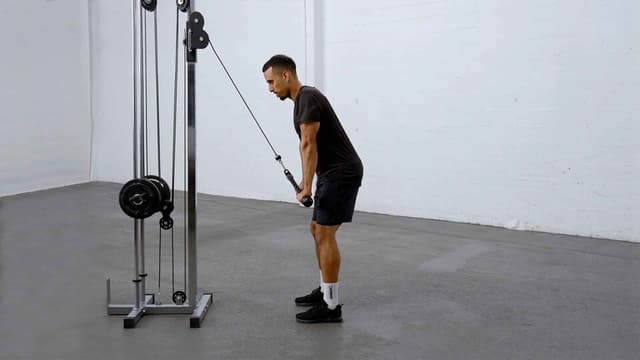
1. Cable Tricep Pushdown
The cable pushdown is a classic. It is easy to learn and safe for joints.
How to do it:
- Stand facing the cable machine.
- Attach a straight bar or rope to the high pulley.
- Grip the bar with palms down (overhand).
- Keep elbows close to your body.
- Push the bar down until arms are straight.
- Pause, then return slowly.
Tip: Do not let your elbows move forward. Keep your back straight.
Muscle focus: Lateral head
2. Rope Tricep Extension
Using a rope lets your hands move freely. This increases range of motion and muscle activation.
How to do it:
- Attach a rope to the high pulley.
- Hold the rope with both hands, palms facing each other.
- Pull the rope down, separating your hands at the bottom.
- Pause and squeeze your triceps.
Tip: Move your hands apart at the end for better contraction.
Muscle focus: Lateral and long heads
3. Overhead Cable Tricep Extension
This move works the long head. It helps build arm length and fullness.
How to do it:
- Attach a rope to the low pulley.
- Face away from the machine.
- Hold the rope overhead with both hands.
- Extend your arms upward.
- Lower slowly back behind your head.
Tip: Keep elbows high and close to your head.
Muscle focus: Long head
4. Reverse Grip Cable Pushdown
This exercise uses an underhand grip. It targets the medial head and improves arm definition.
How to do it:
- Attach a straight bar to the high pulley.
- Grip the bar with palms up (underhand).
- Keep elbows close.
- Push down, keeping wrists straight.
Tip: Go lighter with weight to avoid wrist strain.
Muscle focus: Medial head
5. Single-arm Cable Kickback
Single-arm movements help correct muscle imbalance. Kickbacks are great for finishing a workout.
How to do it:
- Attach a handle to the low pulley.
- Stand side-on to the machine.
- Hold the handle, bend your elbow to 90 degrees.
- Extend your arm backward.
- Pause and squeeze.
Tip: Use slow, controlled movement. Do not swing your arm.
Muscle focus: All heads (especially lateral)
6. Cable Overhead One-arm Extension
This is similar to the two-arm overhead extension, but better for isolating each arm.
How to do it:
- Attach a handle to the low pulley.
- Hold the handle overhead.
- Extend your arm upward.
- Lower behind your head.
Tip: Keep your elbow pointed up.
Muscle focus: Long head
7. Cable Tricep Pressdown With V-bar
The V-bar lets you use a neutral grip. This is comfortable for wrists and hits all heads.
How to do it:
- Attach a V-bar to the high pulley.
- Grip the bar with palms facing in.
- Push down, pause at the bottom.
Tip: Keep wrists straight for safety.
Muscle focus: All heads
8. Cable Crossbody Extension
This unique move stretches the tricep and targets the long head.
How to do it:
- Attach a handle to the low pulley.
- Stand side-on, hold handle across your body.
- Extend your arm out and up.
Tip: Keep shoulder down and do not twist.
Muscle focus: Long head
9. Cable Behind-the-back Extension
This is an advanced move. It hits the lower part of the triceps.
How to do it:
- Attach a handle to the low pulley.
- Stand facing away.
- Reach behind and grab the handle.
- Extend your arm upward.
Tip: Start with light weight to avoid strain.
Muscle focus: Long and medial heads
10. Cable Lying Tricep Extension
This mimics the “skull crusher” but uses cables for constant tension.
How to do it:
- Set a bench near the cable machine.
- Attach a bar or rope to the low pulley.
- Lie back, hold the bar above your forehead.
- Extend arms upward.
Tip: Keep elbows steady and avoid arching your back.
Muscle focus: All heads
Sample Cable Tricep Workout Routine
Now you know the best exercises. Let’s build a routine. A good tricep workout uses 3-5 exercises, covers all heads, and uses different angles. Here is a practical cable tricep routine:
- Cable Tricep Pushdown: 3 sets of 10-12 reps
- Rope Tricep Extension: 3 sets of 12-15 reps
- Overhead Cable Tricep Extension: 3 sets of 10-12 reps
- Reverse Grip Cable Pushdown: 2 sets of 15 reps
- Single-Arm Cable Kickback: 2 sets of 12 reps (each arm)
Rest: 60 seconds between sets
Tip: Start with heavier weights for pushdowns, then use lighter weight for kickbacks.
Most beginners make the mistake of doing too many sets. Quality is more important than quantity. Focus on good form and muscle contraction.
How To Progress With Cable Tricep Workouts
Progress is key for muscle growth. Here’s how to make sure you get stronger:
- Increase weight: Raise the resistance every 2-3 weeks.
- Add reps: Try to do more reps with the same weight.
- Change angles: Switch up exercises and grips.
- Slow down: Use slow, controlled movements for better muscle activation.
Tracking your progress is important. Use a notebook or app to record sets, reps, and weights. This motivates you and shows what works.
Beginners often forget to change exercises. Doing the same movement every week leads to plateaus. Mix up your routine every month.
Common Mistakes With Cable Tricep Training
Cable workouts are safe, but mistakes can reduce results. Watch out for these:
- Using too much weight: Heavy weight can cause bad form and joint pain.
- Letting elbows move: Keep elbows steady for best muscle focus.
- Skipping full range: Extend fully and lower slowly.
- Ignoring angle changes: Change grips and arm positions to hit all heads.
- Not warming up: Warm up for 5 minutes before starting.
Another mistake is not squeezing at the end of each rep. The squeeze activates more muscle fibers and helps growth.
Advanced Tips For Cable Tricep Workouts
If you want to take your training to the next level, try these advanced methods:
- Drop sets: After finishing a set, lower the weight and do more reps.
- Supersets: Combine two exercises without resting between.
- Pause reps: Hold the bottom position for 2 seconds before returning.
- Negative reps: Lower the weight slowly for 4-5 seconds.
Advanced lifters often use cables for finishing sets. This pumps blood into the muscle and improves recovery.
Many people miss the value of mind-muscle connection. Focus on feeling the triceps work. This improves results even if you use lighter weights.
Comparing Cable Triceps To Other Equipment
You may wonder if cables are better than dumbbells or machines. Here’s a clear comparison:
| Equipment | Muscle Activation | Joint Stress | Exercise Variety |
|---|---|---|---|
| Cable Machine | High | Low | Wide |
| Dumbbells | Moderate | Moderate | Medium |
| Barbells | Moderate | High | Limited |
| Smith Machine | Low | Low | Limited |
Cables win for muscle activation and variety. They also keep your joints safe. Dumbbells and barbells are good for strength, but cables are better for shaping and isolating muscles.

Credit: www.menshealth.com
How To Choose The Right Cable Attachment
Cable machines have many attachments. Choosing the right one helps you hit your goals.
- Straight bar: Good for pushdowns and pressdowns. Easy to use.
- Rope: Adds range of motion. Best for extensions and pushdowns.
- V-bar: Comfortable grip. Good for all-around tricep work.
- Single handle: Best for one-arm movements and isolating sides.
Many beginners use only the straight bar. Try different attachments to see what works best for you.
Here’s a comparison of common cable attachments:
| Attachment | Best Use | Grip Type | Muscle Focus |
|---|---|---|---|
| Straight Bar | Pushdowns | Overhand | Lateral head |
| Rope | Extensions | Neutral | Long & lateral heads |
| V-Bar | Pressdowns | Neutral | All heads |
| Single Handle | Kickbacks | One-arm | Lateral head |
Practical Tips For Better Results
Getting the most from cable tricep workouts takes more than just showing up. Here are some practical tips:
- Warm up properly: Five minutes of arm circles or light pushdowns.
- Use correct form: Stand tall, keep elbows close, control the movement.
- Focus on contraction: Squeeze the triceps at the end of each rep.
- Stretch after training: This helps recovery and prevents tightness.
- Train triceps after bigger muscles: Do triceps after chest or shoulders for best results.
Many people overlook tempo. Slow reps (3 seconds down, 1 second up) build more muscle than fast reps.
How Often Should You Train Triceps With Cables?
Frequency is important. Most experts recommend training triceps 2 times per week.
Beginners: Start with 1 session per week. Focus on learning form.
Intermediate: Move to 2 sessions. Split exercises between days.
Advanced: You can do 2-3 sessions, but avoid overtraining.
Triceps recover fast, but too much training can cause injury. Rest is important.
Cable Tricep Workouts For Different Goals
Cable workouts can fit many goals. Here’s how to adjust your routine:
For strength:
- Use heavier weight
- Lower reps (6-8)
- Longer rest (90 seconds)
For muscle size:
- Moderate weight
- Higher reps (10-15)
- Short rest (60 seconds)
For definition:
- Light weight
- High reps (15-20)
- Very short rest (30 seconds)
Match your routine to your goal. Changing rep range and rest time helps you see progress.
Credit: fitbod.me
Tricep Training For Beginners
If you are new to cable tricep workouts, start simple. Learn the basics before moving to advanced exercises.
- Use light weight
- Focus on form and control
- Do 2-3 exercises per session
- Rest enough between sets
Most beginners forget to breathe. Exhale as you push, inhale as you lower.
Ask for help if needed. Trainers can show you proper form.
Tricep Training For Advanced Lifters
Advanced lifters need more challenge. Add intensity with these methods:
- Superset cable pushdowns and overhead extensions
- Use drop sets for the last exercise
- Try pause reps for extra muscle activation
- Change attachments every session
Advanced lifters often use cables for finishing sets after heavy dumbbell or barbell work. This improves muscle shape and recovery.

Credit: www.youtube.com
How To Avoid Plateaus With Cable Tricep Workouts
Plateaus are common. Here’s how to break through:
- Change exercises every month
- Adjust weights and reps
- Use advanced methods like drop sets
- Rest longer between heavy sets
Tracking progress and changing routine keeps muscles growing.
Cable Tricep Workouts At Home
Many home gyms now have cable machines. You can do most tricep exercises at home.
- Buy a compact cable machine
- Use resistance bands if needed
- Focus on form and slow reps
Home workouts are just as effective if you use correct technique.
Nutrition For Tricep Growth
Training is only half the battle. Nutrition matters too.
- Eat enough protein (1 gram per pound of body weight)
- Include healthy carbs and fats
- Drink plenty of water
Protein helps muscles recover and grow. Chicken, fish, eggs, beans, and protein shakes are good choices.
Many beginners skip meals. This slows progress. Eat balanced meals and snacks.
Recovery And Rest
Muscles grow during rest, not during exercise. Make sure to:
- Sleep 7-8 hours per night
- Stretch after workouts
- Take 1-2 rest days per week
Recovery prevents injury and improves results.
Tracking Your Progress
Keep a simple log. Write down:
- Exercises
- Sets and reps
- Weights used
- How you felt
Review your log every month. Adjust your routine as needed.
Frequently Asked Questions
How Many Cable Tricep Exercises Should I Do Per Workout?
Aim for 3 to 5 exercises per session. Choose different movements to hit all parts of the triceps. Too many exercises can cause fatigue and reduce progress. Focus on quality, not quantity.
Can I Train Triceps With Cables Every Day?
No, it is best to train triceps 2 times per week. Muscles need time to recover and grow. Training every day can cause injury and slow progress. Listen to your body and rest as needed.
What Is The Best Cable Attachment For Triceps?
The rope and V-bar are most popular. Rope allows more range of motion and better muscle squeeze. V-bar is comfortable for wrists and hits all tricep heads. Try both to see which feels best for you.
Are Cable Tricep Workouts Good For Beginners?
Yes, cables are great for beginners. The resistance is easy to adjust. Movements are safe for joints. Start with light weight and simple exercises like pushdowns and rope extensions.
How Do I Know If My Triceps Are Getting Stronger?
Track your progress. Increase weight or reps over time. Notice if your arms feel firmer and more defined. If you see improvement in other lifts, like bench press, your triceps are getting stronger.
Cable machines offer a powerful way to train triceps. Using the right exercises, attachments, and routines helps you build stronger, more defined arms. Whether you are a beginner or advanced, cables can improve your results and keep your joints safe. Follow the tips and routines in this article for better progress. Remember, consistency and good form matter most. For more details about cable training and muscle growth, visit Bodybuilding.com.
