

Back And Glute Workout: Build Strength and Sculpt Your Body
Back And Glute Workout: Build Strength, Power, And Shape
A strong back and well-developed glutes are the foundation of a powerful, athletic body. These muscles do much more than make you look good—they help you move better, protect your spine, and boost your athletic ability. Whether you want to lift heavier, run faster, or just feel stronger, focusing on your back and glutes is a smart move.
Many people go to the gym and only train muscles they can see in the mirror. But the back and glutes are often overlooked. This is a big mistake. Weakness here can cause bad posture, back pain, and even injuries.
On the other hand, building these muscles will help you in almost every sport and daily activity.
This guide will give you everything you need to know about back and glute workouts. You’ll learn about muscle anatomy, the best exercises, how to build a plan, and tips that even regular gym-goers often miss. You’ll get sample routines, equipment advice, and solutions for common problems.
By the end, you’ll have the knowledge and confidence to transform your training and your body.
Why Train Your Back And Glutes?
Your back and glutes are two of the largest and most important muscle groups in your body. Here’s why training them matters so much:
- Posture and Balance: A strong back keeps your spine safe and your body upright. Strong glutes help your hips stay stable and your lower back supported.
- Performance: Most sports, from running to swimming to lifting, require a strong back and glutes. These muscles help you jump, sprint, and move with power.
- Injury Prevention: Weak glutes and back muscles can lead to lower back pain, knee problems, and hip injuries.
- Aesthetics: A well-developed back and glutes give you a V-shaped upper body and round, firm hips, which many people find attractive.
Surprisingly, people often do not realize how much the glutes help the back. If your glutes are weak, your lower back has to do extra work, which can cause pain over time.
Key Muscles Involved
Understanding which muscles you’re working helps you train smarter. Let’s look at the main muscles targeted in a back and glute workout.
Back Muscles
- Latissimus dorsi: The broad muscle that gives your back a wide look.
- Rhomboids: These muscles pull your shoulder blades together.
- Trapezius: Runs from your neck to the middle of your back.
- Erector spinae: These long muscles run along your spine and keep it straight.
Glute Muscles
- Gluteus maximus: The largest muscle in your buttocks, responsible for hip extension.
- Gluteus medius: Sits on the side of your hips, controls leg movement out to the side.
- Gluteus minimus: The smallest glute muscle, helps with hip stability.
Supporting Muscles
- Hamstrings: Work with glutes in many movements.
- Core: Stabilizes your body during back and glute exercises.
Best Back And Glute Exercises
Choosing the right exercises is key for results. Here are the top moves for building strength and muscle in these areas. Each exercise is explained with tips to avoid mistakes.
1. Deadlifts
The deadlift is a classic for a reason. It works your entire back, glutes, and more.
- Stand with your feet hip-width apart.
- Grip the bar with hands just outside your knees.
- Keep your back straight, chest up.
- Push through your heels to lift the bar.
- Lower with control.
Common mistake: Rounding your back. This can hurt your spine. Keep your core tight and your back flat.
2. Hip Thrusts
Hip thrusts target your glutes better than almost any other exercise.
- Sit on the floor with your shoulders against a bench.
- Place a barbell across your hips.
- Roll your feet back, knees bent.
- Push through your heels, lifting your hips up.
- Squeeze your glutes hard at the top.
Tip: Pause for a second at the top for maximum glute activation.
3. Pull-ups
Pull-ups build a strong, wide back.
- Hang from a bar with hands slightly wider than shoulders.
- Pull your chest up to the bar.
- Lower slowly.
Too hard? Use a resistance band or assisted pull-up machine.
4. Romanian Deadlifts
This move hits your glutes and hamstrings.
- Stand tall holding a barbell.
- Lower the bar by pushing your hips back.
- Keep your back straight.
- Stop when you feel a stretch in your hamstrings.
- Return to standing.
Common mistake: Bending your knees too much. The movement should come from your hips.
5. Seated Row
Great for the middle back.
- Sit at a cable row machine.
- Grip the handle with both hands.
- Pull the handle to your waist, squeezing your shoulder blades together.
- Return slowly.
6. Step-ups
Step-ups work your glutes, hamstrings, and quads.
- Stand in front of a bench or box.
- Step up with one foot, pushing through your heel.
- Bring the other leg up, then step down.
Tip: Go slow and use a high enough box to feel your glutes working.
7. Face Pulls
Targets rear shoulders and upper back.
- Attach a rope to a cable at chest height.
- Pull the rope toward your face, elbows high.
- Squeeze your shoulder blades together.
8. Glute Bridges
Like hip thrusts but with your shoulders on the floor.
- Lie on your back, knees bent.
- Push through your heels, lifting your hips.
- Squeeze your glutes at the top.
9. Back Extensions
Works your lower back.
- Lie face down on a hyperextension bench.
- Cross your arms or hold a weight.
- Raise your upper body until your body is straight.
- Lower back down.
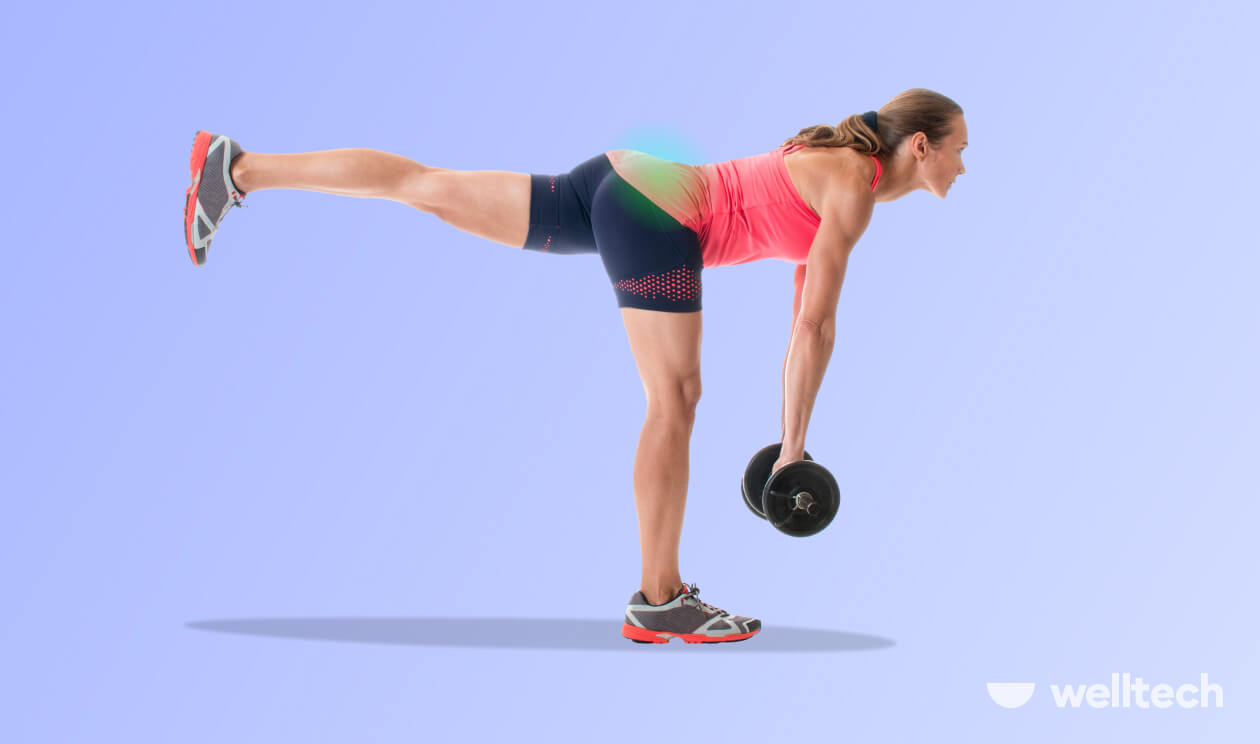
10. Single-leg Deadlifts
Adds balance and core work.
- Stand on one leg, holding a dumbbell.
- Hinge forward at the hips, lowering the weight.
- Keep your back flat.
- Return to standing.
How To Structure Your Back And Glute Workout
A good workout needs more than random exercises. Here’s how to plan an effective session.
Warm-up
Never skip your warm-up. It prepares your muscles and joints, reduces injury risk, and helps you perform better.
- 5–10 minutes of light cardio (walking, cycling)
- Dynamic stretches (leg swings, arm circles)
- Bodyweight glute bridges and band pull-aparts
Exercise Order
Big, compound movements come first, followed by smaller, isolation moves.
- Deadlifts or hip thrusts (choose one as your main lift)
- Pull-ups or seated row
- Romanian deadlifts or single-leg deadlifts
- Step-ups or glute bridges
- Face pulls or back extensions
Sets And Reps
- Big lifts (deadlifts, hip thrusts): 3–5 sets of 5–8 reps
- Other moves: 3–4 sets of 8–15 reps
Rest Times
- Big lifts: 2–3 minutes between sets
- Other moves: 1–2 minutes
Sample Weekly Workout Plan
Here’s an example of how you could split your week:
- Day 1: Back and glute workout (focus on strength)
- Day 2: Upper body (chest, shoulders, arms)
- Day 3: Rest or light activity
- Day 4: Back and glute workout (focus on muscle growth)
- Day 5: Lower body (quads, calves)
- Day 6: Rest
- Day 7: Optional cardio or mobility
Non-obvious tip: Many people train glutes with legs, but pairing them with back lets you focus more energy and recover better.
Credit: welltech.com
Equipment Options
You can train your back and glutes with free weights, machines, or even just your body weight. Each has pros and cons.
| Equipment | Pros | Cons |
|---|---|---|
| Barbell | Heavy loads, full range of motion | Needs space and racks |
| Dumbbells | Versatile, good for single-leg work | Hard to go very heavy |
| Machines | Safe, easy for beginners | Less core activation |
| Resistance Bands | Portable, great for activation | Limited resistance |
| Bodyweight | No equipment needed, good for beginners | Progress can stall without added weight |
Pro tip: If you train at home, invest in a sturdy resistance band and a pair of adjustable dumbbells. These let you do most glute and back movements.
Progression: How To Keep Getting Stronger
Your body adapts quickly. To keep building muscle and strength, you must make your workouts harder over time. This is called progressive overload. Here’s how to do it:
- Add weight: Try to lift a little more each week.
- Do more reps or sets: Increase volume when you can’t add weight.
- Slow the tempo: Take longer to lower the weight.
- Shorten rest: Rest less to make the same weight feel harder.
Hidden insight: If your form breaks down, don’t just add weight. Try to improve your technique first—this is how you train the right muscles and stay safe.
Common Mistakes And How To Avoid Them
Most people make at least one of these errors. Avoid them and you’ll see faster progress.
1. Using Too Much Weight
Lifting too heavy can hurt your form and your back. Only increase the weight when you can do every rep with good technique.
2. Neglecting The Mind-muscle Connection
If you just go through the motions, you won’t get the best results. Focus on feeling your glutes and back muscles working during every rep.
3. Ignoring Mobility
Tight hips or shoulders make it hard to do exercises safely and effectively. Spend time on stretching and foam rolling.
4. Poor Exercise Selection
Not all exercises are created equal. Choose moves that fit your body and goals. If an exercise hurts (not muscle soreness, but real pain), stop and switch to another.
5. Not Enough Recovery
Muscles grow when you rest, not just when you train. Make sure you get enough sleep and don’t work the same muscles hard every day.
Advanced tip: If your glutes don’t “activate” (feel like they’re working), do warm-up sets with resistance bands or light weights to “wake them up” before heavy lifts.
How To Build Your Own Back And Glute Workout
Every person’s body is a little different. Here’s a step-by-step guide to making your own plan.
- Choose 1–2 main lifts: Pick deadlifts, hip thrusts, or pull-ups as your focus.
- Add accessory exercises: Choose 2–3 more from the list above.
- Warm up properly: Don’t skip this step.
- Decide sets and reps: Use the guidelines earlier.
- Track your progress: Write down your weights and reps.
- Adjust as needed: Change exercises or add new ones if you stop making progress.
Example workout:
- Deadlifts: 4x6 reps
- Pull-Ups: 3x8 reps
- Romanian Deadlifts: 3x10 reps
- Step-Ups: 3x12 reps (each leg)
- Face Pulls: 3x15 reps
Glute Activation: The Secret To Faster Results
Many people struggle to “feel” their glutes working. This is called poor glute activation. Here’s how to fix it:
- Do 2–3 sets of bodyweight glute bridges before your main workout.
- Try “clamshells” with a resistance band around your knees.
- Slow down and squeeze your glutes hard at the top of each rep.
- Focus your mind on the muscle (don’t just rush).
This warm-up “wakes up” your glutes so they do more work in your main lifts.
Advanced Back And Glute Training Techniques
Once you master the basics, you can use advanced methods to break through plateaus.
Supersets
Do two exercises back-to-back with no rest. For example, deadlifts and hip thrusts. This saves time and adds intensity.
Pause Reps
Pause for 2–3 seconds at the hardest part of a movement (like the top of a hip thrust). This builds more muscle.
Unilateral Training
Train one side at a time (single-leg deadlifts, one-arm rows). This corrects muscle imbalances and improves core strength.
Bands And Chains
Adding resistance bands or chains to your lifts changes the strength curve—making the movement harder where you’re strongest.
Credit: www.youtube.com
Sample Back And Glute Workout Routines
Here are two full routines you can try—one for the gym, one for home.
Gym Routine
- Barbell Deadlift: 4x6 reps
- Pull-Ups (or Lat Pulldown): 3x8 reps
- Hip Thrust: 4x10 reps
- Seated Row: 3x12 reps
- Step-Ups: 3x12 reps (each leg)
- Face Pulls: 3x15 reps
Home Routine
- Bodyweight Glute Bridge: 4x15 reps
- Resistance Band Pull Aparts: 3x20 reps
- Single-Leg Romanian Deadlift: 3x12 reps (each leg)
- Reverse Lunge: 3x15 reps (each leg)
- Supermans: 3x15 reps
Tip: Rest 60–90 seconds between exercises.
Stretching And Mobility For Back And Glutes
Flexibility and mobility are often ignored but are essential for safety and performance.
- Pigeon Stretch: Opens up the glutes.
- Child’s Pose: Stretches the lower back.
- Cat-Cow: Loosens the spine.
- Hip Flexor Stretch: Balances tightness from glute training.
Hold each stretch for 20–30 seconds after your workout. Never stretch cold muscles.
Nutrition For Back And Glute Growth
Muscles need fuel to grow. Here’s what matters most:
Protein
Aim for 0.7–1 gram per pound of body weight daily. Good sources: chicken, fish, eggs, beans, tofu.
Carbohydrates
Carbs give you energy for hard workouts. Include whole grains, fruits, and vegetables.
Fats
Healthy fats help with hormone production. Avocado, olive oil, and nuts are great choices.
Hydration
Drink water before, during, and after your workout. Dehydration can hurt performance.
Hidden insight: Many people don’t eat enough protein or calories to grow muscle, even if they train hard. Track your food for a week to see where you can improve.
Tracking Progress
How do you know if your back and glutes are getting stronger or bigger?
- Write down your weights, sets, and reps after each workout.
- Take progress photos every few weeks.
- Measure your hips, waist, and back (use a measuring tape).
- Notice changes in posture, strength, and how your clothes fit.
Non-obvious tip: Strength can improve before you see muscle growth. Be patient and consistent.
Comparing Back And Glute Exercise Variations
Different variations target the muscles in unique ways. Here’s how some popular moves compare:
| Exercise | Main Muscles | Intensity (1–5) | Equipment Needed |
|---|---|---|---|
| Barbell Deadlift | Back, glutes, hamstrings | 5 | Barbell |
| Hip Thrust | Glutes | 5 | Barbell/Bench |
| Pull-Up | Upper back, lats | 4 | Pull-Up Bar |
| Glute Bridge | Glutes | 3 | Bodyweight/Band |
| Face Pull | Upper back, rear shoulders | 3 | Cable/Band |
Who Should Avoid Certain Back And Glute Exercises?
Not every exercise fits every person. If you have:
- Lower back pain: Avoid heavy barbell deadlifts. Try glute bridges or step-ups.
- Knee pain: Limit deep squats and lunges. Focus on hip thrusts and Romanian deadlifts.
- Shoulder problems: Skip pull-ups and heavy rows. Use machines or bands.
Always listen to your body. If you’re not sure, ask a physical therapist or qualified trainer.
Back And Glute Workout For Athletes
Athletes need more than just muscle—they need power, speed, and control. Here’s how athletes train these muscles:
- Power cleans: Builds explosive hip and back strength.
- Box jumps: Develops glute and leg power.
- Sled pushes: Works glutes, back, and core.
Most athletic programs use these moves for a reason. They make you faster and more resilient.
Back And Glute Workout For Beginners
If you’re new, keep it simple. Focus on technique and building a base.
- Bodyweight glute bridges: 3x15 reps
- Resistance band pull-aparts: 3x15 reps
- Step-ups: 3x10 reps (each leg)
- Supermans: 3x12 reps
Start with two workouts per week. Add more sets and exercises as you get stronger.
Back And Glute Workout For Advanced Lifters
Once you have a strong foundation, you can add volume and intensity.
- Barbell deadlifts: 5x5 reps
- Weighted pull-ups: 4x6 reps
- Hip thrusts with pause: 5x8 reps
- Romanian deadlifts: 4x8 reps
- Single-leg step-ups: 4x12 reps
Use advanced techniques like supersets and pause reps to keep challenging your muscles.
Recovery And Self-care
Training hard is only half the battle. Recovery is where the real growth happens.
- Sleep 7–9 hours per night.
- Use foam rollers on sore muscles.
- Eat enough calories and protein.
- Take rest days seriously.
If you feel pain (not just soreness), take a break and see a professional if needed.
How Back And Glute Strength Helps Daily Life
Strong back and glute muscles make everyday activities easier:
- Lifting groceries: Less risk of hurting your back.
- Climbing stairs: Strong glutes make it effortless.
- Sitting long hours: Good posture means less pain.
People often notice that they move with more confidence and feel more energetic when these muscles are strong.
Further Learning And Resources
If you want to go deeper, check out guides from trusted sources like the American Council on Exercise. They offer expert advice on exercise form and program design.

Credit: www.youtube.com
Frequently Asked Questions
How Often Should I Train My Back And Glutes?
Most people see good results with 2–3 focused workouts per week. Give yourself at least one rest day between hard sessions for recovery.
Can I Train Back And Glutes At Home?
Yes! You can use bodyweight moves like glute bridges, supermans, and resistance bands. Adjustable dumbbells add even more variety.
How Long Does It Take To See Results?
You may feel stronger in a few weeks, but visible muscle growth often takes 2–3 months of consistent effort. Progress is faster if you eat well and track your training.
What Should I Do If I Feel Pain During Back Or Glute Exercises?
Stop the exercise right away. Check your form, reduce the weight, or switch to a different movement. If pain continues, consult a medical or fitness professional.
Should I Do Cardio With Back And Glute Training?
Yes, cardio supports heart health and fat loss. Do it after strength training or on separate days so you don’t lose energy for heavy lifts.
Building a strong back and glutes is one of the best investments you can make in your fitness journey. With the right exercises, smart planning, and consistent effort, you’ll see real changes in your strength, athletic ability, and appearance. Stay patient, keep learning, and enjoy the benefits of a more powerful body.
