

What are the Best Positive Affirmations to Transform Your Life
What Are The Best Positive Affirmations
Feeling motivated and confident isn’t always easy. Life brings challenges, doubts, and sometimes negative thoughts that slow us down. Yet, many people find that using positive affirmations—short, powerful statements repeated daily—can help change their mindset and improve their lives. But what are the best positive affirmations, and why do they work? This article will guide you through the essentials of positive affirmations, how to use them, and which affirmations truly make a difference. You’ll discover practical tips, examples, and deeper insights that even many beginners miss.
Understanding Positive Affirmations
Positive affirmations are simple but strong sentences you repeat to yourself. The goal is to encourage your mind to believe these statements. For example, saying “I am confident” every morning can help you feel more self-assured over time. These phrases are not just “wishful thinking.
” When used correctly, they help change negative patterns and support personal growth.
Research shows that positive self-talk can lower stress, improve focus, and even increase resilience. It’s not magic; it’s about training your brain to see possibilities instead of obstacles. Think of affirmations as gentle reminders to believe in yourself, even when things get tough.
Why Positive Affirmations Work
Our brains are powerful but sometimes get stuck in negative loops. When you keep telling yourself you can’t do something, your mind starts to believe it. Positive affirmations help break that cycle. They work by:
- Rewiring thought patterns – Regular repetition creates new neural pathways.
- Boosting self-esteem – You start to feel more positive about yourself.
- Reducing stress – Positive focus calms your mind.
- Improving performance – Belief in yourself often leads to better results.
A key insight: Affirmations work best when they are believable and personal. If you say something you don’t believe at all, your mind may reject it. So, it’s important to choose or adapt affirmations that fit your situation.
How To Use Affirmations Effectively
Simply repeating words won’t change your life. For best results, follow these steps:
- Choose specific affirmations that match your goals or feelings.
- Repeat them daily, ideally in the morning or before sleep.
- Speak them out loud if possible, or write them in a journal.
- Visualize the meaning as you say them. Feel the emotion behind the words.
- Be patient. It takes time to see real change.
A common mistake: Using too many affirmations at once. Stick to 3–5 main affirmations and focus on them for several weeks.
Characteristics Of The Best Affirmations
Not all affirmations are equally effective. The best affirmations have these features:
- Present tense: Use “I am” instead of “I will be.”
- Positive language: Avoid “not” or “don’t.” Say “I am calm,” not “I am not stressed.”
- Personal and specific: Fit the statement to your life.
- Short and memorable: Easy to repeat and remember.
Let’s look at some examples and categories to help you find the best positive affirmations for your needs.
Best Positive Affirmations For Self-confidence
Self-confidence is the foundation for success in many areas. Try these affirmations:
- I believe in myself and my abilities.
- I am worthy of respect and acceptance.
- I am proud of who I am.
- I can handle whatever comes my way.
- I trust myself to make good decisions.
If you struggle with self-doubt, focus on one or two of these each day. Over time, you may notice your inner voice becoming kinder.
Positive Affirmations For Motivation And Success
Staying motivated can be hard, especially when facing setbacks. These affirmations can help keep your focus:
- I am capable of achieving my goals.
- Every day, I grow stronger and more determined.
- I am open to new opportunities.
- I turn challenges into opportunities.
- Success is within my reach.
Say these when you feel discouraged or before starting an important task.
Affirmations For Reducing Stress And Anxiety
Stress is a part of life, but you can manage it with the right mindset. Use these affirmations:
- I am calm and in control.
- I choose peace over worry.
- I breathe in relaxation and breathe out tension.
- I am safe and supported.
- I let go of what I cannot change.
Practicing these affirmations during stressful times can help you feel more grounded.
Affirmations For Health And Well-being
Physical and mental health are closely connected to your thoughts. Consider these affirmations:
- My body is strong and healthy.
- I take care of myself every day.
- I am grateful for my healthy body and mind.
- I listen to my body and respect its needs.
- I deserve to feel good.
If you’re dealing with health challenges, these affirmations can support your healing process.
Affirmations For Relationships And Love
Healthy relationships begin with self-love and positive expectations. These affirmations encourage kindness and connection:
- I am worthy of love and respect.
- I attract positive and caring people.
- I communicate with honesty and kindness.
- I give and receive love freely.
- I am open to meaningful connections.
Use these to nurture your relationships with yourself and others.
Affirmations For Abundance And Prosperity
Money and success are sensitive topics for many people. Positive affirmations can help shift limiting beliefs:
- I am open to receiving abundance.
- Money flows to me easily and freely.
- I am worthy of prosperity and success.
- I create opportunities for growth.
- I am grateful for the wealth in my life.
Repeat these to encourage a mindset of abundance.
Morning Affirmations To Start The Day Right
How you begin your day sets the tone for everything that follows. Try these affirmations in the morning:
- Today is a new beginning.
- I am ready for a great day.
- I am full of energy and enthusiasm.
- I approach today with an open mind.
- I am in charge of how I feel today.
Start your day with positivity and intention.
Night Affirmations For Peaceful Sleep
A calm mind helps you sleep better. Use these affirmations before bed:
- I let go of today and welcome rest.
- My mind is calm and peaceful.
- I am thankful for the good things in my life.
- I deserve a restful night’s sleep.
- I am relaxed and ready to dream.
Make these affirmations part of your bedtime routine.
Affirmations For Personal Growth
Personal growth means becoming your best self. These affirmations encourage you to keep moving forward:
- I am always learning and growing.
- I embrace change and new challenges.
- I am proud of my progress.
- I forgive myself and move forward.
- Every day, I become a better version of myself.
Use these when working on self-improvement or learning new skills.
Creating Your Own Affirmations
Sometimes, the best affirmation is the one you create for yourself. To write your own, remember:
- Focus on a specific goal or feeling.
- Use present tense and positive words.
- Keep it simple and meaningful to you.
For example, if you want to feel more confident at work, try: “I am confident in my skills and value my contribution.”
A tip beginners often miss: Adjust your affirmation if it feels untrue. Instead of “I am always confident,” say “I am becoming more confident every day.” This small change can make it easier for your mind to accept.
Comparing Popular Affirmation Styles
Different approaches to affirmations work for different people. Some prefer traditional “I am…” statements. Others like questions or gratitude-based affirmations. Here’s a comparison to help you choose:
| Style | Example | Best For |
|---|---|---|
| Statement | I am confident and capable. | Building self-esteem |
| Question | Why am I so confident today? | Challenging negative thoughts |
| Gratitude-based | I am grateful for my abilities. | Focusing on positives |
Experiment to see which style feels most natural for you.
Affirmations For Different Life Situations
Affirmations can be adapted for any situation. Here are examples for common challenges:
| Situation | Example Affirmation |
|---|---|
| Job Interview | I am prepared and confident for this interview. |
| Exams | I trust my memory and abilities. |
| Public Speaking | I speak clearly and people value my words. |
| Health Challenge | I am healing and getting stronger every day. |
| Relationship Conflict | I listen with empathy and communicate with kindness. |
Using the right affirmation for the moment makes your practice more powerful.

Credit: thechiclife.com
Common Mistakes When Using Affirmations
Many people start with good intentions but give up when affirmations don’t seem to work. Here are mistakes to avoid:
- Choosing statements you can’t believe. Start with small, believable changes.
- Not repeating them consistently. Daily practice is key.
- Expecting instant results. It takes time to change thought patterns.
- Using negative words. Focus on what you want, not what you don’t want.
- Ignoring your feelings. If you feel resistance, adjust the affirmation.
Another insight: If an affirmation feels uncomfortable, that’s normal. It means your mind is challenging old beliefs. Stick with it, but don’t force something that causes distress. Adjust as needed.
How Affirmations Impact The Brain
Science supports the use of positive affirmations. Studies using brain scans show that repeating positive statements can activate areas linked to self-processing and reward. This means your brain starts to treat these affirmations as real possibilities.
A key detail most miss: The effect of affirmations is stronger when you tie them to actions. For example, saying “I am healthy” works best if you also make healthy choices.
Combining Affirmations With Other Practices
Affirmations are powerful alone, but even better with other methods:
- Visualization: Picture yourself living your affirmation.
- Journaling: Write your affirmations and reflect on progress.
- Meditation: Repeat affirmations quietly during meditation for deeper focus.
- Gratitude practice: Pair affirmations with gratitude for double benefits.
A practical tip: Set reminders on your phone or sticky notes around your house. This keeps affirmations top of mind.
Affirmations In Different Cultures
Positive self-talk is not new. Many cultures have their own versions. For example:
- In Buddhism, mantras are repeated for focus and peace.
- In Christianity, scripture verses are used as affirmations.
- In modern psychology, cognitive behavioral therapy uses positive self-statements.
The key idea is universal: What you say to yourself matters.
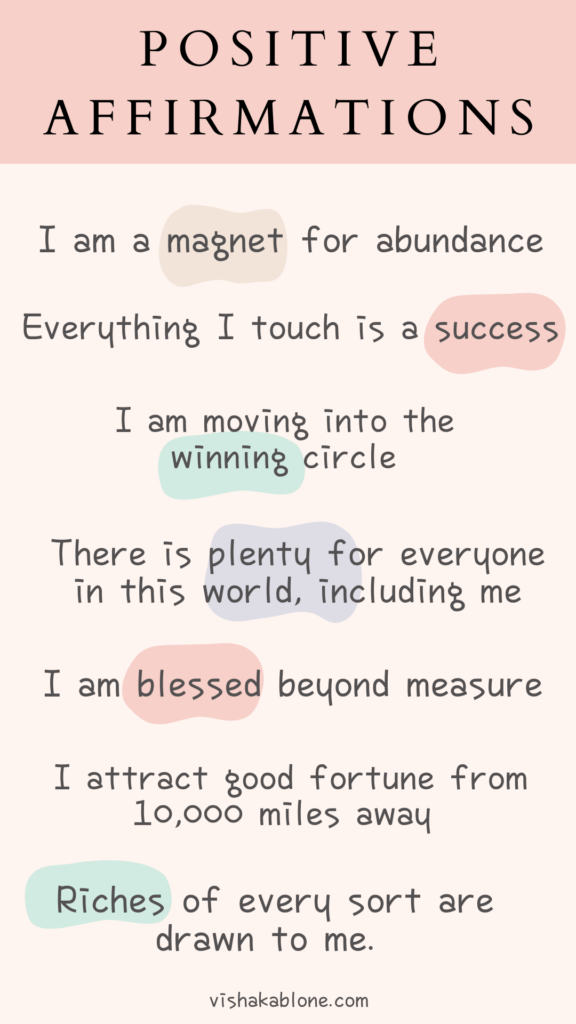
Credit: vishakablone.com
Data On Affirmation Effectiveness
Let’s look at research data on affirmations and their impact:
| Outcome | Improvement (%) | Study Notes |
|---|---|---|
| Self-Esteem | 20–35% | More consistent practice, greater results |
| Stress Reduction | 15–25% | Measured through lower cortisol levels |
| Academic Performance | 10–18% | Especially for students with test anxiety |
While not a cure-all, these numbers show affirmations can make a real difference.
Real-life Success Stories
Many people use affirmations to reach their goals. For example:
- A student struggling with exams started saying, “I am focused and prepared.” Her grades improved as her confidence grew.
- A business owner repeated, “I am worthy of success.” He took more risks and saw his business expand.
- An athlete used, “I am strong and determined,” to overcome setbacks after an injury.
What these stories have in common: Consistent practice and belief in the process.
How To Stay Motivated With Affirmations
It’s easy to start strong and then forget about your affirmations. Here’s how to keep going:
- Link affirmations to a habit. Say them while brushing your teeth.
- Track your progress. Notice small changes in mood or actions.
- Find a partner. Share affirmations with a friend for accountability.
- Change them as you grow. Update affirmations to match your current goals.
Remember, affirmations are a tool, not a rule. Use them in a way that feels right for you.
When Affirmations May Not Work
Affirmations are helpful, but not for every situation. If you’re facing deep sadness or mental health challenges, affirmations alone may not be enough. In these cases, professional support is important. Affirmations can still be a helpful support but should not replace other treatments.
A non-obvious insight: If you feel worse after saying affirmations, notice why. Sometimes, your mind needs time to adjust or you may need a different approach.

Credit: livingasweeterlife.com
Frequently Asked Questions
What Are Positive Affirmations?
Positive affirmations are short, powerful statements you repeat to yourself to encourage positive thinking and self-belief. They help change negative thoughts and support personal growth when practiced regularly.
How Many Affirmations Should I Use Each Day?
It’s best to focus on 3–5 key affirmations at a time. Too many can dilute your focus. Stick with these for a few weeks, then adjust as your needs change.
Can Affirmations Help With Anxiety Or Stress?
Yes, affirmations like “I am calm and in control” can help reduce stress and anxiety. Combine them with deep breathing and other relaxation techniques for the best effect.
What If I Don’t Believe My Affirmation?
If an affirmation feels untrue, adjust it to something more believable, like “I am becoming more confident. ” Over time, as you repeat it, your belief may grow.
Where Can I Learn More About The Science Behind Affirmations?
You can read more about the research on positive self-talk and affirmations at the Wikipedia page on Affirmations.
Using the best positive affirmations is about more than just saying nice things to yourself. It’s a practice that, when done with intention, can help you feel better, do better, and become the person you want to be. Start small, stay consistent, and watch as your mindset—and your life—begins to change.
