

What are Some Affirmations for Success: Transform Your Mindset
What Are Some Affirmations For Success
Everyone wants to be successful. But for many people, the road to success can feel long and difficult. Some days are filled with energy and hope, while others bring doubt and worry. In these moments, your mind plays a big role. What you say to yourself matters just as much as what you do. That’s where affirmations for success come in.
Affirmations are short, positive statements you repeat to yourself. They help you focus your mind, build confidence, and create new patterns of thinking. Over time, using affirmations can change how you see yourself and what you believe is possible. Many top athletes, entrepreneurs, and artists use affirmations every day to stay motivated and achieve their goals.
You do not need special skills or expensive tools to start using affirmations. All you need is your voice, your mind, and the willingness to try. In this article, you will learn what affirmations for success are, how they work, and how you can use them in your own life.
We will also share many examples you can use right away, along with tips to make them more powerful. By the end, you will understand how simple words can help you unlock your best self.
What Are Affirmations For Success?
Affirmations for success are positive statements that focus your thoughts on achieving your goals and building self-belief. They are usually short sentences you repeat regularly, such as “I am confident in my abilities” or “I am worthy of success.” The goal is to replace negative or doubtful thoughts with ones that support your growth and motivation.
Success means different things to different people. For some, it might be getting a dream job or starting a business. For others, it’s about feeling happy, building strong relationships, or reaching personal milestones. Affirmations can be shaped for any type of success.
The science behind affirmations is based on the idea that what you say to yourself influences your actions. If you often tell yourself “I can’t do this,” you are less likely to try. But if you repeat “I have the skills to succeed,” you are more likely to take action and keep going even when things get tough.
Why Do Affirmations Work?
At first, affirmations might seem simple, even too simple to make a difference. But there is strong evidence that they help change your mindset and behaviors. Here’s why:
- Self-talk shapes your beliefs: Most people have an inner voice that can be supportive or critical. Affirmations help you guide this voice in a positive direction.
- Repetition creates new habits: When you repeat positive statements, your brain starts to believe them. Over time, these new beliefs replace old, limiting ones.
- Focus and motivation increase: Affirmations remind you of your goals and keep you focused, especially when you face challenges or setbacks.
- Stress and anxiety decrease: Positive self-talk can reduce worry and help you feel calmer in difficult situations.
Research shows that people who use affirmations are more likely to stay persistent, bounce back from failure, and feel happier with their progress. In a study published by the National Institutes of Health, participants who practiced affirmations had lower stress and improved problem-solving skills compared to those who did not.
How To Create Effective Affirmations For Success
Not all affirmations are equally powerful. Some work better than others because of how they are written and used. Here are some guidelines to help you create strong, effective affirmations:
- Use the present tense: Write your affirmation as if it is happening now. For example, “I am successful” instead of “I will be successful.”
- Keep it positive: Focus on what you want, not what you don’t want. Say “I am confident” instead of “I am not afraid.”
- Be specific: The more clear your affirmation, the better. “I am a skilled writer” is more useful than just “I am good.”
- Make it personal: Use “I” statements to connect the affirmation to yourself.
- Keep it short and simple: Easy-to-remember affirmations are easier to repeat and believe.
- Add emotion: If possible, include words that trigger feelings. For example, “I am excited to achieve my goals.”
Let’s look at examples of weak and strong affirmations in a simple table:
| Weak Affirmation | Strong Affirmation |
|---|---|
| I want to be successful someday. | I am creating my success every day. |
| I hope I can achieve my goals. | I am confident in my ability to achieve my goals. |
| I will stop being afraid of failure. | I learn and grow from every challenge. |
30 Powerful Affirmations For Success
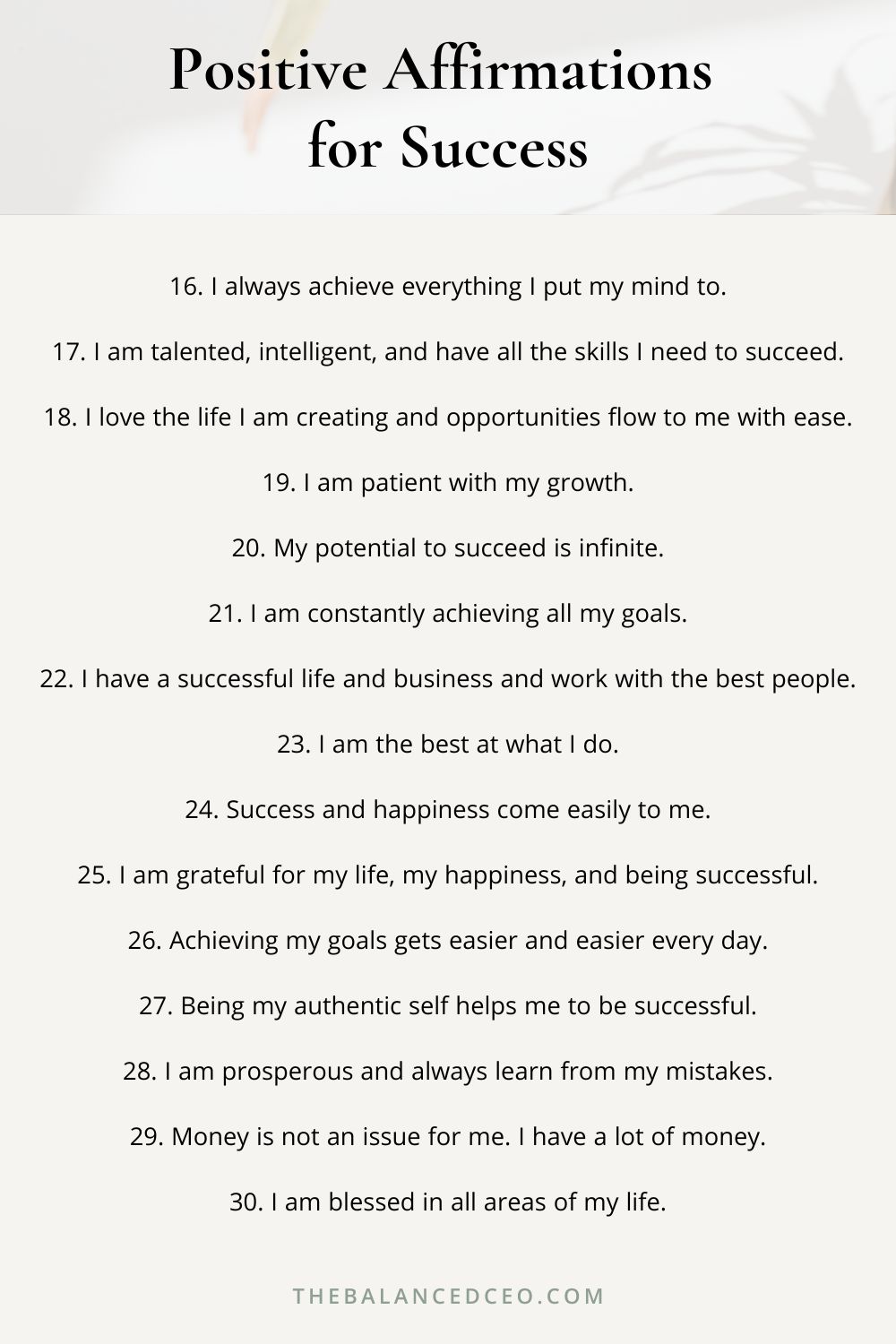
Here are 30 examples of success affirmations you can start using today. You can say them out loud, write them in a journal, or repeat them in your mind:
- I am worthy of success and happiness.
- I believe in my ability to overcome challenges.
- Every day, I am getting closer to my goals.
- I attract opportunities for growth and achievement.
- I am persistent and never give up.
- I am confident in my skills and talents.
- I turn obstacles into stepping stones for success.
- I am focused, disciplined, and motivated.
- I celebrate my progress, no matter how small.
- I am open to learning new things every day.
- I trust myself to make the right choices.
- I create my own success story.
- I am grateful for all my achievements.
- I take action toward my dreams.
- I am surrounded by support and encouragement.
- I handle stress with calm and clarity.
- I am a problem solver and find solutions easily.
- I am proud of what I have accomplished.
- I am open to new ideas and opportunities.
- I stay positive, even in difficult times.
- I am deserving of recognition and reward.
- I am becoming the best version of myself.
- I am in control of my thoughts and actions.
- I am excited about my future success.
- I am committed to my goals.
- I am flexible and adapt to change.
- I am a magnet for success.
- I am driven by purpose and passion.
- I am unstoppable in my journey.
- I am living a life filled with achievement and joy.

Credit: misstask.com
How To Use Affirmations For Success In Daily Life
Saying affirmations once is not enough. They work best when they become a regular part of your day. Here are some ways to include affirmations in your routine:
- Morning routine: Start your day by repeating 3–5 affirmations in front of a mirror.
- During work or study: Whisper or think about an affirmation before a big task or meeting.
- Journaling: Write your favorite affirmations in your notebook or planner each morning or night.
- On your phone: Set reminders with affirmations to pop up during the day.
- Before sleep: Repeat affirmations to yourself as you relax before bed.
Here’s a table showing different ways people add affirmations into their daily habits:
| Time | How to Use Affirmations | Benefit |
|---|---|---|
| Morning | Say affirmations in front of the mirror | Boosts confidence for the day ahead |
| Before a task | Repeat affirmations silently | Reduces anxiety and increases focus |
| Evening | Write affirmations in a journal | Reflects on progress and builds gratitude |
| Throughout the day | Set phone reminders with affirmations | Keeps motivation high and thoughts positive |
Affirmations For Different Types Of Success
Success is not just about money or career. It can show up in many areas of life. Here are some affirmations for different types of success:
Career Success
- I am a valuable member of my team.
- My work makes a positive impact.
- I am open to new career opportunities.
- I am a leader in my field.
- I am constantly improving my professional skills.
Academic Success
- I enjoy learning and growing.
- I am focused and organized in my studies.
- I remember information easily.
- I am confident during exams and presentations.
- I am proud of my academic progress.
Financial Success
- I attract wealth and abundance.
- I am responsible with my money.
- I make smart financial decisions.
- I am open to new sources of income.
- My financial situation improves every day.
Personal Growth Success
- I am always learning from my experiences.
- I forgive myself and move forward.
- I am kind and patient with myself.
- I am growing stronger every day.
- I trust my journey and enjoy the process.
Health And Wellness Success
- I respect and care for my body.
- I make healthy choices with ease.
- I enjoy being active and energetic.
- I am grateful for my health.
- I am committed to my well-being.
Common Mistakes When Using Affirmations
Affirmations can be powerful, but some common mistakes can make them less effective. Here are a few to avoid:
- Choosing statements you don’t believe at all: If an affirmation feels completely untrue, your mind may reject it. Start with affirmations that feel possible and build up to bigger ones.
- Being too vague: “I want to be better” is too general. Use clear, specific statements that match your goals.
- Only using them when you feel bad: Affirmations are most effective when used regularly, not just in tough moments.
- Repeating them without emotion: Say your affirmations with feeling. The more you connect emotionally, the more your mind accepts them.
- Not taking action: Affirmations help shape your thoughts, but you still need to take steps toward your goals.
An insight many beginners miss is that affirmations are not magic—they work best when paired with real actions. For example, saying “I am a skilled speaker” will help you feel more confident, but you should also practice speaking to improve.
The Science Behind Affirmations
You might wonder if affirmations really change anything in your brain. Research in psychology and neuroscience shows that positive self-talk has clear effects. When you repeat affirmations, your brain’s reward system becomes active. This helps you feel more motivated and less anxious.
Studies have found that self-affirmation can:
- Lower levels of cortisol (the stress hormone)
- Increase problem-solving abilities under pressure
- Improve your resilience after failure
One study published in the journal Social Cognitive and Affective Neuroscience showed that repeating self-affirmations increased activity in brain regions linked to self-worth and positive outcomes.
But here’s a detail most people miss: affirmations are more effective when they are personally meaningful. Generic phrases have some effect, but statements that connect with your own values and goals work even better. For example, if you value creativity, an affirmation like “I am creative and resourceful” will have more impact.
For more on this, you can visit the Wikipedia page on self-affirmation.
Credit: thebalancedceo.com
How Long Does It Take For Affirmations To Work?
Many people hope for instant results, but affirmations usually take time. The effects build up as you repeat your statements daily. Some people notice small changes in a week, but bigger shifts often take a month or more.
The key is consistency. Think of affirmations like exercise for your brain. Just as going to the gym once will not build muscle, using affirmations once will not change your beliefs. Make them a habit, and you will see progress.
A practical tip: Track your use of affirmations and how you feel. You might keep a simple log like this:
| Date | Affirmations Used | How I Felt |
|---|---|---|
| Monday | I am confident, I am focused | More motivated, less anxious |
| Tuesday | I am learning, I am making progress | Hopeful, positive |
| Wednesday | I am successful, I am grateful | Proud, satisfied |
How To Write Your Own Affirmations
While it’s helpful to use ready-made affirmations, writing your own makes them more personal and effective. Here are steps to guide you:
- Think about your goal: What area of life do you want to improve? Be clear and specific.
- Identify a limiting belief: What negative thought holds you back? For example, “I’m not good enough to get promoted.”
- Flip it to a positive: Change that thought into a positive statement. For example, “I have the skills to earn a promotion.”
- Keep it short and present tense: Make it easy to repeat.
- Add emotion or action: Use words that spark feeling or movement, like “I am excited,” “I am creating,” or “I choose.”
Example process:
- Goal: Improve public speaking
- Limiting belief: “I always get nervous and mess up.”
- New affirmation: “I speak with confidence and clarity.”
An insight to remember: Affirmations that include action words (“I am taking steps,” “I am growing”) feel more believable and motivating than passive statements.
Combining Visualization With Affirmations
Many successful people combine affirmations with visualization. This means you not only say the positive statement, but also imagine yourself living it. For example, if your affirmation is “I am a confident leader,” picture yourself leading a team, speaking clearly, and making decisions.
Visualization helps your brain “practice” success, making it easier to act that way in real life. Athletes often use this technique before big games or events. You can use it before meetings, interviews, or any challenge.
To combine affirmations and visualization:
- Repeat your affirmation slowly.
- Close your eyes and picture yourself achieving your goal.
- Imagine how it feels, looks, and sounds.
- Do this for 1–2 minutes each day.
This pairing makes the affirmation stronger and helps your mind believe it’s possible.
Using Affirmations In Challenging Times
Affirmations are not just for when things are going well. They are especially helpful during setbacks, failures, or stress. In tough moments, your mind might fill with doubt or fear. Using affirmations can help you stay strong and bounce back.
For example, if you lose a job or fail an exam, you might feel discouraged. An affirmation like “I am resilient and will find new opportunities” can help you focus on solutions rather than problems.
It’s important to accept your feelings, but also guide your thoughts in a supportive direction. Over time, this habit builds mental toughness.
Affirmations Vs. Positive Thinking
Affirmations and positive thinking are similar, but not the same. Positive thinking is a general attitude of looking for the good in situations. Affirmations are specific statements you repeat to shape your thoughts.
Think of affirmations as a tool within the larger idea of positive thinking. They are more focused and direct. For example, positive thinking might be “I’ll do my best,” while an affirmation would be “I am capable of doing my best work today.
”
Both are helpful, but affirmations give you a clear, repeatable way to build new beliefs.
How To Stay Consistent With Affirmations
One of the biggest challenges is using affirmations regularly. Here are practical tips to help you stay consistent:
- Set a specific time: Link affirmations to a daily routine, like brushing your teeth or having breakfast.
- Use reminders: Sticky notes, phone alarms, or affirmation cards can remind you to practice.
- Start small: Begin with just one or two affirmations and add more as the habit grows.
- Involve a friend: Share affirmations with a trusted person and encourage each other.
- Track your progress: Use a journal or app to note which affirmations you use and how you feel.
Most people give up on affirmations because they forget or don’t see instant results. Remember, small steps add up. Even a few minutes each day can make a difference over time.

Credit: www.thegoodbody.com
Affirmations For Success Stories
Many famous people credit affirmations as a key part of their achievements. For example:
- Will Smith has spoken about using positive self-talk to build his career.
- Serena Williams uses affirmations to stay strong during tennis matches.
- Jim Carrey wrote himself a check for a large sum and repeated affirmations until he earned that amount.
Even if you are not a celebrity, you can use affirmations to create your own success story. People from all walks of life—students, parents, business owners—use affirmations to overcome doubt, work toward goals, and feel more confident.
If you ever doubt the power of affirmations, remember that they have helped millions reach new heights.
Frequently Asked Questions
What Are The Best Times To Use Affirmations For Success?
You can use affirmations any time, but the most effective moments are first thing in the morning, before important tasks, and at night before sleep. Repeating affirmations during these times helps set your mindset for the day and reinforces positive beliefs before bed.
How Many Affirmations Should I Use Each Day?
It’s best to start with 3 to 5 affirmations. This number is easy to remember and repeat. As you get comfortable, you can add more or change them to fit your goals. Quality is more important than quantity.
Do Affirmations Work For Everyone?
Most people can benefit from affirmations, but results depend on consistency and how personally meaningful the statements are. If you use affirmations regularly and choose ones that fit your life, you are more likely to see positive changes.
Can Affirmations Replace Hard Work?
No, affirmations are not a shortcut. They help build confidence and motivation, but you still need to take action toward your goals. The best results come when you combine affirmations with effort and smart planning.
What If I Don’t Believe My Affirmation?
If an affirmation feels too hard to believe, start with a smaller, more believable statement. For example, “I am learning to be more confident” can be easier to accept than “I am always confident.” As your belief grows, you can use stronger affirmations.
Success often starts with your mindset. Affirmations are a simple, powerful way to shape your thoughts and move toward your goals. Whether you are aiming for a new job, better grades, more happiness, or personal growth, the right words can help you build the future you want.
Start today, stay consistent, and watch as small changes in your thinking lead to big results in your life.
