

Good Affirmation for Success: Transform Your Mindset Today
Good Affirmation For Success
Success means different things for different people. For some, it is about career achievement. For others, it is about personal happiness, health, or relationships. No matter your goal, one powerful tool that can help is using affirmations. These are positive statements you repeat to yourself. They help shape your thoughts, beliefs, and actions. Many successful people use affirmations to boost confidence, stay focused, and overcome challenges. In this article, you will learn how affirmations work, why they matter, and how to make them part of your daily life. You will also see real examples, research, and practical advice so you can start using good affirmations for success right away.
What Are Affirmations?
Affirmations are simple, positive statements. You say them to yourself, often every day. The goal is to replace negative or limiting thoughts with positive, empowering ones. For example, if you often think, “I am not good enough,” an affirmation would be, “I am capable and strong.
” Over time, these statements can shift your mindset.
A key thing to know is that affirmations are not magic. They cannot make you rich or famous overnight. But they do help train your brain to focus on what you want, not what you fear. This shift makes it easier to act confidently and notice opportunities.
How Affirmations Work In The Brain
Research shows that repeating positive statements can change the way your brain works. When you say or think an affirmation, your brain creates new pathways. These pathways make it easier to believe in yourself and take action. This is called neuroplasticity. It means your brain can change and grow, even as an adult.
For example, a study in the journal Social Cognitive and Affective Neuroscience found that affirmations activate the reward centers in the brain. This makes you feel good and motivated. Another study showed that people who used affirmations performed better under stress.
The Power Of Words
Words are powerful. The things you say to yourself shape how you feel and act. If you tell yourself you will fail, you are less likely to try. If you tell yourself you can succeed, you feel more confident and take positive steps. This is why the right affirmations for success are so important.
Many people do not realize how often they use negative self-talk. For example, you might say, “I always mess up,” or “I am not as smart as others. ” These thoughts become habits. Affirmations break these habits and help you build new, positive ones.
Why Use Affirmations For Success?
Affirmations are not just “feel-good” phrases. They have real benefits when it comes to achieving success. Here are some reasons why affirmations can make a difference:
- Boost Confidence: When you believe in yourself, you are more likely to take risks and try new things.
- Reduce Stress: Positive self-talk helps you handle challenges calmly.
- Improve Focus: Affirmations remind you of your goals and keep you on track.
- Increase Motivation: Repeating your goals every day keeps them top of mind.
- Build Resilience: When things go wrong, affirmations help you bounce back faster.
Let’s look at a quick comparison of people who use affirmations versus those who do not:
| With Affirmations | Without Affirmations |
|---|---|
| Higher confidence | Self-doubt is common |
| More goal-focused | Easily distracted |
| Handles stress better | Feels overwhelmed often |
| Acts with more courage | Fears failure |
One insight many beginners miss: affirmations work best when you truly believe them. If you repeat something you do not believe, it might not help much. The key is to choose statements that feel possible and meaningful to you.

Credit: www.swagmagic.com
How To Create Good Affirmations For Success
Not all affirmations are created equal. Some are too general or unrealistic. For the best results, your affirmations should follow a few simple rules.
Make Them Positive And Present
Affirmations work best when they are stated in the present tense. Say, “I am confident,” not “I will be confident.” Focus on what you want, not what you do not want.
Be Specific
Vague statements like “I am successful” are less powerful. Try to be clear about what success means to you. For example, “I am organized and finish my work on time. ”
Keep Them Short
Long, complicated phrases are hard to remember. Short affirmations are easy to repeat and believe.
Use Emotion
Add feeling to your statements. “I am excited to learn new things every day” is more powerful than “I learn every day. ”
Make Them Believable
If you say “I am a millionaire” but do not feel it is true, try “I am building wealth every day. ” The statement should feel honest and within reach.
Here is a simple guide for building your own affirmations:
| Weak Affirmation | Strong Affirmation | Why Stronger? |
|---|---|---|
| I will be rich. | I am creating financial security. | Focuses on action now, not just a wish. |
| I want to be confident. | I am confident in my abilities. | States confidence as a present truth. |
| I hope for success. | I achieve my goals step by step. | Shows progress and action. |
Examples Of Good Affirmations For Success
You may be wondering what specific affirmations to use. Here are some strong examples that cover work, study, business, and personal growth. Choose the ones that fit your life, or use them as a model to write your own.
- I am focused and productive each day.
- I learn from my mistakes and grow stronger.
- I believe in myself and my abilities.
- I attract opportunities that help me succeed.
- I am calm and confident in stressful situations.
- I take action towards my goals daily.
- I am worthy of success and happiness.
- I finish what I start with excellence.
- I trust my decisions and follow through.
- I am open to new ideas and experiences.
- I turn challenges into opportunities.
- I am grateful for my progress.
- I handle setbacks with resilience.
- I am disciplined and committed to my path.
- I celebrate my achievements, big and small.
You do not need to use all these at once. Choose 2-3 that feel right and repeat them every day.
How To Use Affirmations In Daily Life
Knowing good affirmations is not enough. The real power comes from using them daily. Here is how you can add affirmations to your routine:
Morning Routine
Start your day with affirmations. Say them out loud while looking in the mirror. This sets a positive tone for the day.
Write Them Down
Writing helps you remember and believe your affirmations. Keep a notebook and write your favorite affirmations each morning or evening.
Use Reminders
Place sticky notes with affirmations on your desk, bathroom mirror, or computer. You can also set reminders on your phone.
Visualize Success
While you say your affirmation, imagine yourself achieving your goal. Picture the details—how you feel, what you see, who is with you. This makes the affirmation more real.
Stay Consistent
Repeat your affirmations every day, even when you do not feel motivated. Consistency is key for building new habits.
A common mistake is to say affirmations only when you feel good. The best time is actually when you feel low or uncertain. That is when your mind needs positive input the most.
Common Affirmation Mistakes And How To Avoid Them
Many people try affirmations and quit because they do not see instant results. Here are some common mistakes and how to fix them:
Choosing Unrealistic Affirmations
If your affirmation feels impossible, your mind will resist it. Start with statements that feel true or almost true. For example, “I am becoming more confident every day. ”
Being Inconsistent
Repeating affirmations once or twice is not enough. Make it a daily practice, like brushing your teeth.
Ignoring Emotions
Saying words without feeling has little effect. Try to feel the emotion behind the statement—confidence, excitement, gratitude.
Using Negative Words
Affirmations should never focus on what you do not want. Avoid words like “not,” “never,” or “can’t. ” For example, say “I am healthy” instead of “I am not sick. ”
Forgetting To Take Action
Affirmations are not a substitute for action. They prepare your mind but do not do the work for you. Use them to motivate real steps toward your goal.
Real-life Examples: How Affirmations Lead To Success
Many well-known people use affirmations. For example, world-class athletes repeat positive statements before a game. Business leaders use affirmations before important meetings. Even students use them to build confidence before exams.
One example is Serena Williams, a famous tennis player. She talks about repeating positive statements to herself before and during matches. This helps her stay calm and focused, even under pressure.
Another example is entrepreneurs. Many startup founders use affirmations like, “I am building a great company,” to stay motivated during tough times.
The common thread in all these stories: affirmations do not replace hard work, but they make it easier to keep going, especially when things get hard.
Scientific Evidence: Do Affirmations Really Work?
Some people think affirmations are just wishful thinking. But science shows they can really help. Research published in the journal Psychological Science found that self-affirmation can improve problem-solving under stress. Another study from Carnegie Mellon University showed that affirmations protect against the effects of stress on performance.
The key is that affirmations help you see yourself in a positive light. This boosts your ability to handle setbacks and keep working toward your goals.
A helpful resource on the science behind affirmations can be found at the Wikipedia Affirmations page.
Different Types Of Success: Which Affirmations Fit Your Goals?
Success is not just about money or status. Here are types of success and affirmations that fit each one:
Career Success
- I am a valuable member of my team.
- I am advancing in my career through hard work and learning.
Academic Success
- I am focused and organized in my studies.
- I understand and remember what I learn.
Personal Growth
- I am becoming the best version of myself.
- I forgive myself for past mistakes and move forward.
Financial Success
- I am making smart choices with my money.
- I attract abundance into my life.
Health And Wellness
- I am committed to healthy habits.
- I am strong, energetic, and healthy.
Choosing the right affirmation for your goal is important. A mistake beginners make is using affirmations that do not match their definition of success. Take time to think about what success means to you, then craft statements that fit.
How Long Does It Take To See Results?
Many people want quick results. The truth is, affirmations take time. For most people, a few weeks of daily practice brings small changes. You may notice you feel more positive, or less stressed. Bigger changes, like new habits or more confidence, can take a few months.
A helpful tip: track your progress. Write down how you feel when you start using affirmations. After a few weeks, check again. Small improvements add up over time.
Combining Affirmations With Other Success Tools
Affirmations are powerful, but they work best when combined with other tools. Here are some ideas:
Goal Setting
Write down your goals and use affirmations that match them. For example, if your goal is to finish a project, your affirmation might be, “I complete my work with focus and energy. ”
Visualization
Imagine yourself reaching your goal while you say your affirmation. This creates a stronger link in your mind.
Journaling
After repeating your affirmations, spend a few minutes writing about your progress. This helps you notice small wins and stay motivated.
Positive Habits
Pair affirmations with positive actions. For example, if you say, “I am healthy and active,” also go for a walk or eat a healthy meal.
Combining these tools creates a success mindset and makes it easier to see real results.
The Role Of Environment In Affirmation Success
Your environment affects how well affirmations work. If you are surrounded by negative people or stress, it can be harder to stay positive. Here are some tips:
- Spend time with people who support your goals.
- Limit exposure to negative news or social media.
- Create a positive space for yourself—this could be your desk, a corner of your room, or even your phone background.
Another insight many overlook: share your affirmations with a trusted friend or mentor. Saying them out loud to someone else can make them feel more real and give you extra support.
Affirmations For Overcoming Setbacks
Everyone faces setbacks. Affirmations can help you bounce back. Here are some examples:
- I am resilient and learn from every experience.
- I face challenges with courage and creativity.
- I let go of what I cannot control and focus on what I can.
Repeating these during tough times helps keep your mind strong and focused on solutions, not problems.
Measuring The Impact Of Affirmations
It is easy to forget your progress. Here are simple ways to measure if affirmations are working for you:
- Mood Tracker: Each day, write down how you feel before and after using affirmations.
- Behavior Changes: Notice if you take more positive actions, like speaking up in meetings or starting new tasks.
- Goal Progress: Track if you are reaching your goals faster or with less stress.
Here’s a simple example of how you might track your results:
| Week | Mood Before | Mood After | Notable Actions |
|---|---|---|---|
| 1 | Worried | Calmer | Started a new project |
| 2 | Low energy | Motivated | Spoke up in a meeting |
| 3 | Uncertain | Confident | Finished a big task |
If you do not see changes right away, do not give up. Small steps add up over time.
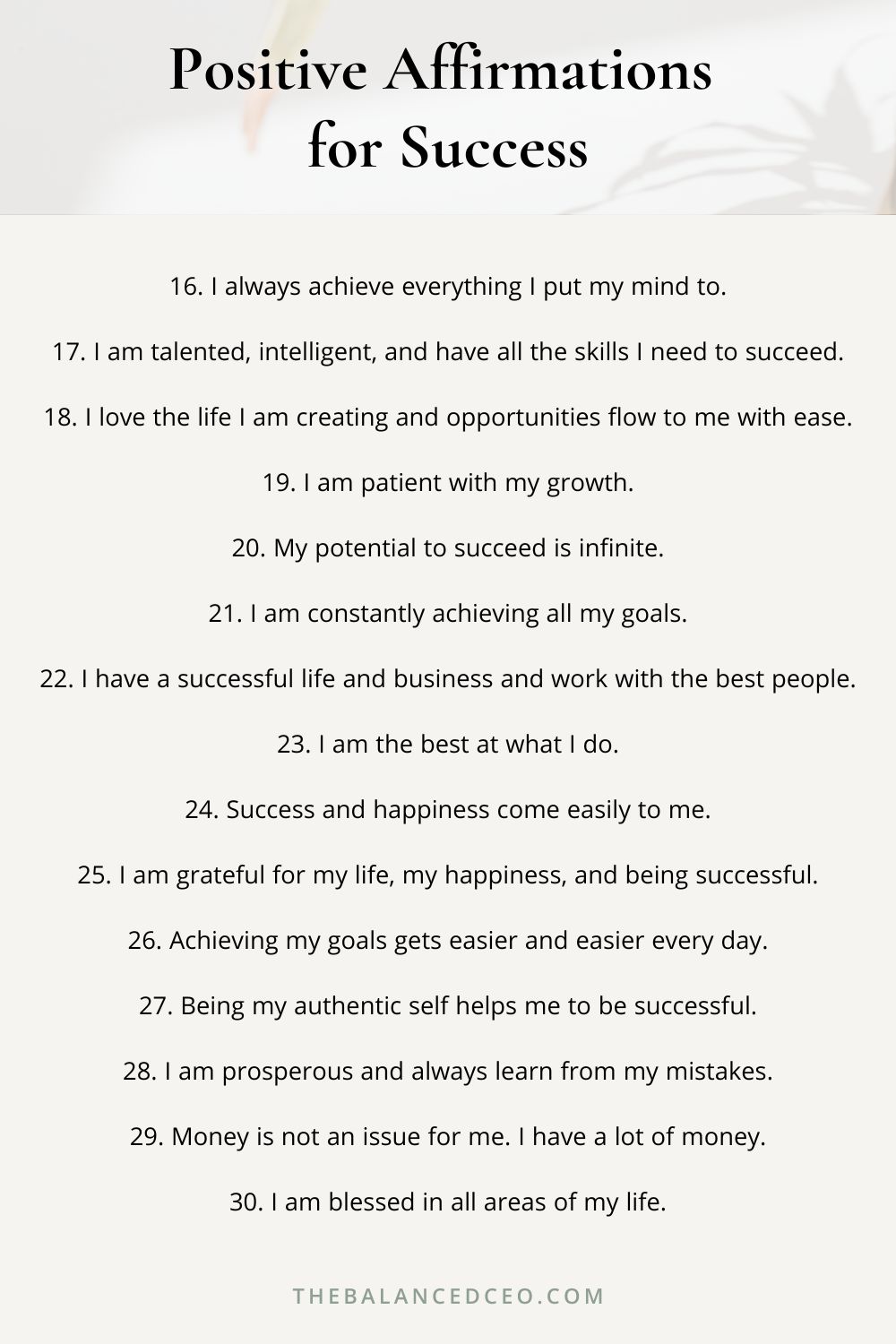
Credit: thebalancedceo.com
Good Affirmations For Different Life Stages
Your affirmations may change as your life changes. Here are examples for different stages:
For Students
- I am capable of learning anything I set my mind to.
- I manage my time well and succeed in my studies.
For Young Professionals
- I am growing in my career each day.
- I build strong relationships with my colleagues.
For Entrepreneurs
- I turn ideas into action and success.
- I welcome challenges as opportunities to grow.
For Parents
- I am a loving and patient parent.
- I teach and learn with my children every day.
For Retirees
- I enjoy new experiences and lifelong learning.
- I am proud of the life I have built.
Choose affirmations that fit your current needs and dreams.
Why Many People Give Up On Affirmations (and How To Succeed)
It is normal to feel awkward when you start using affirmations. Some people stop because they feel silly or do not see fast results. Here is why people give up—and how you can succeed where others quit:
- Lack of belief: If you do not believe the words, start with smaller, believable statements. As your confidence grows, make them stronger.
- Inconsistency: Set a reminder or tie your affirmations to a daily habit, like brushing your teeth.
- Expecting instant results: Remember, affirmations are about changing your mindset. Results come with time and action.
- Negative environment: Find support from friends, online groups, or mentors who believe in you.
Stick with your affirmations for at least a month. Review your progress and adjust as needed.
Practical Tips For Sticking With Affirmations
Here are strategies to help you keep using affirmations, even on busy or tough days:
- Keep it simple: Choose one or two affirmations and repeat them often.
- Connect to daily habits: Say your affirmation while making coffee, driving, or before bed.
- Use technology: Record yourself saying the affirmation and listen to it during the day.
- Involve others: Share affirmations with a friend and check in on each other’s progress.
- Mix it up: Change your affirmation if it stops feeling helpful or true.
Remember, it is normal for affirmations to feel strange at first. Over time, they will become more natural and powerful.
Frequently Asked Questions
How Do I Know If My Affirmation Is Working?
You will notice changes in your thoughts, feelings, or actions. For example, you might feel more confident, take more risks, or handle stress better. Keep track of small changes. It often starts with feeling a bit more positive or hopeful each day.
Can Affirmations Help With Anxiety Or Stress?
Yes, affirmations can reduce anxiety and stress. When you repeat positive statements, your brain focuses less on worry and more on solutions. However, if you have severe anxiety, you may also want to talk to a mental health professional.
How Often Should I Repeat My Affirmations?
For best results, repeat your affirmations at least once a day. Many people say them in the morning and evening. The more often you use them, the stronger the effect. Consistency is more important than the exact number.
What If I Do Not Believe My Affirmation?
Start with smaller, believable statements. For example, instead of “I am a great leader,” try “I am learning to be a better leader every day. ” As your confidence grows, make your affirmations stronger.
Do I Need To Say My Affirmations Out Loud?
Saying them out loud is helpful, but it is not required. You can also write them, think them, or listen to recordings. The key is to focus on the words and the feeling behind them.
Success starts in the mind. Using good affirmations for success is like planting seeds of confidence, focus, and motivation. With daily practice and the right attitude, these seeds grow into habits that move you toward your goals. Start today—choose a few affirmations, repeat them with feeling, and watch how your thoughts and life begin to change.

Credit: www.thegoodbody.com
