

What are Positive Affirmations for Teens: Boost Confidence Daily
What Are Positive Affirmations For Teens
Everyone faces challenges growing up, but teens often feel extra pressure. School stress, friendship changes, family expectations, and social media can make life confusing. Many teenagers feel uncertain or worry about how others see them. Positive affirmations offer a simple, powerful tool to help teens build confidence, manage stress, and create a better self-image.
These short statements can change how a teen thinks, feels, and reacts to the world. With the right guidance and practice, affirmations can make a real difference.
Understanding Positive Affirmations
Positive affirmations are short, encouraging statements. They focus on strengths, goals, or positive feelings. When someone repeats an affirmation, it can help shift their mindset from negative to positive. For teens, affirmations can boost self-esteem, reduce anxiety, and help them face challenges.
For example, a teen might say, “I am capable of handling anything that comes my way. ” This simple phrase can remind them of their strength during difficult times. Another common affirmation, “I am learning every day,” encourages growth and patience.
Research shows that positive self-talk can change brain patterns and behavior. Teens who use affirmations regularly often feel more confident and motivated. It’s not magic, but it can be a powerful habit when used correctly. Even small, daily changes in thinking can add up over time, making it easier for teens to handle setbacks and approach new situations with a positive attitude.
Some teens notice that affirmations help them feel calmer before exams or when facing a conflict. This effect comes from training the mind to expect good outcomes, instead of worrying about what could go wrong. Over weeks and months, repeating positive phrases can become part of a teen’s routine, shaping how they respond to stress.
Why Teens Need Affirmations
Teens face unique struggles. Many feel pressure to fit in or succeed. They may worry about grades, friendships, body image, or family issues. Social media can make these worries worse by showing “perfect” lives that aren’t real.
Affirmations help teens:
- Reduce anxiety: Remind themselves they can handle stress.
- Build self-worth: Focus on strengths instead of weaknesses.
- Feel more hopeful: See possibilities, not just problems.
- Create better habits: Encourage positive choices.
- Strengthen emotional balance: Help manage mood swings.
Many teens struggle silently. Affirmations offer a safe way to support mental health. They don’t need expensive therapy or complicated routines. Just a few minutes daily can help.
A common mistake is thinking affirmations are only for moments of crisis. Actually, using them during everyday situations, like before homework or after disagreements, keeps teens grounded. Another insight: affirmations can help teens separate themselves from negative feedback. For example, “I am more than what others say about me” can protect self-esteem when facing criticism.
How Affirmations Work
Affirmations train the brain to focus on positive thoughts. They work best when:
- Said regularly (daily or more).
- Spoken out loud or written down.
- Chosen carefully to match the teen’s needs.
The brain often believes what it hears repeatedly. If a teen says, “I am strong,” often enough, it becomes easier to believe. Over time, affirmations can change self-talk and behavior.
Using affirmations is not about ignoring problems. Instead, it helps teens face challenges with a better attitude. For example, a teen struggling with a tough subject might use, “I can learn and improve with practice. ” This supports growth and reduces fear.
Another benefit is that affirmations can break negative thinking cycles. If a teen’s mind tends to jump to worst-case scenarios, using positive statements helps interrupt this pattern. Eventually, the mind learns to expect positive outcomes, not just negative ones.
Most Effective Positive Affirmations For Teens
Teens are unique, so affirmations should reflect their personal challenges and goals. Here are some popular and effective examples:
- I am enough just as I am.
- I can handle whatever comes my way.
- My mistakes help me learn and grow.
- I am proud of who I am becoming.
- I deserve respect and kindness.
- I choose to focus on what I can control.
- I am brave even when things are hard.
- I am loved and valued.
- I trust myself to make good decisions.
- I am grateful for the good things in my life.
- I am more than my grades or achievements.
- I have the power to change my story.
- I am creative and curious.
- I will ask for help when I need it.
- I am learning to accept myself.
Teens can pick affirmations that fit their needs or create their own. The key is to use statements that feel true or possible.
It's helpful to note that affirmations can be specific to certain events. For example, before a sports game: “I am prepared and ready to do my best.” Or before a presentation: “I am confident speaking in front of others.” Adding these situational affirmations helps teens feel supported in all areas of life.
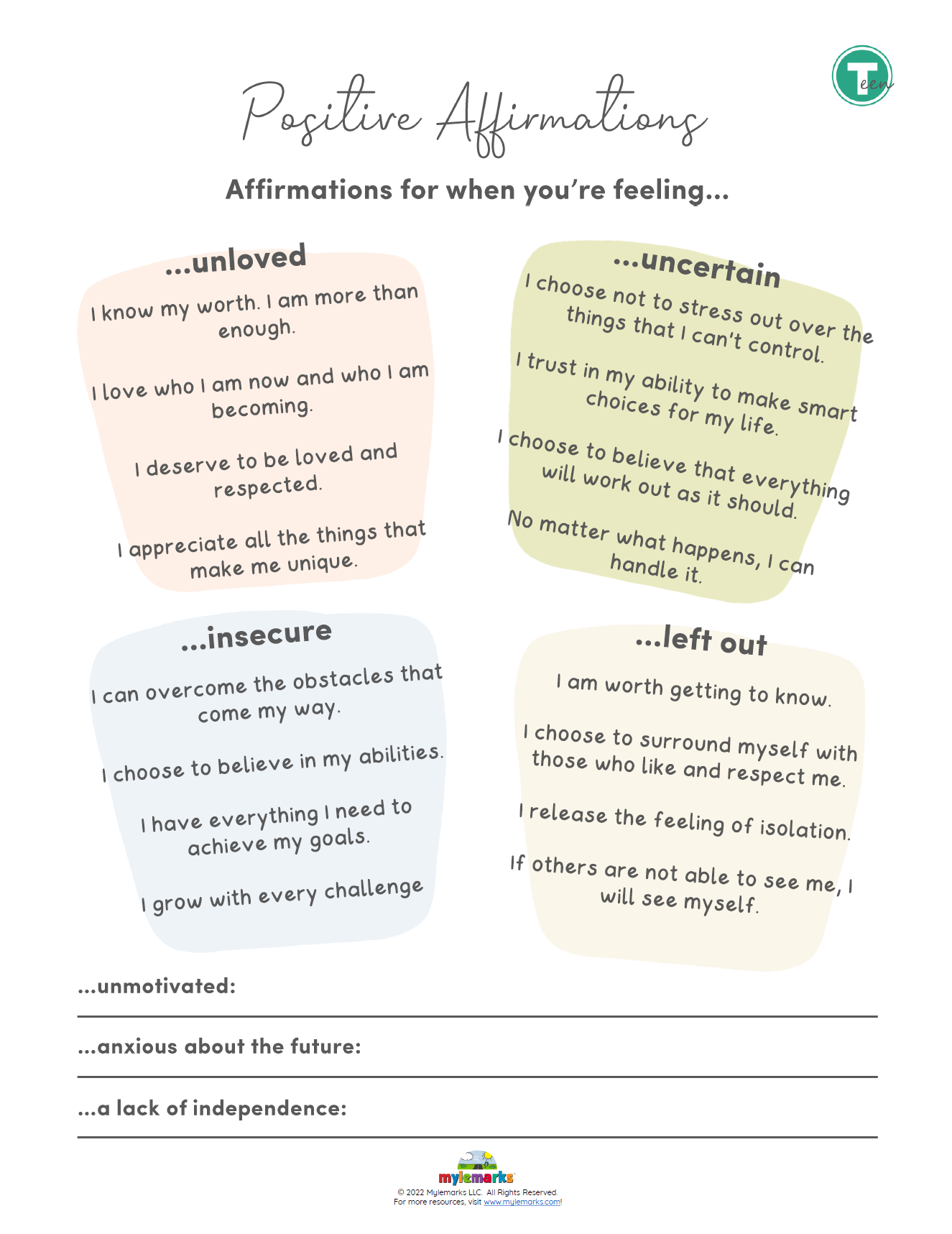
Credit: www.mylemarks.com
How To Create Personal Affirmations
Personalized affirmations are more effective. Here’s how teens can make their own:
- Identify a challenge: What is causing stress or worry?
- Choose positive language: Use “I am,” “I can,” or “I will.”
- Keep it simple: Short, clear phrases work best.
- Make it believable: Use words that feel true or possible.
Example: If a teen feels nervous about speaking in class, they might say, “I am becoming more confident when I speak.”
Some teens struggle to believe positive statements. In this case, use softer language: “I am learning to speak with confidence.” This feels more realistic and less forced.
It’s also useful to write affirmations based on goals. For example, if a teen wants to improve in math, “I am improving my math skills every day” is encouraging and connected to their goal. Personal affirmations can change as teens grow.
Updating them regularly keeps affirmations meaningful and effective.
Using Affirmations In Daily Life
Affirmations work best when they become a habit. Here are practical ways teens can use them:
- Morning routine: Say affirmations while getting ready.
- Before tests or events: Repeat positive phrases to reduce nerves.
- During stress: Use affirmations as reminders to stay calm.
- Writing: Keep a journal with daily affirmations.
- Phone reminders: Set an alarm with a positive statement.
- Mirror notes: Stick affirmation cards on the mirror.
- Bedtime routine: End the day with a positive thought.
Consistency matters. Even on tough days, repeating affirmations can help shift mood and thinking.
Some teens find affirmations helpful during transitions, like starting a new school year or moving to a new place. Using statements such as, “I adapt and grow with change,” can help ease anxiety and build resilience. Over time, teens often notice that affirmations become second nature, helping them approach daily life with more confidence.
Science Behind Affirmations
Many studies support the power of positive self-talk. Brain scans show that repeating positive phrases can change how the brain reacts to stress. Teens who use affirmations often feel less anxious and more in control.
One study found that students who practiced self-affirmation before a test performed better than those who did not. Another study showed that affirmations can help teens cope with social challenges and bullying.
Here’s a comparison of effects from different self-talk habits:
| Self-Talk Type | Impact on Mood | Impact on Performance |
|---|---|---|
| Positive Affirmations | Improves mood | Boosts performance |
| Negative Self-Talk | Increases stress | Reduces performance |
| Neutral Self-Talk | No change | No significant impact |
This data shows that positive affirmations are not just feel-good phrases. They can make a real difference in how teens think and act.
Another insight: affirmations activate parts of the brain linked to reward and motivation. This means using them regularly can make teens feel more energized and ready to tackle challenges. The science is clear—affirmations are a practical tool for building mental strength.
Common Challenges With Affirmations
Some teens find affirmations hard to use at first. They might feel awkward or not believe the statements. Here are common obstacles:
- Feeling silly: Saying positive phrases may feel strange.
- Doubting truth: Some affirmations seem too positive.
- Forgetting: Teens may forget to use them regularly.
- Getting discouraged: Not seeing results right away.
To overcome these challenges:
- Start with softer statements (“I am learning…”).
- Write affirmations in a journal.
- Use reminders on phones or sticky notes.
- Pair affirmations with deep breaths to feel calmer.
It’s normal for affirmations to feel awkward. With practice, they become easier and more natural.
Another tip: teens can ask friends or family to join in. Sharing affirmations in a group or with a buddy makes them feel less strange and builds support. If a teen feels stuck, changing the affirmation or finding new ways to say it can help.

Credit: wholeheartedschoolcounseling.com
Real-life Examples Of Affirmations
Many teens use affirmations for different reasons. Here are some real-life scenarios:
- School stress: “I can do my best, even if it’s not perfect.”
- Friendship problems: “I deserve healthy, supportive friendships.”
- Body image worries: “I am grateful for my body and all it does for me.”
- Family issues: “I am strong enough to handle family challenges.”
- Sports anxiety: “I am prepared and focused.”
These examples show how affirmations can fit many situations. Teens can use them for big or small problems.
Another idea: affirmations can help after disappointments, like not making a team or losing a competition. “I am proud of my effort, no matter the result,” keeps self-esteem strong.
Benefits Of Affirmations For Teens
Positive affirmations offer many advantages:
- Boost confidence: Teens feel better about themselves.
- Improve resilience: They handle setbacks more easily.
- Reduce anxiety: Helps calm nerves in tough situations.
- Encourage growth: Supports a learning attitude.
- Promote kindness: Reminds teens to be gentle with themselves.
- Strengthen decision-making: Builds trust in personal choices.
Here’s a summary of benefits compared to other self-help methods:
| Method | Ease of Use | Cost | Impact |
|---|---|---|---|
| Affirmations | Very easy | Free | High |
| Journaling | Easy | Low | Moderate |
| Therapy | Moderate | High | High |
| Meditation | Moderate | Free | High |
Affirmations stand out because they are easy, free, and can be used anywhere. Teens don’t need special tools or training, just a few words and the desire to practice.
Tips For Making Affirmations Work
To get the most from affirmations, teens should follow some practical tips:
- Be consistent: Use affirmations every day, even on busy days.
- Make them personal: Choose phrases that matter to you.
- Say them out loud: Speaking helps reinforce the message.
- Write them down: Journaling deepens the effect.
- Believe in the possibility: Even if you don’t fully believe yet, trust the process.
- Use visual cues: Place reminders where you’ll see them often.
- Combine with other habits: Pair affirmations with exercise, meditation, or breathing.
- Update regularly: Change affirmations as goals and needs change.
Here’s a helpful comparison between different affirmation strategies:
| Strategy | Best For | Challenges |
|---|---|---|
| Saying Out Loud | Building confidence | May feel awkward |
| Writing | Deep reflection | Needs time |
| Phone Reminders | Busy teens | May ignore alerts |
| Mirror Notes | Visual learners | Needs privacy |
Teens can mix strategies to find what works best. Trying more than one method can make affirmations a stronger habit.
Mistakes Teens Make With Affirmations
While affirmations are simple, teens sometimes make mistakes:
- Using negative wording: Avoid phrases like “I’m not afraid.”
- Being too general: Specific affirmations work better.
- Forcing belief: Use realistic statements if you don’t believe the positive phrase yet.
- Skipping days: Consistency is key.
- Comparing with others: Affirmations are personal.
Example: Instead of “I will never fail,” try “I am learning from every experience.”
Another common mistake is comparing affirmations to others. Affirmations are personal and should fit your own needs.
Sometimes teens write too many affirmations at once and feel overwhelmed. It’s better to start with one or two and build up as confidence grows.
Supporting Teens With Affirmations
Parents, teachers, and friends can help teens use affirmations. Here’s how:
- Encourage open discussion: Talk about challenges and goals.
- Model positive self-talk: Use affirmations yourself.
- Share examples: Help teens find or create their own phrases.
- Offer reminders: Suggest using affirmations during tough times.
- Celebrate progress: Recognize when affirmations help.
Adults can support teens without pushing. If a teen feels pressure, affirmations lose their power. Let them choose what works best.
A helpful tip is to listen and give space for teens to share how affirmations make them feel. Sometimes, hearing another person use affirmations can inspire teens to try new phrases themselves.
Affirmations For Specific Teen Issues
Some challenges need special attention. Here are targeted affirmations for common teen problems:
Academic Pressure
- “I am doing my best and that is enough.”
- “I can improve with practice.”
Social Anxiety
- “I am comfortable being myself around others.”
- “I am worthy of good friends.”
Body Image
- “I appreciate my body for all it does.”
- “I am more than my appearance.”
Family Conflict
- “I can express my feelings calmly.”
- “I am strong enough to handle family challenges.”
Bullying
- “I deserve respect and kindness.”
- “I am not defined by others’ opinions.”
Teens can use these as starting points and adjust them to fit their situation.
It’s important to note that affirmations can help in both positive and negative times. Using them after a difficult day can help teens process feelings and recover faster.
How Affirmations Help Build Resilience
Resilience means bouncing back from problems. Teens who use affirmations become more resilient. Positive phrases remind them of their strengths. When they face setbacks, affirmations help them stay hopeful and motivated.
For example, a teen who fails a test might use, “I learn from mistakes and keep trying. ” This attitude supports growth and prevents giving up.
Affirmations also encourage teens to see challenges as opportunities. Instead of fearing change, “I embrace new experiences” helps them approach life with curiosity.
Practical Ways To Teach Affirmations
Teaching teens to use affirmations requires patience and creativity. Here are some ideas:
- Group activities: Have teens share affirmations in a group.
- Art projects: Write or decorate affirmation cards.
- Role-play: Practice saying affirmations in stressful situations.
- Digital tools: Use apps or online resources for daily reminders.
- Classroom routines: Integrate affirmations into daily lessons.
Some schools include affirmations in morning announcements or classes. This makes positive self-talk part of the daily routine.
Another approach is to encourage teens to create a “wall of affirmations” in their room or school. Seeing positive phrases every day helps reinforce their value.
Signs Affirmations Are Working
Teens may notice changes after using affirmations for a few weeks:
- Feeling more confident
- Less anxious in tough situations
- Better relationships
- Improved school performance
- More positive self-image
- Greater motivation
These signs show that affirmations are making a real impact. If progress is slow, don’t worry. Small improvements are still valuable.
Sometimes, teens realize they are thinking more positively without even trying. This is a sign that affirmations are becoming part of their mindset.
What To Do If Affirmations Don’t Help
Sometimes, affirmations alone are not enough. If a teen feels worse or struggles with serious issues, it’s important to seek help. Talk to a trusted adult, counselor, or mental health professional.
Affirmations are just one tool. They work best alongside other support, like therapy, journaling, or meditation.
If affirmations feel ineffective, try changing the wording or focusing on gratitude. Sometimes, combining positive self-talk with other habits makes it stronger.

Credit: www.thepathway2success.com
Non-obvious Insights For Beginners
Most teens don’t realize that affirmations can be adjusted as they grow. What works at one age may not fit later. Updating affirmations keeps them fresh and effective.
Another overlooked tip: pairing affirmations with gratitude. Saying something positive about yourself and something you’re thankful for strengthens both habits.
Also, teens often benefit from writing affirmations in their own handwriting. This personal touch makes the phrases more meaningful and easier to remember.
Affirmations And Social Media
Teens spend lots of time online. Social media can spread negative messages. Using affirmations helps balance these influences. Teens can share positive phrases with friends or follow accounts that promote healthy self-talk.
But it’s important to remember: affirmations are for personal growth, not for likes or approval. Teens should focus on what feels right for them, not what’s popular.
One helpful practice is to unfollow accounts that spread negativity and find pages or groups that share positive messages. This small change can support a healthier online environment.
Frequently Asked Questions
What Are Positive Affirmations?
Positive affirmations are short, uplifting statements. They focus on strengths, goals, or positive feelings. Teens repeat them to build confidence, manage stress, and improve self-esteem.
How Often Should Teens Use Affirmations?
Affirmations work best when used daily. Teens can say them in the morning, before stressful events, or anytime they need a boost. Consistency helps change thinking patterns.
Can Affirmations Help With Anxiety?
Yes, affirmations can reduce anxiety. When teens use positive phrases, they remind themselves of their abilities and strengths. This can calm nerves and help them face challenges.
What If A Teen Doesn’t Believe Their Affirmation?
It’s normal not to believe affirmations at first. Teens can use softer language, like “I am learning…” or “I am trying…” With practice, belief grows. Adjusting affirmations makes them easier to accept.
Are There Scientific Studies On Affirmations?
Yes, many studies show that positive self-talk can improve mood and performance. For more information, see this research article.
Positive affirmations offer teens a simple, powerful tool for personal growth. They help build confidence, reduce stress, and support resilience. With practice, affirmations can change how a teen thinks, feels, and acts. Everyone deserves kindness from themselves. Affirmations remind teens of their value and potential, helping them face life’s challenges with hope and strength.
