

The Best Affirmations for Success: Unlock Your True Potential
The Best Affirmations For Success
Success is more than just luck or talent. It often starts with what we believe about ourselves. Our thoughts shape our actions, and our actions build our results. Many successful people use affirmations—short, positive statements—to influence their thinking and boost their confidence.
If you want to achieve more in your career, studies, business, or personal life, learning to use the best affirmations for success can be a game changer.
Affirmations are not magic words. They do not instantly change your life. But used correctly, they can help you focus, motivate you to take action, and keep you moving forward when things get tough. For non-native English readers, the idea may seem simple, but choosing the right words and using them effectively makes a big difference.
In this guide, you will learn why affirmations work, how to use them, and which affirmations are most powerful for building success. You’ll also see real examples, practical tips, and answers to common questions. Whether you are just starting out or want to break through to the next level, you will find valuable strategies here.
What Are Success Affirmations?
Affirmations are short, positive sentences you repeat to yourself to change your mindset. Success affirmations are specific statements that focus on your ability to achieve goals, overcome challenges, and grow stronger. These phrases help you replace doubt with confidence, fear with courage, and laziness with energy.
For example, saying “I am capable of reaching my goals” each morning can slowly shift your self-doubt to belief. Over time, this new belief influences your decisions and actions. Affirmations are not just “wishful thinking. ” They are tools for training your mind to see possibilities, not just problems.
How Affirmations Influence Your Mind
Our brains are wired to believe what we tell them often. This idea is called neuroplasticity—your mind can change its structure and beliefs by repeating thoughts and actions. When you use affirmations, you are creating new mental pathways that support success.
Studies show that positive self-talk can:
- Reduce stress and anxiety
- Improve work performance
- Increase motivation and focus
- Build resilience during setbacks
For example, athletes often use affirmations before a competition to boost their confidence. Business leaders use them to stay calm during important meetings. The key is repetition and believing in the words you say.
What Makes An Affirmation Effective?
Not all affirmations are equal. For the best results, your affirmation should be:
- Positive: Use words that focus on what you want, not what you fear.
- Personal: Speak in the first person (“I am…” or “I can…”).
- Present tense: Say it as if it is true now, not in the future.
- Short and clear: Easy to remember and repeat.
- Believable: It should feel possible, not just fantasy.
For example, “I am improving every day” works better than “I will be successful someday,” because it focuses on the present and is easy to believe.
Why Affirmations Matter For Success
Success is not just about skills or luck. It is also about how you think and feel about your abilities. Many people fail because they doubt themselves, fear failure, or focus on obstacles. Affirmations help shift your mindset to see opportunities and solutions.
The Science Behind Affirmations
A research study published by the National Institutes of Health found that self-affirmation activates brain areas involved in self-worth and motivation. This effect makes it easier to handle stress and stay focused on your goals. Another study showed that students who used affirmations improved their grades and confidence.
Below is a simple comparison of how positive affirmations and negative self-talk affect your performance:
| Aspect | Positive Affirmations | Negative Self-Talk |
|---|---|---|
| Confidence | Increases | Decreases |
| Motivation | Boosts | Reduces |
| Stress | Lowers | Raises |
| Focus | Sharpens | Distracts |
Real-life Examples
- Serena Williams often repeats “I am the best” before matches.
- Oprah Winfrey has shared that she used affirmations to overcome self-doubt as a young TV reporter.
- Many entrepreneurs write affirmations on sticky notes and place them on their desks.
These examples show that top performers use affirmations not just for motivation, but as a practical tool for reaching their goals.
The 25 Best Affirmations For Success
Here are 25 of the most effective affirmations for success. You can choose the ones that fit your goals or mix and match them. Remember, what works for one person may not work for another, so feel free to adjust the wording.
- I am capable of achieving my goals.
- Success comes naturally to me.
- I am focused, persistent, and will never quit.
- Every challenge is a chance to grow.
- I attract opportunities and positive people.
- I trust my intuition and make wise decisions.
- My actions today create my future success.
- I am confident in my skills and talents.
- I learn from setbacks and move forward stronger.
- I am disciplined and take action every day.
- I deserve success and happiness.
- I am always improving and learning new things.
- My mind is clear, focused, and sharp.
- I turn ideas into action.
- I stay calm and positive under pressure.
- I believe in myself and my dreams.
- I am a solution-finder, not a complainer.
- I celebrate my progress, no matter how small.
- I am open to new opportunities.
- I use my time wisely and effectively.
- I am grateful for my journey and growth.
- I attract abundance in all areas of life.
- My hard work pays off every day.
- I am unstoppable when I set my mind to something.
- I am creating the life I want.
How To Personalize Affirmations
You may want to create your own affirmations. Start by asking yourself:
- What is my biggest goal right now?
- What limiting thought is holding me back?
- What quality do I want to build (confidence, focus, courage)?
Write your statement in present tense and keep it positive. For example, if you fear public speaking, try: “I speak clearly and confidently in front of others.”
How To Use Affirmations For Maximum Impact
Repeating affirmations is simple, but using them effectively takes practice. Here’s how to get the best results:
1. Choose 3–5 Affirmations
Pick a few statements that connect with you. Too many can feel overwhelming and lose impact. Start with the ones that address your biggest needs.
2. Repeat Daily
Say your affirmations each morning and evening. Speak them out loud, write them down, or record them on your phone. The key is repetition—your brain needs to hear the message often.
3. Use Emotion
Don’t just say the words. Feel them. Picture yourself achieving your goals. The more emotion you put into your affirmation, the more your mind accepts it as real.
4. Place Them Where You’ll See Them
Write your affirmations on sticky notes and put them on your mirror, computer, or phone screen. Seeing them often keeps your goals in front of you.
5. Combine With Action
Affirmations alone are not enough. Use them to motivate yourself, but always follow with action. For example, if your affirmation is “I am disciplined and take action every day,” make sure you do something each day that moves you closer to your goal.
6. Track Your Progress
Keep a journal of your affirmations and note any changes in your mindset, motivation, or results. Reflecting on progress can boost your confidence and help you see which affirmations work best.
Common Mistakes And How To Avoid Them
Even though affirmations are simple, many people struggle to see results. Here are some common mistakes and how to fix them:
Using Unrealistic Affirmations
If you do not believe your affirmation, it won’t work. For example, saying “I am a millionaire” when you struggle to pay bills can create more doubt. Instead, try “I am improving my financial situation every day. ”
Lack Of Consistency
Saying affirmations once or twice is not enough. You need to repeat them daily, just like exercise. Consistency is more important than perfection.
Ignoring Negative Thoughts
Affirmations work best when you notice and replace negative thoughts. When you catch yourself saying, “I can’t do this,” pause and use your positive affirmation instead.
Not Taking Action
Affirmations are not a substitute for hard work. They prepare your mind, but you still need to act. Use affirmations as a starting point, not the end goal.
Success Affirmations For Different Life Areas
Success means different things to different people. You might want to excel at work, in your studies, or in personal growth. Below are targeted affirmations for key life areas.
Career Success
- I am valuable to my team and company.
- I handle challenges at work with confidence.
- I am always learning and growing in my career.
- I am a leader and inspire others.
Academic Success
- I am smart, capable, and focused.
- I learn quickly and remember easily.
- I enjoy studying and discovering new things.
- I perform well on tests and assignments.
Business Success
- My business grows stronger every day.
- I attract loyal customers and partners.
- I make smart decisions for my company.
- I handle risks with courage and wisdom.
Personal Growth
- I am becoming the best version of myself.
- I let go of fear and welcome growth.
- I am open to feedback and use it to improve.
- I create healthy habits for success.
Financial Success
- I manage my money wisely and carefully.
- I attract financial opportunities.
- I am building wealth for my future.
- I am grateful for my financial progress.
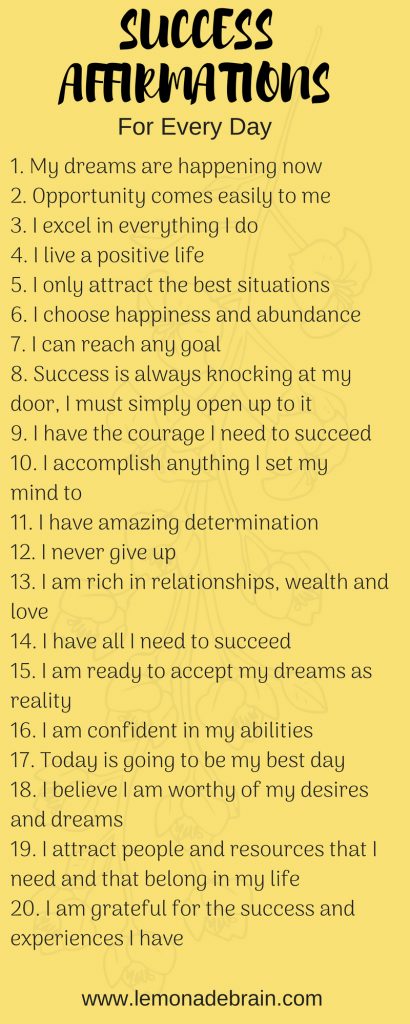
Credit: lemonadebrain.com
When And Where To Use Success Affirmations
Affirmations are flexible. You can use them almost anywhere and anytime. Here are some ideas for when to use them:
- Morning Routine: Start your day with positive energy.
- Before Important Events: Calm nerves before meetings, interviews, or exams.
- During Challenges: Stay strong during setbacks or failures.
- Before Sleep: End your day with hope and gratitude.
- While Exercising: Combine affirmations with physical activity for extra motivation.
Combining Affirmations With Visualization
Visualization is a technique where you imagine yourself achieving your goals in detail. When you use affirmations with visualization, the effect is even stronger. For example, as you say “I am confident in my skills,” picture yourself giving a great presentation or receiving praise for your work.
Here’s how to combine the two:
- Close your eyes and relax.
- Repeat your affirmation out loud or silently.
- Imagine a clear picture of your success.
- Feel the emotions—pride, excitement, relief.
- Do this for 2–5 minutes each day.
This method helps your brain “practice” success, making it easier to act confidently in real life.
Measuring The Effectiveness Of Your Affirmations
It’s important to know if your affirmations are working. Here’s a simple way to track progress:
| Week | Affirmation Used | Mindset Change | Action Taken | Result |
|---|---|---|---|---|
| 1 | I am focused and persistent | Felt more motivated | Worked on project daily | Finished ahead of time |
| 2 | I attract opportunities | More open to new ideas | Joined a networking event | Met a new business contact |
Review this table every week. Notice which affirmations help you take action or feel better. If you do not see progress, try changing your affirmation.
Two Insights Most Beginners Miss
- Affirmations work best when they inspire action. Many people think repeating words is enough. But the real power of affirmations comes when they push you to do something different—apply for that job, speak up in a meeting, or study with more focus. Always connect your affirmations to real steps.
- It’s normal to feel uncomfortable at first. When you start using affirmations, you might feel silly or fake. This is common. Your mind is used to old thinking patterns. Stick with it, and soon the words will feel more natural—and your results will improve.
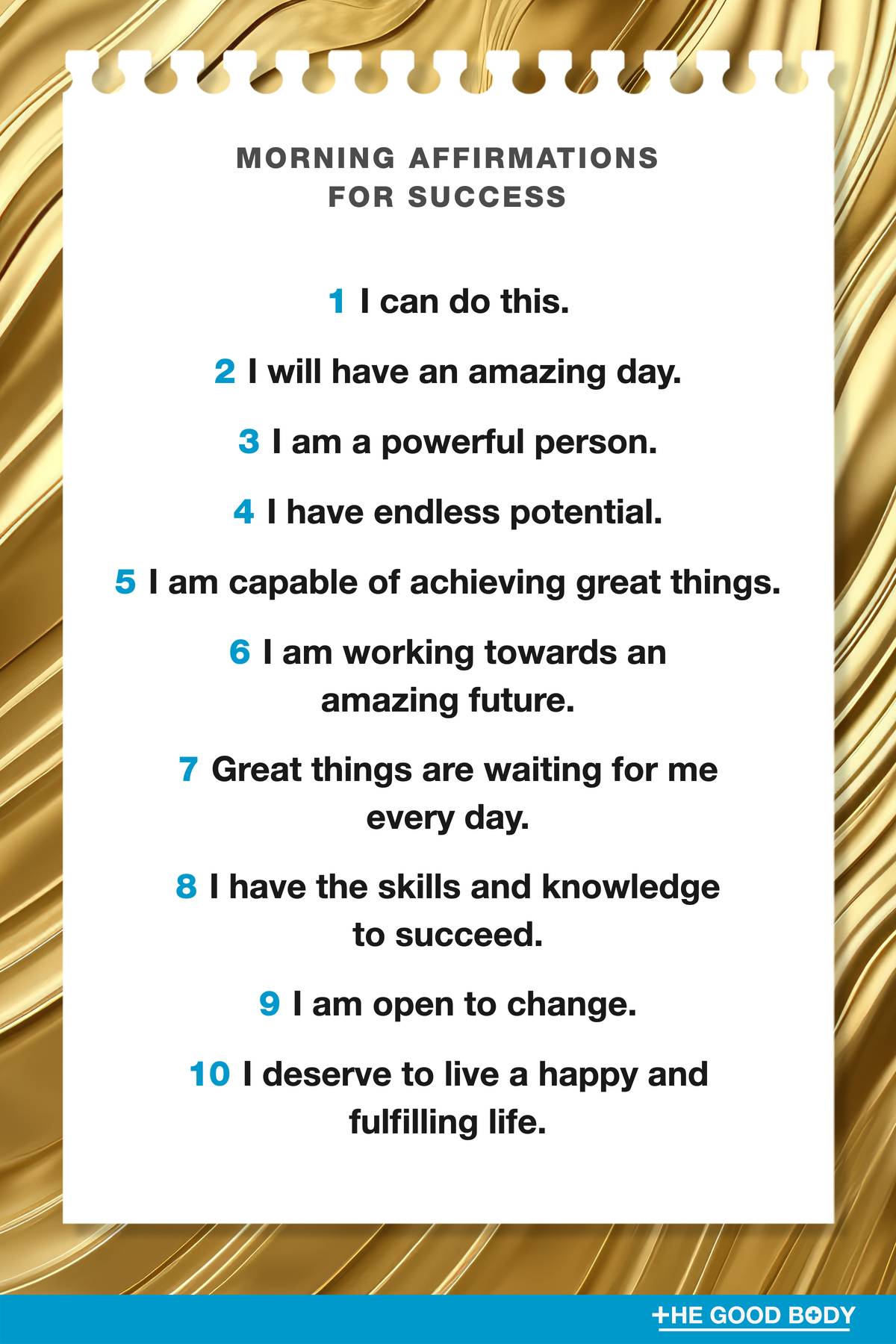
Credit: www.thegoodbody.com
Practical Tips To Make Affirmations A Habit
Building a new habit takes time. Here’s how to make affirmations part of your daily life:
- Attach to an existing routine: Repeat your affirmations right after brushing your teeth or before you check your phone.
- Set reminders: Use your phone to remind you to say your affirmations.
- Pair with music or movement: Repeat affirmations while walking, stretching, or listening to uplifting music.
- Share with a friend: Practice affirmations together for accountability.
- Record your voice: Listen to your affirmations during your commute.
Small changes like these can make affirmations automatic and effective.
Dealing With Setbacks Using Affirmations
No path to success is smooth. You will face setbacks. Affirmations can help you recover faster and stay motivated.
For example, after a failure, say:
- I learn from every experience.
- I am resilient and bounce back quickly.
- Every setback is a setup for a comeback.
These phrases shift your focus from the problem to the solution. Over time, you’ll notice you recover faster and keep moving forward.
Affirmations Vs. Visualization Vs. Goal Setting
All three are powerful success tools, but they serve different purposes. Here’s a quick comparison:
| Tool | Main Purpose | How to Use | Best For |
|---|---|---|---|
| Affirmations | Change mindset, build confidence | Repeat positive statements daily | Overcoming self-doubt, building habits |
| Visualization | Picture success in detail | Imagine achieving goals with emotion | Motivation, reducing anxiety |
| Goal Setting | Create clear targets | Write specific, measurable goals | Planning and tracking progress |
Using all three together gives you a strong mental foundation for success.
Are Affirmations Always Effective?
Affirmations are not a cure-all. Some people see quick results, while others take longer. The key factors are:
- Consistency: Daily repetition matters.
- Belief: You need to feel your affirmation is possible.
- Action: Words must lead to new habits or steps.
If you struggle with deep self-doubt or negative beliefs, consider combining affirmations with other tools such as journaling, therapy, or coaching. Remember, affirmations are just one part of personal growth.
Where To Find More Affirmations
There are many books, podcasts, and websites that share new affirmations and advice. For example, the Wikipedia page on Affirmations explains the history and science behind these powerful statements.
You can also create a “success affirmation journal” where you write new phrases that inspire you. Over time, you’ll discover which statements give you the most energy and motivation.
Frequently Asked Questions
What Is The Best Time Of Day To Say Success Affirmations?
The best time is when your mind is quiet and open—usually right after waking up and before going to bed. These moments help your brain absorb new ideas. However, you can also use affirmations before important events or when you feel stressed.
How Long Does It Take To See Results From Affirmations?
Some people notice a mindset shift in a few days. For most, it takes several weeks of daily repetition. The key is consistency. Combine affirmations with action, and you’ll see bigger changes over time.
Can Affirmations Help With Anxiety Or Fear Of Failure?
Yes, affirmations can reduce anxiety by focusing your mind on positive outcomes and abilities. For example, “I am calm and in control” helps during stressful situations. But for deep anxiety, combine affirmations with other tools like breathing exercises or professional help.
How Do I Know If My Affirmation Is Working?
Notice changes in your thoughts, feelings, and actions. If you feel more confident and motivated, your affirmation is working. You can also keep a journal to track progress. If you see no change, try adjusting your affirmation to make it more believable or relevant.
Can I Use Affirmations In My Native Language?
Absolutely. The most important thing is that you understand and believe your affirmation. Using your native language can make the message stronger. You can also translate powerful affirmations into English as your skills improve.
Success is a journey, not a one-time event. The best affirmations for success are those you use with belief and action. With daily practice, you can build a mindset that sees possibilities instead of problems. Over time, small changes in your thinking lead to big results in your life.
Whether you are starting a new project, aiming for a promotion, or building better habits, affirmations can be a trusted tool on your path to success.

Credit: www.thegoodbody.com
