

What Are Daily Affirmations For: Benefits and How to Use Them
What Are Daily Affirmations For
Life can sometimes feel overwhelming. Stress, doubt, and negative thoughts can pile up. Many people search for simple ways to boost their mood, improve focus, and feel more confident. One practical tool that’s gained a lot of attention is the use of daily affirmations.
Daily affirmations are positive statements you repeat to yourself, often every morning or night. The goal is to shape your mind, challenge negative thinking, and encourage a better outlook on life. But what are daily affirmations really for? Why do so many people use them?
And do they actually work?
This article explores the world of daily affirmations. You’ll discover how they help, when to use them, how to create your own, and the science behind their effects. Whether you’re new to affirmations or want to deepen your practice, you’ll find clear answers and practical tips here.
Understanding Daily Affirmations
At their core, daily affirmations are short, positive phrases. People use them to boost self-belief, set intentions, and create mental habits that support their goals. You might see affirmations like “I am enough,” “I choose happiness,” or “I am capable of great things.”
Affirmations are not magic. They don’t instantly solve problems. Instead, they help train your mind to focus on your strengths and possibilities. Over time, these repeated statements can shift your thoughts and feelings in a positive direction.
How Daily Affirmations Work
The human brain is always learning. When you repeat thoughts, your brain treats them as important information. This is called neuroplasticity—your brain’s ability to rewire itself. Affirmations use this ability by reinforcing positive ideas.
For example, if you often think, “I can’t do this,” your mind starts to believe it. But if you say, “I am learning and growing every day,” you teach your brain to expect progress, not failure.
Common Areas Where Affirmations Help
People use affirmations in many parts of life. Some common examples:
- Self-confidence: “I am worthy of love and respect.”
- Stress relief: “I am calm and in control.”
- Career goals: “I am successful in my work.”
- Relationships: “I attract healthy, caring people.”
- Health: “My body is strong and healthy.”
You can use affirmations for almost any goal or challenge.
The Purpose Of Daily Affirmations
Many people wonder, “What are daily affirmations for?” The answer is simple: they support a healthier, more positive mindset. But there’s more to it. Let’s look closer at the main reasons people use affirmations every day.
1. Building Self-esteem
Low self-esteem can hold you back in work, relationships, and personal growth. Daily affirmations can help rebuild self-worth by challenging negative self-talk. When you repeat positive phrases, you remind yourself of your strengths and potential.
For example, saying “I am enough” every day can slowly replace the thought, “I’m not good enough. ” Over time, this shift helps you feel more confident and capable.
2. Reducing Stress And Anxiety
Stressful thoughts can become a habit. Affirmations give you a tool to break the cycle. When anxiety rises, repeating calming statements like “I am safe and calm” can help your body relax.
Research shows that positive self-talk lowers stress hormones and can even improve health. Many therapists recommend affirmations as part of stress management plans.
3. Focusing On Goals
It’s easy to lose sight of your goals in daily life. Affirmations keep your intentions clear. By saying “I am moving toward my dreams,” you remind yourself to take action.
Athletes, students, and business leaders often use affirmations to stay motivated. This mental focus increases your chances of reaching your goals.
4. Shifting Negative Thought Patterns
Negative thoughts are powerful. They can become automatic and hard to change. Affirmations help you notice and replace these patterns. Instead of thinking, “I always mess up,” you might say, “I learn from my mistakes and grow.”
This doesn’t mean ignoring problems. It means choosing thoughts that help you move forward, not hold you back.
5. Creating A Positive Habit
Affirmations work best when used regularly. Making them part of your daily routine turns positive thinking into a habit. Just like brushing your teeth keeps your mouth healthy, affirmations keep your mind strong.
Science And Research Behind Daily Affirmations
Many people ask if affirmations are just wishful thinking or if there’s real science behind them. Research in psychology and neuroscience shows that affirmations can have real effects, but results depend on how you use them.
What Studies Say
- A study from Carnegie Mellon University found that self-affirmation can reduce stress and improve problem-solving under pressure.
- Research published in the journal Social Cognitive and Affective Neuroscience showed that affirmations activate the brain’s reward centers—the same areas that light up when we experience something enjoyable.
- Studies also show that affirmations work best when they are believable. If you say something too far from your current beliefs, your mind might reject it.
When Affirmations Work Best
- Personal relevance: Affirmations should matter to you. Generic phrases have less effect.
- Consistency: Repeating affirmations daily is key.
- Action-based: Combining affirmations with real steps makes them stronger.
Limitations And Misunderstandings
Affirmations are not a cure-all. They can’t replace therapy or solve mental health issues alone. Some people think affirmations mean ignoring problems, but that’s not true. Affirmations help you face challenges with a better mindset, not avoid them.
How To Create Effective Daily Affirmations
Not all affirmations are equally powerful. The most effective ones are clear, personal, and easy to remember. Here’s how you can create your own affirmations that work.
1. Make Them Positive
Focus on what you want, not what you want to avoid. Instead of “I am not anxious,” say, “I am calm and confident. ”
2. Use Present Tense
Speak as if the affirmation is already true. “I am strong” is more powerful than “I will be strong. ”
3. Keep Them Simple
Short, clear phrases are easier to remember and repeat. “I am worthy” is better than a long, complicated sentence.
4. Be Specific
Tailor your affirmation to your needs. Instead of “I am successful,” try “I am growing in my career each day. ”
5. Believe In Your Words
Choose affirmations you can accept. If “I love myself fully” feels untrue, start with “I am learning to accept myself. ”
6. Repeat Consistently
Say your affirmations every day, ideally at the same time. Morning and night routines work well for many people.
Here’s a quick comparison of effective vs. less effective affirmations:
| Less Effective | More Effective |
|---|---|
| I will not be nervous | I am calm and prepared |
| I want to be successful | I am taking steps toward success |
| I hope to be healthy | I care for my body every day |

Credit: aapsychiatry.com
Practical Ways To Use Daily Affirmations
It’s one thing to know about affirmations. It’s another to use them in your life. Here are practical methods to make affirmations part of your routine.
Morning Routine
Start your day with positive statements. Stand in front of a mirror, take a deep breath, and repeat your affirmations out loud. This sets the tone for your whole day.
Journaling
Write your affirmations in a notebook. Many people find that writing helps them focus and remember the words better.
Digital Reminders
Set your phone or computer to show your affirmation as a daily notification. This keeps your mind on track, even on busy days.
Visual Cues
Place sticky notes with affirmations where you’ll see them often—on your bathroom mirror, refrigerator, or desk.
Meditation
Combine affirmations with deep breathing or meditation. Close your eyes and repeat your phrase slowly, focusing on each word.
Audio Recordings
Record yourself saying your affirmations and listen to them during your commute or while exercising.
Here’s a comparison of different affirmation methods:
| Method | Best For | Tips |
|---|---|---|
| Mirror Practice | Building confidence | Look into your eyes as you speak |
| Journaling | Deep focus | Write slowly and reflect |
| Digital Reminders | Busy schedules | Set alarms or home screen notes |
| Visual Cues | Frequent reminders | Use bright colors for sticky notes |
| Meditation | Reducing stress | Pair with deep breathing |
Examples Of Daily Affirmations
Looking for inspiration? Here are some examples for different situations. You can use these or adapt them to fit your needs.
For Self-confidence
- “I trust myself to make good choices.”
- “I am proud of who I am becoming.”
- “I can handle anything that comes my way.”
For Stress Relief
- “I am safe and supported.”
- “I choose peace over worry.”
- “I let go of what I cannot control.”
For Success
- “I am focused and persistent.”
- “Each day, I move closer to my goals.”
- “I am open to new opportunities.”
For Health
- “I honor my body and mind.”
- “I make healthy choices each day.”
- “I am grateful for my strength.”
For Relationships
- “I attract kindness and respect.”
- “I communicate with love and clarity.”
- “I deserve healthy, happy relationships.”
Common Mistakes And How To Avoid Them
Many people try affirmations but give up quickly. Why? They often make simple mistakes that limit results.
1. Choosing Unrealistic Statements
If your affirmation feels false, your mind will resist. Start with phrases that are believable but still positive. For example, instead of “I am a millionaire,” try “I am learning to manage money wisely. ”
2. Inconsistent Practice
Affirmations need regular repetition. If you only use them once in a while, results will be weak. Make them part of your daily routine.
3. Ignoring Negative Emotions
Affirmations are not about denying feelings. If you feel sad or anxious, notice those feelings first. Then use affirmations to guide your mind gently toward hope and confidence.
4. Using Generic Phrases
Personalize your affirmations. “I am happy” is less effective than “I am finding joy in my daily life. ”
5. Expecting Instant Results
Change takes time. Be patient. Affirmations shape your mindset slowly, just like exercise builds muscles.
Here’s a summary of common mistakes and solutions:
| Mistake | Solution |
|---|---|
| Unrealistic statements | Choose believable phrases |
| Inconsistent use | Set a daily affirmation time |
| Ignoring emotions | Acknowledge feelings first |
| Generic phrases | Make affirmations personal |
| Wanting quick results | Stay patient and persistent |
The Role Of Affirmations In Different Cultures
Affirmations are not new. Many cultures have used positive statements, mantras, and prayers for centuries. While the language might change, the core idea remains: words shape thoughts, and thoughts shape actions.
Eastern Practices
In traditions like Buddhism and Hinduism, mantras are repeated for peace and focus. These are similar to affirmations, though often spiritual in nature.
Western Psychology
Modern psychology uses techniques like cognitive behavioral therapy (CBT), which teaches people to replace negative thoughts with positive ones. Affirmations fit well within this approach.
Everyday Life
Even outside formal practices, parents, teachers, and leaders use affirming words to encourage others. “You can do it,” “I believe in you,” and “You are strong” are all real-life affirmations.
Who Can Benefit From Daily Affirmations?
Affirmations are not just for one type of person. Almost anyone can use them, from students and workers to athletes and parents.
Students
Affirmations help students reduce test anxiety and build confidence. Phrases like “I am prepared” or “I can learn anything” can help before exams.
Professionals
In the workplace, affirmations support focus, leadership, and stress management. Leaders often use them to stay calm under pressure.
Athletes
Sports psychology often includes affirmations. “I am strong and fast,” “I stay focused under pressure,” and “I recover quickly” are common among athletes.
Parents And Caregivers
Raising children is challenging. Affirmations help parents stay patient and positive: “I am doing my best,” “I am a loving parent.”
People Facing Challenges
Anyone going through a hard time—illness, job loss, or grief—can use affirmations for hope and resilience. “I am healing,” “I will get through this,” and “I am not alone” are comforting statements.
Advanced Tips For Deepening Your Practice
Once you’re comfortable with basic affirmations, try these advanced strategies for even greater effect.
Pair With Visualization
Close your eyes and imagine your affirmation as real. If you say, “I am confident,” picture yourself speaking with clarity and standing tall.
Link Affirmations To Actions
Tie your affirmations to daily habits. For example, after you brush your teeth, repeat your affirmation. This builds a strong, automatic connection.
Share With Others
Saying affirmations with a friend or family member can increase support and accountability. It also spreads positivity.
Track Your Progress
Keep a journal of your affirmations and note changes in your mood, actions, or results. This helps you see your growth and adjust your practice.
Adjust As You Grow
As your life changes, update your affirmations. What worked last year may not fit now. Stay flexible and choose phrases that match your current needs.
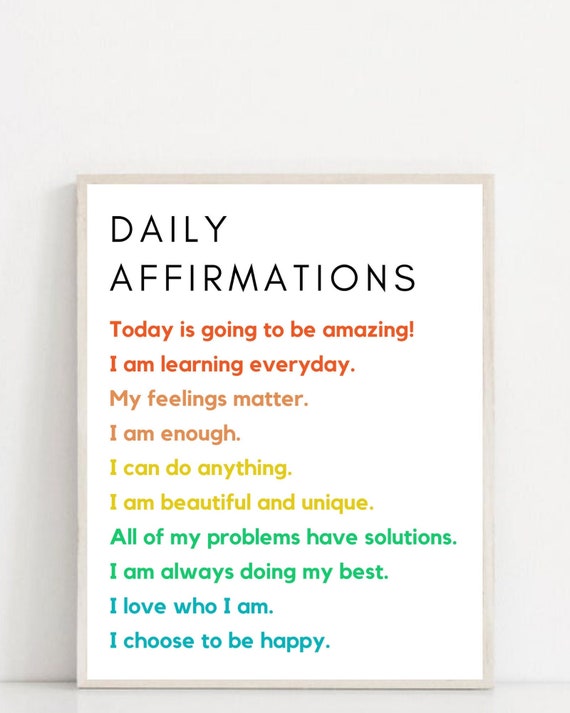
Credit: www.etsy.com
Real-life Stories: How Affirmations Changed Lives
Many people have shared their experiences with daily affirmations. Here are a few stories that show the real impact.
Overcoming Social Anxiety
Maria, a college student, struggled to speak in class. She started saying, “I am comfortable sharing my ideas. ” At first, it felt strange. But after a month, she noticed less fear and more confidence. She began raising her hand and joining group discussions.
Recovering From Burnout
James, a manager, felt exhausted and negative about his job. He started repeating, “I am making a difference, one step at a time. ” This small shift helped him focus on small wins. Over time, he regained energy and found more satisfaction at work.
Building Healthy Habits
Samantha wanted to exercise more but felt unmotivated. She used the affirmation, “I enjoy moving my body every day. ” She placed it on her fridge. Gradually, exercise became something she looked forward to, not a chore.
These stories show that affirmations can create real change, but only with steady practice and belief.
Are Affirmations For Everyone?
Affirmations are simple, but they’re not for everyone. Some people find them unhelpful or uncomfortable. That’s okay. If affirmations don’t work for you, other methods like journaling, therapy, or meditation might fit better.
However, most people can benefit if they choose the right affirmations and use them consistently. The key is to stay open, patient, and gentle with yourself.

Credit: livingasweeterlife.com
Where To Find More About Affirmations
If you want to learn more about the science, examples, or history of daily affirmations, check out resources from trusted psychology sites. For a deeper look, visit Wikipedia: Affirmations.
Frequently Asked Questions
What Are Daily Affirmations Used For?
Daily affirmations are used to build a positive mindset, boost self-confidence, reduce stress, and help you stay focused on your goals. They work by repeating positive statements to shape your thinking and encourage helpful habits.
How Long Does It Take For Affirmations To Work?
Results vary. Some people feel a difference in a few days, but for most, it takes weeks or months of regular practice. Consistency and belief in your affirmations are key for seeing results.
Can Affirmations Help With Anxiety?
Yes, affirmations can help reduce anxiety by shifting your focus from worry to calm, positive thoughts. However, they work best alongside other tools like breathing exercises, therapy, or mindfulness if anxiety is strong.
Should I Say My Affirmations Out Loud Or In My Head?
Both methods can work. Saying affirmations out loud often feels more powerful because you hear your own voice. But repeating them silently is also effective, especially in public or quiet places.
Do I Need To Believe My Affirmation For It To Work?
It helps if you believe your affirmation, but you don’t need perfect faith. Start with phrases that feel believable, and build from there. Over time, your belief will grow as you see changes in your thoughts and actions.
Daily affirmations are a simple tool with the power to change how you see yourself and your life. When used wisely, they can support your journey toward greater confidence, peace, and success. The key is regular practice, patience, and kindness toward yourself as you grow.
