

Morning Affirmation to Start the Day: Boost Your Mindset Fast
Morning Affirmation To Start The Day
Starting your day with a clear mind and positive attitude can change the whole course of your life. Many people wake up feeling anxious, tired, or stressed about what lies ahead. But there's a simple tool that can help you feel confident and ready: morning affirmations. These are short, powerful statements you say to yourself, often aloud, to boost your mood and shape your mindset. People from all walks of life use affirmations—from athletes to business leaders—to tap into their best selves.
You might wonder if repeating words really works. Science shows that positive self-talk can improve mental health, focus, and even performance at work or school. By starting your day with affirmations, you set the tone for everything that follows. You can face challenges with more courage, enjoy small wins, and feel less overwhelmed.
In this article, you’ll learn what morning affirmations are, how they work, and how to create your own. You’ll also discover practical tips, examples, and answers to common questions. Whether you’re new to affirmations or want to deepen your practice, this guide will help you build a morning routine that supports your goals and well-being.
What Are Morning Affirmations?
Morning affirmations are positive statements you say, think, or write soon after waking up. Their main purpose is to guide your thoughts, shift your attitude, and help you focus on what matters. Unlike casual thinking, affirmations are intentional. You choose them based on what you want to feel or achieve.
For example, someone might say: “I am confident and ready for today.” Another person may use: “Today, I choose happiness.” These phrases work best when you repeat them with feeling. Some people use a mirror, others write them in a journal, and some simply pause and say them silently.
The reason morning affirmations are powerful is that your mind is most open when you first wake up. You haven’t yet faced the stress or distractions of the day. Your brain is also naturally more relaxed, which makes positive suggestions stick better.
By starting your day with affirmations, you train your mind to notice good things, handle problems calmly, and believe in your abilities.
How Do Morning Affirmations Work?
Morning affirmations work through a mix of psychology and brain science. The process is simple, but the effects can be deep.
- Changing Thought Patterns: Your brain is shaped by repeated thoughts. If you often think “I can’t do this,” your mind starts believing it. Affirmations interrupt negative patterns and replace them with positive ones.
- Boosting Self-Esteem: When you say positive statements daily, you build confidence. Studies show that self-affirmation can protect against stress and improve resilience.
- Activating the Reticular Activating System (RAS): The RAS is a part of your brain that filters information. When you focus on a positive idea, your RAS helps you notice things that support it. For example, if your affirmation is “I am productive,” you start seeing chances to be productive during the day.
- Supporting Goal Achievement: Affirmations help you see yourself reaching your goals. This mental rehearsal can make you more likely to take action and succeed.
Scientific Evidence
Research has shown that affirmations can reduce stress, improve problem-solving, and support mental health. One study found that people using self-affirmation felt less threatened by challenges and performed better. Another showed that positive self-talk boosted feelings of control and motivation.
While affirmations are not magic, they are a proven tool for shaping attitude and behavior.

Credit: interiorloveaffair.com
Benefits Of Morning Affirmations
People use morning affirmations for many reasons. Here are some of the most common benefits:
- Improved Mood: Affirmations can help you start the day feeling happier and more optimistic.
- Reduced Stress: Positive self-talk lowers anxiety and helps you handle problems calmly.
- Greater Confidence: Repeating affirmations builds belief in yourself and your abilities.
- Better Focus: Affirmations can help you pay attention to what matters and ignore distractions.
- Increased Motivation: When you affirm your goals, you feel more driven to work toward them.
- Healthier Relationships: By practicing kindness and gratitude, you improve your interactions with others.
Let’s look at some practical examples and real-life stories.
Real-life Example
Maria, a teacher, starts her day with: “I am patient and inspiring.” She noticed that after a few weeks, her stress levels dropped. She became more patient with her students, and her classroom atmosphere improved. Her affirmation helped her focus on the qualities she wanted to show, even during tough moments.
Hidden Benefits Most People Miss
- Physical Health: Positive affirmations can lead to healthier choices. When you believe in your worth, you are more likely to eat well, exercise, and take care of yourself.
- Long-Term Growth: Affirmations don’t just change your mood for one day. Over time, they help you build habits and attitudes that support lasting success.
How To Create Effective Morning Affirmations
Not all affirmations are equally powerful. The way you craft them matters. Here’s a practical guide to help you create affirmations that work for you:
- Keep It Positive: Use words that focus on what you want, not what you fear. Say “I am confident” instead of “I am not scared.”
- Use Present Tense: Affirmations work best when you speak as if your goal is already true. For example: “I am healthy,” not “I will be healthy.”
- Be Specific: Generic affirmations feel less personal. Instead of “I am successful,” try “I handle challenges with grace.”
- Make It Believable: Choose statements you can accept, even if they stretch you. If “I am rich” feels false, try “I am improving my finances every day.”
- Add Emotion: Include words that stir feelings. “I am excited for new opportunities” is more powerful than “I will get opportunities.”
Steps To Write Your Own Affirmations
- Identify an area of life where you want change (work, health, relationships).
- Think about your ideal state in that area.
- Write a statement that reflects this goal in positive, present tense.
- Repeat your affirmation daily, ideally in the morning.
Common Mistakes To Avoid
- Using negative words (“I am not tired” instead of “I am energized”).
- Being too vague (“I want to be better” instead of “I am learning and growing”).
- Forgetting to repeat your affirmation regularly.
- Choosing statements that feel impossible or fake.
Examples Of Powerful Morning Affirmations
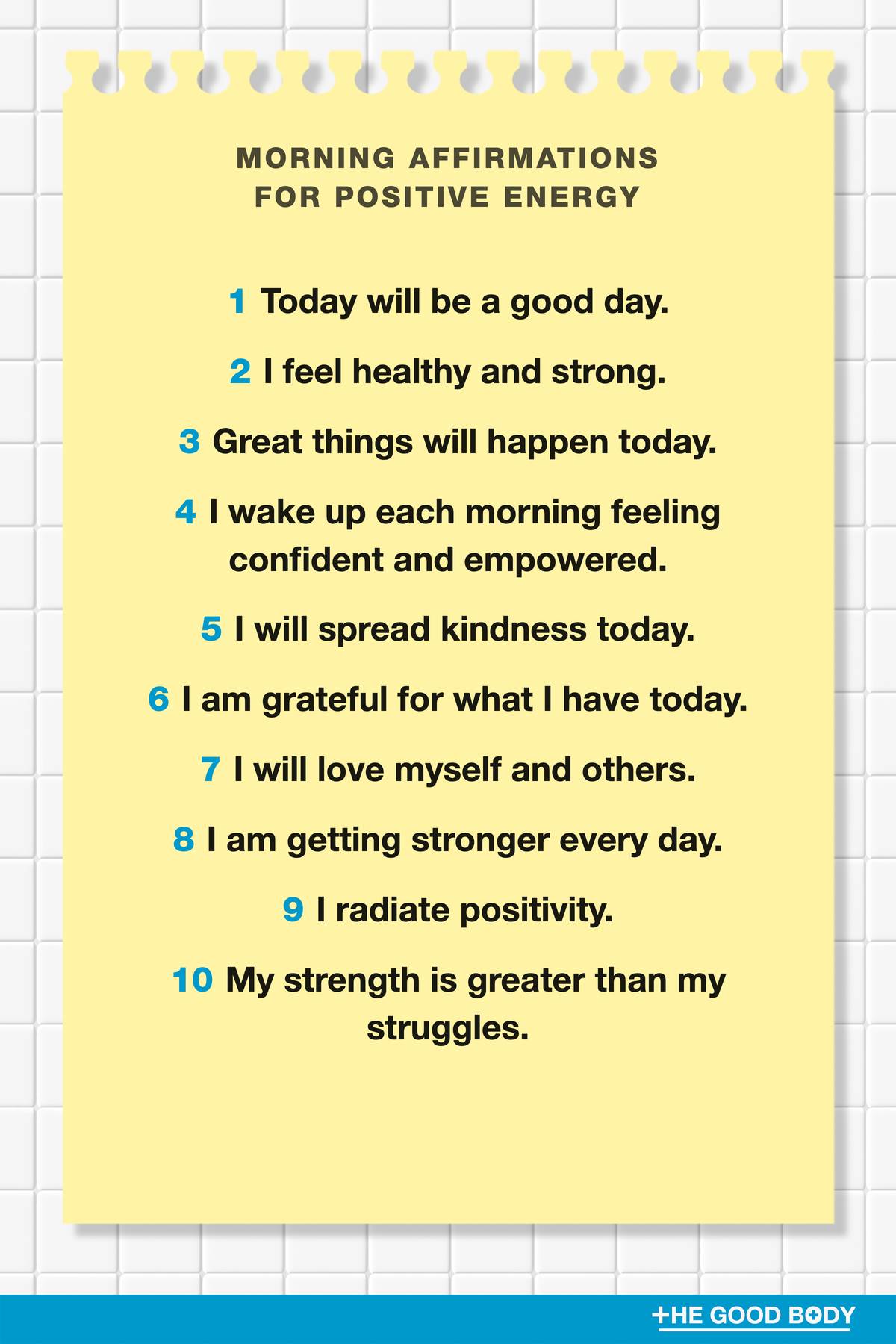
Here are some sample affirmations you can use or adapt:
- “I am ready for whatever today brings.”
- “I am calm and focused.”
- “My mind is clear and sharp.”
- “I am grateful for this new day.”
- “I trust myself to make good decisions.”
- “I am strong, capable, and resilient.”
- “I attract positive energy.”
- “I am worthy of love and respect.”
- “I choose happiness and peace.”
- “Today, I will do my best.”
You can customize these to fit your needs. For example, if you have a big meeting, use: “I am confident and prepared.” If you want to improve your health, try: “I care for my body and mind.”
Morning Affirmation Techniques
There are several ways to practice morning affirmations. Each method has its own strengths. Here’s a comparison to help you choose:
| Technique | How It Works | Best For |
|---|---|---|
| Speaking Aloud | Say affirmations out loud, often in front of a mirror | Building confidence and self-image |
| Writing | Write affirmations in a journal each morning | Clarifying goals and tracking progress |
| Listening | Play recorded affirmations or use apps | Busy mornings or multitasking |
| Visualization | Picture yourself living your affirmation | Boosting motivation and focus |
Practical Tips For Each Technique
- Speaking Aloud: Look at yourself in the mirror. Speak slowly and clearly. Stand tall and use confident body language.
- Writing: Use a notebook dedicated to affirmations. Write the same affirmation several times, or create new ones each day.
- Listening: Choose recordings with a calm voice and background music. Many apps offer customizable affirmations.
- Visualization: Close your eyes and imagine your affirmation as real. Feel the emotions and notice the details.
Credit: www.thegoodbody.com
Building A Morning Affirmation Routine
Consistency is key. To make affirmations work, you need a routine. Here’s a simple plan:
- Set a Time: Choose a moment when you’re not rushed—right after waking, during breakfast, or before leaving home.
- Prepare Your Space: Find a quiet spot. You can use your bedroom, bathroom, or any peaceful area.
- Choose Your Affirmation: Pick one or two statements to focus on each day.
- Repeat: Say, write, or listen to your affirmation for 2–5 minutes.
- Reflect: Pause and notice how you feel. If you sense doubt, adjust your affirmation.
- Track Progress: Keep a journal or use an app to record your affirmations and results.
Example Morning Routine
- Wake up and sit quietly for one minute.
- Say: “I am grateful for this day.”
- Look in the mirror and repeat: “I am confident and ready.”
- Write your affirmation in a journal.
- Take three deep breaths and picture your day going well.
Morning Affirmations Vs. Other Positive Practices
You might wonder how morning affirmations compare to other habits like meditation, gratitude journaling, or goal setting. Here’s a comparison:
| Practice | Main Purpose | Benefits | Time Needed |
|---|---|---|---|
| Morning Affirmations | Shape thoughts and beliefs | Boost mood, confidence, focus | 2–5 minutes |
| Meditation | Calm mind and body | Reduce stress, improve attention | 5–20 minutes |
| Gratitude Journaling | Appreciate good things | Increase happiness, resilience | 5–10 minutes |
| Goal Setting | Plan actions and targets | Increase motivation, clarity | 10–15 minutes |
Morning affirmations work well with other practices. For example, you can meditate first, then say your affirmation. Or you can write your affirmation in a gratitude journal.
Combining Practices For Maximum Impact
- Start with a few minutes of meditation to calm your mind.
- Write three things you are grateful for.
- Say your morning affirmation aloud.
- Review your goals for the day.
This combination helps you feel centered, motivated, and focused.
Customizing Affirmations For Different Goals
Morning affirmations can be tailored to fit many life goals. Here are some examples:
For Work And Career
- “I am organized and productive.”
- “I handle challenges calmly and professionally.”
- “My skills are valuable.”
For Health And Wellness
- “I make healthy choices today.”
- “I respect my body and mind.”
- “I am energetic and strong.”
For Relationships
- “I listen with compassion.”
- “I am patient and understanding.”
- “I attract positive people.”
For Personal Growth
- “I am learning every day.”
- “I embrace new experiences.”
- “I am open to change.”
You can mix and match affirmations based on your needs. Some people keep a list and pick one each morning. Others use the same affirmation for a week or month to build deeper belief.
Data On Morning Affirmation Effectiveness
Many people ask if affirmations really work. Research and surveys show positive results.
- A survey of over 1,000 adults found that those who used morning affirmations felt 20% more optimistic compared to those who didn’t.
- In another study, participants who practiced daily affirmations reported lower stress levels and higher self-esteem after several weeks.
- Athletes who used affirmations before training saw improved performance and focus.
While results vary, the data suggest that affirmations are a low-risk, high-reward habit. They are easy to start, cost nothing, and can be tailored to any goal.
Non-obvious Insights
- Small Habits Lead to Big Changes: Many people think affirmations must be grand or dramatic. In reality, simple statements repeated daily can create lasting mindset shifts.
- Consistency Beats Perfection: Some days your affirmation might feel forced or awkward. That’s normal. The key is to keep practicing, even when it feels strange.
Common Challenges And How To Overcome Them
When starting morning affirmations, you might face some hurdles. Here’s how to handle them:
- Feeling Silly: It’s normal to feel awkward at first. Try starting with silent affirmations or writing them down. Over time, speaking aloud will feel more natural.
- Doubting Results: You may not see changes right away. Give yourself at least two weeks of daily practice. Notice small shifts in mood or attitude.
- Forgetting to Practice: Set a reminder or pair affirmations with another habit (like brushing your teeth).
- Choosing the Right Words: If your affirmation feels false, adjust it. Instead of “I am a millionaire,” try “I am building my financial future.”
Morning Affirmations For Children And Teens
Affirmations aren’t just for adults. Kids and teens can benefit too. Positive self-talk helps build self-esteem, resilience, and social skills.
Sample Affirmations For Young People
- “I am a good friend.”
- “I try my best every day.”
- “I am smart and creative.”
- “I can handle new challenges.”
Parents and teachers can help children practice affirmations by making it a fun part of the morning routine. For example, you can create affirmation cards, sing them, or write them on sticky notes.
Tips For Success With Kids
- Use simple language and short phrases.
- Make it playful—use songs, games, or drawings.
- Praise effort, not just results.
The Role Of Community And Support
Morning affirmations can be more powerful when shared. Some people join groups or online communities to practice together. Sharing affirmations with a friend or family member can help you stay motivated.
- Buddy System: Find a friend to share daily affirmations.
- Social Media: Join online groups focused on positive mindset.
- Workplace Practices: Some teams start meetings with a group affirmation.
Example Of Community Impact
In a small office, employees began each day by sharing a group affirmation: “We support each other and grow together.” Over time, trust and teamwork improved. People felt more connected and motivated.
Measuring Progress With Morning Affirmations
Tracking your results can help you see the impact of affirmations. Here’s a simple tracking table:
| Date | Affirmation Used | Mood After | Noticed Changes |
|---|---|---|---|
| Monday | I am calm and focused | Relaxed | Handled stress better |
| Tuesday | I am grateful for this day | Happy | Felt more positive |
| Wednesday | I trust myself | Confident | Made good decisions |
Review your notes weekly. Look for patterns in mood and performance. Adjust your affirmations as needed.
Using Technology To Enhance Morning Affirmations
Technology can make affirmations easier. Here are some options:
- Apps: Many apps offer daily reminders, guided affirmations, and tracking features.
- Smart Speakers: Set up a morning routine that plays your chosen affirmation.
- Online Communities: Connect with others and share your progress.
One popular app lets you record your own affirmations and play them each morning. You can also use a digital journal to track your mood and goals.
Frequently Asked Questions
What Is The Best Time To Practice Morning Affirmations?
The best time is soon after waking up, before your mind becomes busy with tasks. Many people practice affirmations during breakfast or while getting ready. Choose a time when you can focus and feel relaxed.
How Many Affirmations Should I Use Each Morning?
It’s best to start with one or two affirmations. Too many can feel overwhelming or lose impact. As you get comfortable, you can add more or rotate different statements based on your goals.
Can Morning Affirmations Help With Anxiety Or Stress?
Yes, affirmations can reduce anxiety and stress by shifting your focus to positive thoughts. Combine affirmations with breathing exercises or meditation for greater effect.
Do I Need To Believe My Affirmation For It To Work?
You don’t have to fully believe your affirmation at first. The practice helps build belief over time. Choose statements that feel possible, even if they stretch your comfort zone.
Are There Scientific Studies Supporting Morning Affirmations?
Yes, studies show that self-affirmation can boost confidence, reduce stress, and improve problem-solving. You can learn more from Psychology Today, which covers research on positive self-talk and affirmations.
Starting your day with morning affirmations is a simple, effective way to build a positive mindset. Whether you speak, write, or visualize your affirmations, the key is consistency. Over time, you’ll notice more confidence, focus, and resilience. The practice fits any lifestyle, takes only a few minutes, and costs nothing.
Don’t wait for a perfect moment—begin tomorrow morning. Your mind, mood, and future will thank you.
Credit: motivateus.com
