

How to Use Affirmation to Transform Your Mindset Fast
How To Use Affirmation
Many people talk about using affirmations to improve their lives, but not everyone understands how this simple method can bring real change. At first, the idea of repeating positive statements might sound too easy. You might wonder: Can saying a few words really help you feel better, boost your confidence, or reach your goals? The answer is yes—if you know how to use affirmation the right way.
Affirmations are more than just positive thinking or wishful words. They are deliberate, focused statements that help you shape your thoughts and actions. Science shows that self-affirmation can change how you see yourself, manage stress, and even improve performance. But to see these benefits, you need more than just a list of nice words.
You need clear steps, a plan, and a little patience.
This guide will walk you through everything you need to know about using affirmations effectively. Whether you are new to affirmations or want to get better results, you will find practical advice, examples, and answers to common questions. By the end, you will understand not only what to say, but also why, how, and when to use affirmations for the best results.
What Are Affirmations?
Affirmations are simple, positive statements that you repeat to yourself to encourage a certain way of thinking or behaving. They are not magic spells, but they work by guiding your mind to focus on what you want to believe or achieve.
For example, saying “I am confident” helps you build self-confidence over time.
Affirmations use the power of self-talk. Everyone talks to themselves, but often these thoughts are negative or critical. Affirmations train your mind to replace these unhelpful thoughts with encouraging ones. Over time, this can change your mood, your actions, and even how you see the world.
Example: Instead of thinking “I always make mistakes,” you say, “I learn and grow from every experience.”
Non-obvious insight: The most powerful affirmations are not just positive—they are believable to you right now. If you do not believe the words, your mind will resist them.
Why Use Affirmations?
Affirmations are simple, but their effects can be deep. Here are some proven benefits:
- Reduce Stress: Research shows that self-affirmation can lower stress and help you feel more relaxed.
- Boost Self-Confidence: Repeating positive beliefs about yourself can make you feel more capable.
- Improve Focus: Affirmations help you keep your goals in mind, making it easier to avoid distractions.
- Support New Habits: When you want to change behavior, affirmations can remind you of your intention.
- Enhance Performance: Many athletes and performers use affirmations to improve their mindset before a big event.
Non-obvious insight: Affirmations also work by reducing the power of negative thoughts. They do not just add positive ideas—they can push out the negative ones that hold you back.
How Affirmations Work
Your brain is always looking for patterns and meaning. When you repeat something often, your mind starts to believe it, even if it was not true before. This is called neuroplasticity—the brain’s ability to change and adapt.
When you use affirmations:
- You create new mental pathways.
- You train yourself to notice opportunities instead of problems.
- You start acting in ways that match your positive self-talk.
Practical example: If you say, “I am a good public speaker,” you may begin to notice and remember your speaking successes, not just your mistakes. This builds real confidence.
Types Of Affirmations
There are many kinds of affirmations, each with a different purpose. Here are some common types:
Self-esteem Affirmations
These focus on building a positive self-image.
- “I am worthy of respect.”
- “I value myself and my ideas.”
Goal-oriented Affirmations
These help you stay focused on what you want to achieve.
- “I am committed to my health and fitness.”
- “I finish what I start.”
Emotional Healing Affirmations
These offer comfort and healing during tough times.
- “I am healing and becoming stronger every day.”
- “I forgive myself and move forward.”
Relationship Affirmations
These improve how you connect with others.
- “I attract positive, healthy relationships.”
- “I communicate clearly and kindly.”
Success Affirmations
These support ambition and achievement.
- “I am open to new opportunities.”
- “I am successful in all I do.”
Non-obvious insight: Combining different types of affirmations is often more powerful than sticking to just one. For example, pairing self-esteem and goal-oriented affirmations can support both how you feel and what you do.
How To Create Effective Affirmations
Not all affirmations work equally well. The way you write or choose your affirmation matters. Here is how to make your affirmations more effective:
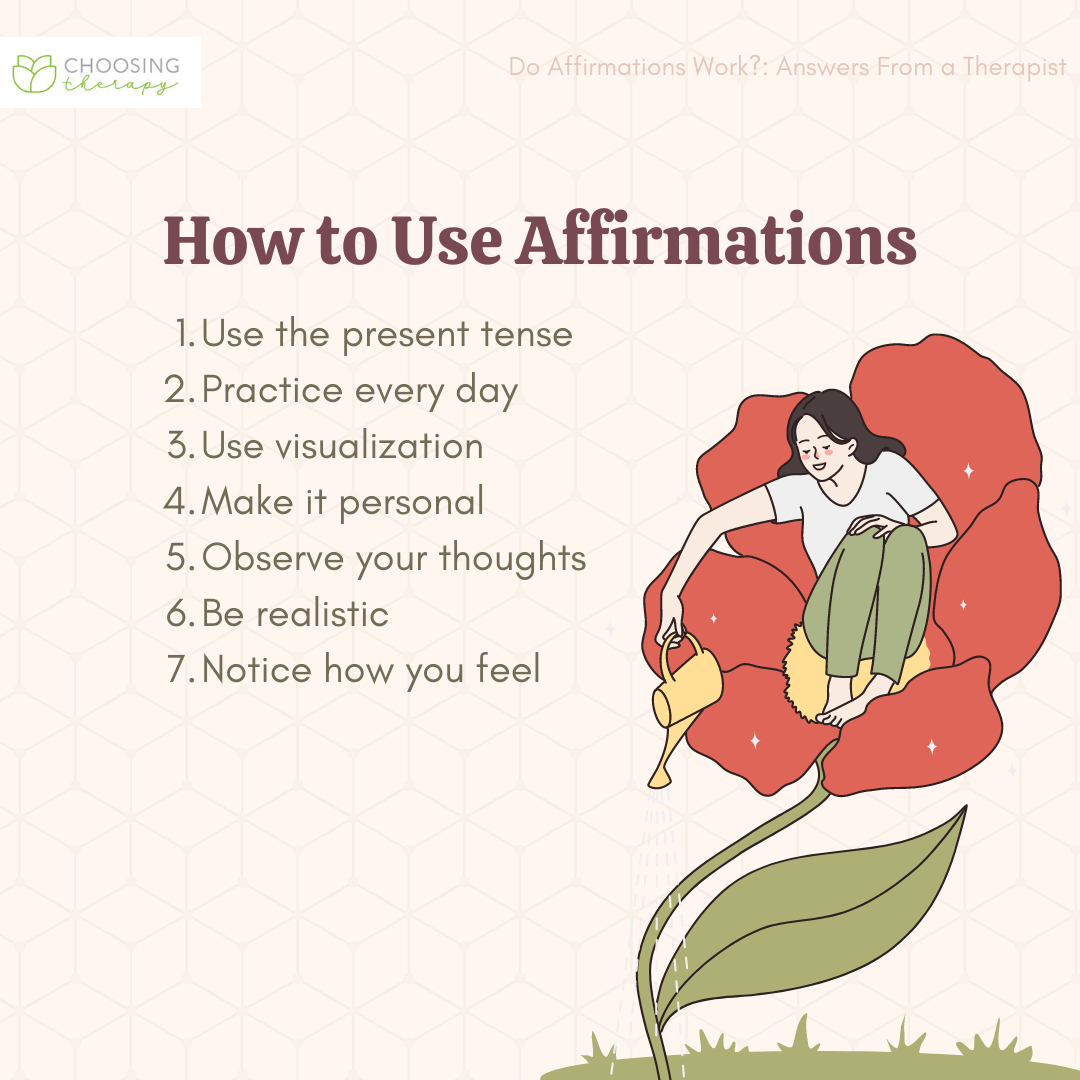
1. Use Present Tense
Affirmations are most powerful when you say them as if they are true now, not in the future.
- Correct: “I am calm and in control.”
- Not as strong: “I will be calm and in control.”
2. Be Positive
Focus on what you want, not what you want to avoid.
- Strong: “I eat healthy foods.”
- Weak: “I don’t eat junk food.”
3. Keep It Simple
Short, clear affirmations are easier to remember and repeat.
- “I am confident.”
- “I trust myself.”
4. Make It Personal
Use “I” or “my” so the affirmation feels like it is truly about you.
- “I am creative.”
- “My ideas are valuable.”
5. Make It Believable
Choose words that you can accept, at least a little. If your affirmation feels too far from your current reality, adjust it.
- If “I am rich” feels wrong, try “I am open to new ways of creating wealth.”
6. Add Emotion
If possible, include how you want to feel.
- “I am excited about my future.”
- “I enjoy learning new things.”
Practical tip: If you struggle to believe your affirmation, add “I am willing to…” or “I am learning to…” at the start.
How To Use Affirmations Daily
Saying an affirmation once is not enough. Real change happens with regular practice. Here are some ways to use affirmations every day:
Morning Routine
Start your day by repeating your affirmations. This sets a positive tone for the rest of your day.
- Say your affirmations out loud while looking in the mirror.
- Write them in a journal each morning.
During Challenges
Use affirmations when you feel stressed, nervous, or negative.
- Before a meeting, say: “I am prepared and capable.”
- If you make a mistake, say: “I learn and grow from every experience.”
With Visualization
Picture yourself acting or feeling the way your affirmation describes.
- As you say, “I am confident,” imagine yourself speaking confidently in public.
Before Sleep
End your day with affirmations to calm your mind.
- Repeat: “I am grateful for today’s experiences,” as you get ready for bed.
On The Go
You can use affirmations anytime—while driving, walking, or waiting in line.
Pro tip: Set reminders on your phone to repeat your affirmations throughout the day.
Common Mistakes And How To Avoid Them
Many people try affirmations but give up quickly. Here are some mistakes to avoid:
- Being too vague: “I want to be happy” is less useful than “I am grateful for the good in my life.”
- Not believing your words: If your affirmation feels fake, change it so it feels more real.
- Repeating without feeling: Saying the words without emotion will not help. Try to feel the meaning.
- Not being consistent: You need to practice daily, not just once in a while.
- Trying to do too many at once: Start with 2 or 3 affirmations. Focus on them until you see progress.
Non-obvious insight: Some people think affirmations should work instantly. In reality, it can take weeks or months to notice real change. Patience is key.
Examples Of Affirmations For Different Goals
Here are examples for different situations:
Confidence
- “I trust myself and my choices.”
- “I am proud of who I am.”
Career
- “I am successful in my career.”
- “I handle challenges with skill and calm.”
Health
- “I care for my body with love and respect.”
- “I am strong and healthy.”
Relationships
- “I am worthy of love and respect.”
- “I attract positive people into my life.”
Money
- “Money flows to me easily.”
- “I am open to new sources of income.”
Overcoming Fear
- “I face my fears with courage.”
- “I am braver every day.”
Personal Growth
- “I am always learning and growing.”
- “I am becoming the best version of myself.”
Credit: www.choosingtherapy.com
Table: Strong Vs. Weak Affirmations
See how small changes can make your affirmation more effective.
| Weak Affirmation | Stronger Version |
|---|---|
| I want to be confident. | I am confident. |
| I don't want to be anxious. | I am calm and relaxed. |
| I will be successful someday. | I am successful in my work. |
| I hope I get better at speaking. | I am a skilled speaker. |
How To Track Your Progress
Affirmations work best when you can see your growth. Tracking helps you notice changes, even small ones. Here’s how you can do it:
- Journal: Write down your affirmations each day, and note any changes you see in your thoughts or behavior.
- Mood Tracker: Use a simple chart to mark your mood before and after using affirmations.
- Goal Checklists: List your goals and check off when you achieve steps toward them.
Non-obvious insight: Sometimes progress is not obvious. You may notice you react differently to stress, or feel a bit braver. These small shifts matter.
Table: Tracking Affirmation Practice
A simple way to record your practice and progress.
| Day | Affirmation Used | Mood Before | Mood After | Notes |
|---|---|---|---|---|
| Monday | I am confident | Nervous | Calmer | Spoke up in meeting |
| Tuesday | I am focused | Distracted | Motivated | Finished big task |
| Wednesday | I am strong | Tired | More energy | Went for a walk |
Using Affirmation With Other Self-help Tools
Affirmations work even better when you combine them with other techniques.
Visualization
Imagine yourself living your affirmation. This makes it feel more real.
- If your affirmation is “I am a confident speaker,” picture yourself speaking in front of a group, feeling calm and strong.
Meditation
Repeat your affirmations quietly during meditation. This helps your mind accept them more deeply.
Goal Setting
Write your affirmations next to your goals. This keeps you focused and motivated.
Gratitude Practice
Combine affirmations with gratitude. For example: “I am grateful for my strong, healthy body.”
Support From Others
Share your affirmations with a friend or coach. They can remind you and encourage you.
Practical tip: If you write goals on sticky notes, add an affirmation beside each goal to keep you motivated.
How Long Does It Take For Affirmations To Work?
There is no exact timeline. Some people feel a change in a few days, others may need weeks or months. It depends on:
- How often you repeat your affirmations
- How strongly you feel the words
- Whether you believe in your affirmation
- How much you want to change
Most experts suggest practicing for at least 21 days. But remember, the goal is not just to repeat words, but to create a new way of thinking.
Non-obvious insight: Sometimes, you will notice change in one area of your life, even if your affirmation is about something else. Positive self-talk can lift your whole mood and outlook.
Table: Common Affirmation Mistakes And Solutions
This table highlights mistakes people make and how to fix them.
| Mistake | Better Approach |
|---|---|
| Affirmation feels fake | Add "I am willing to..." or "I am learning to..." |
| Too many affirmations | Focus on 2-3 key affirmations |
| Repeating without emotion | Imagine the feeling as you say the words |
| Not tracking progress | Use a journal or chart |
Credit: www.boldtuesday.com
When Affirmations Might Not Work
Affirmations are a tool, not a cure-all. Sometimes, they do not work as expected. Here’s why:
- If you have deep self-doubt or trauma, affirmations alone may not be enough. You might need extra support, like therapy.
- If you choose affirmations that feel too far from your truth, your mind may reject them.
- If you expect instant results, you may get discouraged.
- If you only repeat affirmations but do not take action, change will be slow.
Practical advice: Affirmations work best as part of a bigger plan. Combine them with action, support, and self-care.
Advanced Tips For Using Affirmations
If you want to go beyond the basics, try these:
Record Your Voice
Use your phone to record your affirmations. Listen to them during daily tasks. Hearing your own voice can make the words more powerful.
Write By Hand
Writing affirmations by hand makes your brain focus more than typing.
Use Visual Reminders
Place sticky notes with affirmations on your mirror, desk, or fridge.
Affirmation Apps
Some apps send reminders or help you track your progress. Choose one that fits your style.
Group Practice
Practice affirmations with friends or a group. Shared energy can boost results.
Non-obvious insight: Changing the language of your affirmation can help. If you speak more than one language, try saying affirmations in your native language for a stronger emotional effect.
Real-life Examples And Stories
Hearing how others use affirmations can be inspiring. Here are a few examples:
- Maria, a student: Maria felt nervous before exams. She started saying, “I am prepared and capable.” After a few weeks, she noticed she felt calmer and scored better.
- Jamal, a manager: Jamal wanted to be a better leader. He used, “I lead with confidence and kindness.” With daily practice, his team noticed he was more encouraging and made better decisions.
- Sasha, recovering from illness: Sasha repeated, “I am healing and growing stronger.” This helped her stay hopeful and positive during recovery.
Practical insight: These stories show that affirmations support change, but action is also needed. Maria studied harder, Jamal learned new skills, and Sasha followed her treatment plan.
Affirmations For Kids And Teens
Affirmations are not just for adults. Children and teenagers can benefit too.
- “I am smart and creative.”
- “I make friends easily.”
- “I am loved and valued.”
Tips for parents and teachers:
- Say affirmations together as a family or class.
- Make it a game—repeat affirmations in a fun voice or with movement.
- Encourage children to write or draw their own affirmations.
Non-obvious insight: The earlier kids learn positive self-talk, the more natural it becomes as they grow.
Cultural And Spiritual Aspects Of Affirmation
Different cultures and traditions use affirmations in their own ways. For example, in meditation or prayer, repeating phrases is common. In some spiritual practices, affirmations are like mantras.
- In yoga, people use phrases like “I am peace.”
- In some African traditions, proverbs work as affirmations to teach values.
- In Western psychology, affirmations are linked to cognitive-behavioral therapy.
Practical insight: You can adapt affirmations to fit your beliefs or values. The key is to choose words that matter to you.
Scientific Research On Affirmations
Many studies have looked at how affirmations affect the mind and body. Research shows:
- Self-affirmation can reduce stress and improve problem-solving.
- People who use affirmations are more open to feedback and less defensive.
- Affirmations can help people make better health choices.
For a deeper look at the science, see this article on Wikipedia.
Non-obvious insight: The brain’s reward system is activated when you use affirmations that match your values. This means the right affirmation can actually make you feel good.

Credit: www.blogthelamare.com
Frequently Asked Questions
What Is The Best Time Of Day To Use Affirmations?
The best times are in the morning, to start your day with focus, and at night, to end your day on a positive note. However, you can use affirmations any time you need a boost, such as before a stressful event or when you feel down.
How Many Affirmations Should I Use At One Time?
It is best to start with 2 or 3 affirmations. Focus on these until you see changes, then add more if you wish. Using too many at once can feel overwhelming and less effective.
Do I Need To Say Affirmations Out Loud?
Saying affirmations out loud is helpful because you hear your own voice, which makes the words more real. However, you can also write them, think them silently, or listen to recordings. Use the method that feels most natural to you.
Can Affirmations Help With Anxiety Or Depression?
Affirmations can support mental health, but they are not a replacement for professional help. They can be a useful tool to manage negative thoughts, but if you struggle with severe anxiety or depression, talk to a doctor or therapist.
What Should I Do If My Affirmation Does Not Feel True?
If your affirmation feels fake, adjust it so it is closer to your current reality. Try adding “I am willing to…” or “I am learning to…” to make it feel more believable. Over time, as you build confidence, you can make your affirmations stronger.
Learning how to use affirmation is a journey, not a quick fix. With patience and practice, you can shift your thoughts, improve your mood, and reach your goals. The most important step is to start—one positive statement at a time.
