

How Many Affirmations Do You Need for Daily Success?
How Many Affirmations: The Complete Guide to Quantity, Quality, and Results
Affirmations are simple, positive statements that people repeat to themselves to build confidence, self-belief, and a positive mindset. They are used by athletes, business leaders, students, and anyone wanting to improve their life or achieve goals. But one question that many people ask is: How many affirmations should you use each day? Is there a magic number for best results? Or can you say as many as you like?
This guide will help you understand the ideal number of affirmations, how to choose them, and how to make them work for you. Whether you are a beginner or an experienced practitioner, you’ll discover practical advice, science-backed insights, and real-life examples to make your affirmation practice more effective.
What Are Affirmations And Why Do They Matter?
Affirmations are short, positive phrases you say or write to yourself. The goal is to shape your thinking, build new habits, and create positive change. For example, someone who wants to be more confident might use: “I am confident in my abilities.” Over time, these statements help your brain accept them as true, making it easier to act in positive ways.
Research shows that affirmations can:
- Reduce stress and anxiety
- Boost motivation and performance
- Strengthen self-esteem
- Support healthy habits
The key to success is using affirmations consistently and with intention. But how many should you use to get the best results?
How Many Affirmations Should You Use?
There is no single answer. The right number depends on your goals, experience, and daily routine. However, experts and experienced users agree on some general guidelines.
The “quality Over Quantity” Rule
A common mistake is to use too many affirmations at once. If you repeat 20 or 30 statements quickly, your brain may not fully process any of them. This can make them feel meaningless or forced.
Instead, focus on a smaller group of high-quality affirmations that truly matter to you. Most people see good results with 3 to 7 affirmations daily. This allows you to focus deeply on each one, connect emotionally, and give your mind time to accept them.
Finding Your Personal Number
Here’s how to decide how many affirmations to use:
- Beginner: Start with 1 to 3 statements. Pick areas of life where you want real change. Fewer affirmations mean more focus and emotional power.
- Intermediate: When you feel comfortable, increase to 3 to 7 affirmations. This covers several goals or life areas, but not so many that you lose focus.
- Advanced: Some experienced users go up to 10 affirmations, but only if each one is clear, meaningful, and not rushed.
It’s better to repeat a few affirmations with deep belief than to rush through many without meaning.
Factors That Affect The Best Number For You
- Time available: More time allows for more affirmations, but don’t force it.
- Attention span: If you get bored or distracted, use fewer.
- Specificity of goals: Each affirmation should target a real goal or belief.
- Emotional connection: Only use affirmations that feel true or possible for you.
Some people find that repeating a single, powerful affirmation all day is more helpful than using many. Others like to cover several aspects of their life. Listen to your feelings and adjust as needed.
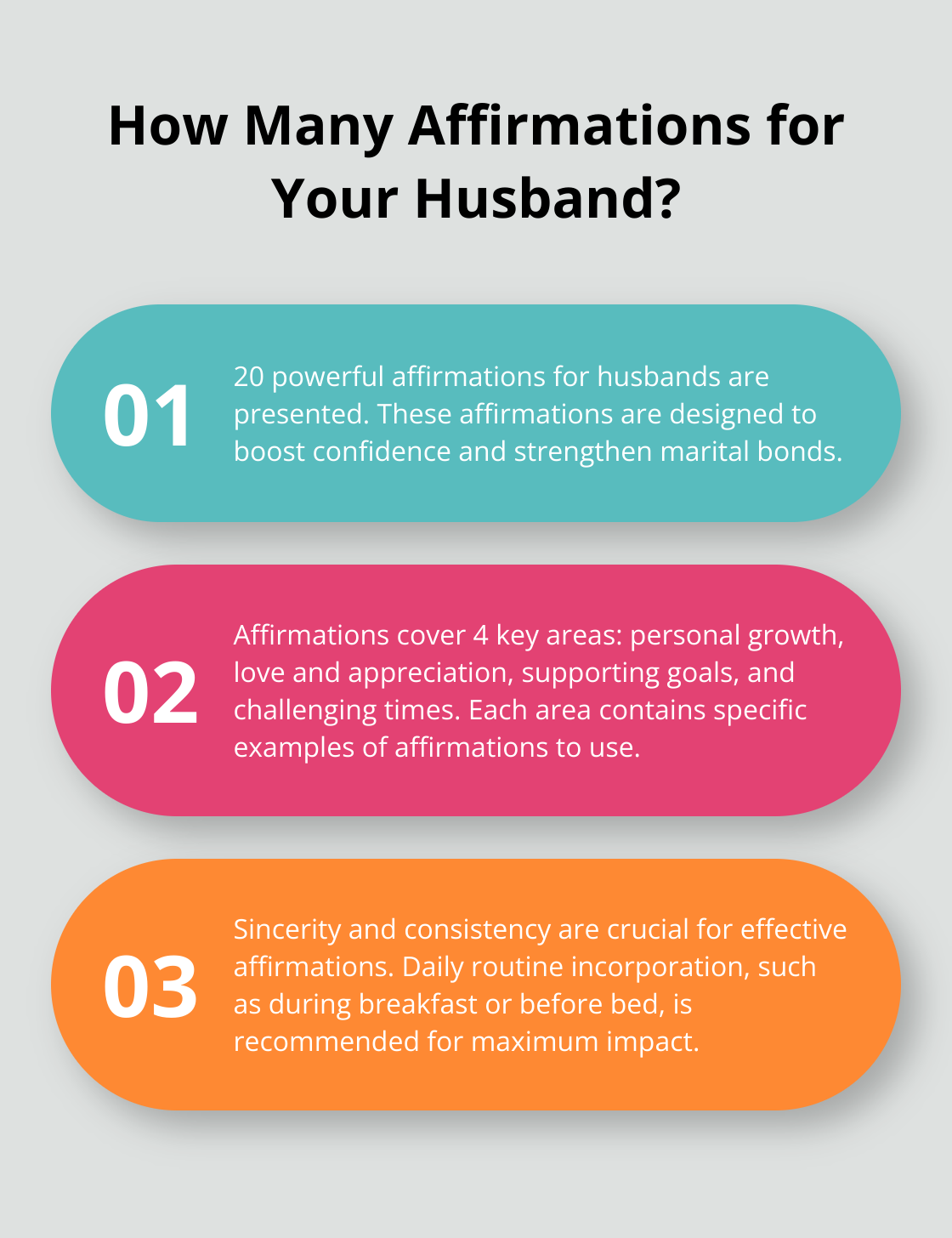
Credit: www.globalpositivenewsnetwork.com
How To Choose The Right Affirmations
Not all affirmations are created equal. The number you use matters, but the content and quality are even more important. Here’s how to pick the best ones for you:
1. Make Them Personal
Affirmations work best when they reflect your real desires and challenges. Use “I” statements and focus on what you want to experience.
Example:
“I am calm and in control” instead of “People are always calm around me. ”
2. Keep Them Positive
Focus on what you want, not what you want to avoid. Avoid words like “not,” “never,” or “don’t. ”
Example:
“I am healthy and full of energy” is better than “I am not sick. ”
3. Be Specific
General statements are less effective. Tie your affirmation to a clear outcome or feeling.
Example:
“I complete my work with focus and joy” is better than “I am productive. ”
4. Use The Present Tense
Phrase affirmations as if they are true right now. This signals to your brain that it’s real and possible.
Example:
“i Am Confident” Instead Of “i Will Become Confident.”
5. Choose What Feels Believable
If your mind completely rejects an affirmation, it may not work. You can soften the language:
“I am learning to be confident” or “I am becoming more confident each day. ”
6. Prioritize Core Values
Choose affirmations that match your deepest values and needs. These have the strongest emotional impact and stay with you longer.
How Often Should You Repeat Affirmations?
Repetition is crucial. For affirmations to work, you must repeat them regularly and with attention. Here’s what most experts recommend:
- 2–3 times a day: Morning, midday, and evening are popular.
- Repeat each affirmation 5–10 times per session.
- Write them down as well as saying them out loud.
- Visualize the affirmation as true while repeating it.
If you are using 3 to 7 affirmations, this means 15 to 70 repetitions per day. This is enough to influence your thoughts without feeling like a chore.

Credit: tiffanywoodfield.com
Sample Affirmation Routines
People often wonder how to structure their daily affirmation practice. Here are a few examples for different needs and experience levels:
Morning Routine (beginner)
- Choose 2 affirmations: One for confidence, one for health.
- Repeat each 10 times while looking in the mirror.
- Write each one once in a journal.
Midday Reset (busy Professional)
- Use 3 affirmations: Focus, calm, gratitude.
- Repeat each 5 times during lunch break.
- Take 30 seconds to visualize each one as reality.
Night Routine (stress Relief)
- Focus on 1 affirmation: Peace or relaxation.
- Repeat it slowly 10 times before sleep.
- Imagine yourself feeling calm and safe.
These routines are flexible. You can adjust the number of affirmations, repetitions, and timing as needed.
Common Mistakes In Affirmation Practice
Many people start using affirmations with excitement but give up when they don’t see instant results. Here are some mistakes to avoid:
1. Using Too Many Affirmations
Trying to cover every area of life at once can make your practice feel overwhelming. Stick to a manageable number.
2. Picking Generic Or Impersonal Affirmations
If your statements are copied from the internet and don’t match your life, they will lack emotional power.
3. Repeating Without Feeling
Affirmations work best when you say them with feeling and belief. Rushing through them or saying them robotically won’t help.
4. Ignoring Negative Thoughts
Affirmations are not about denying problems. If you have strong doubts or fears, try to address them honestly. You can use “bridge” affirmations like “I am learning to trust myself. ”
5. Expecting Instant Results
Building new beliefs takes time. Be patient and persistent.
How Affirmations Affect The Brain
Affirmations are not just “wishful thinking.” Neuroscience shows that repeating positive statements can change brain pathways over time. This process is called neuroplasticity. When you repeat an affirmation, your brain forms new connections that make the belief easier to accept.
A famous study published in the journal *Social Cognitive and Affective Neuroscience* found that self-affirmation activates the brain’s reward centers, making it easier to handle stress and accept new challenges. This effect is strongest when the affirmation matches your real values and desires.
Data And Examples: Number Of Affirmations Used By Different Groups
Different people and groups use different numbers of affirmations, depending on their needs and experience. Here is a comparison:
| Group | Number of Affirmations | Typical Focus |
|---|---|---|
| Beginners | 1–3 | Core goals or struggles |
| Students | 3–5 | Confidence, learning, motivation |
| Professionals | 3–7 | Focus, leadership, stress |
| Athletes | 2–4 | Performance, resilience |
| Experienced users | 5–10 | Multiple life areas |
As you can see, most people use fewer than 10 affirmations daily. Even those who use more tend to focus on quality over quantity.
The Science: What Research Says About Affirmation Effectiveness
While affirmations are popular in self-help, science offers mixed but promising results. Studies show that affirmations are most effective when:
- They are self-relevant (directly connected to your life)
- You repeat them regularly
- You combine them with action (not just words)
One research study found that students who used affirmations before tests had less stress and better grades, especially those who believed in their statements. Another found that affirmations helped people manage negative emotions and improve problem-solving under pressure.
However, repeating too many affirmations or using statements you don’t believe can cause “mental resistance. ” Your brain may reject statements that feel too far from reality. That’s why the right number and right content matter.
Examples: Effective Affirmations For Different Goals
You can create affirmations for almost any life area. Here are some examples for different goals:
Confidence And Self-esteem
- “I am worthy of respect and kindness.”
- “I trust myself to make good choices.”
- “I am confident in social situations.”
Health And Wellness
- “I choose healthy foods that nourish my body.”
- “I am full of energy and strength.”
- “Every day, I care for my body and mind.”
Career And Success
- “I am focused and productive at work.”
- “Opportunities for growth come to me easily.”
- “I handle challenges with calm and creativity.”
Stress Relief And Calm
- “I am at peace with myself and my surroundings.”
- “I release tension with every breath.”
- “Calmness is my natural state.”
Relationships
- “I communicate with love and understanding.”
- “I attract positive, supportive people.”
- “I am open to giving and receiving love.”
You don’t need to use all of these. Pick the ones that truly matter to you.
How To Track Your Affirmation Progress
Many people wonder how to know if affirmations are working. Here are some simple ways to track progress:
- Keep a journal: Write your affirmations each day and note any changes in thoughts, feelings, or actions.
- Set a reminder: After 2–4 weeks, check if your beliefs or habits have shifted.
- Notice emotional changes: Do you feel more confident, calm, or focused after repeating your affirmations?
- Track real-life results: Have you achieved any goals or made positive changes in your behavior?
It’s important to notice small shifts, not just big changes. Affirmations often work slowly, building new beliefs over time.
Advanced Tips For Mastering Affirmation Practice
If you have been using affirmations for a while and want to go deeper, try these advanced strategies:
1. Combine Affirmations With Visualization
While saying your affirmation, close your eyes and imagine it as real. Picture yourself acting, speaking, or feeling in line with your statement.
2. Use “if–then” Affirmations
These are special statements that prepare you for challenges.
“If I feel nervous in a meeting, then I will breathe deeply and remember my strengths. ”
3. Record And Listen
Record yourself saying your affirmations. Listen to the recording during your commute or before sleep. Hearing your own voice can increase belief.
4. Link Affirmations To Habits
Connect your affirmations to daily actions, like brushing your teeth or making coffee. This builds the habit and makes it automatic.
5. Adjust As You Grow
As your goals or beliefs change, update your affirmations. Don’t hold on to old statements that no longer fit your life.
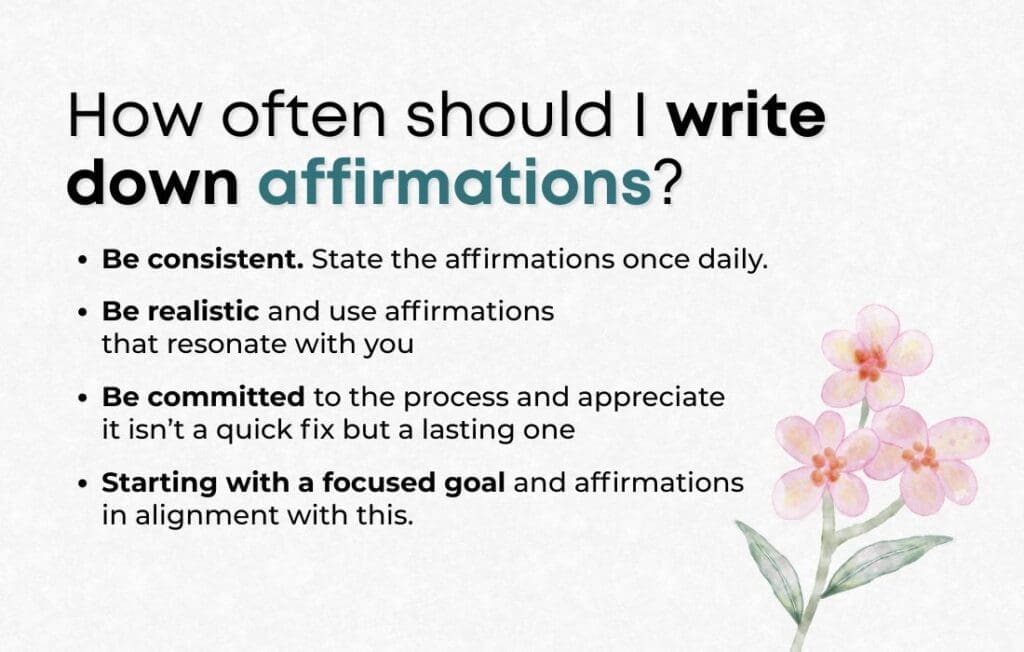
Credit: tiffanywoodfield.com
Comparing Affirmation Methods: Spoken, Written, And Visual
People use affirmations in different ways. Each method has pros and cons. Here’s a quick comparison:
| Method | Benefits | Drawbacks |
|---|---|---|
| Spoken | Strong emotional impact, easy to do anywhere | Can feel awkward at first |
| Written | Slows you down, increases focus, easy to track | Takes more time, needs pen and paper |
| Visual | Boosts imagination, links to goals and dreams | Requires quiet space, not for everyone |
Try different methods and see which works best for you. Many people combine all three for the strongest effect.
Non-obvious Insights Most Beginners Miss
Most guides on affirmations focus on the basics, but a few key insights can make your practice more powerful:
- Change is gradual, not instant: The brain needs time to accept new beliefs. Consistency is more important than speed.
- Affirmations can bring up resistance: If you feel strong doubt or discomfort, that’s normal. It means you’ve touched a deep belief. Use this as a chance to grow, not a reason to quit.
- Your environment matters: If you’re surrounded by negativity, affirmations alone may not be enough. Try to spend time with positive people and uplifting materials.
- Affirmations support, not replace, action: Saying “I am healthy” is more powerful when you also eat well and exercise.
- Adjust your affirmations as you progress: What you need now may not be what you need in the future. Review and update your practice every few months.
How To Avoid Affirmation Fatigue
Using too many affirmations can lead to affirmation fatigue—feeling bored, overwhelmed, or disconnected from the practice. Here’s how to prevent it:
- Limit yourself to 3–7 affirmations at one time.
- Rotate your affirmations every few weeks to keep them fresh.
- Take breaks if needed. It’s okay to pause and restart.
- Focus on quality and emotional connection, not just repetition.
If you notice your affirmations feeling dull or meaningless, it may be time to simplify or change them.
Real-life Examples: How Many Affirmations Work In Practice
Here are stories from different people on how they use affirmations:
Maria, Student:
“I started with just one affirmation: ‘I am smart and capable.’ After a month, I added two more for confidence and time management. Three is perfect for me—I can remember them easily and really believe them.”
James, Manager:
“I use five affirmations each morning. One for leadership, one for calm, two for personal goals, and one for gratitude. I write them every day and say them aloud. Any more, and I feel rushed. ”
Leila, Athlete:
“I focus on two affirmations before every game: ‘I am strong’ and ‘I perform at my best.’ I repeat them as I warm up. I’ve tried more, but two is my sweet spot.”
Their experiences show there is no “right” number—just what works for you.
Frequently Asked Questions
What Happens If I Use Too Many Affirmations?
If you try to use a long list of affirmations each day, your mind can become overwhelmed. This makes it harder to focus deeply on any single statement. You may end up repeating words without feeling or meaning, which reduces their power.
It’s better to use a small number that you can connect with emotionally.
Can I Change My Affirmations Often?
Yes, you can update or change your affirmations as your goals and needs shift. Many people review their list every few weeks or months. If an affirmation no longer fits, replace it with one that matches your current desires.
Is It Okay To Use Only One Affirmation?
Absolutely. Using one strong, meaningful affirmation can be very effective, especially for beginners. The key is emotional connection and belief. Some people find that focusing on one statement helps them make faster progress.
Do I Need To Say Affirmations Out Loud, Or Can I Think Them Silently?
Both methods can work. Saying affirmations out loud often creates a stronger emotional impact, but thinking them silently can also be effective, especially in public or quiet spaces. You can also write them down for extra focus.
Are There Scientific Studies Supporting The Use Of Affirmations?
Yes, some scientific studies support the use of affirmations for stress reduction, motivation, and performance. However, results can vary by person and situation. The most effective affirmations are those that are personally meaningful and repeated regularly. For more details, you can visit Wikipedia.
Affirmations are a simple but powerful tool for shaping your mindset and achieving your goals. The number you use should fit your needs, your lifestyle, and your emotional connection to each statement. Start small, focus on quality, and adjust as you grow.
With patience and practice, affirmations can help you create real, lasting change in your life.
