

Affirmation Ideas for Women: Boost Confidence and Self-Love
Affirmation Ideas For Women
Every woman faces moments of self-doubt, stress, or uncertainty. Life can feel overwhelming when you juggle work, relationships, family, and personal goals. In these moments, affirmations can offer a simple but powerful way to shift your mindset. An affirmation is a positive statement that you repeat to yourself to challenge negative thoughts, boost confidence, or help you focus on what matters. While some people see affirmations as just “feel-good” words, research suggests they can actually help change how you think and feel over time.
The right affirmations are not just empty phrases—they are tools you can use to build self-esteem, manage anxiety, and even reach your goals. But to work, they need to be meaningful and relevant to your life. This article explores a wide range of affirmation ideas for women, explains how to use them effectively, and gives you practical tips to make affirmations a natural part of your daily routine.
Why Affirmations Matter For Women
Women often carry many roles: professional, caregiver, partner, friend, and more. Society can place high expectations on women, which sometimes leads to self-criticism or pressure to be perfect. Affirmations help break these patterns by focusing your mind on strengths, possibilities, and the positive qualities you already have.
Recent studies show that practicing affirmations can reduce stress, improve self-worth, and help you bounce back from setbacks. For example, a study published by the National Institutes of Health found that people who practiced self-affirmation were better at problem-solving under pressure.
The effects are not instant, but with regular use, affirmations can reshape your self-talk and create a foundation for lasting confidence.
How To Create Powerful Affirmations
Affirmations work best when they are:
- Personal: Tailored to your own needs and experiences.
- Present tense: Use “I am” or “I have” instead of “I will be.”
- Positive: Focus on what you want, not what you’re avoiding.
- Believable: Choose statements you can accept, even if they stretch your comfort zone.
For example, “I am strong and capable” is more effective than “I am not weak. ” If a statement feels too far from your current reality, try “I am learning to believe in myself” or “I am open to new possibilities.
”
50 Affirmation Ideas For Women
Here are 50 affirmation ideas that address different areas of a woman’s life. Use these as inspiration, or adapt them to fit your own situation.
Self-esteem And Confidence
- I am worthy of love and respect.
- I trust myself to make the right choices.
- My voice matters and deserves to be heard.
- I am proud of who I am becoming.
- I believe in my abilities and talents.
- I am beautiful inside and out.
- I am enough just as I am.
- I honor my strengths and accept my flaws.
- My confidence grows with every challenge I face.
- I am not afraid to stand up for myself.
Career And Ambition
- I am capable of achieving my goals.
- My ideas are valuable and important.
- I bring unique skills to my work.
- I am open to new opportunities.
- I am growing and improving every day.
- I trust myself to handle any situation at work.
- I am a leader in my own way.
- I am making a difference through my work.
- I attract success and abundance.
- I am proud of my accomplishments.
Relationships And Connection
- I am deserving of healthy, loving relationships.
- I communicate my needs with kindness.
- I attract positive and supportive people.
- I give and receive love freely.
- I am patient and understanding with others.
- I set healthy boundaries in my relationships.
- I am grateful for the people who care about me.
- I am open to deep and meaningful connections.
- I forgive myself and others for past mistakes.
- I am loved just as I am.
Health And Self-care
- I honor my body and treat it with respect.
- I listen to my body’s needs.
- I am committed to my health and well-being.
- I am strong, healthy, and full of energy.
- I give myself permission to rest.
- I am patient with my healing process.
- I am in tune with my mind, body, and spirit.
- I choose foods and habits that nourish me.
- I am grateful for my body and all it does for me.
- I make time for activities that bring me joy.
Courage And Resilience
- I face challenges with courage and determination.
- I am stronger than any obstacle.
- I trust that I can handle whatever comes my way.
- I learn and grow from every experience.
- I am resilient and bounce back from setbacks.
- I welcome change and adapt easily.
- I let go of what I cannot control.
- I am brave enough to try new things.
- I am open to life’s possibilities.
- I celebrate my progress, no matter how small.
Examples Of Affirmations In Daily Life
Affirmations are most effective when they fit your real experiences. Here are some ways women use affirmations in daily life:
- Before a work presentation, repeating “I am prepared and ready to share my ideas” can help calm nerves.
- When feeling overwhelmed by family duties, reminding yourself “I am doing my best, and that is enough” can ease guilt.
- During times of self-doubt, saying “I trust myself to make good decisions” builds inner strength.
Some women keep a journal to write their affirmations each morning. Others put sticky notes with positive words on their mirror or computer. Some record themselves saying affirmations and listen during their commute. The key is to make affirmations a regular habit, so the positive messages become part of your thinking.
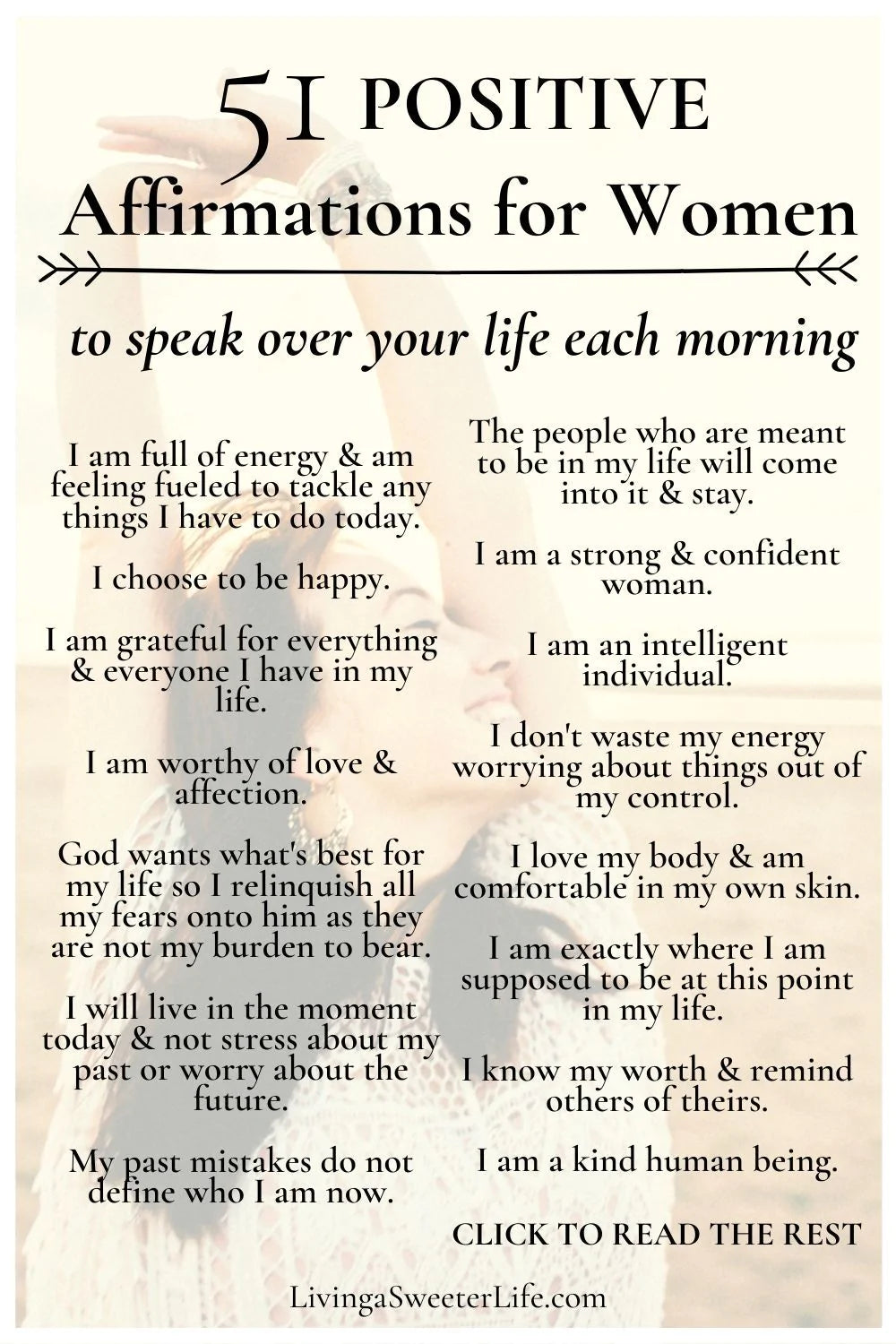
Credit: livingasweeterlife.com
Affirmations For Different Stages Of Life
Women’s needs change as they move through different stages. Here are tailored affirmation ideas for some key moments:
For Young Women And Students
- I am capable of learning new things every day.
- I am proud of the progress I make.
- I am more than my grades or achievements.
- I choose friends who support and respect me.
- I am discovering who I want to be.
For Working Mothers
- I am balancing work and family with strength and grace.
- I am a role model for my children.
- I forgive myself for not being perfect.
- I am allowed to ask for help when I need it.
- I create special moments with my family.
For Women Facing Midlife Changes
- I embrace the wisdom I have gained over the years.
- I am open to new adventures at any age.
- I let go of expectations that no longer serve me.
- I celebrate my body and all it has carried me through.
- I trust the path I am on.
For Women Experiencing Loss Or Hardship
- I am allowed to feel and heal at my own pace.
- I am supported and loved, even when I feel alone.
- I honor my feelings without judgment.
- I am resilient, even in difficult times.
- I am moving forward, one step at a time.
Data And Research: Do Affirmations Really Work?
There is growing scientific interest in how affirmations affect the mind. While affirmations alone won’t solve every problem, research suggests they can have real benefits. Here is a look at some findings:
| Benefit | Research Finding | Source |
|---|---|---|
| Reduced Stress | People using affirmations show lower levels of stress in challenging situations. | NIH Study |
| Improved Academic Performance | Students practicing self-affirmation perform better on tests under pressure. | APA Research |
| Greater Well-being | Regular affirmation use is linked to higher self-esteem and happiness. | NIH Study |
Some beginners expect instant results, but real change comes with repetition. It is also important to combine affirmations with real action. For example, saying “I am healthy” is more effective if you also make healthy choices.
Common Mistakes When Using Affirmations
To get the most from affirmations, watch out for these common mistakes:
- Being too vague: “I am happy” is nice, but “I am finding joy in small moments every day” feels more real.
- Choosing impossible statements: If you don’t believe your affirmation at all, your mind may reject it. Start with something you can accept.
- Forgetting to use them regularly: Consistency is key. Affirmations work best as a habit, not just when you remember.
- Not linking words to action: Affirmations should inspire you to act, not replace effort.
- Repeating affirmations without emotion: Say or write your affirmations with feeling, not just as a chore.
Practical Tips To Make Affirmations Work
Making affirmations part of your daily routine does not have to be complicated. Here are some practical ways to use them:
1. Write Them Down Every Morning
Start your day by writing three affirmations in a journal. This helps focus your mind on what matters before distractions begin.
2. Use Visual Reminders
Place sticky notes with affirmations on your mirror, fridge, or computer. Seeing them often keeps positive thoughts top of mind.
3. Pair Affirmations With Breathing
Repeat an affirmation slowly while taking deep breaths. This calms your body and helps you absorb the message.
4. Record And Listen
Record yourself saying affirmations. Listen to them during your commute or as you fall asleep. Hearing your own voice can make the words more powerful.
5. Add Movement
Say your affirmation as you walk, stretch, or exercise. Linking words with movement helps some people remember and believe the message.
6. Use Affirmations As A Response To Negative Thoughts
Whenever a negative thought arises (“I’m not good enough”), gently replace it with a positive affirmation (“I am learning and growing every day”).
7. Practice With A Friend
Share affirmations with a trusted friend or family member. Supporting each other builds accountability and encouragement.
Comparison: Affirmations Vs. Other Self-help Tools
How Do Affirmations Compare To Other Popular Self-help Techniques?
| Method | Main Focus | Time Needed | Best For |
|---|---|---|---|
| Affirmations | Positive self-talk, mindset shift | 1-5 minutes daily | Boosting confidence, changing habits |
| Meditation | Calm, presence, stress reduction | 10-30 minutes daily | Reducing anxiety, building focus |
| Journaling | Self-reflection, clarity | 5-20 minutes daily | Understanding emotions, setting goals |
| Therapy | Deep personal growth, healing | 1 hour weekly (or as needed) | Complex issues, trauma, mental health |
Affirmations are easy to start and require little time. They can be used alone or combined with other self-care habits for greater benefit.
Creative Ways To Use Affirmations
Affirmations do not have to be boring or repetitive. Here are creative ways women make affirmations fun and meaningful:
- Affirmation jars: Write positive statements on slips of paper and keep them in a jar. Pick one when you need encouragement.
- Affirmation art: Create paintings, collages, or digital graphics of your favorite affirmations. Hang them in your space as reminders.
- Affirmation bracelets: Wear jewelry engraved with a meaningful word or phrase.
- Affirmation alarms: Set reminders on your phone with positive statements at different times of the day.
- Affirmation groups: Form a small group where everyone shares and discusses affirmations each week.
Non-obvious Insights For Beginners
Many people try affirmations and give up because they do not feel instant results. Here are two important things beginners often miss:
- Your subconscious mind learns by repetition and emotion. Saying an affirmation once or twice is not enough. The more you repeat it, especially with emotion, the more your mind accepts it as truth.
- Affirmations can reveal inner beliefs. If you notice strong resistance to a certain affirmation, it may point to an area where you need healing or growth. Use this as a chance to explore your feelings, not to judge yourself.
Examples Of Personalized Affirmations
Generic affirmations are helpful, but personalizing them makes them stronger. Here are examples of how to make affirmations more specific:
- Instead of “I am successful,” try “I am making steady progress toward my goal of starting my own business.”
- Change “I am healthy” to “I am making choices that support my energy and well-being every day.”
- Instead of “I am confident,” say “I speak up in meetings because my ideas are valuable.”
Personalized affirmations connect better with your real life and goals.
How To Stick With Affirmations Long Term
Making affirmations a lasting habit can be a challenge. Here are steps that help:
- Tie affirmations to an existing routine: Say them after brushing your teeth, before bed, or during your morning coffee.
- Keep them visible: Use reminders or display affirmations in places you look often.
- Track your progress: Notice small changes in your mood, confidence, or actions. Celebrate any improvement, no matter how minor.
- Be patient: Like exercise, results grow over time. If you miss a day, just start again.
- Review and update: Change your affirmations as your goals and needs change.
How Affirmations Impact Women’s Lives: Real Stories
Hearing how affirmations affect real women can inspire you to try them yourself. Here are some true-to-life examples:
- Maria, a new manager, used the affirmation “I am a capable and supportive leader” every morning. She found she was more confident in meetings and more willing to delegate tasks.
- Jenna, a mother of two, repeated “I am patient and present with my children” during stressful days. She noticed she reacted with more calm and less frustration.
- Priya, returning to work after a break, struggled with self-doubt. She used “I bring fresh skills and ideas to my team” to remind herself of her value.
These stories show that the right words, repeated often, can have a real impact.

Credit: notesbythalia.com
Common Challenges And How To Overcome Them
Even with good intentions, it is easy to get discouraged. Here are some typical challenges and solutions:
Feeling Silly Or Uncomfortable
Many people feel awkward saying affirmations at first. This is normal. Start by writing them down, or saying them quietly to yourself. With practice, it gets easier.
Lack Of Time
You do not need a long ritual. Even one minute of affirmations can help. Tie them to something you already do, like your morning routine.
Not Believing The Words
If an affirmation feels fake, soften it: “I am learning to…” or “I am open to the idea that…” Over time, belief can grow.
Forgetting To Use Them
Set reminders, use sticky notes, or ask a friend to join you. Consistency makes a difference.
The Science Of Affirmations: How They Work In Your Brain
Understanding how affirmations work can increase your motivation. When you repeat positive statements, you activate the reward centers in your brain. Over time, this can:
- Decrease negative self-talk
- Boost motivation
- Build new, helpful thought patterns
Researchers say affirmations work best when you focus on your values and goals, not just generic “positive thinking. ” When you link affirmations to what matters to you, the effect is stronger.
For more on the science of affirmations, you can read this Psychology Today overview.
Sample Affirmation Routines
To make affirmations part of your day, try these routines:
| Time of Day | Action | Example Affirmation |
|---|---|---|
| Morning | Write 3 affirmations in your journal | "I am ready to face today with confidence." |
| Lunch Break | Read a sticky note on your desk | "I am making progress, even in small steps." |
| Evening | Say an affirmation before bed | "I am grateful for what I achieved today." |
Choose the routine that feels easiest to stick with. You can always adjust as you go.
Frequently Asked Questions
What Is The Best Way To Use Affirmations For Women?
The best way is to repeat affirmations daily, either out loud, in writing, or quietly in your mind. Tie them to a regular habit, like brushing your teeth or having coffee, to make them easy to remember. Personalize your affirmations so they feel true and relevant to your life.
How Long Does It Take For Affirmations To Work?
Most women start to notice small changes after a few weeks of consistent practice. The key is repetition and emotion. For lasting change, keep using affirmations even when you start to see results.
Can Affirmations Help With Anxiety Or Low Self-esteem?
Yes, affirmations can help reduce anxiety and build self-esteem over time. They work by replacing negative thoughts with positive ones. For severe anxiety, affirmations are helpful but may work best along with professional support.
Is It Okay To Use The Same Affirmation Every Day?
Absolutely. Using the same affirmation daily can help reinforce the message. You can also update or change your affirmations as your goals and needs change.
Can I Write My Own Affirmations?
Yes, writing your own affirmations is often more powerful. Use positive, present-tense language and focus on what you want to believe or achieve. The more personal the affirmation, the more effective it can be.
Affirmations are not a magic cure, but they are a proven tool for building a more positive mindset. By choosing the right words and using them regularly, you can change the way you see yourself and face life’s challenges with more confidence and hope.
Whether you are new to affirmations or looking to deepen your practice, start today with just one positive statement and see where it leads you.

Credit: www.thegoodbody.com
