

Best Affirmation for Success: Transform Your Mindset Today
Success is a word with many meanings. For some, it is earning more money, for others, it is reaching personal goals, or simply waking up happy every day. But one thing is clear: the way we think and speak to ourselves shapes our reality. Affirmations—short, positive statements—are powerful tools to guide our minds toward success. When used correctly, affirmations help you develop confidence, focus, and resilience. Whether you are a student, a business professional, or someone looking for a fresh start, the right affirmation can open doors you never imagined.
Many people try affirmations but give up too soon. They say, “This is silly,” or “It’s not working for me. ” The truth? Success affirmations are not magic spells. They work through repetition and belief, slowly changing your thinking habits.
When you repeat a phrase every morning, your mind starts to accept it as true. This affects how you act, how you respond to challenges, and even how others see you.
In this article, you will discover the best affirmations for success, how to use them, and why they matter. You will also learn practical ways to make affirmations part of your daily life, backed by science and real-life examples. Whether you are new to this or want to deepen your practice, you will find everything you need to turn positive words into real-world achievements.
What Are Affirmations?
Affirmations are positive statements you say to yourself to encourage self-belief and change negative thoughts. They are like mental exercises for your brain. Instead of letting doubts control your day, you choose to focus on what you want to achieve. For example, instead of thinking “I always fail,” you repeat, “I am capable of achieving my goals.” Over time, your brain starts to believe the new message.
Psychologists call this process self-affirmation theory. Studies show that affirmations can reduce stress, improve performance, and even support better health. But the key is consistency. Like learning a new language or building muscle, the benefits come with time.
Why Affirmations For Success Matter
Success is not only about talent or luck. It is also about your mindset—the way you view yourself and your abilities. People with a “growth mindset” believe they can improve through effort and learning. Those with a “fixed mindset” believe their abilities are set and cannot change.
Affirmations help you build a growth mindset. When you say, “I am open to new opportunities,” your brain gets used to searching for possibilities. When you repeat, “I learn from my mistakes,” you start seeing failure as a teacher, not a threat.
Research from Stanford University shows that people who use positive self-talk are more likely to succeed in school, work, and sports. Affirmations help you:
- Stay motivated during tough times
- Overcome fear and self-doubt
- Focus on goals instead of problems
- Build resilience and bounce back from setbacks
One insight many beginners miss is that affirmations are not about ignoring reality. If you fail a test, you do not say, “I am a genius at math,” and hope for a miracle. Instead, you say, “I can improve my math skills with practice,” which combines hope with action.
How Affirmations Work In The Brain
It is easy to think affirmations are just “feel-good” phrases. But neuroscience explains why they matter. Your brain has a system called the reticular activating system (RAS). This system filters what you notice from the world. For example, if you decide to buy a red car, suddenly you see red cars everywhere.
When you use affirmations, you train your RAS to notice chances for success. If you tell yourself, “I find solutions to problems,” your brain starts looking for answers instead of obstacles. Over time, this changes your behavior and results.
MRI studies show that self-affirmations activate the reward centers in the brain. This makes you feel more confident and less stressed, especially when facing challenges.
25 Best Affirmations For Success
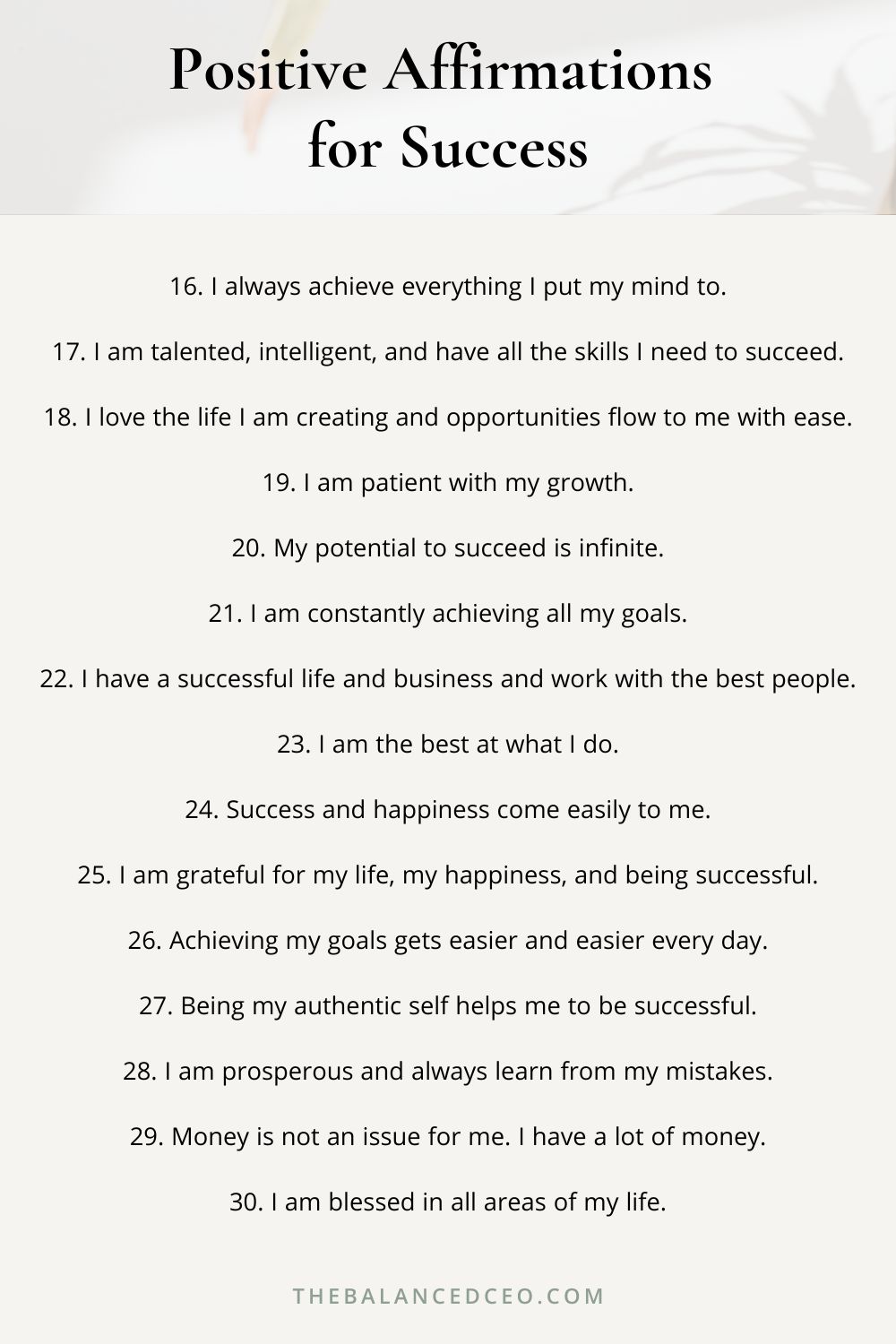
The right affirmation can shift your focus and boost your confidence. Here are 25 of the most effective affirmations for success. Choose the ones that speak to you or mix and match to create your own:
- I believe in my ability to succeed.
- Every day, I grow stronger and wiser.
- I am open to new opportunities.
- I turn challenges into chances.
- Success is my natural state.
- I attract positive outcomes.
- I am committed to my goals.
- I am confident in my decisions.
- I learn and grow from every experience.
- I deserve success and happiness.
- I stay focused and persistent.
- I am grateful for all progress, big or small.
- I inspire others through my actions.
- I am not afraid to take risks.
- I am worthy of my dreams.
- I overcome obstacles with courage.
- I create my own success story.
- I am disciplined and motivated.
- I trust my journey.
- I handle setbacks with grace.
- I welcome new skills and knowledge.
- I am always improving.
- I give my best in everything I do.
- I celebrate my achievements.
- I turn my goals into reality.
Not all affirmations work for everyone. The best affirmation is the one that feels true or possible for you. If you feel resistance, tweak the words until they fit your life.
Credit: thebalancedceo.com
How To Create Your Own Affirmations
Sometimes, the most powerful affirmation is the one you write yourself. Here’s how to create affirmations that work for you:
- Keep it positive. Use words that focus on what you want, not what you fear.
- Use the present tense. Say “I am confident,” not “I will be confident.” This helps your brain accept it now.
- Make it personal. Choose words that feel true to you, not just popular phrases.
- Be specific. Instead of “I am successful,” try “I am successful in my career as a teacher.”
- Keep it short. Simple phrases are easier to remember and repeat.
For example, if you want to improve your public speaking, your affirmation could be: “I speak clearly and confidently in front of others.” If you want to save money, try: “I make wise decisions with my finances.”
Common Mistakes When Using Affirmations
Many people give up on affirmations because they do not see results right away. Here are some mistakes to avoid:
- Being too vague. “I want to be rich” is not as effective as “I attract opportunities for financial growth.”
- Not believing the words. If the affirmation feels fake, your brain will reject it. Start with something believable.
- Lack of repetition. Saying an affirmation once is not enough. Practice daily, especially in the morning and before bed.
- Ignoring feelings. Affirmations should feel good when you say them. If they make you anxious, adjust the words.
- Expecting instant results. Change takes time. Stick with your affirmations for at least 21 days.
A practical tip: Write your affirmation on sticky notes and place them where you will see them often—on your bathroom mirror, your computer, or your fridge.
Science-backed Benefits Of Affirmations
Affirmations are not just positive thinking. There is real science behind their power. Studies show that self-affirmations:
- Reduce stress and lower cortisol (the stress hormone)
- Improve performance in school and at work
- Increase physical activity and healthy choices
- Boost problem-solving skills under pressure
One experiment found that students who practiced affirmations before a test scored higher than those who did not. Another study reported that people who used affirmations were less likely to give up on hard tasks.
Interestingly, affirmations also help with physical health. People recovering from illness or surgery heal faster when they use positive self-talk. The reason? Affirmations improve your mood and lower anxiety, which helps your body recover.
For more details, you can visit the Positive Psychology website, which provides research and practical tips on affirmations.
How To Use Affirmations For Maximum Success
Affirmations work best when they become part of your routine. Here are proven ways to use them:
Morning Routine
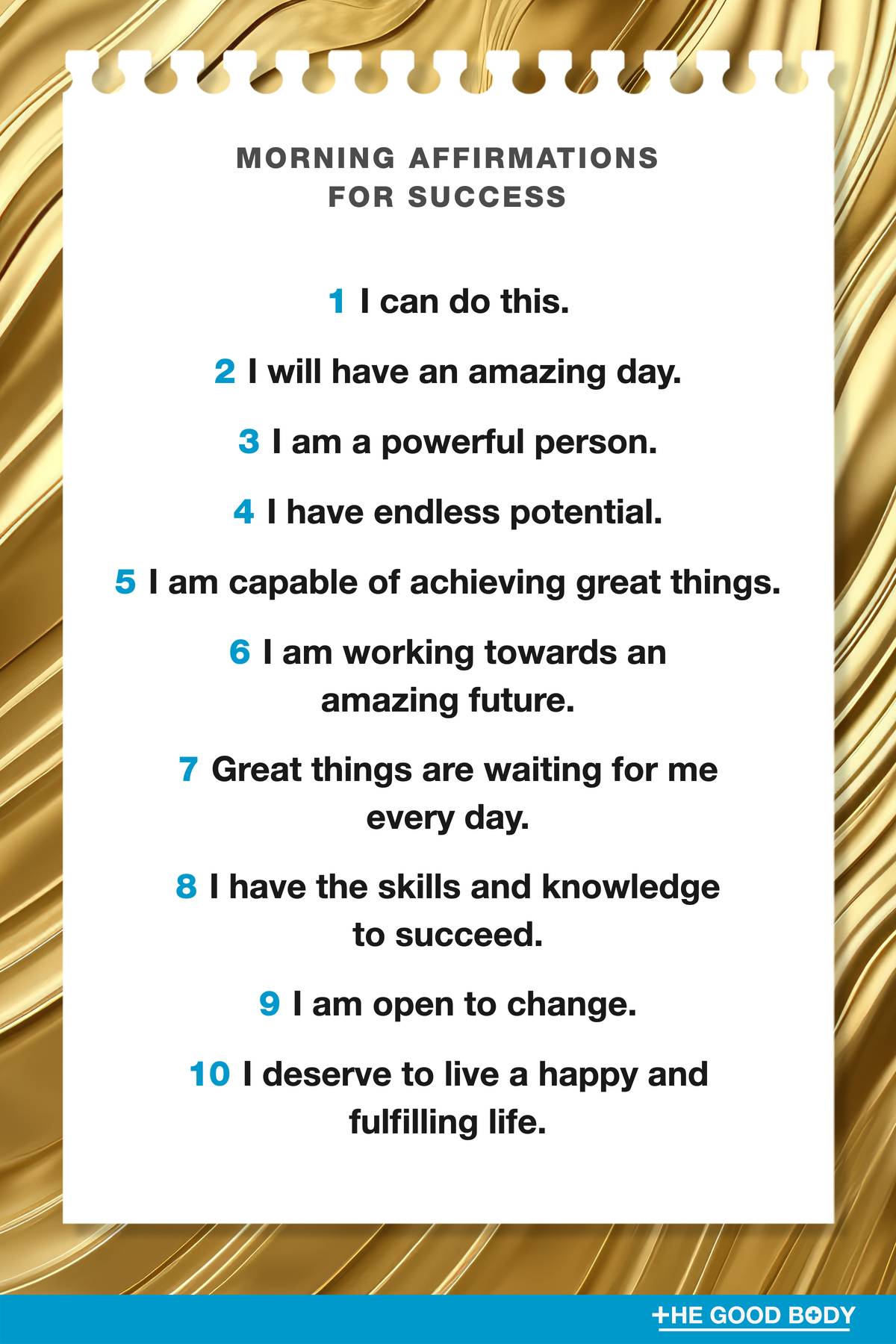
Start your day with affirmations. Say them out loud or write them in a journal. This sets a positive tone for the rest of your day.
Visualization
While repeating your affirmation, close your eyes and imagine it coming true. If your affirmation is, “I am confident in meetings,” picture yourself speaking up and being heard.
Combine With Action
Affirmations are most powerful when linked to action. For example, if you say, “I am organized and productive,” plan your tasks for the day.
Affirmation Reminders
Set reminders on your phone to repeat your affirmations every few hours. This keeps your mind focused, especially during stressful times.
Affirmation Partner
Share your affirmations with a friend or family member. Encourage each other to stay positive and accountable.
Many beginners do not realize that affirmations can be written, spoken, or even listened to as recordings. Try different methods and see which works best for you.

Credit: www.thegoodbody.com
Examples Of Affirmations For Different Success Goals
Success means different things to everyone. Here are examples of affirmations for specific goals:
Career Success
- “I am confident in my skills and knowledge.”
- “I attract new career opportunities.”
- “I am respected by my colleagues.”
Financial Success
- “I make wise financial choices.”
- “I attract abundance into my life.”
- “I am open to new income sources.”
Academic Success
- “I am focused and motivated to study.”
- “I understand and remember what I learn.”
- “I achieve my academic goals.”
Health And Fitness Success
- “I am strong and healthy.”
- “I enjoy taking care of my body.”
- “I am consistent with my healthy habits.”
Personal Growth Success
- “I am always learning and improving.”
- “I accept myself and strive to be better.”
- “I turn challenges into opportunities.”
It is important to choose affirmations that match your current goals. Change them as your life changes.
Affirmations Vs. Positive Thinking: What’s The Difference?
People often confuse affirmations with general positive thinking. While both are helpful, they are not the same.
- Positive thinking is a broad attitude that focuses on seeing the good in situations.
- Affirmations are specific, repeated statements aimed at changing your mindset about a goal or challenge.
Affirmations are more focused and intentional. For example, positive thinking is, “I hope things get better. ” An affirmation is, “I am making things better every day. ”
Credit: www.thegoodbody.com
Do Affirmations Work For Everyone?
Most people benefit from affirmations, but results can vary. Some people notice a change in a few days, while others need weeks or months. The main factors are:
- Belief: Do you trust the process and your own words?
- Consistency: Do you repeat affirmations daily?
- Action: Do you take steps toward your goals, not just say the words?
Affirmations are less effective if you do not believe in them or never act on them. But almost anyone can find some benefit, even if it is just a small boost in mood or focus.
A non-obvious tip: If you struggle to believe an affirmation, add “I am learning to…” or “I am open to…” at the beginning. For example, “I am learning to be confident in meetings.” This makes it easier for your brain to accept.
Measuring The Impact Of Affirmations
Some people wonder how to know if affirmations are working. Here are signs to look for:
- You notice more positive thoughts and fewer negative ones
- You feel calmer and more focused
- You recover from setbacks faster
- You start seeing small successes in your goals
For a clearer view, try keeping a journal. Write down your affirmations and note any changes in your attitude, behavior, or results.
Here is a simple way to track your progress:
| Week | Mood (1-10) | Confidence (1-10) | Progress Toward Goal |
|---|---|---|---|
| 1 | 5 | 4 | Started using affirmations |
| 2 | 6 | 5 | Took first step toward goal |
| 3 | 7 | 6 | Handled a setback well |
| 4 | 8 | 7 | Reached a milestone |
If you see steady improvement, your affirmations are working.
Real-life Success Stories
Hearing about others’ experiences can inspire you to keep going. Here are some true stories:
Maria, a sales manager, used the affirmation “I am confident in my presentations.” After a month of daily practice, she noticed she spoke more clearly and closed more deals.
James, a college student, struggled with anxiety before exams. He started saying, “I am prepared and calm.” His grades improved, and he felt less nervous.
Li, a small business owner, was afraid to raise his prices. He used, “I provide great value and deserve fair payment.” Soon, he felt comfortable asking for more, and his business grew.
One insight: Many people start with low expectations but are surprised by how much affirmations change their actions and results over time.
When Affirmations Alone Are Not Enough
Affirmations are helpful, but they are not a substitute for hard work or professional help. If you struggle with deep anxiety, depression, or trauma, affirmations alone may not solve the problem. It is okay to ask for support from a coach, mentor, or therapist.
Affirmations are tools, not miracles. They work best alongside other good habits—planning, learning, taking action, and asking for help when needed.
Table: Affirmations Vs. Other Success Tools
How do affirmations compare to other popular methods for success? This table shows key differences:
| Tool | Main Benefit | Best For | Time Needed |
|---|---|---|---|
| Affirmations | Improves mindset, builds confidence | Daily motivation | 2-5 minutes/day |
| Goal Setting | Clarifies direction | Long-term planning | 30-60 minutes/month |
| Meditation | Reduces stress, improves focus | Mental clarity | 10-20 minutes/day |
| Journaling | Tracks growth, solves problems | Self-reflection | 10 minutes/day |
Combining these tools often brings the best results.
Myths And Misconceptions About Affirmations
There is a lot of confusion about affirmations. Let’s clear up some common myths:
Myth 1: Affirmations are just wishful thinking.
Fact: Affirmations train your brain to see possibilities and motivate you to act.
Myth 2: You must believe every word 100% for them to work.
Fact: It is normal to feel doubt at first. What matters is repetition and openness.
Myth 3: Affirmations are only for “positive people.”
Fact: Anyone can use affirmations, even if you are naturally skeptical or struggle with negative thinking.
Myth 4: Affirmations can replace action.
Fact: Affirmations work best when you combine them with real steps toward your goals.
Myth 5: There is one “magic” affirmation for everyone.
Fact: The best affirmation is the one that fits your needs, personality, and dreams.
A non-obvious insight: Some people respond better to affirmations that challenge them just a little, rather than ones that feel completely comfortable. For example, “I am becoming more confident” can be more effective than “I am always confident.”
Making Affirmations Stick: Long-term Strategies
If you want affirmations to change your life, make them a habit, not a one-time event. Here’s how:
- Connect your affirmation practice to a daily activity, like brushing your teeth or making coffee.
- Record your affirmations in your own voice and listen to them during your commute.
- Celebrate small wins, even if they seem minor.
- Change your affirmations as your goals and life situations change.
One common mistake: Sticking with the same affirmation for years, even after you have outgrown it. Update your affirmations as you grow.
Table: Sample Daily Affirmation Schedule
A routine can help you remember and stay motivated. Here’s a sample schedule:
| Time | Activity | Affirmation Example |
|---|---|---|
| Morning | Getting ready | I am ready for a successful day. |
| Afternoon | Lunch break | I am focused and productive. |
| Evening | Before sleep | I am grateful for my progress today. |
Choose times that fit your life.
Frequently Asked Questions
What Is The Best Affirmation For Success?
There is no single “best” affirmation for success. The most effective one is personal and matches your current goals and values. For many people, “I am capable of achieving my goals” is a good starting point. Adjust your affirmation until it feels meaningful to you.
How Many Affirmations Should I Use Each Day?
Quality matters more than quantity. Start with 1-3 affirmations that feel important to you. Repeat them every day, rather than trying to memorize a long list. When you feel ready, you can add or change affirmations as your goals change.
When Is The Best Time To Say Affirmations?
The best times are when your mind is calm and open, such as in the morning, before sleep, or during a break. You can also use affirmations before stressful situations, like meetings or exams, to boost confidence.
Can Affirmations Help With Anxiety Or Negative Thoughts?
Affirmations can help reduce anxiety and negative thinking by focusing your mind on positive possibilities. However, if you have serious anxiety or depression, combine affirmations with other support like therapy or counseling for the best results.
How Long Does It Take To See Results From Affirmations?
Most people notice small changes in 2-3 weeks, such as feeling more positive or motivated. Bigger results, like reaching a goal or changing a habit, can take months. The key is to be patient and consistent.
The path to success is not always easy, but the words you choose can make a real difference. With the right affirmation, you train your mind to believe in possibilities and take action, step by step. Start with one phrase that inspires you, and repeat it every day.
Over time, you may be surprised by how much you can achieve.
