

Affirmations to Start Your Morning: Boost Positivity and Energy
Starting your day with a positive mindset can change everything. You wake up, maybe feeling tired or stressed, but the thoughts you choose in the first moments matter. This is where affirmations come in. They are simple, powerful statements you repeat to yourself. These words help shape your beliefs, boost your mood, and set a positive direction for the day. Many successful people use affirmations every morning, and research shows they can improve focus, reduce stress, and even support better health. But affirmations are not magic. You need to choose the right ones, understand how to use them, and practice regularly. This article will guide you step by step. You’ll learn what affirmations are, why they work, how to craft them, and see real examples you can use tomorrow morning. If you want to start your day with more energy, confidence, and happiness, read on.
What Are Affirmations?
Affirmations are short, positive statements. You repeat them to yourself, usually out loud or quietly in your mind. The idea is to help reprogram your thinking. If you always tell yourself, “I am not good enough,” it becomes a belief. But if you change that statement to, “I am capable and strong,” your brain starts to believe the new message.
Affirmations are not just wishful thinking. They are based on the idea that thoughts shape feelings, and feelings shape actions. By choosing your thoughts, you influence your whole day. Imagine your brain as a garden. If you plant positive seeds (affirmations), you grow confidence, hope, and motivation.
If you plant negative seeds, you grow doubt and fear.
Why Use Affirmations In The Morning?
Mornings are a fresh start. The mind is clear, and the day has not yet filled with stress or distractions. This is the perfect time for affirmations. Here’s why:
- Set the Tone: The first thoughts of your day often influence your mood, energy, and how you handle problems.
- Reduce Stress: Positive words help calm your mind before the day gets busy.
- Boost Focus: Affirmations remind you of your goals and values.
- Build Confidence: Starting with self-belief makes it easier to face challenges.
Research from leading psychology journals shows that morning affirmations can lower anxiety and improve performance at work and school. Just a few minutes can make a big difference.
How Affirmations Work (the Science)
You might wonder if affirmations really work. Studies suggest they do, but only if you believe in them and repeat them often. Here’s how:
- Neuroplasticity: Your brain can change and grow at any age. Repeating positive statements helps build new neural pathways, making positive thinking easier over time.
- Self-affirmation theory: This theory says people want to see themselves in a good light. When you say good things about yourself, you protect your self-worth.
- Emotional regulation: Affirmations help you manage emotions, especially stress and fear.
A study published in the journal Social Cognitive and Affective Neuroscience found that people who practiced affirmations showed more activity in the parts of the brain linked to self-worth and value. That means your brain responds to these words on a deep level.
Creating Effective Morning Affirmations
Not all affirmations are equal. To get results, you need to craft them the right way. Here are the key tips:
- Keep it Positive: Focus on what you want, not what you don’t want. Say, “I am healthy and strong,” not “I am not sick.”
- Use Present Tense: Say, “I am successful,” not “I will be successful.” This helps your mind believe it’s true now.
- Make it Personal: Use “I” or “my” statements. They should feel real to you.
- Be Specific: General statements are less powerful. Instead of “I am happy,” try “I choose happiness and gratitude today.”
- Keep it Short: Simple sentences are easier to remember and repeat.
- Feel the Words: Say the affirmation with emotion. The more you feel it, the more it works.
Here is a quick example of a strong affirmation: “I am calm and in control of my day.” This is positive, present, personal, and easy to repeat.
25 Powerful Affirmations To Start Your Morning
These affirmations cover different needs: motivation, confidence, gratitude, and peace. You can use one or mix them. Remember, choose statements that feel true or possible for you.
- I am ready for a new day and new opportunities.
- I am grateful for this fresh start.
- I am strong, confident, and capable of handling anything today.
- I choose happiness and peace right now.
- I believe in myself and my abilities.
- I am focused on my goals and dreams.
- I am surrounded by love and support.
- I am open to success and good things.
- I am in control of my thoughts and actions.
- I deserve all the good that comes to me.
- I am healthy, energetic, and full of life.
- I am proud of who I am becoming.
- I face today with courage and calm.
- I am attracting positive experiences.
- I am kind to myself and others.
- I trust the journey of my life.
- I am creative and full of ideas.
- I am making progress every day.
- I am thankful for all that I have.
- I am free from worry and stress.
- I am a magnet for success.
- I am patient with myself and my goals.
- I am worthy of love, respect, and kindness.
- I am choosing to let go of what I cannot control.
- I am excited for what today will bring.
You don’t need to use all 25. Start with 2 or 3, or write your own using these as models.
How To Use Affirmations In Your Morning Routine
Saying affirmations is simple, but making them a habit takes planning. Here’s how to fit them into your morning:
- Pick a Quiet Time: Right after you wake up is best, before checking your phone or email.
- Stand or Sit Comfortably: Good posture helps you feel confident.
- Say Them Out Loud: If you can. Hearing your voice makes affirmations stronger.
- Repeat Each Statement 3-5 Times: Repetition helps your brain remember.
- Look in the Mirror: Eye contact with yourself increases impact.
- Visualize Success: Imagine the affirmation is true as you say it.
- Write Them Down: Writing helps reinforce the message.
- Stay Consistent: Practice every day, even if you don’t feel results right away.
Some people stick affirmations on their bathroom mirror, fridge, or desk. Others set reminders on their phone. Find what works for you.
Common Mistakes When Using Affirmations
Affirmations seem easy, but there are pitfalls. Avoid these mistakes:
- Being Too Negative: “I don’t want to be tired” focuses on tiredness. Say, “I am full of energy” instead.
- Doubting Yourself: If the affirmation feels completely untrue, it can backfire. Start with something you believe, even a little.
- Being Inconsistent: Skipping days weakens the effect. Make affirmations a daily habit.
- Rushing Through: Saying them quickly without thinking or feeling won’t help. Take your time.
- Choosing Generic Statements: “I am great” is less powerful than “I am confident in my work today.”
A non-obvious insight: If an affirmation feels fake, adjust it. For example, change “I love myself completely” to “I am learning to accept myself.” This makes it believable, which is key for results.
Examples: Affirmations For Different Needs
Everyone is different. Here are sample affirmations for specific situations:
For Work And Career
- “I am confident in my skills and talents.”
- “I am open to new ideas and solutions.”
- “I handle challenges at work with calm and focus.”
- “I am attracting new career opportunities.”
For Health And Energy
- “I am full of energy and strength.”
- “I take care of my body and mind.”
- “I make healthy choices today.”
For Relationships
- “I am a good friend and listener.”
- “I am surrounded by people who care about me.”
- “I communicate honestly and kindly.”
For Anxiety And Stress
- “I am calm, even when things are uncertain.”
- “I let go of what I cannot control.”
- “I trust that everything will work out.”
For Self-love And Confidence
- “I am worthy of respect and kindness.”
- “I am proud of who I am.”
- “I accept myself, flaws and all.”
These examples show that affirmations can be tailored to whatever you need most in the morning.

Credit: interiorloveaffair.com
Data: How Affirmations Impact Your Day
It helps to look at real data and studies about affirmations. The following information gives you an idea of their actual impact.
| Benefit | Average Improvement (based on studies) | Typical Time to Notice Change |
|---|---|---|
| Reduced Stress | 20-30% lower stress reports | 2-4 weeks |
| Increased Confidence | 15-25% higher self-ratings | 3-6 weeks |
| Improved Focus | 10-20% better attention scores | 2-3 weeks |
The key point: Results are not instant. Consistent practice is what creates lasting change.
Morning Affirmations Vs. Other Positive Habits
How do affirmations compare to other morning habits like meditation, journaling, or exercise? Here is a simple comparison:
| Habit | Main Benefit | Time Needed | Best For |
|---|---|---|---|
| Affirmations | Boosts mindset and self-belief | 2-5 minutes | Quick positivity |
| Meditation | Reduces stress, increases awareness | 5-15 minutes | Calm and focus |
| Journaling | Clarifies thoughts, tracks progress | 5-10 minutes | Self-reflection |
| Exercise | Boosts energy, improves health | 10-30 minutes | Physical well-being |
You don’t have to choose just one. Many people combine affirmations with meditation or exercise for a stronger morning routine.
How To Write Your Own Affirmations
Ready to make your own? It’s easier than you think, but there are two insights beginners often miss:
- Make affirmations that address your real challenges. If you struggle with self-doubt, focus your statement there.
- Use words that trigger emotion for you. If “success” feels distant, try “progress” or “growth.”
Here’s a simple step-by-step:
- Identify an area to improve: Example: confidence at work.
- Write a positive, present-tense statement: “I am confident in meetings.”
- Make it believable: If it feels too much, try “I am becoming more confident in meetings.”
- Test and adjust: Say it out loud. Does it feel real? If not, tweak the words.
The best affirmations are the ones that feel personal and powerful to you.
Real-life Stories: The Power Of Morning Affirmations
Many people have seen big changes from using affirmations. For example, a teacher named Sara started saying, “I am patient and calm with my students.” Over time, she noticed less stress and better connections with her class. A young professional, David, used “I am ready for challenges today.” It helped him face work problems with more confidence.
These are not isolated cases. In fact, many therapists and coaches recommend affirmations as part of daily routines. If you start and stay consistent, you’ll likely see results too.
Tips To Make Affirmations Work Faster
You want results, and there are ways to speed up the process:
- Pair with Action: After saying “I am healthy,” choose a healthy breakfast. This links words with real behavior.
- Use Visual Reminders: Put sticky notes where you’ll see them—mirror, fridge, laptop.
- Practice Mindfulness: As you say the affirmation, take a deep breath and feel the words.
- Share with Someone: Say your affirmations with a friend or family member. This builds accountability.
One practical tip: Change your affirmation every few weeks to keep it fresh and motivating.
When Affirmations Don’t Work
Sometimes, affirmations don’t bring the changes you want. Why? Here are a few reasons:
- The statement is too far from your current belief. If you don’t believe it at all, your mind might resist.
- You’re only saying words without feeling or meaning.
- You expect instant results and stop before the change happens.
If this happens, don’t give up. Instead, adjust your affirmation. Make it smaller or more believable. For example, instead of “I am always confident,” try “I am learning to be more confident every day. ”

Credit: www.hanakotherapies.com
Advanced: Combining Affirmations With Visualization
To boost the power of your morning affirmations, try adding visualization. This means you not only say the words but also imagine them as true. For example, when you say, “I am successful in my job,” picture yourself finishing a task and feeling proud.
Visualization activates the same brain areas as real-life actions. Athletes often use this trick before big games. You can do the same for your day.
Here’s how:
- Say your affirmation.
- Close your eyes for a few seconds.
- Imagine yourself living that statement—see, hear, and feel it.
- Open your eyes and continue with your morning.
This extra step helps your mind accept the affirmation as reality.
Morning Affirmations For Kids And Teens
Affirmations are not just for adults. Kids and teens can benefit, too. They help build self-esteem, reduce anxiety, and encourage positive behavior.
Here are a few examples for younger people:
- “I am smart and can learn new things.”
- “I am a good friend.”
- “I am brave, even when things are hard.”
- “I am proud of who I am.”
Parents can say these with their children at breakfast or before school. It creates a positive family habit.
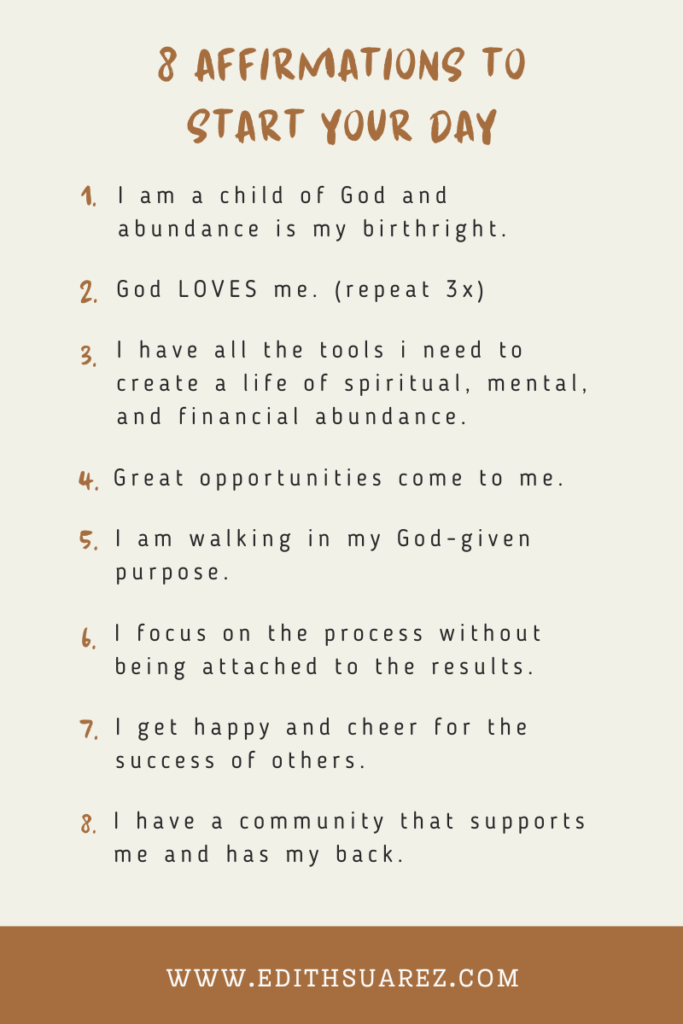
Credit: edithsuarez.com
Cultural Views On Affirmations
Different cultures have their own ways of using positive statements. In some traditions, affirmations are linked to prayer or meditation. In others, they are part of daily rituals. For example, mindfulness practices in Buddhism focus on repeating loving-kindness phrases. Western psychology uses affirmations for self-esteem.
What matters is not the words, but the intention and regular practice.
Mixing Affirmations With Other Morning Habits
Affirmations can be even more powerful when combined with other morning routines. Here are some ideas:
- After Meditation: Your mind is calm and open, making affirmations more effective.
- Before Exercise: Boost your motivation with, “I am strong and energetic.”
- During Shower: The warm water helps you relax and focus on your words.
- While Journaling: Write your affirmation and add a few reasons why it matters today.
Mixing habits keeps your routine fresh and increases the benefits.
Frequently Asked Questions
How Many Affirmations Should I Use Each Morning?
Start with 2-5. This number is easy to remember and repeat. Too many can feel overwhelming. As you get used to the practice, you can add more or change them based on your needs.
Do Affirmations Really Work If I Don’t Believe Them?
They work best when you believe, at least a little. If an affirmation feels fake, adjust it to something you can accept. For example, say “I am learning to be confident” instead of “I am always confident. ” Small steps help build belief.
When Will I Start Seeing Results?
Most people notice small changes in mood or attitude in 2-4 weeks. Bigger changes, like improved self-confidence, may take longer. Consistency is the key. Don’t expect overnight results.
Can I Say Affirmations Silently Or Do I Need To Say Them Out Loud?
Both ways work, but saying them out loud is usually more powerful. Hearing your own voice helps your mind remember and believe the words. If you can’t speak out loud, repeating in your mind or writing them is also effective.
Where Can I Find More Information About Affirmations?
Reliable sources include psychology books, therapy resources, and respected wellness sites. For more research-based information, visit the Wikipedia page on affirmations.
Starting your morning with affirmations is simple, free, and powerful. With the right statements and regular practice, you can change your mindset, reduce stress, and set a positive tone for your whole day. It’s not just about saying nice words—it’s about creating a habit that lifts you up and helps you become the person you want to be.
Why not try it tomorrow morning and see how you feel?
