

What are Tricep Workouts With Dumbbells: Best Moves to Try
What Are Tricep Workouts With Dumbbells
Many people want stronger arms, but most focus only on the biceps. The triceps are actually the larger muscle on the back of your upper arm. If you want toned, powerful arms, you cannot ignore triceps. Dumbbells make tricep training accessible for everyone—whether you’re at home, in a gym, or even traveling. You don’t need complicated equipment or special machines. With a pair of dumbbells, you can target all three heads of the triceps muscle and build real strength.
In this article, you’ll learn exactly how dumbbell workouts work for triceps, which exercises are most effective, how to structure your routine, and common mistakes to avoid. We’ll explore the science behind tricep growth, compare dumbbells with other equipment, and break down essential tips for both beginners and experienced lifters.
By the end, you’ll have a complete guide to tricep training with dumbbells that fits your goals and your lifestyle.
Understanding The Triceps
The triceps brachii muscle sits on the back of the upper arm. It has three parts, called “heads”:
- Long head: Runs along the back of your arm, helps with shoulder and elbow movement.
- Lateral head: On the outer side of your arm, gives the “horseshoe” shape.
- Medial head: Located under the other two, provides stability and endurance.
The main job of the triceps is to extend your elbow. Any movement where you straighten your arm will use your triceps. When you push, press, or reach overhead, your triceps are working.
Why Train Triceps?
Strong triceps help with:
- Pushing strength: Better performance in sports, fitness, and daily activities.
- Arm shape: More defined, toned upper arms.
- Joint health: Support for elbow and shoulder movements.
Neglecting triceps can cause muscle imbalances, leading to poor posture and increased injury risk.
Benefits Of Using Dumbbells For Triceps
Dumbbells are one of the most versatile tools for tricep workouts. They offer several advantages over machines, barbells, and resistance bands.
1. Improved Range Of Motion
With dumbbells, your arms can move freely. You’re not locked into a fixed path like with a barbell or machine. This freedom helps you work the full range of the triceps, which is key for growth and flexibility.
2. Balanced Muscle Development
Dumbbells force each arm to work independently. This reduces the risk of one arm becoming stronger than the other. It also helps correct imbalances, which can improve your overall strength and appearance.
3. Adaptable To Any Level
You can start with very light dumbbells and progress as you get stronger. Many exercises can be adjusted for beginners or advanced lifters. Dumbbells work for all fitness levels.
4. Convenience
Dumbbells are easy to use at home, require little space, and are simple to store. You don’t need a full gym setup.
5. Joint Safety
The free movement allowed by dumbbells reduces stress on the wrists, elbows, and shoulders, lowering the risk of injury.
Science Behind Tricep Growth
To build stronger and bigger triceps, you need to follow basic muscle growth principles:
- Progressive overload: Increase weight, reps, or intensity over time.
- Proper technique: Focus on slow, controlled movements.
- Full range of motion: Stretch and contract the muscle completely.
Research shows that training triceps with a mix of compound (multi-joint) and isolation (single-joint) movements is most effective. Compound exercises like the dumbbell bench press involve the triceps as helpers, while isolation moves like the overhead dumbbell extension target the triceps directly.
Most Effective Tricep Dumbbell Exercises
Let’s break down the top dumbbell exercises for triceps. Each one targets the muscle in a different way. You can combine several of these in your routine for full development.
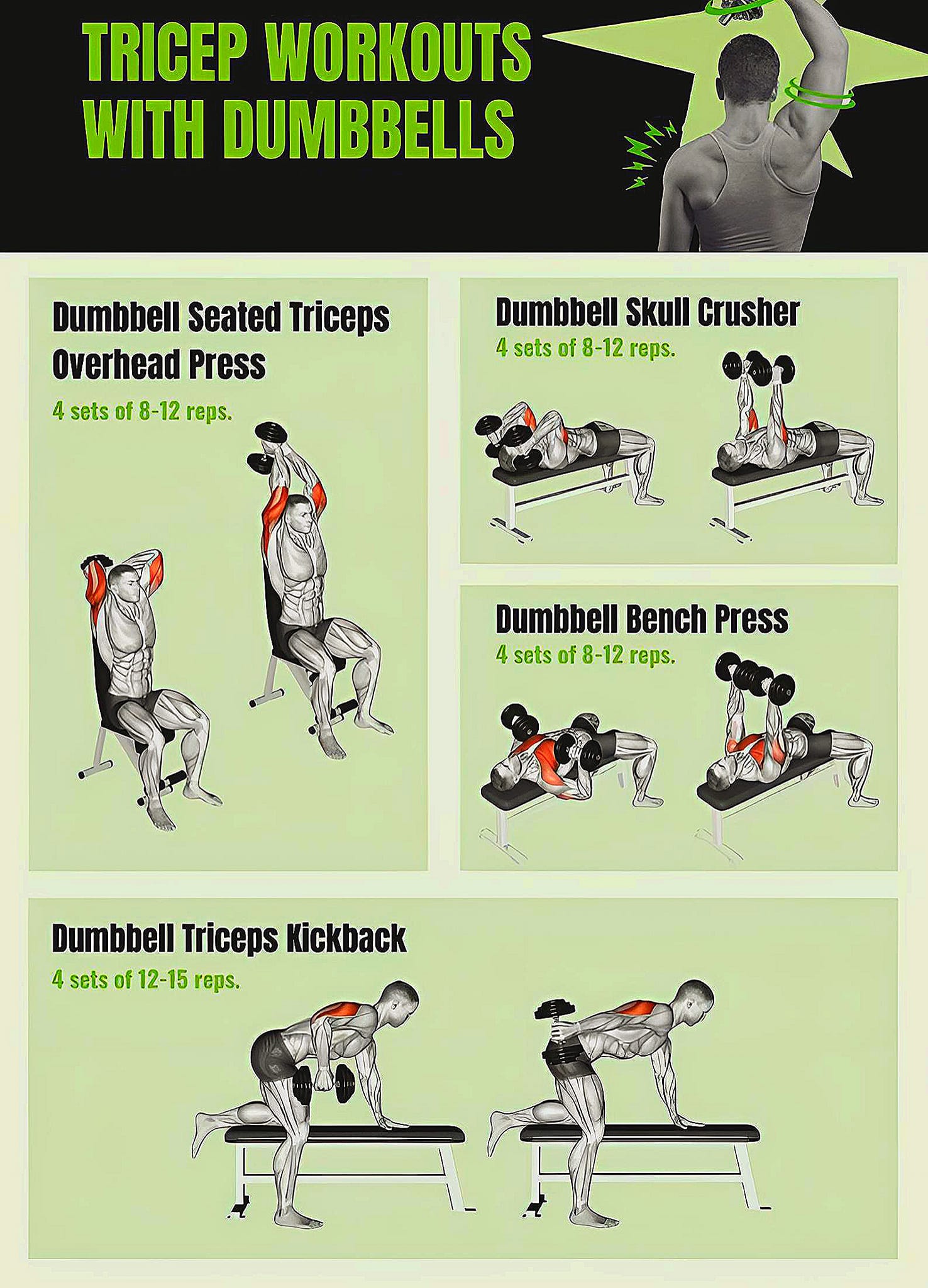
1. Dumbbell Tricep Kickback
This exercise isolates the triceps and is easy to learn.
How to do it:
- Hold a dumbbell in one hand.
- Bend forward at the waist, keeping your back flat.
- Keep your upper arm still; bend your elbow to 90 degrees.
- Extend your arm straight back, squeezing your triceps.
- Return to start and repeat.
Tips:
- Keep your elbow close to your body.
- Don’t swing the dumbbell.
- Use light weights for perfect form.
2. Overhead Dumbbell Extension
Targets the long head of the triceps.
How to do it:
- Sit or stand with a dumbbell held overhead, both hands gripping one end.
- Lower the dumbbell behind your head, keeping elbows close.
- Straighten your arms to lift the dumbbell back up.
Tips:
- Avoid flaring elbows too much.
- Use a slow, controlled motion.
3. Dumbbell Skull Crusher
Works all three heads of the triceps.
How to do it:
- Lie on a bench, holding two dumbbells.
- Start with arms straight above your chest.
- Bend elbows to lower dumbbells toward your forehead.
- Extend arms to return to start.
Tips:
- Don’t drop dumbbells too fast.
- Keep upper arms steady.
4. Dumbbell Close-grip Press
Combines chest and triceps work.
How to do it:
- Lie on a bench, hold two dumbbells close together above your chest.
- Lower dumbbells to chest, keeping elbows tucked.
- Press back up.
Tips:
- Focus on pushing with triceps, not chest.
5. Single-arm Overhead Extension
Great for correcting imbalances.
How to do it:
- Hold a dumbbell in one hand, raise above head.
- Lower behind head, then extend back up.
Tips:
- Keep elbow pointing forward.
- Don’t rush.
6. Dumbbell Floor Press
Safe for beginners.
How to do it:
- Lie on the floor, hold two dumbbells.
- Press up, then lower until elbows touch floor.
Tips:
- Don’t arch back.
- Use full extension.
7. Dumbbell Tate Press
Works inner triceps.
How to do it:
- Lie on bench, hold dumbbells above chest.
- Lower dumbbells towards chest, keeping elbows out.
- Press back up.
Tips:
- Use lighter weights to avoid shoulder strain.
8. Seated Dumbbell French Press
Variation of overhead extension.
How to do it:
- Sit, hold dumbbell overhead with both hands.
- Lower behind head, then press up.
Tips:
- Keep wrists straight.
9. Dumbbell Reverse Grip Press
Targets medial head.
How to do it:
- Lie on bench, hold dumbbells with palms facing up.
- Press up and lower to chest.
Tips:
- Keep elbows close.
10. Dumbbell Diamond Press
Focuses on lateral head.
How to do it:
- Lie on bench, hold dumbbells together above chest.
- Lower to chest, elbows close.
Tips:
- Squeeze dumbbells together.
Structuring Your Tricep Dumbbell Workout
To get the best results, you need to plan your workouts carefully. Here’s how you can build a routine:
Frequency
Most people train triceps 2–3 times per week. This allows time for recovery and growth.
Sets And Reps
- Beginners: 2–3 sets of 10–12 reps per exercise
- Intermediate: 3–4 sets of 8–12 reps
- Advanced: 4–5 sets of 6–12 reps
Sample Routine
You can mix exercises to cover all tricep heads. Here’s an example:
- Overhead Dumbbell Extension – 3 sets x 10 reps
- Dumbbell Kickback – 3 sets x 12 reps
- Dumbbell Skull Crusher – 3 sets x 8 reps
- Dumbbell Close-Grip Press – 3 sets x 10 reps
Rest: 60–90 seconds between sets
Progression
As you get stronger, increase the weight or number of reps. Don’t jump too quickly; slow progress is safer and more effective.
Comparing Dumbbells With Other Tricep Equipment
Many people wonder if dumbbells are better than other tools. Let’s compare dumbbells with barbells, resistance bands, and machines.
| Equipment | Strength Gains | Muscle Activation | Ease of Use | Safety |
|---|---|---|---|---|
| Dumbbells | High | Excellent | Easy | Safe |
| Barbells | Very High | Good | Medium | Moderate |
| Resistance Bands | Moderate | Moderate | Very Easy | Very Safe |
| Machines | High | Good | Easy | Safe |
As you can see, dumbbells score high for strength gains, muscle activation, and safety. They are easy to use and offer more freedom than machines or barbells.
Common Mistakes In Dumbbell Tricep Workouts
Many beginners make errors that limit progress or cause injury. Watch out for these:
1. Using Too Much Weight
Heavy weights can make you lose form, especially in isolation exercises. Start light and focus on technique.
2. Poor Elbow Position
Letting elbows flare out reduces tricep activation and increases shoulder strain. Keep elbows close to your body or pointing forward.
3. Incomplete Range Of Motion
Not fully straightening or bending your arm limits muscle growth. Move through the full range for every rep.
4. Speeding Through Reps
Rushing leads to poor control. Slow, controlled movements build muscle better and prevent injury.
5. Neglecting Recovery
Triceps need rest to grow. Don’t train them every day.
6. Ignoring Warm-ups
A simple warm-up, like arm circles or light pressing, prepares muscles and joints for exercise.
How Dumbbell Tricep Workouts Fit Different Goals
Tricep training isn’t just for bodybuilders. It suits a wide range of fitness goals.
1. Toning And Shaping
For people who want lean, defined arms, dumbbell workouts are perfect. High reps with moderate weights can help reduce fat and improve muscle tone.
2. Building Strength
For those seeking strength, lower reps with heavier dumbbells will challenge the triceps and boost pushing power.
3. Improving Functionality
If you want better performance in sports or daily life, mix compound and isolation moves. This builds endurance and stability.
4. Rehabilitation
Light dumbbell exercises can help recover from injuries. Always consult a health professional for guidance.

Credit: www.youtube.com
Beginner’s Guide To Tricep Dumbbell Training
If you’re new, start simple and focus on learning the basics.
Choosing The Right Weight
Pick a weight you can lift for 10–15 reps with good form. If you struggle, go lighter.
Learning Proper Form
Practice each movement without weight first. Use a mirror or record yourself to check elbow position.
Sample Beginner Routine
- Dumbbell Kickback – 2 sets x 12 reps
- Overhead Dumbbell Extension – 2 sets x 10 reps
- Dumbbell Floor Press – 2 sets x 12 reps
Rest 90 seconds between sets.
Avoiding Overtraining
Train triceps 2 times per week. Give at least 48 hours rest between sessions.
Advanced Tricep Dumbbell Techniques
For more experienced lifters, you can use advanced strategies to push your triceps further.
Drop Sets
Do a set with heavy weight, then reduce the weight and continue without rest. This exhausts the muscle.
Supersets
Pair two tricep exercises and do them back-to-back. For example, do overhead extensions and kickbacks together.
Slow Eccentric Reps
Lower the dumbbell slowly (3–5 seconds), then lift normally. This increases muscle tension and growth.
Example Advanced Routine
- Dumbbell Skull Crusher (slow eccentric) – 4 sets x 8 reps
- Dumbbell Tate Press – 3 sets x 10 reps
- Drop Set Kickbacks – 3 sets
Tricep Dumbbell Workout Variations
Changing your routine prevents plateaus and keeps training interesting.
1. Incline Bench Kickbacks
Use an incline bench for kickbacks. This changes the angle and increases muscle activation.
2. Standing Vs. Seated Extensions
Standing extensions involve core muscles, while seated versions isolate triceps more.
3. Alternating Arms
Doing exercises one arm at a time can improve mind-muscle connection and fix imbalances.
4. Unilateral Training
Single-arm overhead extensions help balance strength between arms.
Tips For Maximizing Tricep Growth
Small changes can make a big difference in your results.
- Focus on muscle contraction: Squeeze triceps at the top of each rep.
- Control the lowering phase: Don’t let dumbbells drop quickly.
- Change grip positions: Try neutral, reverse, and standard grips.
- Increase training volume gradually: Don’t add too many sets at once.
- Eat enough protein: Muscles need protein to grow.
Many beginners forget to change grip positions or squeeze the triceps at the top. These details boost muscle activation.

Credit: repfitness.com
Sample Weekly Tricep Dumbbell Training Plan
Here’s a simple plan for balanced development:
Day 1 (Strength):
- Dumbbell Skull Crusher – 4 sets x 8 reps
- Dumbbell Close-Grip Press – 3 sets x 10 reps
Day 3 (Endurance):
- Dumbbell Kickback – 3 sets x 15 reps
- Overhead Dumbbell Extension – 3 sets x 12 reps
Day 5 (Variety):
- Dumbbell Tate Press – 3 sets x 10 reps
- Incline Bench Kickback – 3 sets x 12 reps
Rest days allow your muscles to recover and grow.
Tricep Dumbbell Exercise Comparison
Different dumbbell exercises target different parts of the triceps. Here’s a comparison of three popular moves:
| Exercise | Main Tricep Head Targeted | Difficulty | Recommended For |
|---|---|---|---|
| Overhead Extension | Long Head | Moderate | All Levels |
| Kickback | Lateral Head | Easy | Beginners |
| Skull Crusher | All Heads | Hard | Intermediate/Advanced |
This helps you pick exercises based on your skill level and goals.
How To Avoid Plateaus In Tricep Training
Plateaus happen when progress stops. Here’s how to keep improving:
Change Exercise Selection
Switch up your routine every 4–6 weeks. Try new variations and grips.
Adjust Sets And Reps
Increase or decrease volume to challenge muscles differently.
Improve Nutrition
Make sure you’re eating enough calories and protein to support muscle growth.
Track Progress
Keep a workout log. Write down weights, reps, and how you feel. This helps you see what’s working.
Tricep Dumbbell Workout For Home
You don’t need a gym to train your triceps. With just a pair of dumbbells, you can do a full workout at home.
Home Routine Example
- Dumbbell Kickback – 3 sets x 15 reps
- Overhead Extension – 3 sets x 12 reps
- Floor Press – 3 sets x 10 reps
No bench? Use a sturdy chair for seated exercises.
Safety Tips
- Check your workout space for hazards.
- Use proper form to avoid injury.
- Warm up before starting.
Recovery And Injury Prevention
Training triceps too often or with bad form can cause injuries. Here’s how to stay safe:
Listen To Your Body
If you feel pain (not just muscle soreness), stop and rest.
Stretch After Workouts
Gentle stretching helps prevent tightness.
Use Good Technique
Always focus on form. Don’t let ego push you to heavier weights.
Don’t Neglect Other Muscles
Balanced training prevents overuse injuries.
Nutrition For Tricep Growth
Muscle growth needs the right fuel. Protein is most important, but don’t forget about carbs and healthy fats.
Protein Sources
- Chicken, beef, fish
- Eggs
- Beans
- Greek yogurt
Aim for 0.7–1 gram of protein per pound of bodyweight.
Hydration
Drink water before, during, and after workouts. Dehydration slows recovery.
Supplements
A simple whey protein shake can help, but focus on whole foods first.
How Dumbbell Tricep Training Helps Other Exercises
Strong triceps make other movements easier:
- Bench press: More power to push the bar.
- Shoulder press: Helps lock out overhead weights.
- Push-ups: Better endurance and form.
Triceps are involved in many compound lifts. Training them improves overall strength.
Why Women Should Train Triceps
Many women worry about “bulky” arms. In reality, tricep training creates lean, toned arms and improves confidence. Dumbbell exercises are safe and adaptable for all fitness levels. Higher reps with moderate weights can help shape the arms without adding unwanted bulk.
Tricep Dumbbell Training Myths
There are several common myths:
- Myth 1: Only heavy weights build muscle. Truth: High reps with moderate weights also grow muscle.
- Myth 2: Triceps don’t matter for arm size. Truth: Triceps are bigger than biceps.
- Myth 3: Dumbbells are less effective than machines. Truth: Dumbbells offer more freedom and often activate more muscle.
Real-life Example
Consider Sarah, who wanted stronger arms but only trained biceps. She added dumbbell tricep workouts twice a week. In two months, her arm definition improved, and she could do more push-ups. Focusing on triceps made a big difference.
Tricep Dumbbell Exercise Intensity Table
Intensity varies by exercise and weight. Here’s a guide:
| Exercise | Intensity (1-10) | Best for |
|---|---|---|
| Kickback | 5 | Beginners |
| Overhead Extension | 7 | All Levels |
| Skull Crusher | 8 | Experienced |
| Close-Grip Press | 6 | Intermediate |
| Tate Press | 7 | Advanced |
Use this to plan your workout based on your experience.
Frequently Asked Questions
What Is The Best Dumbbell Exercise For Triceps?
The overhead dumbbell extension is great for targeting the long head of the triceps. The skull crusher works all three heads and builds size and strength. For beginners, the kickback is easy and effective.
How Often Should I Train Triceps With Dumbbells?
Most people benefit from 2–3 sessions per week. This allows muscles to recover and grow. Avoid training triceps every day to prevent overuse injuries.
Can I Build Big Triceps With Only Dumbbells?
Yes, you can. Dumbbell exercises activate all tricep heads and offer enough resistance for growth. Consistent training, good nutrition, and gradual progression are key.
What Weight Dumbbells Should I Use For Tricep Workouts?
Start with a weight you can lift for 10–15 reps with good form. For most beginners, 5–15 pound dumbbells work well. Increase weight as you get stronger.
Are Dumbbell Tricep Workouts Safe For Beginners?
They are very safe if you use proper form and start with light weights. Always warm up and avoid rushing through exercises. Dumbbells are easier on joints compared to barbells.
Building strong, toned triceps with dumbbells is achievable for anyone. With the right exercises, a smart routine, and attention to form, your arms will become stronger and more defined. Dumbbells offer flexibility, safety, and effectiveness, making them the ideal choice for tricep training at any fitness level. For more detailed exercise descriptions and muscle science, visit Healthline. Keep challenging yourself, track your progress, and enjoy the benefits of powerful triceps.
Credit: www.nilds.gov.ng
