

Ladies Glute Workout: Top Exercises for a Toned and Lifted Booty
Ladies Glute Workout: The Complete Guide to Building Strong, Toned Glutes
A strong, toned lower body is not just about looks—it helps with daily movement, posture, and injury prevention. For many women, building the glute muscles (the gluteus maximus, medius, and minimus) is a top fitness goal. But with so much information online, it’s easy to feel overwhelmed or confused about where to start.
This guide will help you understand why glute training is important, how to build a workout plan, and what exercises to choose. You'll learn how to activate your glutes, avoid common mistakes, and see real progress. Whether you're a beginner or have some experience, you’ll find practical advice, useful comparisons, and answers to common questions. Let’s dive into the world of ladies’ glute workouts and unlock your lower body’s true potential.
Why Glute Workouts Matter For Women
Many women focus on their glutes for aesthetics, but the benefits go much deeper. The glute muscles are the largest in the body and play a key role in movement. Training them properly can lead to:
- Improved posture and reduced back pain
- More power in activities like running, jumping, and climbing stairs
- Better balance and stability
- Injury prevention, especially in the knees and hips
Weak glutes can cause other muscles to overwork, leading to pain and injury. For example, if your glutes are inactive, your lower back and hamstrings take on extra strain. This is a common cause of discomfort for people who sit for long periods.
The Three Main Glute Muscles
Understanding the three glute muscles helps you train them effectively:
- Gluteus maximus: The largest part, gives shape and power to your backside.
- Gluteus medius: Located on the side of your hip, important for hip stability.
- Gluteus minimus: Under the medius, helps with leg movement and stability.
A good workout plan trains all three muscles for strength, size, and function.
Key Principles Of Effective Glute Training
To get real results, women need to focus on more than just squats. Here are the core principles:
Progressive Overload
Muscles grow when you challenge them. Progressive overload means slowly increasing the weight, sets, or reps over time. This signals your body to build stronger muscles.
Mind-muscle Connection
Many women perform glute exercises but feel them more in the thighs or back. To target your glutes, focus on the muscles during each rep. Slow down, squeeze at the top, and avoid rushing.
Exercise Variety
No single exercise works every part of your glutes. Include different movements to train all areas. For example:
- Hip thrusts for the gluteus maximus
- Side-lying leg lifts for the medius and minimus
- Step-ups and lunges for overall balance
Recovery Is Essential
Muscles need time to recover. Rest at least 48 hours before training glutes again. This helps prevent injury and supports muscle growth.
Consistency
Results take time. Stick with your routine for several weeks. Adjust as you get stronger.
How To Build A Ladies Glute Workout
Let’s break down the steps to create your own effective glute workout plan.
1. Set Clear Goals
Decide what you want: bigger glutes, more strength, better athletic performance, or injury prevention. Your goal shapes your workout structure.
2. Choose The Right Exercises
Pick 4–6 exercises for each session. Combine compound movements (work multiple muscles) and isolation exercises (focus on glutes). For example:
- Compound: Squats, deadlifts, hip thrusts, lunges
- Isolation: Glute bridges, kickbacks, clamshells
3. Plan Your Sets And Reps
For most women, 3–4 sets of 8–15 reps is a great starting point. Heavier weights and fewer reps build strength, while lighter weights and more reps improve endurance.
4. Warm Up And Activate
Start with a 5–10 minute warm-up (walking, cycling, or dynamic stretches). Then, do 1–2 activation exercises to wake up your glutes. This prepares your muscles and helps you feel them during the workout.
5. Track Your Progress
Write down your exercises, weights, and reps each session. Adjust as you get stronger.
The Best Glute Exercises For Women
Let’s look at the best exercises for building and shaping the glutes. Each one has a unique benefit. Mix and match based on your fitness level.
Hip Thrust
The hip thrust is one of the most effective glute builders.
- Sit on the floor with your upper back against a bench, feet flat
- Roll a barbell or place a dumbbell over your hips
- Drive through your heels, lifting your hips until your body forms a line from shoulders to knees
- Squeeze your glutes at the top, lower back down
Tip: Pause and squeeze at the top for 1–2 seconds for maximum activation.
Glute Bridge
Similar to the hip thrust but performed lying on the floor.
- Lie on your back, knees bent, feet flat
- Push through your heels, lift your hips as high as possible
- Squeeze your glutes, then lower
This is great for beginners or as a warm-up.
Bulgarian Split Squat
This single-leg squat targets the glutes, quads, and hamstrings.
- Stand with one foot on a bench behind you
- Lower your body until your front thigh is parallel to the ground
- Push through your front heel to return
Keep your chest up and core tight.
Romanian Deadlift
This move trains the glutes and hamstrings.
- Hold a barbell or dumbbells in front of your thighs
- With a slight knee bend, hinge at your hips, lowering the weight down your legs
- Stop when you feel a stretch, return to standing by driving your hips forward
Don’t round your back; keep it straight.
Cable Kickback
This isolation exercise targets the gluteus maximus.
- Attach an ankle strap to a low cable
- Stand facing the machine, and kick your leg back and up
- Squeeze at the top, then lower slowly
Go slow to avoid using momentum.
Clamshell
Works the glute medius and minimus.
- Lie on your side, knees bent, feet together
- Open your top knee while keeping your feet together
- Pause, then lower
Add a resistance band for more challenge.
Step-up
A simple but powerful move.
- Stand in front of a bench or sturdy box
- Step up with one foot, drive through your heel, and bring the other leg up
- Step down and repeat
Keep the movement slow and controlled.
Sample Glute Workout Plan
Here’s a sample workout for women, designed to hit all glute areas:
- Glute activation: Banded clamshells – 2 sets of 15 reps each side
- Hip thrusts – 4 sets of 10 reps
- Bulgarian split squats – 3 sets of 12 reps each leg
- Romanian deadlifts – 3 sets of 12 reps
- Cable kickbacks – 3 sets of 15 reps each side
- Step-ups – 3 sets of 12 reps each leg
Rest 60–90 seconds between sets. Adjust weight to make the last 2 reps challenging but doable.
Comparing Glute Exercises: What Works Best?
Not all exercises are equal for glute development. Here’s a comparison of common moves for glute activation and muscle growth:
| Exercise | Glute Activation | Difficulty | Equipment Needed |
|---|---|---|---|
| Hip Thrust | Very High | Intermediate | Barbell/Bench |
| Glute Bridge | High | Beginner | Bodyweight/Dumbbell |
| Bulgarian Split Squat | High | Intermediate | Bench/Dumbbells |
| Step-Up | Medium | Beginner | Bench/Box |
| Cable Kickback | Medium | Beginner | Cable Machine |
| Clamshell | Medium | Beginner | Resistance Band |
Non-obvious insight: Many beginners believe squats are the best glute builder, but studies show hip thrusts and split squats often activate the glutes more. Try shifting focus if you feel squats mainly in your thighs.
Advanced Glute Training Techniques
Once you’ve mastered the basics, add new challenges to keep progressing.
1. Resistance Bands
Bands add tension at the top of movements like squats, bridges, and clamshells. They’re affordable and perfect for home workouts. Use them to increase glute activation or for warm-ups.
2. Tempo Training
Slow down your reps—take 3 seconds down, 1 second up. This increases time under tension and helps you feel the glutes working.
3. Unilateral Exercises
Single-leg moves (like split squats or single-leg glute bridges) help fix muscle imbalances. You may notice one side is weaker or smaller—single-leg work addresses this.
4. Drop Sets And Supersets
For a bigger challenge, try doing two exercises back-to-back (superset), or continue a set with lighter weight after reaching failure (drop set). For example: hip thrusts followed by bodyweight bridges.
5. Glute Activation Before Heavy Lifts
Before squats or deadlifts, do 1–2 sets of light glute exercises (like banded walks). This “wakes up” the muscles, so you use them more during your main lifts.
Common Mistakes Women Make In Glute Training
Many women train hard but see little change. Here’s why:
1. Poor Form
If you rush or use bad form, other muscles take over. Example: Leaning too far forward in squats shifts work to your quads, not glutes.
2. Not Enough Weight
Bodyweight moves are good for beginners, but you need resistance to build muscle. Increase the weight as you get stronger.
3. Ignoring Mind-muscle Connection
Thinking about your glutes during each rep can double activation. Don’t just move the weight—focus on feeling the muscle work.
4. Skipping Compound Movements
Isolation exercises help, but big moves like hip thrusts and split squats drive most growth.
5. Lack Of Variety
Repeating the same exercises leads to plateaus. Change your routine every 4–6 weeks for best results.
Pro tip: Film yourself or train with a coach to check your form. Most people miss small errors that make a big difference.
Home Vs. Gym Glute Workouts
You can build great glutes at home or in the gym. Here’s a quick comparison:
| Setting | Pros | Cons | Best Exercises |
|---|---|---|---|
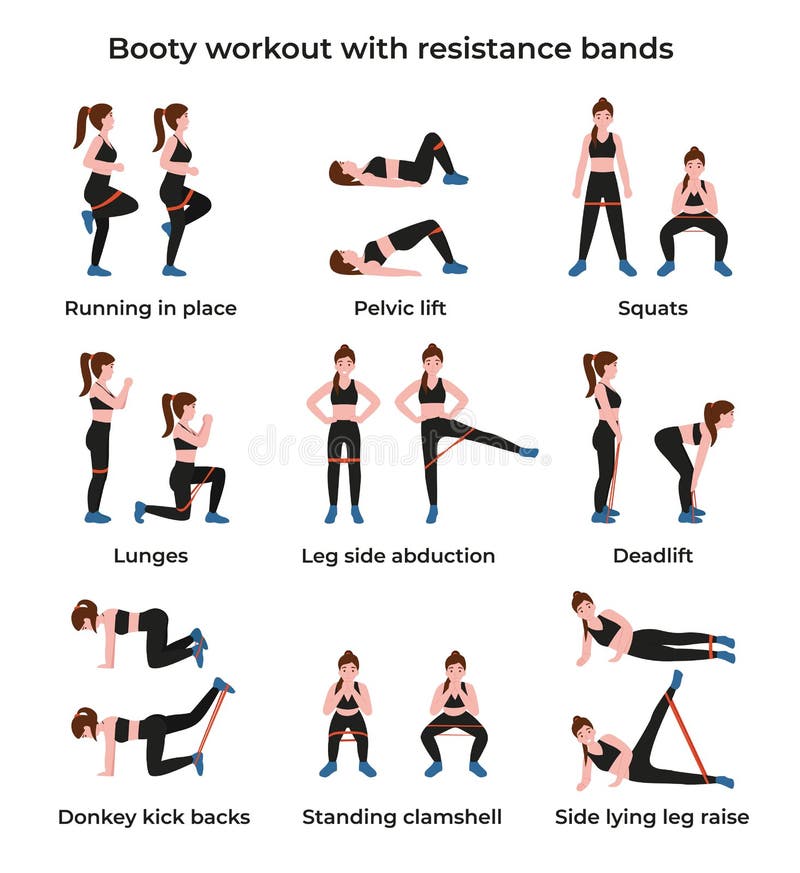
| Home | Convenient, private, low cost | Limited equipment, harder to add heavy weight | Banded bridges, single-leg squats, step-ups, clamshells |
| Gym | Access to heavy weights, machines, variety | Travel time, membership cost, busy equipment | Hip thrusts, deadlifts, cable kickbacks, split squats |
Non-obvious insight: You don’t need machines to see results. Consistent bodyweight and band exercises can build glutes, especially for beginners.
Credit: www.dreamstime.com
Nutrition Tips For Glute Growth
Working out is only half the story—your body needs the right fuel to build muscle.
Protein
Muscles need protein to repair and grow. Aim for at least 0.7 grams per pound of bodyweight each day (for a 140-pound woman, that’s about 100 grams). Good sources include:
- Chicken, turkey, fish
- Eggs
- Greek yogurt
- Beans and lentils
Carbohydrates
Carbs give energy for tough workouts and help muscles recover. Choose whole grains, fruits, and veggies.
Healthy Fats
Fats support hormone health. Include avocados, nuts, olive oil, and fatty fish.
Hydration
Drink enough water—muscles work best when hydrated.
Example Meal Plan For Glute Growth
- Breakfast: Scrambled eggs, whole grain toast, berries
- Snack: Greek yogurt, almonds
- Lunch: Grilled chicken, quinoa, roasted vegetables
- Snack: Hummus with carrots
- Dinner: Salmon, brown rice, steamed broccoli
Pro tip: Track your food for a week. Many women under-eat protein without realizing it.
How To Tell If Your Glute Workout Is Working
Results may take weeks to show, but here are clear signs you’re on the right track:
- You feel your glutes working during exercises (not your back or thighs)
- You can lift heavier weights over time
- Your glutes look and feel firmer or rounder
- Your clothes fit differently in the hip area
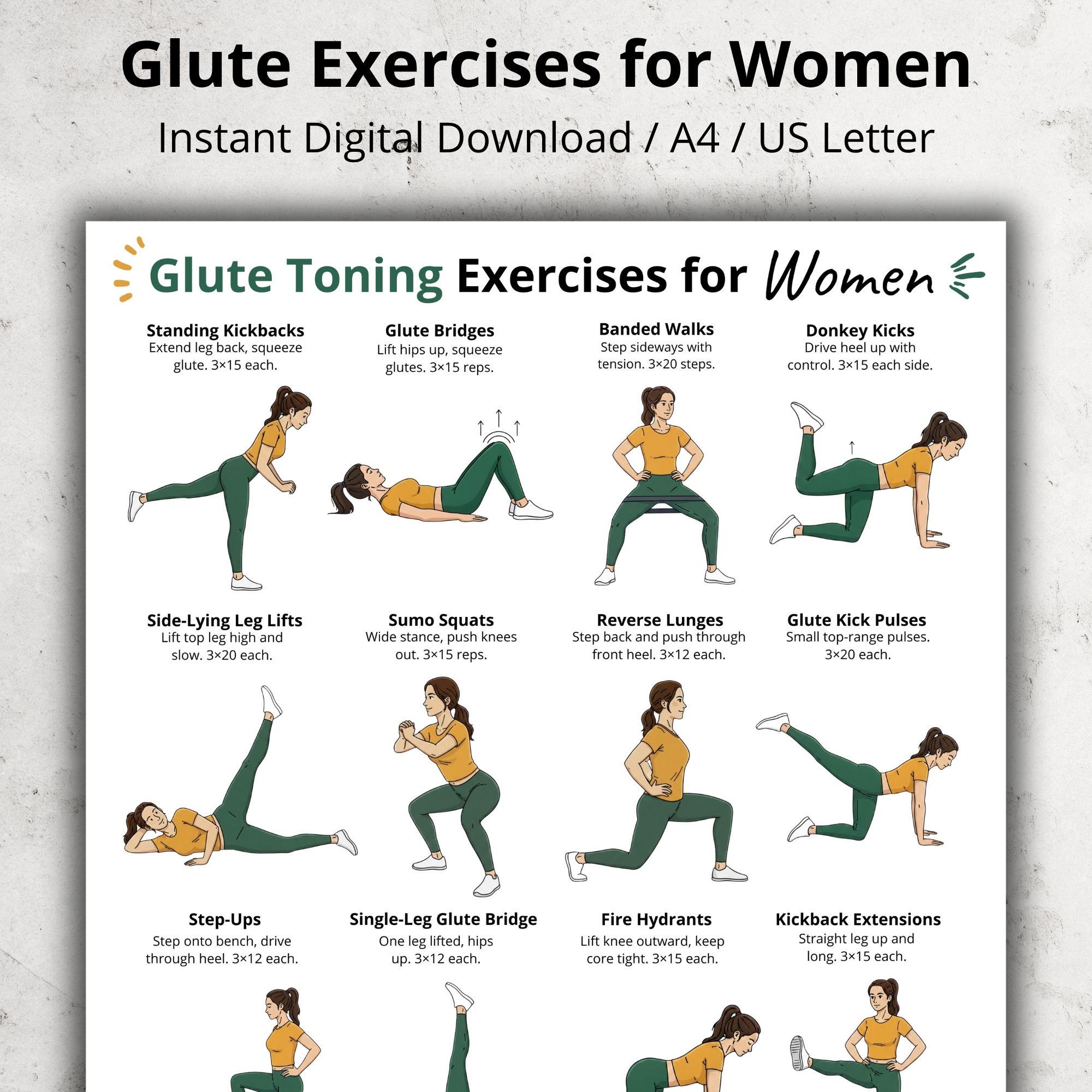
Unexpected insight: Soreness is not required for muscle growth. Focus on progress in strength, not just how sore you feel.
Credit: www.etsy.com
How Often Should Women Train Glutes?
Most women see good results training glutes 2–3 times per week. This gives enough stimulus without overtraining. For example:
- Monday: Full lower body (glute-focused)
- Wednesday: Upper body
- Friday: Glute and hamstring focus
Rest at least one day between hard glute sessions. More is not always better—quality beats quantity.
Cardio And Glute Growth: What You Need To Know
Cardio is great for health and fat loss, but too much can slow muscle growth. Here’s how to balance it:
- Limit long, slow cardio (like jogging) if your main goal is glute size
- Include short, intense intervals (like sprints or hill runs) for better glute activation
- Try stair climbing or incline walking for extra glute work
Aim for 2–3 cardio sessions per week, and place them after your glute workouts when possible.
Stretching And Mobility For Glute Health
Strong glutes need to be flexible too. Tight hips or lower back can block glute activation.
Best stretches for glutes:
- Figure-4 stretch: Lie on your back, cross one ankle over the opposite knee, pull the leg toward your chest
- Pigeon pose: From a plank, bring one knee toward your hand, extend the other leg behind
- Hip flexor stretch: Kneel on one knee, push hips forward, feel the stretch in the front of your hip
Hold each stretch for 20–30 seconds. Stretch after your workout or on rest days.
Tracking Your Glute Progress
Measuring progress keeps you motivated. Here’s how:
- Take photos from the side and back every 4 weeks
- Measure your hips and thighs with a tape
- Log your weights and reps each workout
Unexpected insight: Weight on the scale may stay the same or go up as you build muscle and lose fat. Focus on how you look and feel.

Credit: www.muscleandstrength.com
Real-life Example: Glute Transformation Story
Sara, a 32-year-old office worker, wanted to lift and tone her glutes. She started with bodyweight bridges, split squats, and resistance bands at home, training three times a week. After four weeks, she added dumbbells and increased her protein. By week eight, her glutes felt firmer, and her jeans fit better.
She noticed less back pain and more energy for daily tasks.
Sara’s biggest lesson: “Activating my glutes before each workout made a huge difference. I thought I was doing everything right before, but once I slowed down and focused on the muscle, my results took off.”
Glute Workouts For Different Fitness Levels
Everyone starts somewhere. Here’s how to adjust your glute workout based on experience:
| Level | Focus | Best Exercises | Tips |
|---|---|---|---|
| Beginner | Learning form, muscle activation | Bodyweight bridges, clamshells, step-ups | Start with low weight, focus on control |
| Intermediate | Adding weight, variety | Hip thrusts, split squats, deadlifts | Add resistance, try new exercises |
| Advanced | High intensity, advanced techniques | Barbell hip thrusts, heavy deadlifts, supersets | Use drop sets, increase training volume |
Insight: Progress isn’t just about adding weight. Better form, more control, and stronger activation are just as important.
Glute Training And Hormones
Women sometimes worry about bulking up or changing their body shape too much. Here’s what you need to know:
- Women have less testosterone than men, so muscle growth is slower and less dramatic
- Building glutes shapes curves, but you won’t get bulky unless you train like a bodybuilder and eat a lot more calories
Bonus: Strong glutes can help with hormonal balance by supporting better insulin sensitivity and reducing belly fat.
Using Technology To Boost Your Glute Workout
Many women find success with apps or online programs. These tools can track progress, suggest workouts, or help with form.
Some popular options:
- Fitness tracking apps (log your sets, reps, and weights)
- Video tutorials for proper technique
- Online communities for support and motivation
If you like structure, try a glute-specific program for 8–12 weeks.
For more tips on exercise and health, the Mayo Clinic’s guide to strength training is a trusted resource.
Frequently Asked Questions
What If I Only Feel My Thighs, Not My Glutes, During Workouts?
This is common, especially for beginners. Try glute activation exercises before your main workout, slow down your reps, and focus on squeezing your glutes. Adjust foot placement and range of motion until you feel your glutes working.
How Long Does It Take To See Glute Growth?
Most women notice changes in 6–12 weeks if they train consistently and eat enough protein. Progress is slow but steady. Take photos every month to track small changes.
Do I Need To Lift Heavy Weights To Grow My Glutes?
Heavy weights help, but you can see results with moderate weight and high volume. The key is challenging your muscles—if the last few reps are tough, you’re on the right track.
Can I Do Glute Workouts Every Day?
It’s best to give your muscles time to rest and recover. Training glutes 2–3 times a week is enough for most women. Overtraining can cause injury or slow progress.
What Is The Best Exercise For Glutes At Home?
Hip thrusts (using a couch or bench), single-leg glute bridges, and banded exercises are excellent for home workouts. Focus on slow, controlled reps and increase resistance as you get stronger.
Strong, shapely glutes are possible for every woman. Start simple, focus on quality, and build your routine as you grow. With the right approach, you’ll see not just a change in your body, but also in your confidence and strength.
