

How to Do Tricep Workout on Cable Machine for Maximum Gains
How To Do Tricep Workout On Cable Machine
Building strong, defined triceps can transform the look and strength of your arms. While many people focus on biceps, the triceps actually make up most of your upper arm muscle. Using a cable machine for triceps training is one of the most effective ways to target all three heads of the muscle, achieve a better pump, and reduce injury risk. Whether you are a beginner or want to upgrade your routine, learning the best ways to use a cable machine for triceps will give you results you can see and feel.
Why Use A Cable Machine For Triceps?
Cable machines are a favorite for tricep workouts, and for good reason. Cables keep constant tension on your muscles throughout the movement. Unlike dumbbells, where tension can drop off at the top or bottom, cables challenge your triceps at every point. This means you get a better workout in less time.
Cables also allow you to change attachments, adjust the height, and control the range of motion. This makes it easy to target different tricep heads and avoid plateaus. Plus, cable exercises are usually more joint-friendly, which helps protect your elbows and shoulders.
Understanding The Triceps Muscle
Knowing what you’re working is important. The triceps brachii has three heads:
- Long head: Runs along the back of the arm, helps extend your arm and stabilize the shoulder.
- Lateral head: Located on the outside of the upper arm, gives the triceps their “horseshoe” shape.
- Medial head: Underneath the other two, works hard during all elbow extension.
A good triceps workout will hit all three heads using different angles and grips.
Benefits Of Cable Tricep Workouts
- Constant tension: Muscles stay engaged through the whole movement.
- Better mind-muscle connection: Easier to focus on squeezing the triceps.
- Safer for joints: Smooth movement reduces stress on elbows.
- Versatility: Many exercises and grip options.
- Progressive overload: Easy to increase weight in small steps.
Key Attachments For Triceps On Cable Machine
Choosing the right attachment can make a big difference. Here are the most popular options:
- Rope attachment: Great for pushing out at the bottom, activates all three heads.
- Straight bar: Allows for heavier weight, focuses more on lateral and long head.
- V-bar: Puts wrists in a neutral position, good for comfort and joint safety.
- Single handle: Perfect for one-arm movements, helps fix muscle imbalances.
How To Set Up The Cable Machine For Triceps
Before you start, make sure the machine is set up correctly:
- Adjust the pulley height: Most tricep pushdowns use a high pulley. Overhead extensions use a low pulley.
- Select the right weight: Start lighter if you’re new to cables. Focus on form.
- Choose your attachment: Attach the rope, bar, or handle securely.
- Stand with good posture: Chest up, shoulders back, core tight.
- Keep a slight bend in knees: Helps protect your lower back.
Best Tricep Cable Exercises
Let’s look at the most effective cable exercises for triceps. Each one has unique benefits, and together they provide a complete triceps workout.
Cable Tricep Pushdown
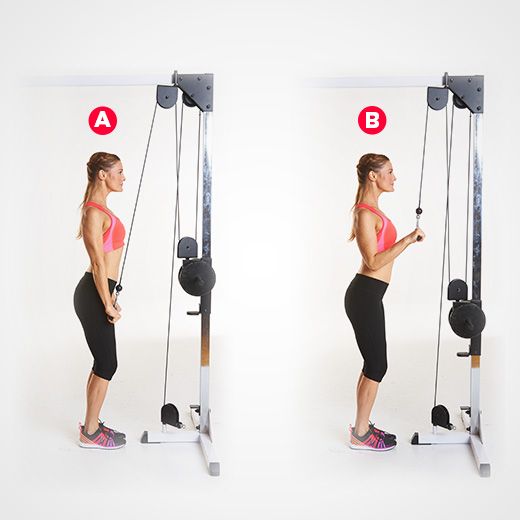
This is a classic exercise that targets all three tricep heads, especially the lateral head. It’s simple, effective, and easy to learn.
How to do it:
- Attach a rope or straight bar to the high pulley.
- Stand facing the machine with feet shoulder-width apart.
- Grab the attachment with both hands, elbows close to your sides.
- Push the bar or rope down, straightening your arms fully.
- Squeeze the triceps at the bottom, then return slowly to the start.
Tips:
- Keep your elbows tight to your sides.
- Don’t swing your body or use momentum.
- For extra intensity, spread the rope ends apart at the bottom.
Overhead Cable Tricep Extension
This move stretches the long head and works the triceps through a big range of motion.
How to do it:
- Use a rope or single handle on the low pulley.
- Stand with your back to the machine.
- Grab the rope, step forward, and lean slightly forward.
- Extend your arms overhead, then bend your elbows to lower the weight behind your head.
- Press the weight back up, focusing on the triceps.
Tips:
- Keep elbows close to your head.
- Use slow, controlled movements.
- Don’t let the weight pull your arms too far back.
Single Arm Cable Tricep Extension
Unilateral work helps fix muscle imbalances and increases focus on each arm.
How to do it:
- Attach a single handle to the low pulley.
- Stand sideways to the machine, grab the handle with one hand.
- Step out, bend your elbow, and bring your hand up to your shoulder.
- Extend your arm straight down or overhead, depending on the angle you want.
- Squeeze, then return with control.
Tips:
- Keep your body still.
- Focus on the squeeze at the end of the movement.
Reverse Grip Tricep Pushdown
Changing your grip changes the muscle focus, hitting more of the medial head.
How to do it:
- Attach a straight bar to the high pulley.
- Grab the bar with palms facing up (underhand grip).
- Keep elbows at your sides and push down until arms are straight.
- Return slowly.
Tips:
- Keep wrists straight.
- Do not let elbows flare out.
Cable Kickbacks
This exercise isolates the triceps and gives a good squeeze at the top.
How to do it:
- Attach a single handle to the low pulley.
- Bend forward at the waist, keep back flat.
- Hold the handle with one hand, upper arm parallel to the floor.
- Extend your arm straight back, then return.
Tips:
- Do not swing your arm.
- Pause and squeeze at the end.
Rope Overhead Tricep Extension (seated Or Standing)
Works the long head deeply and stretches the muscle.
How to do it:
- Attach a rope to the low pulley.
- Sit on a bench or stand, facing away from the machine.
- Lift the rope overhead, elbows next to ears.
- Extend arms up, then lower the rope behind your head.
Tips:
- Do not arch your back.
- Keep elbows in.
Tricep Pressdown With V-bar
The V-bar is a good choice if you want comfort and a neutral wrist position.
How to do it:
- Attach a V-bar to the high pulley.
- Stand close to the cable, grip the bar with both hands.
- Push down until arms are straight.
- Return slowly.
Tips:
- Focus on the bottom part of the movement.
- Don’t lean forward too much.
Lying Cable Tricep Extension
This variation hits the triceps from a different angle and reduces shoulder involvement.
How to do it:
- Place a bench in front of the low pulley.
- Lie down, grab the bar or rope with both hands.
- Extend your arms straight up.
- Lower the attachment towards your forehead, then extend back up.
Tips:
- Use a controlled motion.
- Don’t let the weight pull you off the bench.

Credit: fitbod.me
Comparison: Cable Vs. Dumbbell Tricep Exercises
Here’s a look at how cable and dumbbell triceps exercises compare:
| Feature | Cable Exercises | Dumbbell Exercises |
|---|---|---|
| Muscle Tension | Constant | Varies through range |
| Range of Motion | Adjustable | Some limits |
| Joint Stress | Low | Can be higher |
| Exercise Variety | High | High |
| Isolation | Excellent | Good |
Sample Tricep Cable Workout Routine
If you want a balanced, effective routine, try this workout. It hits all three tricep heads and uses different angles and grips.
Warm-Up (5 minutes):
- Arm circles
- Light cable pushdowns
- Elbow stretches
Main Workout:
- Cable Tricep Pushdown (straight bar) – 4 sets x 10-12 reps
- Overhead Rope Extension – 3 sets x 12-15 reps
- Single Arm Cable Extension – 3 sets x 10 reps per arm
- Reverse Grip Pushdown – 2 sets x 15 reps
- Cable Kickbacks – 2 sets x 12 reps
Rest: 45-60 seconds between sets.
Cool Down:
- Stretch triceps and shoulders
- Shake out arms
This routine can be done 1-2 times per week. Make sure to increase the weight as you get stronger.
How To Progress Your Cable Tricep Workouts
If you want to see improvement, you need to make your workouts harder over time. This is called progressive overload. Here’s how to do it safely:
- Increase weight: Add small amounts of weight when you can do all reps with good form.
- Add reps or sets: Do more reps or another set.
- Slow down reps: Try a slow negative (lowering) phase.
- Shorten rest time: Rest less between sets.
- Try new angles: Switch attachments or change the height.
Non-obvious insight: Avoid increasing weight too fast on cable exercises. Small changes matter more than big jumps, because you’re isolating a small muscle group.
Common Mistakes To Avoid
Even experienced gym-goers make mistakes on cable triceps exercises. Watch out for these:
- Using too much weight: Leads to swinging and poor form, less triceps activation.
- Flaring elbows: Reduces triceps work, puts stress on shoulders.
- Not locking out: Stopping short at the bottom means the muscle isn’t fully contracting.
- Ignoring negative phase: Lowering the weight slowly builds more muscle.
- Bad posture: Rounded back or leaning too far forward is unsafe.
Non-obvious insight: On cable pushdowns, if you lean back too much, you turn the exercise into more of a chest or shoulder move. Stay upright for best results.
How To Activate All Three Tricep Heads
Many people only feel their triceps in one place. To hit all three heads:
- Use different angles: Overhead for the long head, pushdowns for lateral and medial.
- Change grips: Rope and reverse grips bring in more fibers.
- Focus on full range of motion: Stretch and contract fully each rep.
Table: Best Cable Attachments For Each Tricep Head
| Tricep Head | Best Attachment | Example Exercise |
|---|---|---|
| Long Head | Rope or Single Handle | Overhead Extension |
| Lateral Head | Straight Bar or V-Bar | Pushdown |
| Medial Head | Rope (split at bottom) or Reverse Grip Bar | Reverse Grip Pushdown |
How To Warm Up For Cable Triceps
Warming up is important to avoid injury and get the most out of your workout. Here’s a quick plan:
- General warm-up: 5 minutes of cardio (treadmill, bike, or rower).
- Dynamic stretches: Arm circles, shoulder rolls.
- Light weight sets: Do 1-2 sets of light cable pushdowns, focus on movement quality.
Using Tempo For Better Results
Tempo means the speed you move the weight. Changing tempo can boost muscle growth.
- 2 seconds up, 3 seconds down: Standard tempo.
- Pause at bottom: Hold the squeeze for 1-2 seconds.
- Slow negative: Lower the weight for 4-5 seconds.
Slowing down helps you feel the muscle working and makes each rep more effective.
How To Fit Cable Triceps Into Your Training Plan
You can train triceps with chest, shoulders, or on their own day. Here are some options:
- After chest day: Triceps are already warmed up from presses.
- With shoulders: Many shoulder presses use triceps.
- On arm day: Combine with biceps for a full pump.
If you train triceps after other muscles, use higher reps and lighter weights to avoid overworking your elbows.
Who Should Use Cable Tricep Workouts?
Cable triceps exercises are great for:
- Beginners: Easy to learn, low injury risk.
- Bodybuilders: Focus on muscle shape and size.
- Older adults: Gentle on joints.
- Anyone with elbow pain: Cables are smoother than free weights.
At-home Alternatives (if No Cable Machine)
If you don’t have a cable machine, you can try:
- Resistance bands: Anchor to a door for pushdowns and extensions.
- Dumbbell kickbacks or overhead extensions: Use as substitutes.
- Bodyweight dips: Not exactly the same, but still effective.
Remember, bands and dumbbells don’t give as much constant tension as cables, but they are still helpful.
How To Fix Weak Triceps
If you struggle to grow your triceps, try these:
- Add an extra tricep day with lower weight, higher reps.
- Use slow negatives to force the muscle to work harder.
- Check your form—film yourself or ask a coach.
- Try drop sets: Do as many reps as possible, lower the weight, repeat.
If your elbows hurt, try using a rope or V-bar instead of a straight bar.
Recovery After Tricep Workouts
Muscles grow during rest, not in the gym. To recover:
- Eat enough protein (about 1 gram per pound of body weight).
- Sleep 7-8 hours per night.
- Stretch triceps and shoulders.
- Use ice or heat if you feel sore.
Table: Sample Weekly Tricep Cable Workout Plan
| Day | Exercises | Sets x Reps |
|---|---|---|
| Monday (After Chest) | Pushdown, Overhead Extension | 3 x 12 each |
| Thursday (Arm Day) | Single Arm Extension, Reverse Grip Pushdown, Kickbacks | 3 x 10-15 each |
Credit: www.womenshealthmag.com
Safety Tips For Tricep Cable Work
- Always check the cable and attachments before starting.
- Start with lighter weights if you’re new.
- Stop if you feel sharp pain.
- Use a full range of motion, but don’t let the weight stack slam.
- Keep wrists straight to avoid strain.
How To Choose The Right Weight
Pick a weight you can move with good form for 10-15 reps. If you can do more than 15 easily, go heavier next time. If you can’t do 8 reps, use less weight. Progress is better than ego lifting.
Visualization For Better Results
Picture your triceps working as you do each rep. This mind-muscle connection boosts results, according to research. Try closing your eyes for a few reps or flexing your triceps before you start each set.
Why Triceps Matter For Strength And Appearance
Strong triceps help with more than just arm size. They improve your:
- Bench press strength
- Push-up power
- Shoulder stability
- Overall arm shape
Many people get stuck on bench press because of weak triceps, not chest.
When To Change Your Routine
Change your cable triceps routine every 6-8 weeks. Try new grips, new angles, or a different order of exercises. This keeps your muscles guessing and growing.
Should You Train Triceps To Failure?
Going to failure (can’t do any more reps) can build muscle, but only do it on your last set. Doing every set to failure can lead to sore elbows and slower recovery.
Is Cable Machine Enough For Triceps?
Cables can build strong, defined triceps on their own, but some people mix in dips or close-grip bench press for variety. Focus on quality, not just quantity.
Useful External Resource
For more details on muscle anatomy and exercise science, check out this Wikipedia page on the triceps brachii.

Credit: angla.cl
Frequently Asked Questions
What Is The Best Attachment For Cable Tricep Exercises?
The rope attachment is very popular because it lets you spread the ends at the bottom, hitting all three tricep heads well. V-bar and straight bar are also good for heavy pushdowns, while a single handle is best for one-arm work.
How Many Times Per Week Should I Do Cable Tricep Workouts?
Most people get good results training triceps 1-2 times per week. Allow at least 48 hours of rest between sessions to help your muscles recover and grow.
Can I Build Big Triceps With Only Cable Exercises?
Yes, you can build strong, defined triceps with cable exercises alone. The key is using the right form, enough weight, and progressing over time. For maximum size, some people add dips or close-grip bench press, but cables are enough for most.
Why Do My Elbows Hurt During Cable Tricep Exercises?
Common reasons include using too much weight, flaring elbows, or bad form. Try using a rope or V-bar, lower the weight, and keep your elbows close to your sides. If pain continues, see a health professional.
Should I Lock Out My Elbows At The End Of Each Rep?
You should fully extend your arms but not forcefully “snap” your elbows. A strong squeeze at the end of the rep is important, but keep tension on the muscle and avoid joint pain.
Building strong triceps is more than just doing endless pushdowns. The cable machine gives you the tools for safe, effective muscle growth if you use it wisely. Focus on form, use a variety of exercises, and don’t rush the process.
With patience and smart training, you’ll see your triceps—and your whole upper body—grow stronger.
