

How
If you want strong, well-shaped arms, the triceps are a key muscle to target. Many people focus only on biceps, but the triceps make up about two-thirds of your upper arm’s muscle. Training them can give your arms a firm, toned look and improve your strength for pushing movements. You don’t need fancy machines or a gym membership to work your triceps. With the right exercises and approach, you can build them at home — even if you have very limited equipment.
Let’s explore how you can train your triceps effectively using simple tools, bodyweight, and smart techniques. Whether you’re a beginner or already have some experience, this guide will help you understand the essentials, avoid common mistakes, and make real progress.
Understanding The Triceps Muscle
The triceps brachii sits at the back of your upper arm. It has three parts, called “heads”:
- Long head: Runs along the back of the arm and helps with shoulder movement.
- Lateral head: Gives the arm that “horseshoe” shape when developed.
- Medial head: Located deeper inside, supporting overall strength.
When you extend your elbow — like pushing open a door or straightening your arm — your triceps do the work. Most home exercises hit all three heads, but some movements target specific areas better.
Benefits Of Training Triceps At Home
Working your triceps at home comes with several advantages:
- Convenience: Train whenever you want, no need to travel.
- Cost savings: No gym fees or expensive machines.
- Privacy: Perfect for those who feel shy or self-conscious.
- Flexibility: You can adapt workouts to your schedule and space.
Also, strong triceps help with everyday actions — lifting, pushing, and even stabilizing your shoulder. They’re important for sports, carrying groceries, and preventing injuries.
Basic Principles For Effective Triceps Training
To get real results, follow these simple principles:
- Progressive overload: Gradually increase resistance or reps over time. If you do the same thing every session, your muscles won’t grow.
- Form and technique: Focus on correct movement. Poor form wastes effort and can lead to injury.
- Variety: Use different exercises to hit all parts of the triceps.
- Rest and recovery: Muscles need time to repair after workouts. Train triceps 2-3 times a week, not daily.
If you’re new, start with easier moves and slowly add difficulty. Don’t rush — quality matters more than quantity.
Essential Bodyweight Triceps Exercises
You can build strong triceps without any equipment. Here are the most effective bodyweight moves:
1. Diamond Push-ups
Diamond push-ups are a classic triceps exercise. Place your hands close together so your thumbs and index fingers form a diamond shape. Keep your body straight and lower yourself until your chest nearly touches your hands.
- Targets: All three triceps heads, especially the lateral head.
- Tip: Keep elbows close to your body for maximum triceps activation.
2. Triceps Dips (using A Chair)
Sit on the edge of a sturdy chair or bench. Place your hands next to your hips, fingers facing forward. Slide your hips off the chair and lower yourself by bending your elbows. Push back up.
- Targets: Long and lateral heads.
- Tip: Keep feet close for easier dips; stretch legs out for more difficulty.
3. Close-grip Push-ups
Similar to standard push-ups, but your hands are shoulder-width or slightly closer. This variation shifts more work to the triceps.
- Targets: Triceps and chest.
- Tip: Don’t let your elbows flare out — keep them close for better isolation.
4. Bench Or Floor Triceps Extension
Lie on your back, knees bent. Hold a heavy book, water bottle, or dumbbell above your chest. Bend your elbows to lower the weight to your forehead, then extend arms back up.
- Targets: All triceps heads.
- Tip: Control the weight — don’t let it drop quickly.
5. Pike Push-ups
From a push-up position, hike your hips up to form an inverted V. Lower your head toward the floor, then push back up. While this exercise hits shoulders, it also works the triceps hard.
- Targets: Triceps, shoulders.
- Tip: Move slowly to avoid shoulder strain.
Using Household Items For Added Resistance
You don’t need official weights. Many common items can add resistance:
- Water bottles: Use as light dumbbells.
- Backpack: Fill with books for more weight.
- Towels: Useful for resistance or sliding exercises.
- Heavy books: Great for overhead extensions.
Always check that your items are safe and won’t slip or break. For example, make sure water bottles are tightly sealed and backpacks have strong straps.
Triceps Exercises With Minimal Equipment
If you have basic gear, you can expand your options. Here are smart ways to use simple tools:
Resistance Bands
Resistance bands are affordable and effective. They work well for triceps, offering constant tension.
Band Triceps Extension: Stand on the band, hold the ends behind your head, and extend your arms upward.
Band Kickbacks: Anchor the band under your foot. Hold the handle, lean forward, and extend your arm backward.
Dumbbells
If you own dumbbells (or can improvise with heavy items), try these moves:
Overhead Triceps Extension: Sit or stand, hold a dumbbell with both hands above your head. Lower it behind your head, then extend your arms.
Triceps Kickbacks: Lean forward, hold a dumbbell, and extend your arm backward.
Close-Grip Floor Press: Lie on your back, press dumbbells upward with hands close together.
Comparison: Equipment Vs. Bodyweight
Let’s compare bodyweight exercises and equipment-based moves for triceps:
| Exercise Type | Advantages | Challenges |
|---|---|---|
| Bodyweight | Free, easy to start, builds functional strength | May get too easy over time |
| Equipment | More resistance, variety, faster progress | Requires investment, space |
If you’re starting out, bodyweight is enough. As you get stronger, simple tools can help push your progress further.
Sample Triceps Workouts For Different Levels
A good workout balances challenge and safety. Here are examples for beginners, intermediate, and advanced levels. Adjust reps and sets based on your ability.
Beginner Workout
- Diamond push-ups: 3 sets of 8-10 reps
- Chair dips: 3 sets of 8-10 reps
- Overhead extension (with a water bottle): 3 sets of 10 reps
Rest 60 seconds between sets.
Intermediate Workout
- Close-grip push-ups: 4 sets of 12 reps
- Band triceps extension: 4 sets of 10 reps
- Triceps kickbacks (with dumbbells or bottles): 4 sets of 10 reps
Rest 45 seconds between sets.
Advanced Workout
- Diamond push-ups (add backpack for weight): 5 sets of 15 reps
- Bench dips (legs straight): 5 sets of 12 reps
- Overhead extension (heavy dumbbell): 5 sets of 10 reps
- Pike push-ups: 5 sets of 10 reps
Rest 30 seconds between sets.
Non-obvious insight: Many people forget that increasing resistance is key. If you don’t have heavier weights, try slowing your reps, adding pauses, or increasing volume. These changes make bodyweight moves much harder.
How To Make Progress Over Time
Your muscles adapt quickly. If you want them to grow, you must challenge them regularly.
- Increase reps: Add more repetitions as you get stronger.
- Add resistance: Use heavier items or fill your backpack with more weight.
- Change tempo: Slow down each rep, or pause at the hardest point.
- Try new variations: Mix exercises to keep your body guessing.
Keep a simple log of your workouts. Note which exercises you did, how many reps, and what resistance. This helps you track growth and plan new goals.

Credit: fitasamamabear.com
Common Mistakes When Training Triceps At Home
Even with good intentions, many people make simple mistakes that slow progress or cause injuries.
1. Using Poor Form
Sloppy technique reduces effectiveness and increases injury risk. For example, flaring elbows on push-ups shifts the work away from the triceps.
2. Skipping Warm-ups
Training cold muscles increases injury risk. Spend 5 minutes warming up — arm circles, shoulder rolls, light push-ups.
3. Not Resting Enough
Muscles need recovery. Training the same area every day can lead to strains and poor results. Aim for 2-3 sessions per week.
4. Forgetting The Importance Of Nutrition
Muscle needs protein to grow. If your diet is weak, your results will be too. Include lean meats, eggs, beans, or protein shakes.
5. Ignoring Progressive Overload
Doing the same workout every time stalls progress. Change reps, resistance, or exercise variations regularly.
Non-obvious insight: People often underestimate the role of the long head of the triceps. Overhead moves (like extensions) are essential for full development but are commonly skipped.
Tips For Staying Motivated At Home
Building strong triceps takes time and consistency. Here are ways to stay on track:
- Set clear goals: “I want to do 20 diamond push-ups” or “I’ll add weight to my dips next month.”
- Track progress: Use a notebook or app to record workouts.
- Find a workout buddy: Even online friends can help keep you accountable.
- Celebrate small wins: Notice when you increase reps or resistance.
- Join online communities: Share your progress and learn from others.
How Triceps Training Fits Into Your Overall Routine
Triceps are just one part of your arm. They work together with the chest, shoulders, and even your core. If you want balanced strength, include:
- Chest exercises: Push-ups, presses.
- Shoulder exercises: Pike push-ups, overhead presses.
- Biceps work: Curls, pull-ups.
Don’t just train arms. Include lower body, back, and cardio for overall health.
Safety Considerations For Home Workouts
Training at home means you’re in charge of safety. Follow these tips:
Warm-up And Cool-down
Begin with light movements — arm circles, jumping jacks, or easy push-ups. After workouts, stretch your triceps and shoulders to reduce soreness.
Check Your Equipment
If you’re using chairs, bottles, or backpacks, make sure they’re stable and strong. Avoid slippery surfaces and keep your workout area clear.
Listen To Your Body
If you feel pain (not just muscle fatigue), stop and check your form. Sharp pain can signal injury. Rest and see a doctor if needed.
Gradual Progression
Don’t jump to hard exercises too quickly. Build up strength and mobility first.

Credit: squatwolf.com
How Triceps Training Improves Daily Life
Strong triceps help with many everyday tasks:
- Pushing doors open
- Carrying bags
- Playing sports
- Lifting children or groceries
You’ll notice your arms feel firmer and you have more strength for daily actions. This boosts confidence and reduces injury risk.
Tracking Results: How To Know You’re Improving
It’s easy to lose motivation if you don’t see results. Here’s how to track your progress:
| Tracking Method | What It Shows | How Often |
|---|---|---|
| Reps/sets log | Strength improvements | Every workout |
| Arm measurement | Muscle growth | Monthly |
| Progress photos | Visual changes | Every 2-4 weeks |
Not all progress is visible. Sometimes, you’ll notice you can do more reps or your arms feel stronger. These are signs you’re moving forward.
Advanced Techniques For Home Triceps Training
Once you’ve mastered the basics, try these advanced methods to keep building strength:
1. Slow Negatives
Lower your body or weight very slowly (5-8 seconds). This increases muscle tension and growth.
2. Isometric Holds
Pause at the hardest part of the exercise (like at the bottom of a dip) for 3-5 seconds.
3. Supersets
Do two exercises back-to-back with no rest. For example, diamond push-ups then chair dips.
4. Unilateral (one-arm) Moves
Try one-arm triceps extensions or push-ups. These are challenging and help fix strength imbalances.
5. Explosive Movements
Push yourself up quickly (like clapping push-ups). These build power and target fast-twitch fibers.
Tip: Don’t try advanced techniques until you have good form and basic strength.
Nutrition For Triceps Growth
Building muscle isn’t just about exercise. Your diet plays a big role.
Key Nutrients
- Protein: Essential for muscle repair. Aim for 1.2–1.7 grams per kilogram of body weight.
- Carbohydrates: Provide energy for workouts.
- Healthy fats: Support hormone production.
Sample High-protein Snacks
- Greek yogurt
- Hard-boiled eggs
- Chicken breast
- Protein shakes
- Beans or lentils
Drink enough water and avoid skipping meals. If you’re vegetarian or vegan, plant-based proteins like tofu, tempeh, and lentils are great options.
How To Avoid Plateaus
A plateau is when your progress stops. This can happen if you repeat the same workout without changes.
- Switch exercises: Try new moves every few weeks.
- Change resistance: Add weight or slow your reps.
- Adjust sets/reps: Increase volume or intensity.
- Review your diet: Make sure you’re getting enough protein.
Sometimes, taking a week off helps your muscles recover and restart growth.
Frequently Asked Questions
What’s The Best Triceps Exercise For Home?
Diamond push-ups and chair dips are highly effective. They work all triceps heads and require no equipment. Overhead extensions (with bottles or dumbbells) are also excellent.
How Often Should I Train Triceps At Home?
Aim for 2-3 sessions per week. This gives your muscles time to recover and grow. Avoid training the same muscle every day.
Can I Build Big Triceps Without Equipment?
Yes, you can gain size and strength with bodyweight moves. As you progress, adding household items or bands helps continue growth.
Why Aren’t My Triceps Growing?
Possible reasons include poor form, not increasing resistance, weak nutrition, or not resting enough. Track your workouts and diet to find the cause.
Is It Safe To Train Triceps At Home?
Yes, if you use good form, warm up, and check your equipment. Start easy and increase difficulty slowly. If you feel sharp pain, stop and rest.
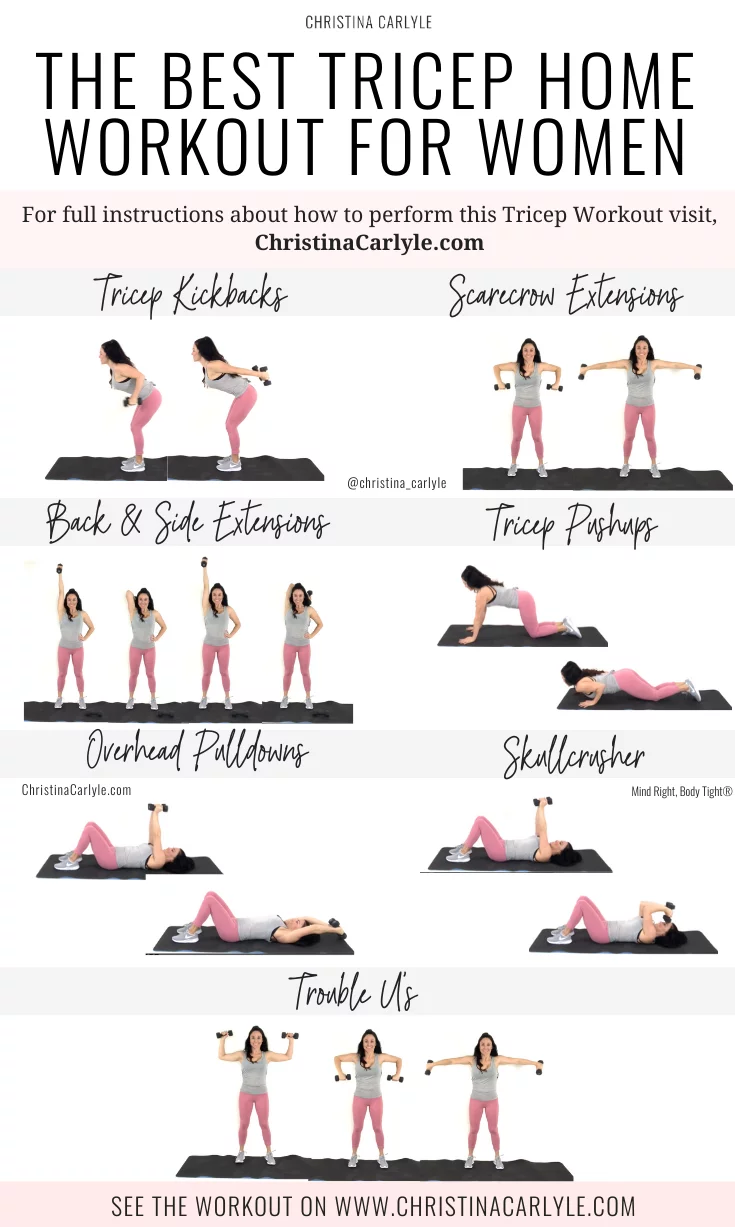
Credit: www.christinacarlyle.com
Final Thoughts
Training your triceps at home is simple, effective, and affordable. You don’t need a gym — just commitment, creativity, and smart technique. Start with bodyweight moves, then add resistance with household items or bands. Focus on correct form, progressive overload, and nutrition. Track your progress and celebrate improvements, no matter how small. With consistency, you’ll see stronger, firmer arms and feel more confident in daily life. For more fitness tips, visit Healthline.
