

Glute Workout No Equipment: Sculpt Stronger Glutes Anywhere
Glute Workout No Equipment
Having strong glutes is about much more than just appearance. The glute muscles—gluteus maximus, medius, and minimus—play a major role in your daily movement, stability, and even in preventing injuries. Many people believe you need gym machines or heavy weights to get results. But the truth is, you can build, tone, and strengthen your glutes anywhere, using only your body weight.
This article will guide you through effective glute workouts without equipment, covering important muscle science, proven exercise routines, and expert tips. Whether you’re a beginner or more advanced, you’ll discover how to target your glutes at home or on the go. By the end, you’ll know exactly how to create your own no-equipment glute routine and see real progress.
Understanding Your Glutes
Before you start, it’s helpful to know what makes your glutes unique. The gluteus maximus is the largest muscle, responsible for hip extension and power. The gluteus medius and minimus are smaller, but they stabilize your pelvis and keep your hips steady when you walk, run, or climb stairs.
Weak glutes can lead to poor posture, back pain, and knee problems. Strong glutes, on the other hand, improve athletic performance, balance, and everyday movements like standing up or lifting things.
Why Bodyweight Training Works
You might wonder: Can you really build glutes with no equipment? The answer is yes. When you use your own body weight, you can still create enough resistance. The key is choosing the right moves, focusing on form, and using volume and tempo to challenge your muscles.
Bodyweight exercises also help you activate the right muscles. Many people have “sleepy glutes” from sitting too much. These workouts teach your body to use your glutes correctly, not just your legs or back.
Key Principles For Glute Growth Without Equipment
To get the most from your no-equipment glute workouts, keep these principles in mind:
- Progressive Overload: Find ways to make your workouts harder over time. You can add reps, sets, or slow down each movement.
- Mind-Muscle Connection: Focus on squeezing and feeling your glutes in every rep.
- Full Range of Motion: Go deep in movements like squats and lunges to activate more muscle fibers.
- Frequency: Train your glutes 2–4 times a week for best results.
- Recovery: Muscles need time to recover. Listen to your body and rest as needed.
Top Bodyweight Glute Exercises
These exercises target all parts of your glutes. Mix and match them to build your routine.
Glute Bridge
Lie on your back, knees bent, feet flat on the floor. Push through your heels and lift your hips until your body forms a straight line from shoulders to knees. Squeeze your glutes at the top, then lower down.
Tip: Pause for 2–3 seconds at the top for more muscle activation.
Single-leg Glute Bridge
Same as the glute bridge, but lift one leg off the floor. This challenges each side of your glutes and improves balance.
Insight: Most beginners let their hips drop on one side—keep your hips level for full benefit.
Bulgarian Split Squat (rear-foot Elevated Split Squat)
Stand in front of a chair or bench. Place one foot behind you on the chair. Lower your back knee toward the floor, keeping your chest up. Push through your front heel to stand up.
Non-obvious tip: Lean slightly forward to shift work to your glutes instead of your quads.
Hip Thrust (bodyweight)
Sit on the floor with your upper back against a sofa or bench. Feet flat, knees bent. Push through heels and lift hips high, squeezing your glutes at the top.
Extra challenge: Try single-leg hip thrusts for more intensity.
Step-up
Find a sturdy chair or step. Step up with one foot, push through your heel, and bring your other knee up as high as you can. Step down and repeat.
Form tip: Avoid pushing off with your lower foot. Focus on using your glutes.
Squat Variations
- Standard Squat: Stand with feet shoulder-width apart, squat down until thighs are parallel to the floor, then stand up.
- Sumo Squat: Wider stance, toes turned out, squat down and up.
- Pulse Squat: Hold bottom position and pulse up and down for 10–20 reps.
Insight: Many people lean forward too much—keep your chest up for better glute engagement.
Donkey Kick
On hands and knees, lift one leg up and back, keeping your knee bent at 90 degrees. Squeeze your glute at the top, then lower.
Mistake to avoid: Don’t arch your lower back—keep your core tight.
Fire Hydrant
On hands and knees, lift one knee out to the side. Pause, then lower. This targets the gluteus medius for side strength.
Lateral Leg Raise
Lie on your side, legs stacked. Lift your top leg up and back slightly, then lower. Focus on slow, controlled movement.
Frog Pump
Lie on your back with knees bent, feet together and knees out. Push through your feet and lift hips up, squeezing at the top.
Example: This move is often overlooked but creates a strong glute burn.
Curtsy Lunge
Stand tall, step one foot back and across behind you, then lower into a lunge. Push back to start. This works the glutes from a different angle.
Reverse Lunge
Step one foot back, lower knee to the floor, then return to start. Focus on pushing up through the heel of your front foot.
Glute March
Lie on your back in a bridge position. Lift one knee toward your chest, then switch legs in a marching motion, keeping hips up.
Wall Sit With Glute Focus
Lean against a wall, knees bent at 90 degrees. Push heels into the floor and focus on squeezing glutes the entire time.
Example No-equipment Glute Workout Routines
You can structure your glute workouts in different ways. Here are three sample routines for various fitness levels.
Beginner Bodyweight Glute Workout
- Glute Bridge – 3 sets x 15 reps
- Squat – 3 sets x 12 reps
- Donkey Kick – 3 sets x 12 reps per leg
- Lateral Leg Raise – 2 sets x 15 reps per leg
Rest 45–60 seconds between sets.
Intermediate Bodyweight Glute Workout
- Bulgarian Split Squat – 3 sets x 10 reps per leg
- Single-Leg Glute Bridge – 3 sets x 12 reps per leg
- Hip Thrust (Bodyweight) – 3 sets x 15 reps
- Fire Hydrant – 3 sets x 15 reps per leg
- Frog Pump – 2 sets x 20 reps
Rest 45 seconds between sets.
Advanced Bodyweight Glute Workout
- Single-Leg Hip Thrust – 4 sets x 12 reps per leg
- Sumo Squat with Pulse – 4 sets x 15 reps
- Curtsy Lunge – 3 sets x 12 reps per leg
- Step-Up (explosive) – 3 sets x 10 reps per leg
- Glute March – 3 sets x 16 reps (alternating legs)
- Wall Sit (glute focus) – 3 sets x 45 seconds
Rest 30–45 seconds between sets.
Pro tip: You don’t need to do every exercise every session. Pick 4–6 moves, mix them up, and change your routine every few weeks for best results.
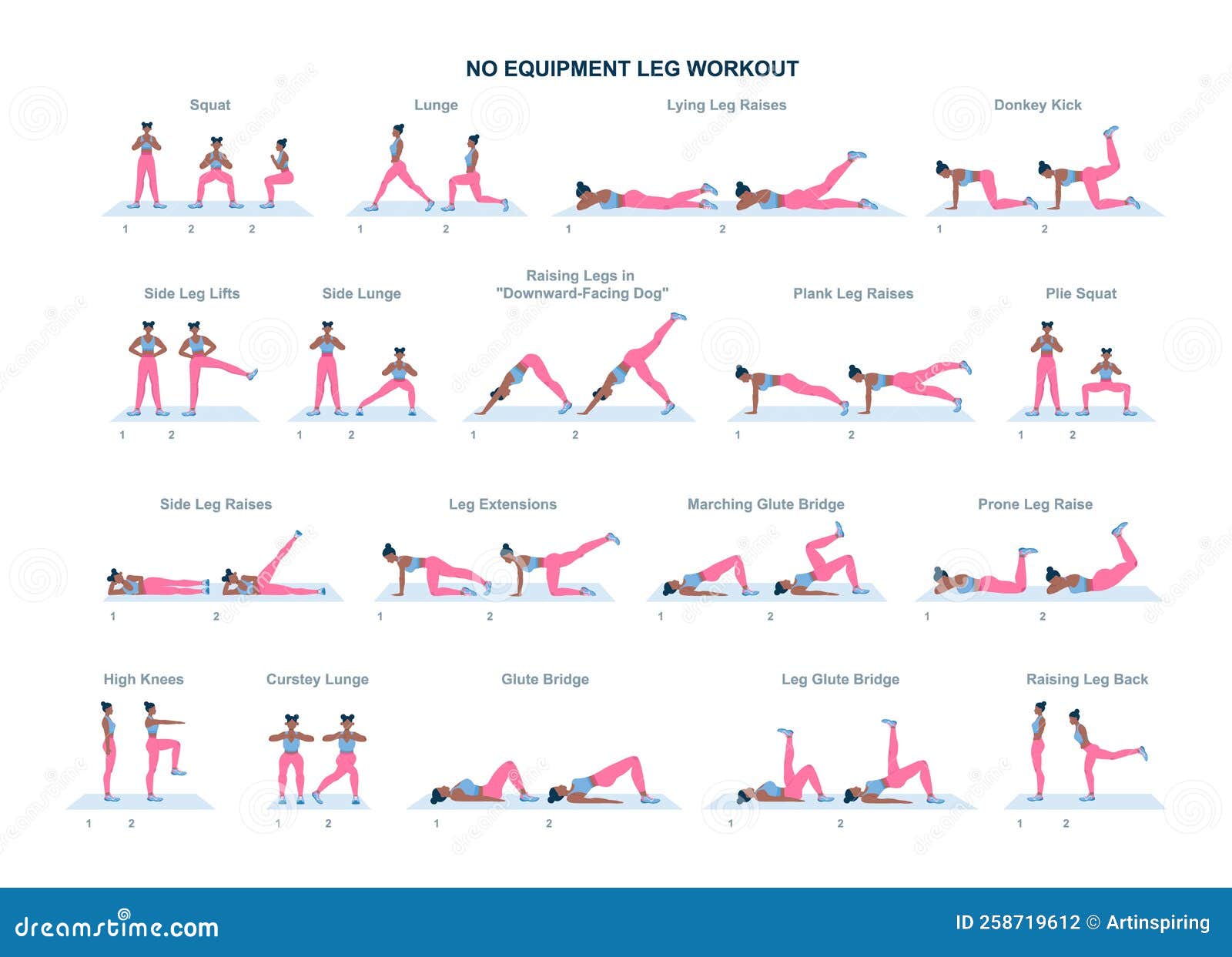
Credit: www.dreamstime.com
How To Progress Without Equipment
You might worry about hitting a plateau if you’re not adding weight. Here are some smart ways to keep progressing using only your body:
- Increase reps and sets: Gradually add more repetitions or another set.
- Slow down: Count 3 seconds up, 3 seconds down to increase time under tension.
- Add pauses: Hold the top of a bridge or squat for 2–5 seconds.
- Use single-leg moves: These are much harder than double-leg.
- Shorter rest: Take less rest between sets to keep muscles working.
- Change angles: Try sumo, curtsy, or step-up variations to hit new muscle fibers.
These small tweaks keep your glutes challenged and force them to grow stronger.
Common Mistakes In No-equipment Glute Workouts
Even with the best exercises, mistakes can slow your progress or cause pain. Avoid these pitfalls:
- Neglecting form: Poor alignment means your glutes don’t work as hard, and you may use your back or quads instead.
- Rushing reps: Quick, sloppy movements reduce muscle tension. Move with control.
- Forgetting the squeeze: Always squeeze your glutes at the top of each rep.
- Not activating glutes first: Warm up with bridges or fire hydrants to “wake up” your glutes before harder moves.
- Skipping warm-up and cool-down: These prevent injury and help muscles recover.
Glute Workout Warm-up And Mobility
A good warm-up prepares your glutes and joints for action. Spend 5–7 minutes before your workout:
- 20 bodyweight squats
- 15 glute bridges
- 10 walking lunges per leg
- 15 seconds per side dynamic hip stretch
After your workout, stretch your glutes and hips to keep them healthy and flexible.
Science Behind Bodyweight Glute Training
Research shows that you can activate your glutes as much—or even more—using bodyweight exercises compared to machines. For example, studies find that single-leg glute bridges and hip thrusts can produce high levels of gluteus maximus activation. The secret is in using full range of motion and mind-muscle connection.
Here’s a quick comparison of glute muscle activation from different exercises, based on EMG (electromyography) studies:
| Exercise | Gluteus Maximus Activation (relative) | Gluteus Medius Activation (relative) |
|---|---|---|
| Single-Leg Glute Bridge | Very High | Moderate |
| Hip Thrust | High | Low |
| Bulgarian Split Squat | High | High |
| Standard Squat | Moderate | Low |
| Fire Hydrant | Low | Very High |
This table shows why mixing different types of moves matters—some exercises target the big glute, others hit the sides for balance and shape.
Creating Your Own No-equipment Glute Routine
To build your own routine, follow these steps:
- Pick 4–6 exercises: Choose from the list above. Include at least one single-leg exercise and one hip thrust or bridge variation.
- Set reps and sets: Start with 2–4 sets of 10–20 reps per exercise.
- Plan your frequency: Aim for 2–4 sessions per week, with at least one rest day in between.
- Track your progress: Write down your reps and sets. Try to improve a little each week.
- Listen to your body: If you feel pain (not muscle burn), stop and check your form.
A sample weekly plan might look like:
| Day | Workout |
|---|---|
| Monday | Glute Workout + Core |
| Wednesday | Glute Workout + Cardio |
| Friday | Glute Workout + Upper Body |
| Sunday | Active Recovery (stretch, walk) |
Rotate exercises every few weeks to keep things fresh and challenge your body.
Advanced Tactics For Faster Results
If you want to take your glute training further without equipment, try these strategies:
1. Add Plyometrics
Explosive moves like jump squats or step-up jumps boost glute power and burn more calories. Use them carefully, as they’re more intense on your joints.
2. Use Pre-exhaustion
Do a high-rep isolation move (like donkey kicks) before squats or lunges. This tires out your glutes so they work harder on compound exercises.
3. Experiment With Tempos
Change the speed of your reps. For example, lower down in a squat for 4 seconds, hold 2 seconds at the bottom, then explode up. This increases muscle tension and growth.
4. Combine Unilateral And Bilateral Moves
Mix single-leg (unilateral) exercises with both-leg (bilateral) moves in the same workout. This ensures balanced strength and better muscle development.
5. Track Recovery And Sleep
Muscles grow when you rest, not just when you train. Aim for 7–9 hours of sleep and take at least one full rest day per week.

Credit: www.asheborolawfirm.com
Nutrition For Glute Growth
Many people overlook the importance of food. To build and shape your glutes, you need the right nutrition:
- Protein: Helps repair and grow muscle. Aim for 0.6–0.8 grams per pound of body weight daily.
- Healthy carbs: Provide energy for tough workouts—think whole grains, fruit, and veggies.
- Good fats: Support hormones and recovery. Include nuts, seeds, avocados, and olive oil.
- Hydration: Muscles work best when you’re hydrated, so drink enough water.
If you’re not eating enough, your body won’t build muscle, no matter how hard you train.
Tracking Your Glute Progress
Visible changes can take weeks or months, but tracking helps keep you motivated.
- Take photos: Once every 2–4 weeks, from different angles.
- Measure: Use a tape measure around your hips and glutes.
- Strength tests: See if you can do more reps or harder variations over time.
Focus on both how you look and how you feel—better balance, less pain, more power.
Glute Training For Different Goals
Not everyone wants the same result from their glute workout. Here’s how to adjust your approach:
| Goal | Strategy | Exercise Focus |
|---|---|---|
| Strength | Lower reps, more sets, harder variations | Single-leg bridges, Bulgarian split squats |
| Endurance | Higher reps, less rest | Standard squats, glute marches, frog pumps |
| Shape/Tone | Mix of reps and tempos, focus on full range | Hip thrusts, sumo squats, curtsy lunges |
If you’re not sure where to start, focus on general strength and stability. You can always adjust as you go.
Staying Motivated Without Equipment
Training at home or without equipment can feel less exciting than the gym. Here’s how to stay on track:
- Set clear goals: Know what you’re working toward, like “do 20 single-leg bridges” or “train 3 times a week.”
- Track your workouts: Use an app or notebook.
- Join online communities: Share progress, ask questions, and get support.
- Try new routines: Swap exercises or challenge yourself with new moves.
- Reward yourself: Celebrate milestones like consistency or strength gains.
Frequently Asked Questions
What Should I Do If I Don’t Feel My Glutes Working During Exercises?
If you’re not feeling your glutes, check your form. Sometimes your quads or back take over. Try slowing down, squeezing your glutes at the top, and warming up with glute activation moves like bridges or fire hydrants. Practicing the mind-muscle connection makes a big difference.

Credit: samarthyaclasses.com
How Many Times Per Week Should I Train My Glutes?
Most people get great results with 2–4 sessions per week. Make sure you have at least one rest day between workouts to let muscles recover and grow. Quality is more important than just doing more sessions.
Do I Need To Do Cardio With Glute Workouts?
You don’t have to, but cardio helps overall fitness, burns extra calories, and can help reveal muscle definition. Combining glute workouts with some walking, running, or cycling is a good idea for balance.
Can I Still Grow My Glutes If I’m A Beginner Or Older Adult?
Absolutely. Your glutes respond to exercise at any age or level. Start with simple moves, focus on form, and progress slowly. Many older adults see big improvements in balance, pain reduction, and strength from glute training.
Where Can I Learn More About The Science Behind Glute Training?
For more in-depth information, check out the National Institutes of Health resource on muscle activation and exercise.
Building strong, shapely glutes doesn’t require fancy machines or heavy weights. With consistent effort, smart routines, and attention to form, you can transform your glutes anywhere—no equipment needed. Start today, and experience the benefits for your body, movement, and confidence.
