

Glute Workout at the Gym: Sculpt Stronger, Rounder Glutes Fast
Glute Workout At The Gym
Building strong glutes is more than just a fitness trend. Well-developed glute muscles help with power, balance, and stability. They support your hips, protect your back, and improve athletic performance. For many people, having toned glutes also boosts confidence and body image. But achieving this isn’t easy without the right approach. Gym workouts offer the tools, weights, and variety needed to target your glutes from different angles.
Many people try basic squats or lunges and wonder why their glutes aren’t growing. The truth is, glute training requires focused exercises, proper form, and progressive overload. This article will walk you through everything you need to know for an effective glute workout at the gym.
You’ll learn top exercises, how to build a routine, what matters most, and how to avoid common mistakes. Whether you’re a beginner or looking to take your glute training to the next level, you’ll find practical advice and expert tips here.
The Importance Of Glute Training
Your gluteal muscles are the largest muscles in your body. They include the gluteus maximus, gluteus medius, and gluteus minimus. These muscles power movements like standing up, running, jumping, and climbing stairs.
Strong glutes help:
- Improve posture
- Reduce risk of lower back pain
- Increase athletic performance
- Support hip and knee health
Weak glutes can cause problems. You may feel pain in your lower back, hips, or knees. Your balance and stability can suffer. Many people spend long hours sitting, which leads to gluteal amnesia (glutes “forget” how to activate). Training your glutes at the gym helps wake them up and keeps them strong.
Key Principles For Glute Growth
Before diving into exercises, it’s important to understand what drives glute development:
1. Progressive Overload
Your muscles grow when you challenge them. This means lifting heavier weights, increasing reps, or adding more sets over time.
2. Variety Of Movements
Glutes respond best to different types of exercises. Mix hip thrusts, squats, lunges, and abduction movements to work all three glute muscles.
3. Mind-muscle Connection
Focusing on squeezing your glutes during each rep helps activate them. Many people push through workouts without thinking, but conscious activation leads to better results.
4. Proper Form
Quality beats quantity. Performing exercises with correct form prevents injuries and ensures your glutes are doing the work—not your lower back or thighs.
5. Recovery
Muscles grow when you rest. Give your glutes time to recover between workouts. Aim for 48–72 hours between heavy glute sessions.
Essential Gym Equipment For Glute Training
You don’t need fancy machines to train your glutes, but some equipment makes workouts more effective:
- Barbell: For hip thrusts, squats, and deadlifts
- Dumbbells: Useful for lunges, step-ups, and single-leg exercises
- Resistance bands: Great for abduction movements and activation drills
- Smith machine: Helps with hip thrusts and squats if you prefer extra stability
- Cable machine: Allows for kickbacks and abduction exercises
- Leg press machine: Useful for heavy glute pressing
- Bench or box: Needed for hip thrusts, step-ups, and Bulgarian split squats
Not every gym has all equipment, but most gyms have the basics. Beginners can start with bodyweight and resistance bands, then add weights as they progress.
Best Glute Exercises At The Gym
Let’s explore the most effective gym exercises for glute building. Each targets different parts of the gluteal muscles. These exercises are proven by trainers and scientific studies.
Barbell Hip Thrust
The hip thrust is a top glute builder. It targets the gluteus maximus more than squats or lunges.
How to do it:
- Sit on the floor with your upper back against a bench.
- Roll a barbell over your hips.
- Bend knees, feet flat, shoulder-width apart.
- Push hips upward, squeezing glutes at the top.
- Lower back down with control.
Tips:
- Use a pad for comfort.
- Don’t arch your back.
- Pause and squeeze glutes at the top.
Squats
Squats work the glutes, quads, and hamstrings. Variations like deep squats and wide-stance squats emphasize glutes.
How to do it:
- Stand with feet shoulder-width apart.
- Hold a barbell on your upper back.
- Lower into a squat, keeping chest up and knees out.
- Go as low as comfortable (ideally below parallel).
- Push through heels to return to standing.
Tips:
- Keep weight on heels.
- Avoid rounding your back.
- Try sumo squats for more glute activation.
Bulgarian Split Squat
This exercise isolates each leg, working glutes and improving balance.
How to do it:
- Stand in front of a bench.
- Place one foot behind you on the bench.
- Lower into a lunge, front knee above ankle.
- Push through front heel to stand.
Tips:
- Keep torso upright.
- Use dumbbells for added resistance.
- Focus on glute contraction.
Deadlifts
Deadlifts build glutes, hamstrings, and lower back. Romanian deadlifts target glutes more than conventional deadlifts.
How to do it:
- Hold a barbell in front.
- Stand with feet hip-width apart.
- Lower barbell by hinging at hips, keeping back straight.
- Feel stretch in hamstrings and glutes.
- Return to standing by squeezing glutes.
Tips:
- Don’t round your back.
- Keep bar close to legs.
- Slow and controlled movement.
Cable Kickbacks
Cable kickbacks isolate the gluteus maximus. They’re good for finishing a workout.
How to do it:
- Attach ankle strap to cable machine.
- Stand facing the machine, hold onto the frame.
- Kick back one leg, squeezing glutes.
- Return slowly.
Tips:
- Don’t swing your leg.
- Keep torso stable.
- Use light to moderate weight.
Step-ups
Step-ups work glutes and improve single-leg strength.
How to do it:
- Stand in front of a bench or box.
- Hold dumbbells at your sides.
- Step up with one leg, driving through heel.
- Step down and repeat.
Tips:
- Use a box high enough for hip to bend.
- Don’t push off with bottom leg.
- Alternate legs for balance.
Glute Bridge
The glute bridge is similar to hip thrust, but on the floor.
How to do it:
- Lie on your back, knees bent, feet flat.
- Push hips upward, squeezing glutes.
- Lower slowly.
Tips:
- Use a barbell for added resistance.
- Keep feet hip-width apart.
- Don’t hyperextend your back.
Abduction Machine
This machine targets the gluteus medius and minimus.
How to use:
- Sit on the machine, legs inside pads.
- Push knees outward.
- Return slowly.
Tips:
- Use moderate weight.
- Pause at peak contraction.
- Try slow negatives for extra burn.
Lunges
Lunges target glutes, quads, and hamstrings. Walking lunges or reverse lunges hit glutes harder.
How to do it:
- Stand with feet together.
- Step forward or backward, lowering into a lunge.
- Push back up, squeezing glutes.
Tips:
- Don’t let knee go past toes.
- Keep torso upright.
- Use dumbbells for more resistance.
Leg Press
The leg press can be adjusted to focus on glutes.
How to do it:
- Sit on leg press machine.
- Place feet high and wide on platform.
- Lower weight, then push back up.
Tips:
- Don’t lock knees.
- Keep feet in glute-focused position.
- Use heavy weight for strength.
Sample Glute Workout Routine
Putting exercises together is key. Here’s a sample gym routine for glute growth. This routine covers all angles and includes compound and isolation movements.
Warm-Up (10 minutes):
- 5 minutes of light cardio (treadmill or bike)
- 5 minutes of glute activation (resistance band lateral walks, bodyweight glute bridges)
Main Workout:
- Barbell Hip Thrust: 4 sets x 8–12 reps
- Bulgarian Split Squat: 3 sets x 10 reps per leg
- Romanian Deadlift: 3 sets x 10–12 reps
- Cable Kickback: 3 sets x 12–15 reps per leg
- Abduction Machine: 3 sets x 15–20 reps
- Step-Up: 2 sets x 10 reps per leg
Cooldown (5 minutes):
- Light stretching (hip flexors, glutes, hamstrings)
Tips:
- Rest 60–90 seconds between sets.
- Increase weight when reps feel easy.
- Focus on form and glute squeeze.
Comparison: Glute-focused Vs. Quad-focused Leg Exercises
To understand which exercises work the glutes versus the quads, here’s a simple comparison:
| Exercise | Main Target | Glute Activation | Quad Activation |
|---|---|---|---|
| Barbell Hip Thrust | Glutes | High | Low |
| Back Squat | Glutes/Quads | Medium | Medium |
| Leg Press (feet high) | Glutes | High | Low |
| Leg Extension | Quads | Low | High |
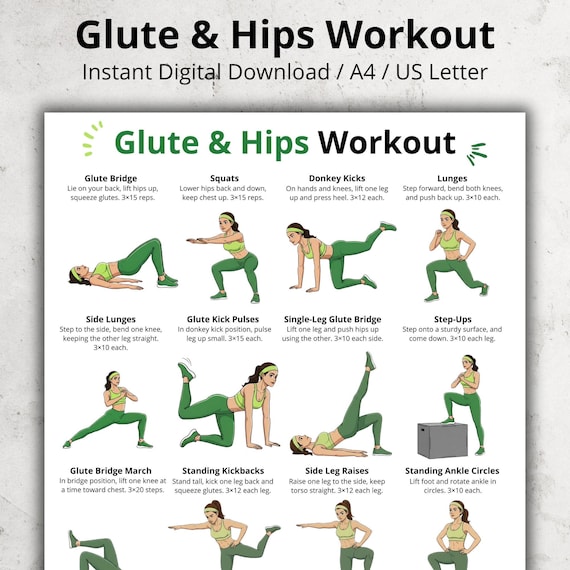
Credit: www.etsy.com
Glute Activation: Why It Matters
Many people do glute workouts but don’t feel their glutes working. This is often because the glutes aren’t “activated. ” Glute activation means your glutes are firing and doing the work. Without activation, other muscles take over—like the quads or lower back.
How to activate glutes:
- Start your workout with banded side walks or glute bridges.
- Focus on squeezing glutes during each rep.
- Slow down the movement and pause at the peak.
A study published in the Journal of Strength and Conditioning Research found that hip thrusts and glute bridges produced higher glute activation compared to squats or lunges. Proper activation also improves exercise safety.
Common Mistakes In Glute Training
Even with the best exercises, mistakes can limit your progress. Here are the most common errors:
1. Poor Form
Rushing through exercises, rounding your back, or letting knees cave in can reduce glute work and cause injury.
2. Not Using Enough Resistance
Glutes need heavy loads for growth. If you use only light weights, you may get toned but not build real muscle.
3. Neglecting Single-leg Movements
One-leg exercises like Bulgarian split squats and step-ups help balance and target glutes better.
4. Skipping Warm-up And Activation
Without activation, your glutes stay “sleepy” and don’t work as hard.
5. Overtraining
Training glutes daily can lead to fatigue and slow progress. Allow time for recovery.
6. Ignoring Mind-muscle Connection
If you don’t focus on glute squeeze, other muscles may take over.

Credit: www.menshealth.com
Advanced Glute Training Techniques
For those who want more results, advanced methods can help break plateaus.
Drop Sets
After your last set, reduce the weight and keep going until you can’t. This burns out the glutes and encourages growth.
Supersets
Pair two exercises back-to-back, like hip thrusts followed by banded abductions. This saves time and increases intensity.
Tempo Training
Slow down each rep, especially the lowering phase. For example, take 4 seconds to lower in a squat and 2 seconds to rise. This increases muscle tension.
Partial Reps
At the end of a set, do partial reps in the hardest range. For hip thrusts, do short pulses at the top.
Program Example For Advanced Lifters
If you’re experienced, try this routine once a week:
- Barbell Hip Thrust (heavy): 4 sets x 6–8 reps
- Romanian Deadlift (slow tempo): 3 sets x 8 reps
- Superset: Bulgarian Split Squat x Resistance Band Abductions (3 sets each)
- Drop Set: Cable Kickbacks (2 sets to failure)
Glute Progress Tracking
Tracking progress keeps you motivated and helps spot weaknesses. Here are ways to measure your glute development:
- Take photos every 4 weeks: Compare muscle shape and size.
- Measure hip circumference: Use a tape measure around the widest part.
- Log workout weights: Write down sets, reps, and weights.
- Check strength gains: Are you lifting heavier or more reps?
For most people, visible changes take 8–12 weeks if training consistently.
Nutrition For Glute Growth
Training is only half the story. Nutrition is key for building muscle. Here’s what matters for glute gains:
- Protein: Aim for 0.7–1 gram per pound of bodyweight daily. Protein repairs and builds muscle.
- Calories: Eat enough calories to support muscle growth. If you’re always in a calorie deficit, muscle gains slow down.
- Healthy fats: Support hormone health. Include avocado, nuts, olive oil.
- Carbs: Fuel your workouts. Eat whole grains, fruits, and vegetables.
Hydration is important too. Drink water throughout the day to help muscle recovery.
How Often Should You Train Glutes?
Glutes respond well to 2–3 sessions per week. This gives enough stimulus but allows for recovery. Training glutes every day can cause overtraining and slow progress.
Sample weekly plan:
- Monday: Glute-focused workout
- Wednesday: Lower body (mixed glutes and legs)
- Saturday: Glute-focused workout
Rest days or upper body days fill the rest of the week. Adjust based on your recovery and goals.
Glute Training For Different Goals
For Muscle Growth (hypertrophy)
Focus on heavy weights, 8–12 reps, and progressive overload. Use compound movements and isolation exercises.
For Tone And Endurance
Use lighter weights, higher reps (15–20), and short rest periods. Include exercises like banded abductions and step-ups.
For Athletic Performance
Mix heavy lifts with explosive movements (box jumps, sprints). Prioritize hip thrusts, squats, and single-leg exercises.
For Fat Loss
Combine glute training with cardio. Use circuit-style workouts to burn calories while building glutes.
Comparison: Bodyweight Vs. Weighted Glute Exercises
Wondering if you need weights? Here’s how bodyweight and weighted exercises compare:
| Exercise Type | Muscle Activation | Strength Gains | Growth Potential |
|---|---|---|---|
| Bodyweight | Low–Medium | Slow | Limited |
| Weighted | High | Fast | High |
Weighted exercises are better for building strong, rounded glutes. Bodyweight movements are good for beginners or as warm-ups.
How To Prevent Injuries During Glute Workouts
Glute training involves heavy loads and complex movements. Protect yourself with these tips:
- Warm up thoroughly: 5–10 minutes of cardio and glute activation.
- Check form: Use mirrors or record yourself.
- Start with lighter weights: Increase gradually.
- Don’t rush reps: Control movement, especially in hip thrusts and deadlifts.
- Listen to your body: Stop if you feel sharp pain.
If you have old injuries, consult a trainer or physical therapist before starting heavy glute workouts.
Glute Workout Myths And Truths
Many myths surround glute training. Let’s clear up the most common:
1. “squats Alone Will Build Big Glutes”
Squats help, but hip thrusts and other exercises are needed for best results.
2. “you Must Train Glutes Every Day”
Glutes need rest. Overtraining slows growth.
3. “women Should Avoid Heavy Weights”
Heavy weights are safe and effective for everyone. They build muscle, not bulk.
4. “you Need Special Supplements”
Supplements can help, but aren’t required. Nutrition and training matter more.
5. “genetics Decide Your Glute Shape”
Genetics play a role, but hard work and smart training can change muscle size and shape.

Credit: nilds.gov.ng
Glute Workout For Beginners
If you’re new to glute training, start simple. Here’s a beginner routine:
Warm-up:
- 5 minutes brisk walking
- 2 sets x 12 reps bodyweight glute bridges
Main Workout:
- Goblet Squat: 3 sets x 10 reps
- Step-Up: 2 sets x 10 reps per leg
- Resistance Band Lateral Walk: 2 sets x 15 steps per side
- Glute Bridge: 2 sets x 12 reps
Cooldown:
- Stretch glutes and hips
Tips:
- Focus on form, not weight.
- Use mirrors to check posture.
- Increase resistance slowly.
Glute Workout For Intermediate And Advanced Lifters
Once you master basic movements, add weights and variety.
Intermediate Routine:
- Barbell Hip Thrust: 4 sets x 10 reps
- Bulgarian Split Squat: 3 sets x 10 reps per leg
- Romanian Deadlift: 3 sets x 12 reps
- Cable Kickback: 3 sets x 15 reps per leg
Advanced Routine:
- Heavy Hip Thrust: 4 sets x 6 reps
- Superset: Sumo Squat x Banded Abduction (3 sets each)
- Drop Set: Step-Up (2 sets to failure)
- Partial Reps: Glute Bridge (2 sets x 20 reps at top range)
Real-life Glute Transformation Example
Let’s consider a real transformation. Sara, a gym member, wanted stronger, rounder glutes. She started with bodyweight exercises, then added hip thrusts, split squats, and deadlifts. She tracked her progress every month, increased weights, and focused on mind-muscle connection.
After 10 weeks, Sara gained 1.5 inches in hip circumference and improved her squat by 40 pounds. She felt less back pain and more confidence in her body. Her main insight: “Activating my glutes before every workout made the biggest difference.”
Popular Questions About Glute Workouts
Frequently Asked Questions
What Is The Best Exercise For Glute Growth?
The barbell hip thrust is often considered the best. Studies show it activates gluteus maximus more than squats or lunges. Hip thrusts allow you to lift heavy weight and focus on glute contraction.
How Many Times Per Week Should I Train My Glutes?
For most people, 2–3 times per week is ideal. This gives enough stimulation and allows for recovery. Training more often can lead to fatigue and slow progress.
Can I Build Glutes With Bodyweight Exercises Only?
Bodyweight exercises help beginners and aid activation. But for real muscle growth, weighted exercises are more effective. Add weights as you get stronger.
How Long Does It Take To See Results From Glute Workouts?
Visible changes usually take 8–12 weeks with consistent training and proper nutrition. Progress depends on your starting point and effort.
Are Glute Workouts Safe For People With Knee Or Back Pain?
Glute workouts can help support knees and back, but safety depends on your condition. Start with low-impact exercises and consult a trainer or physical therapist if you have injuries.
Final Thoughts
Strong, well-developed glutes improve health, performance, and confidence. The right gym workout combines compound lifts, isolation movements, and activation drills. Avoid common mistakes by focusing on form, progressive overload, and recovery. Track your progress and adjust your routine as you grow stronger.
Nutrition and rest are just as important as training.
Glute training is a journey. It takes time, effort, and smart strategy. But the results are worth it—for your body, your health, and your mindset. If you want more science-backed tips, visit National Institutes of Health for research on muscle activation and exercise selection.
Now, take your gym glute workout to the next level. With patience and consistency, you’ll build glutes that support your body and look great, too.
