

Glute Building Workout: Sculpt Stronger, Rounder Glutes Fast
Glute Building Workout: The Complete Guide To Stronger, Shapelier Glutes
If you want to develop strong, round, and powerful glutes, you are not alone. The glute muscles—especially the gluteus maximus, gluteus medius, and gluteus minimus—are some of the most important muscles in your body. They help you walk, run, stand, and even support your lower back. A well-developed glute not only looks good but also improves overall athletic performance and reduces injury risk. However, building your glutes takes more than just doing endless squats. It requires a smart, focused approach with the right mix of exercises, training frequency, nutrition, and recovery.
This guide will walk you through everything you need to know about building glutes effectively. You will learn the best exercises, how to structure your workouts, mistakes to avoid, how diet supports muscle growth, and much more. Whether you are a beginner or already experienced in the gym, you will find practical tips and strategies to help you reach your glute goals.
Why Glute Strength Matters
Many people focus on the glutes for looks, but their function is just as important. Your glutes are the largest muscle group in your lower body and play a key role in movements like jumping, sprinting, and lifting. Weak glutes can lead to poor posture, lower back pain, and knee problems. Strong glutes, on the other hand, stabilize your hips and pelvis, help protect your back, and improve your performance in sports and daily life.
For example, runners with strong glutes often experience better speed and less risk of injury. If you sit for long hours, your glutes can become inactive, leading to “dead butt syndrome,” where the muscles stop firing properly. Training your glutes helps wake up these muscles, improving balance, power, and overall movement.
Understanding Your Glute Muscles
To build your glutes, it helps to know what muscles you are working. The glute complex includes:
- Gluteus maximus: The largest muscle, giving your butt its main shape and power for movements like hip extension and climbing.
- Gluteus medius: Located on the side of your hip, it stabilizes your pelvis during walking and running.
- Gluteus minimus: The smallest glute muscle, it works with the medius to stabilize your hip.
Many glute exercises also work other muscles, like the hamstrings and lower back. But to grow your glutes, you need exercises that target all three glute muscles.
Principles Of Effective Glute Training
Building your glutes is more than picking a few exercises. Here are the main principles for the best results:
1. Progressive Overload
You must gradually increase the difficulty of your workouts. This can mean adding weight, doing more reps, or increasing the number of sets over time.
2. Exercise Selection
Use a mix of compound (multi-joint) and isolation exercises. Compound lifts like squats and hip thrusts build strength and size, while isolation moves like glute bridges or abductions fine-tune the shape.
3. Training Frequency
Training glutes 2-3 times per week allows enough stimulus for growth while giving time for recovery.
4. Mind-Muscle Connection
Focus on contracting and feeling your glutes during each exercise. Rushing through reps with poor form reduces results.
5. Nutrition
Muscle building needs enough protein and calories. Without the right diet, your glute growth will stall.
The Best Glute Building Exercises
Not all exercises are equal for glute growth. Some recruit more glute fibers, while others mostly work the legs or back. Here are the most effective exercises for glute development:
1. Barbell Hip Thrust
The hip thrust is one of the most powerful moves for glute growth. Start by sitting on the floor with your upper back against a bench and a loaded barbell across your hips. Roll the bar over your legs, plant your feet flat, then drive your hips up by squeezing your glutes.
Pause at the top, then lower back down. Focus on full hip extension.
Tips: Keep your chin tucked and core tight. Do not let your lower back arch.
2. Squats
Squats are a classic compound exercise. Stand with feet shoulder-width apart, barbell on your upper back. Lower your body by bending your hips and knees until your thighs are parallel to the floor, then push back up. Squats work your glutes, quads, and core.
Variation: Try sumo squats (wider stance, toes out) to hit the glutes more.
3. Romanian Deadlifts
This exercise targets the glutes and hamstrings. Hold a barbell at hip level, stand tall, then hinge at your hips to lower the bar down your legs, keeping your back flat. Go as low as your flexibility allows, then return to standing by squeezing your glutes.
Common mistake: Rounding your lower back. Keep your chest up.
4. Bulgarian Split Squats
Stand about two feet in front of a bench. Place one foot behind you on the bench. Lower your hips until your front thigh is parallel to the floor, then rise back up. This move builds single-leg strength and glute size.
Tip: Lean your torso slightly forward to engage the glutes more.
5. Glute Bridges
Similar to hip thrusts, but performed on the floor. Lie on your back, feet flat and close to your body. Push through your heels to lift your hips, squeezing your glutes at the top.
Progression: Add weight or pause longer at the top.
6. Cable Kickbacks
Use a cable machine with an ankle strap. Stand facing the machine, and kick your leg back, keeping your knee slightly bent. This isolates the glute.
Form tip: Keep your core braced and do not use your lower back.
7. Step-ups
Find a sturdy box or bench. Step up with one leg, driving through your heel, and bring your other leg to the top. Step down and repeat. Use dumbbells for added resistance.
Tip: Focus on the glute contraction as you lift.
8. Lateral Band Walks
Place a resistance band just above your knees. Get into a half-squat position and take small steps sideways. This exercise targets the glute medius, which helps round out your hips.
9. Frog Pumps
Lie on your back, bring your feet together (soles touching), and push your knees out. Thrust your hips up, squeezing your glutes at the top. This move can create a deep glute burn.
10. Single-leg Glute Bridge
Lie on your back with one foot on the ground and the other raised. Lift your hips by squeezing the glute of the working leg. This increases the challenge and helps fix muscle imbalances.
Glute Building Workout Routines
You can train your glutes with full-body workouts or dedicate sessions just for glutes. Here are three sample routines for different experience levels.
Beginner Glute Workout (2 Days/week)
- Bodyweight Squats: 3 sets x 12 reps
- Glute Bridges: 3 sets x 15 reps
- Step-Ups: 3 sets x 10 reps (each leg)
- Lateral Band Walks: 3 sets x 15 steps
Rest 60-90 seconds between sets.
Intermediate Glute Workout (3 Days/week)
- Barbell Hip Thrusts: 4 sets x 10 reps
- Bulgarian Split Squats: 3 sets x 10 reps (each leg)
- Romanian Deadlifts: 3 sets x 12 reps
- Cable Kickbacks: 3 sets x 15 reps (each leg)
- Lateral Band Walks: 3 sets x 20 steps
Rest 60-120 seconds between sets.
Advanced Glute Workout (3 Days/week)
- Barbell Squats: 4 sets x 8 reps
- Barbell Hip Thrusts: 4 sets x 10 reps
- Bulgarian Split Squats: 3 sets x 8 reps (each leg)
- Single-Leg Glute Bridge: 3 sets x 12 reps (each leg)
- Frog Pumps: 3 sets x 20 reps
- Cable Kickbacks: 3 sets x 15 reps (each leg)
Rest 90-150 seconds between sets.
Pro tip: For best results, change your routine every 6-8 weeks to avoid plateaus.
Sample Weekly Glute Training Schedule
Here is an example schedule for training glutes twice or three times per week:
| Day | Workout |
|---|---|
| Monday | Glute Workout |
| Wednesday | Upper Body/Rest |
| Friday | Glute Workout |
| Saturday/Sunday | Active Recovery/Rest |
This allows enough time for your muscles to recover and grow.
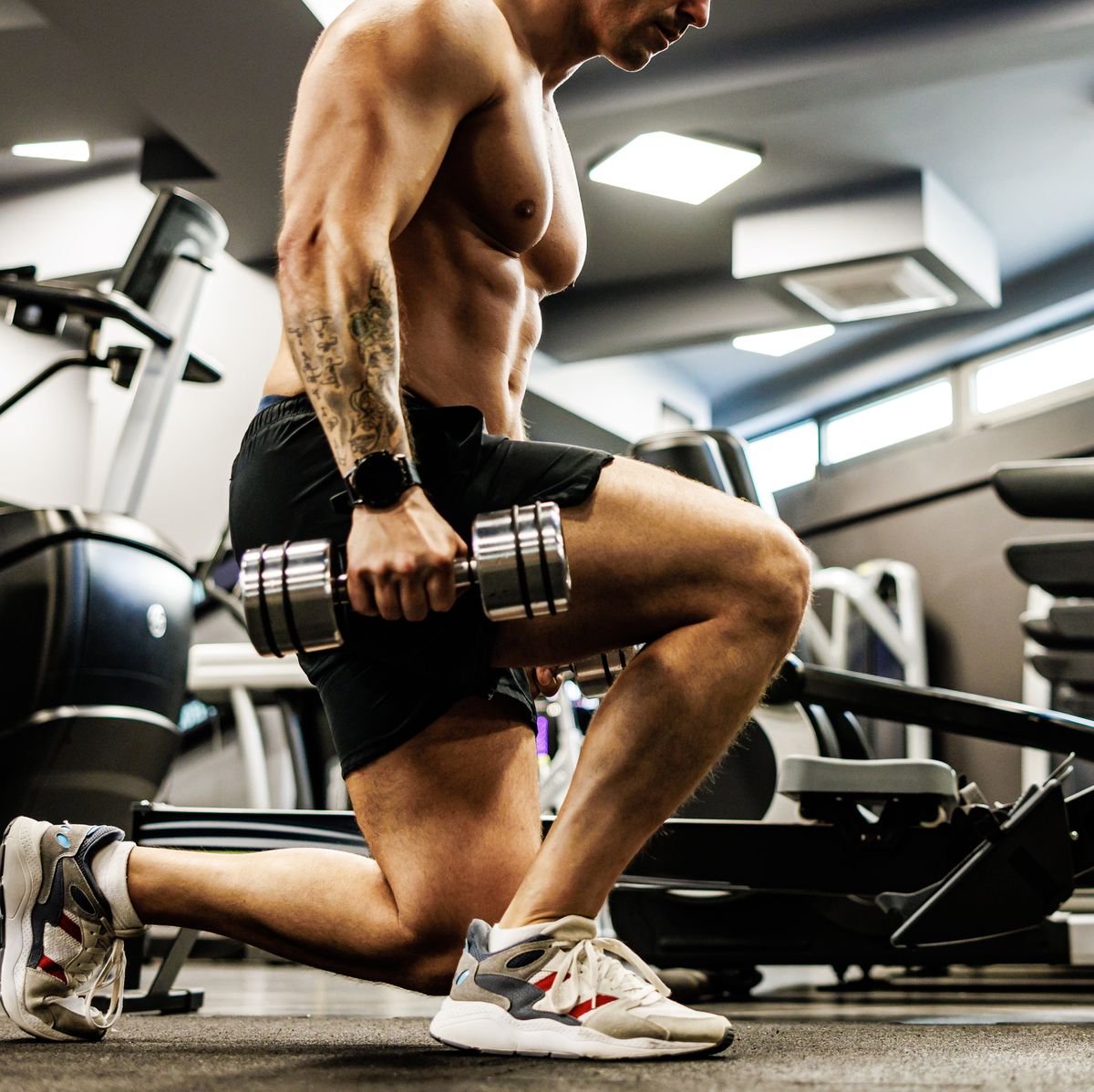
Credit: www.menshealth.com
Choosing The Right Weights And Progression
Many people wonder how heavy they should lift for glute training. The answer is: use a weight that feels challenging but still allows you to complete your target reps with good form. If you can easily do more than your target reps, increase the weight. If you cannot finish your set with good form, use a lighter weight.
A good rule: the last 2-3 reps of each set should feel hard, but not impossible.
Progression example: If you start doing hip thrusts with 60 lbs for 10 reps, and after two weeks you can do 12 reps, increase the weight to 70 lbs and go back to 10 reps.
Comparing Glute Exercises: Which Is Best?
Research shows some exercises activate the glutes more than others. Here is a comparison of glute activation levels (based on electromyography, or EMG studies):
| Exercise | Glute Activation (EMG %) |
|---|---|
| Barbell Hip Thrust | ~80-100% |
| Squats | ~60-80% |
| Romanian Deadlift | ~55-70% |
| Glute Bridge | ~70-90% |
| Lateral Band Walk | ~30-50% |
Key takeaway: Hip thrusts and glute bridges generally produce the highest glute activation, but a mix of exercises is best for full development.
Common Mistakes In Glute Training
Even with the best intentions, many people make errors that slow their glute progress. Watch out for these mistakes:
1. Not Using Enough Weight
Progressive overload is key. If you stick with very light weights, your glutes will not grow.
2. Relying Only on Squats
Squats are great, but they also work your quads. Add hip thrusts, bridges, and isolation moves for full glute activation.
3. Poor Form
Letting your lower back take over or moving too fast reduces the work done by your glutes.
4. Skipping Mind-Muscle Connection
If you cannot feel your glutes working, slow down and focus on squeezing them at the top of each rep.
5. Neglecting Recovery
Muscles grow when you rest. Overtraining can lead to fatigue and injury, not bigger glutes.
How Nutrition Supports Glute Growth
You can have the best workout plan, but without the right food, your glutes will not grow. Muscle building requires a calorie surplus (eating more calories than you burn) and enough protein for repair.
- Protein: Aim for 0.7–1 gram per pound of body weight daily. Good sources include chicken, beef, fish, eggs, dairy, lentils, and tofu.
- Carbohydrates: Give energy for tough workouts. Include rice, oats, potatoes, fruit, and whole grains.
- Healthy fats: Support hormones and recovery. Use nuts, seeds, avocados, and olive oil.
Sample meal for glute growth: Grilled chicken breast, brown rice, steamed broccoli, and avocado.
| Food | Protein (g) | Carbs (g) | Fat (g) |
|---|---|---|---|
| Chicken breast (4 oz) | 25 | 0 | 2 |
| Brown rice (1 cup cooked) | 5 | 45 | 1 |
| Avocado (half) | 2 | 12 | 15 |
| Broccoli (1 cup cooked) | 3 | 6 | 0 |
Insider tip: Many beginners forget about water. Staying hydrated helps performance and recovery.

Credit: www.youtube.com
Glute Activation: Waking Up Your Muscles
If you sit a lot, your glutes may not “fire” well. This means other muscles (like your lower back or hamstrings) try to take over. Before heavy glute exercises, do a quick activation routine:
- Bodyweight Glute Bridges: 2 sets x 15 reps
- Clamshells with Band: 2 sets x 15 reps (each side)
- Lateral Band Walks: 2 sets x 10 steps
This “wakes up” your glutes so they do more work during big lifts.
Cardio And Glute Building
Some people worry that too much cardio will shrink their glutes. The truth: moderate cardio is fine, but long, high-intensity cardio (like running for hours) can slow muscle growth if you do not eat enough. Choose cardio that supports your goals:
- Walking on an incline: Activates glutes without overworking them
- Stair climbing: Great for glute endurance
- Sprints: Short, intense bursts build power and glute size
If your main goal is bigger glutes, limit cardio to 2-3 sessions per week and keep them 20-30 minutes long.
Advanced Techniques For Faster Glute Growth
Once you have mastered the basics, try these advanced methods:
1. Tempo Training
Change the speed of your reps. Try lowering slowly (3-4 seconds down), then exploding up. This increases time under tension for more muscle growth.
2. Paused Reps
Pause for 2-3 seconds at the hardest part of the lift (usually the top). This builds strength and mind-muscle connection.
3. Resistance Bands
Add bands to hip thrusts or bridges for extra glute activation, especially at the top of the movement.
4. Drop Sets
After your last set, drop the weight and keep going until you cannot do more reps. This pushes your muscles beyond normal fatigue.
5. Unilateral Training
Single-leg exercises (like single-leg hip thrusts or split squats) fix muscle imbalances and force each glute to work harder.
Warning: Do not try all these methods at once. Add one at a time and see how your body responds.
Tracking Your Glute Progress
Building glutes takes time. Many people get discouraged when they do not see fast changes. Here’s how to track your progress:
- Take photos: Every 4 weeks, use the same lighting and pose. Small changes add up.
- Measure your hips: Use a tape measure around the widest part.
- Track your lifts: Write down the weights and reps for each exercise. Getting stronger usually means your muscles are growing.
Non-obvious insight: Sometimes, your glutes get firmer before they get much bigger. The mirror can show changes even if the scale does not.
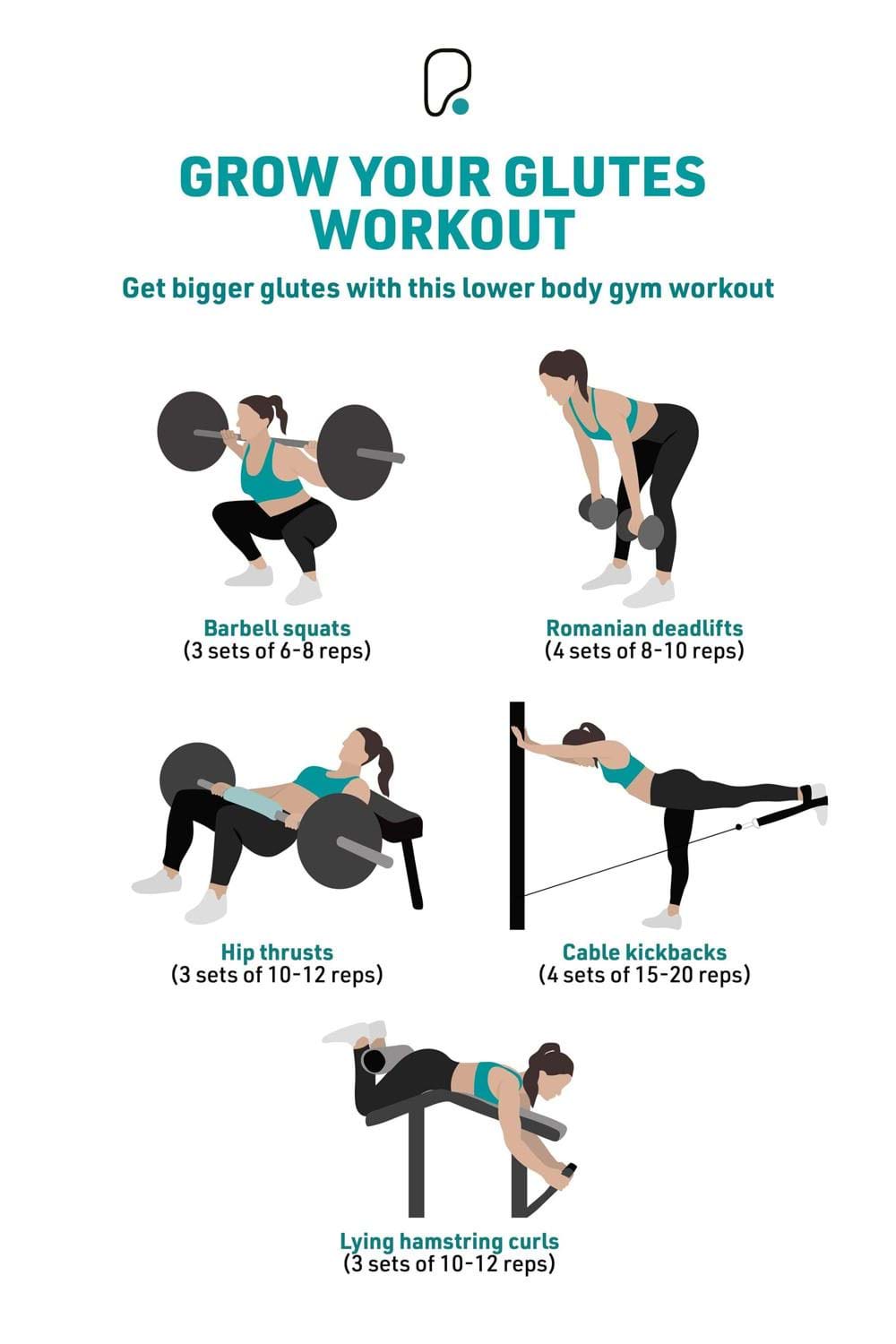
Credit: www.puregym.com
Glute Training For Men And Women
Both men and women can benefit from glute training, but goals may differ. Women often aim for rounder, fuller glutes, while men may focus on strength and power. The exercises are the same, but the number of sets, reps, and weekly volume may change.
Example: Women may use higher reps (12-20) for more volume, while men may stick with moderate reps (8-12) and heavier weights.
Home Vs. Gym Glute Workouts
You do not need a gym to build great glutes, but equipment helps. Here is a quick comparison:
| Option | Pros | Cons |
|---|---|---|
| Gym | Heavier weights, more machines, faster progress | Cost, travel time |
| Home | Convenience, low cost, privacy | Limited weights, slower progression |
Tip: If training at home, invest in a set of resistance bands and adjustable dumbbells for best results.
Recovery And Rest: Growing Outside The Gym
Muscle growth happens during recovery, not just in the gym. Follow these tips for faster results:
- Sleep: Aim for 7-9 hours per night. Sleep is when your body repairs muscle.
- Active recovery: Light walking, stretching, or yoga helps blood flow and reduces soreness.
- Rest days: Take at least one full rest day per week. Do not train glutes hard two days in a row.
Insider tip: Many people skip stretching. Tight hip flexors can limit glute growth. Stretch your hips, quads, and hamstrings regularly.
Supplements: Do You Need Them?
Supplements are not magic, but they can help if your diet is lacking. The most proven supplements for muscle growth are:
- Whey protein: Easy way to get more protein if you struggle with food.
- Creatine monohydrate: Boosts strength and muscle size.
- Fish oil: Reduces inflammation and supports recovery.
- Multivitamin: Fills any gaps in your diet.
Always talk to a doctor before starting new supplements, especially if you have health issues.
Staying Motivated For The Long Term
Building glutes takes patience. Results come slowly but are worth the effort. Here are ways to stay motivated:
- Set small goals: Celebrate each strength increase or new exercise mastered.
- Find a workout partner: Training with a friend boosts consistency.
- Track progress: Photos and measurements show results even when the mirror does not.
- Mix it up: Change exercises or routines every few months to keep things fun.
Non-obvious insight: Sometimes you will not feel sore, but your glutes are still growing. Soreness is not the only sign of a good workout.
When To Change Your Glute Routine
If you stop seeing progress for 3-4 weeks, it may be time to change your program. Signs you need a change:
- No increase in strength or reps
- No visible changes in photos or measurements
- Workouts feel boring or too easy
How to change: Switch exercises, increase weight, add sets, or try new training methods. Keep challenging your muscles.
Importance Of Consistency
Consistency is the secret ingredient for glute growth. Training hard for a few weeks, then stopping, brings little progress. Stick with your plan for at least 12 weeks to see meaningful change. Remember: muscle building is a marathon, not a sprint.
Further Learning And Resources
If you want to dig deeper, check out research from sports science organizations or reputable trainers. One excellent resource is the Wikipedia page on the gluteus maximus for more anatomy details.
Frequently Asked Questions
How Long Does It Take To See Glute Growth?
Most people see small changes in 4-6 weeks with consistent training and nutrition. Noticeable size and shape improvements often take 3-6 months. Progress depends on your genetics, training quality, and diet.
Can You Build Glutes Without Weights?
Yes, you can make progress with bodyweight and resistance bands, especially if you are a beginner. Over time, using extra weight leads to faster and bigger gains. At home, focus on single-leg exercises, higher reps, and slowing down your reps for more challenge.
Why Can't I Feel My Glutes Working?
This is common, especially for people who sit a lot. Try glute activation exercises before your main workout, focus on the mind-muscle connection, and slow down your reps. Sometimes you need to fix your form or reduce the weight to target the glutes better.
Do Squats Build Glutes Or Just Legs?
Squats work both the glutes and the quadriceps (front of the thigh). To focus more on glutes, use a wider stance, push your hips back, and make sure you reach at least parallel depth. But for best results, add hip thrusts and bridges to your routine.
Is Cardio Bad For Glute Growth?
Moderate cardio is not bad, but too much can make it harder to gain muscle if you do not eat enough. Focus on short, intense cardio (like sprints or incline walking) and keep your main focus on strength training for glutes.
Building your glutes can transform your body, boost your athletic ability, and support your health. Stay consistent, keep learning, and enjoy the process. With the right mix of exercises, nutrition, and recovery, your glute goals are within reach.
