

Shirt And T-Shirt Difference: Key Features Explained Simply
Shirt And T-shirt Difference
When you look into your wardrobe, you might see shirts and t-shirts lined up side by side. At first, they can seem similar—both are upper body clothing. But the difference between a shirt and a t-shirt goes much deeper than just style. Understanding these differences can help you choose the right outfit for any occasion, boost your confidence, and even express your personality.
Many people mix up these terms, especially non-native English speakers. This confusion can lead to mistakes when shopping, dressing for events, or talking about fashion. In this article, you’ll discover the clear, practical differences between shirts and t-shirts. We’ll explore their history, design, fabric, usage, and cultural meaning.
You’ll also see how each fits into modern life, and learn some tips to make better choices. Whether you want to dress smarter, feel more comfortable, or simply understand fashion language, this guide will help you.
What Is A Shirt?
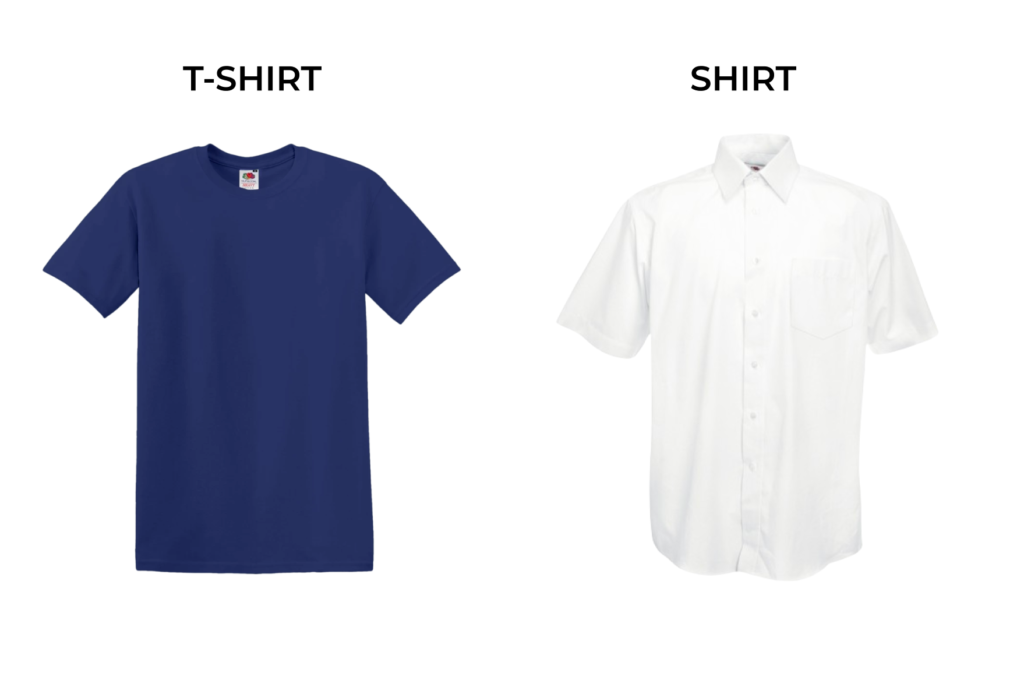
A shirt is a classic piece of clothing worn on the upper body. The most common type is the dress shirt. It has a collar, buttons down the front, and sleeves (usually long, but sometimes short). Shirts are made from woven fabrics like cotton, linen, or polyester blends.
Shirts are often seen as formal or business wear. You’ll find them in workplaces, meetings, or special events. They can be worn tucked into pants, with a tie, or under a jacket. There are many types of shirts, including:
- Dress shirts (the most formal)
- Casual shirts (like flannel or denim)
- Polo shirts (with a collar and short sleeves)
- Western shirts (with snap buttons and unique designs)
Shirts can have patterns or be plain. They usually have a structured shape, which means they keep their form and look neat even after washing.
What Is A T-shirt?
A t-shirt is a simple, comfortable top. It has no collar, usually no buttons, and is pulled over the head. The sleeves are short, although some t-shirts have long sleeves. T-shirts are made from knitted fabric, most often cotton or cotton blends.
T-shirts are casual, relaxed, and easy to wear. They are perfect for everyday use, sports, or leisure. You’ll see t-shirts with graphic prints, slogans, logos, or plain colors. People wear t-shirts for comfort and self-expression.
The basic t-shirt design is a crew neck (round neckline) or a v-neck (V-shaped neckline). T-shirts do not have the structure of shirts; they are softer and more flexible.
Credit: www.wordans.com
Shirt Vs T-shirt: Key Differences
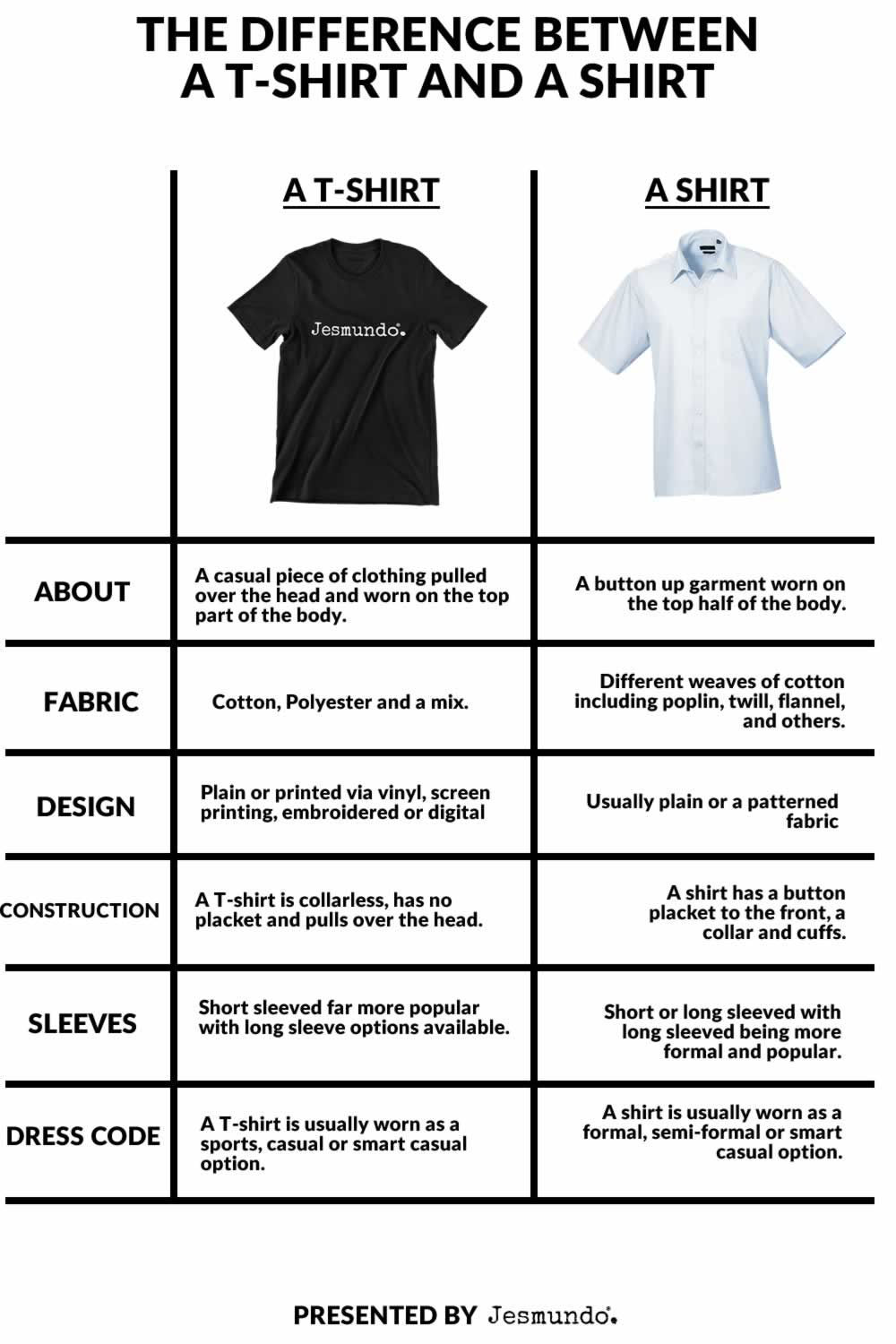
Let’s break down the main differences between shirts and t-shirts. This comparison will help you quickly understand which is which.
| Feature | Shirt | T-Shirt |
|---|---|---|
| Collar | Always present | Usually absent |
| Buttons | Front buttons | No buttons |
| Sleeves | Long/short; often cuffed | Mostly short |
| Fabric | Woven, structured | Knitted, soft |
| Fit | Structured, formal | Relaxed, casual |
| Use | Formal, semi-formal | Casual, leisure |
| Care | Ironing needed | Minimal ironing |
This table highlights the main points. Shirts have a collar, buttons, and structured fit. T-shirts are collarless, buttonless, and casual. Shirts need ironing to look neat; t-shirts are easy to maintain.
How Shirts And T-shirts Developed
Fashion is always changing. The history of shirts and t-shirts shows how culture and technology shape what we wear.
The Shirt: From Formality To Everyday
Shirts started as a formal garment for men. In early times, shirts were worn under coats or jackets, and only the collar and cuffs were visible. Over time, shirts became more visible and were designed with patterns, colors, and unique fabrics.
Today, shirts are worn by both men and women. They are used for work, business, and special occasions. You can find shirts in many styles—some are very formal, others are casual and relaxed.
The T-shirt: From Underwear To Icon
T-shirts began as underwear. Soldiers wore them under uniforms for comfort. Later, t-shirts became popular because they were easy to wear and wash. In movies and music, t-shirts became a symbol of youth and rebellion.
Now, t-shirts are everywhere. People wear them for sports, work, or just relaxing at home. T-shirts are used for advertising, art, and self-expression. They are a canvas for creativity.
Credit: www.jesmundo.co.uk
Fabrics And Materials
The fabric of a shirt or t-shirt affects how it feels, looks, and wears. Choosing the right material is important for comfort and style.
Shirt Fabrics
Shirts use woven fabrics. These fabrics are made by interlacing threads, which creates a firm and structured cloth. Common shirt fabrics include:
- Cotton: Soft, breathable, easy to iron
- Linen: Cool, lightweight, but wrinkles easily
- Polyester: Durable, less breathable, resists wrinkles
- Blends: Mix of cotton and polyester for balance
Dress shirts are usually made from higher-quality cotton or blends. Casual shirts might use denim, flannel, or chambray.
T-shirt Fabrics
T-shirts use knitted fabrics. These fabrics are made by looping threads, which makes them stretchy and comfortable. Common t-shirt fabrics include:
- Cotton jersey: Soft, stretchy, breathable
- Polyester blends: Durable, less absorbent
- Tri-blends: Mix of cotton, polyester, and rayon for softness
T-shirts feel softer and move with your body. They are less likely to wrinkle, and are easy to wash and dry.
Design Features
The design of a shirt or t-shirt affects how it looks and functions. Let’s explore the main design features.
Shirt Design
- Collar: Most shirts have a collar. It can be pointed, spread, or button-down.
- Buttons: Shirts usually have a row of buttons down the front.
- Cuffs: Long-sleeve shirts have cuffs at the wrist, often with buttons.
- Pockets: Some shirts have chest pockets.
- Hem: The bottom edge is often curved or straight.
Shirts are designed to look neat and sharp. The shape is tailored to fit the body.
T-shirt Design
- Neckline: T-shirts have a crew neck (round) or v-neck.
- Sleeves: Usually short, but sometimes long.
- Prints: T-shirts often feature graphics, logos, or text.
- Hem: The bottom edge is usually straight.
T-shirts are simple and relaxed. They focus on comfort and easy style.
When To Wear A Shirt Vs A T-shirt
Choosing between a shirt and a t-shirt depends on the occasion, weather, and your personal style.
Shirts: Formal And Semi-formal Occasions
Wear a shirt when you need to look smart or professional. Examples include:
- Work or business meetings
- Job interviews
- Formal events like weddings or parties
- Dinner in a nice restaurant
Shirts are good for situations where appearance matters. They can be paired with a tie or jacket for a polished look.
T-shirts: Casual And Leisure
Wear a t-shirt for relaxed, informal situations. Examples include:
- Hanging out with friends
- Going to the gym
- Running errands
- Casual outdoor events
T-shirts are ideal for comfort and easy movement. They are also a way to show your personality with colors or prints.
Fit And Comfort
Fit is important for both shirts and t-shirts. The way a garment fits affects how you feel and look.
Shirt Fit
Shirts are made with structure. They have seams and darts to shape the body. The fit can be:
- Slim fit: Close to the body, modern look
- Regular fit: Classic, comfortable
- Loose fit: Relaxed, casual
A shirt should fit across the shoulders, chest, and arms. Too tight or too loose looks awkward. The collar should sit comfortably around your neck.
T-shirt Fit
T-shirts are soft and flexible. The fit can be:
- Fitted: Close to the body, shows shape
- Classic: Slightly loose, comfortable
- Oversized: Very loose, trendy
A t-shirt should allow movement. The neckline should not be too tight or too loose. The sleeves should cover the upper arm.
Maintenance And Care
Taking care of your shirts and t-shirts helps them last longer and look better.
Shirt Care
Shirts need more maintenance. Tips include:
- Ironing: Shirts wrinkle easily and need ironing after washing.
- Washing: Use gentle detergent; avoid hot water.
- Storing: Hang shirts to keep their shape.
Some shirts need special care, like dry cleaning. Always check the label.
T-shirt Care
T-shirts are easy to care for. Tips include:
- Washing: Machine wash with regular detergent.
- Drying: Air dry or use a dryer.
- Ironing: Usually not needed; if wrinkled, use low heat.
T-shirts can shrink if washed in hot water. Turn them inside out to protect prints.
Cost And Value
The price of shirts and t-shirts depends on fabric, brand, and quality.
Shirt Cost
Shirts are usually more expensive because of:
- Higher-quality fabric
- More complex construction
- Brand reputation
Formal shirts can cost much more than casual shirts. Custom-made shirts are pricier but offer better fit.
T-shirt Cost
T-shirts are cheaper because:
- Simple design
- Easy production
- Lower fabric cost
Designer t-shirts or limited editions can be expensive. Most t-shirts are affordable and easy to buy.
Popular Styles And Trends
Fashion changes fast. Shirts and t-shirts both have popular styles and trends.
Shirt Styles
- Classic white shirt: Always in style
- Patterned shirts: Stripes, checks, florals
- Denim shirts: Casual, rugged look
- Flannel shirts: Warm, cozy, popular in cold weather
- Polo shirts: Sporty, with a collar and buttons
Shirts can be dressed up or down. The style depends on fabric, color, and pattern.
T-shirt Styles
- Graphic tees: Prints, art, slogans
- Plain tees: Simple, versatile
- V-neck tees: Trendy, shows more neck
- Long sleeve tees: Good for cooler weather
- Athletic tees: Made for sports, with moisture-wicking fabric
T-shirts are a way to show personality. People choose colors and prints to express themselves.
Cultural And Social Meaning
Shirts and t-shirts have different meanings in society.
Shirts: Status And Formality
In many cultures, shirts show status and respect. Wearing a shirt means you care about appearance. In business, a shirt can signal professionalism and trust.
Some shirts are symbols of tradition, like the kurta in South Asia or the guayabera in Latin America.
T-shirts: Freedom And Expression
T-shirts are a symbol of freedom. They are casual, relaxed, and easy to wear. T-shirts are often used for:
- Showing support for causes (printed slogans)
- Advertising brands
- Expressing art or humor
T-shirts are a blank canvas. People use them to express ideas, beliefs, or style.
Common Mistakes When Choosing
Many people make mistakes when picking a shirt or t-shirt. Here are some tips to avoid them.
- Mixing formal and casual: Wearing a t-shirt to a formal event looks unprofessional. Choose a shirt for important occasions.
- Wrong fit: A shirt or t-shirt that is too tight or too loose looks bad. Try before you buy, or check size charts.
- Ignoring fabric: Some fabrics feel hot or itchy. Choose cotton or blends for comfort.
- Overlooking care needs: Shirts need ironing; t-shirts are easy care. Think about maintenance before buying.
- Picking based on price only: Cheap shirts or t-shirts may not last. Quality matters more than price.
Shirt Vs T-shirt: Real-life Examples
Understanding the difference is easier with real-life examples.
- Interview: A formal shirt, possibly with a tie, is expected. A t-shirt is not suitable.
- Office work: Most offices require shirts, sometimes with a jacket. Creative offices may allow t-shirts.
- Sports: T-shirts are perfect for movement and sweat. Shirts are not practical.
- Casual dinner: A shirt makes you look smart; a t-shirt is okay for informal places.
- Weekend outing: T-shirts are ideal for comfort and fun.
Shirt And T-shirt Around The World
Different cultures have unique views on shirts and t-shirts.
Western Countries
In the US and Europe, shirts are linked with business and formal occasions. T-shirts are for leisure and youth culture.
Asia
Shirts are worn for business, school, and ceremonies. T-shirts are common for youth and casual events.
Africa
Traditional shirts have unique patterns and meaning. T-shirts are used for everyday wear.
Latin America
Shirts like the guayabera are used for special events. T-shirts are popular in daily life.
Gender And Age Differences
Shirts and t-shirts are worn by all genders and ages, but the style and meaning can change.
- Men: Shirts are often used for business; t-shirts for casual wear.
- Women: Shirts can be formal or casual; t-shirts are popular for comfort.
- Children: T-shirts are easy for play; shirts for school or family events.
- Older adults: Shirts are seen as more mature; t-shirts for relaxation.
Credit: www.jesmundo.co.uk
Shirt Vs T-shirt: Data And Statistics
Let’s look at some data that shows how shirts and t-shirts are used.
| Usage | Shirt (%) | T-Shirt (%) |
|---|---|---|
| Business/Office | 85 | 15 |
| Casual/Home | 20 | 80 |
| Sports/Outdoor | 5 | 95 |
| Formal Events | 90 | 10 |
This data shows shirts dominate formal and business events, while t-shirts are preferred for casual, home, and sports.
Environmental Impact
Both shirts and t-shirts affect the environment. The impact depends on fabric, production, and care.
- Cotton production uses water and chemicals.
- Polyester is made from oil, which is not renewable.
- Care: Shirts need ironing, which uses electricity. T-shirts are easier to care for.
Choosing organic cotton or recycled materials helps reduce impact.
Non-obvious Insights
- Layering possibilities: Shirts can be layered over t-shirts for a stylish, casual look. This is popular in colder months or for fashion statements.
- Collar influence: The collar on shirts changes how people see you. A button-down collar is seen as less formal, while a pointed collar is more business-like.
- Fabric weave matters: The weave in shirts (like oxford or poplin) affects breathability and appearance. Many beginners miss this detail when shopping.
- T-shirt prints can fade: High-quality t-shirts use special inks that last longer. Cheap prints wash out quickly. Always check care instructions.
Shirt Vs T-shirt: Which Should You Choose?
The best choice depends on your needs:
- For formal, business, or important events, choose a shirt.
- For comfort, relaxation, or creative expression, choose a t-shirt.
Consider fabric, fit, and occasion. Try different styles to find what suits you.
Comparison Table: Shirt Vs T-shirt Summary
Here’s a summary table for quick reference.
| Aspect | Shirt | T-Shirt |
|---|---|---|
| Structure | Formal, tailored | Casual, relaxed |
| Features | Collar, buttons, cuffs | No collar, no buttons |
| Fabric | Woven (cotton, linen, blends) | Knitted (jersey, blends) |
| Care | Needs ironing | Easy care |
| Cost | Higher, depends on quality | Lower, mass-produced |
| Best for | Work, formal events | Sports, leisure |
Frequently Asked Questions
What Is The Main Difference Between A Shirt And A T-shirt?
The main difference is in structure and formality. A shirt has a collar, buttons, and structured shape, making it formal. A t-shirt is collarless, buttonless, and casual, made from soft fabric.
Can I Wear A T-shirt To A Formal Event?
No, a t-shirt is not suitable for formal events. Formal events require a shirt, sometimes with a tie or jacket. T-shirts are best for casual or leisure situations.
What Fabrics Are Best For Shirts And T-shirts?
Shirts use woven fabrics like cotton, linen, or blends for structure. T-shirts use knitted fabrics like cotton jersey or blends for softness and stretch. Choose cotton for breathability and comfort.
How Can I Tell If A Top Is A Shirt Or A T-shirt?
Check for a collar and buttons. If the garment has a collar and front buttons, it’s a shirt. If it has no collar and is pulled over the head, it’s a t-shirt.
Are Shirts And T-shirts Unisex?
Yes, both shirts and t-shirts are worn by all genders. Designs, cuts, and patterns may differ, but the basic structure remains the same. Choose what fits your style and comfort.
Understanding the difference between shirts and t-shirts helps you make smarter choices in fashion, comfort, and expression. Now you can confidently pick the right garment for any occasion. If you want to learn more about clothing history and styles, visit Wikipedia for detailed information.
Fashion is about expressing who you are. Whether you prefer the neat look of a shirt or the relaxed feel of a t-shirt, knowing the difference helps you dress well and feel good.
