

Different Shirt And Tshirt: Key Differences You Need to Know
Different Shirt And Tshirt
Fashion is more than just clothing. It is a way to express who you are, how you feel, and sometimes, what you want others to see in you. When people talk about casual or smart dressing, two items are always present: shirts and t-shirts. At first look, they may seem simple, but when you dive deeper, you’ll see that shirts and t-shirts have their own stories, uses, and styles. Knowing their differences can help you dress better for any occasion, feel more confident, and even save money by making smarter choices.
People often think shirts and t-shirts are the same because both cover your upper body. But, in reality, they are quite different. The fabrics, the designs, how you wear them, and even the message you send by choosing one over the other—these things matter.
This article explores the unique traits of shirts and t-shirts. You’ll learn about their history, how they are made, which one to pick for certain events, and even some facts that surprise most beginners. If you want to look good and make smart choices, understanding the world of shirts and t-shirts is a great place to start.
What Makes A Shirt?
A shirt is a broad term, but in most cases, people mean a button-down or formal shirt with a collar and sleeves. Shirts have been worn for hundreds of years, and they have changed with time. Today, you see shirts in offices, at weddings, and even on casual days out.
Key Features Of Shirts
- Collar: Most shirts have a structured collar. This is what gives them a smart and neat look. There are many collar types: pointed, spread, club, and more.
- Buttons: Shirts usually have a row of buttons from top to bottom. Some shirts (like polo shirts) have just a few buttons at the top.
- Cuffs: The end of the sleeves, called cuffs, are often stiff and may have buttons or even cufflinks.
- Fit: Shirts come in different fits, such as slim fit, regular, and relaxed. The fit you choose can change your whole look.
- Fabric: Most shirts are made from woven fabrics like cotton, linen, or blends. The fabric is stronger and less stretchy than what you find in t-shirts.
Types Of Shirts
There are many kinds of shirts, each with its own purpose and style.
- Dress shirt: Worn with suits or formal trousers, usually in plain colors or subtle patterns.
- Casual shirt: Made from softer fabrics, often with playful patterns or colors.
- Oxford shirt: Made from thicker, textured cotton. Good for both business and casual settings.
- Flannel shirt: Made from soft, warm fabric, often with a check pattern.
- Polo shirt: Has a collar and short buttons but is softer than a formal shirt.
Practical Uses
People wear shirts for:
- Business meetings: Because they look professional.
- Formal events: Like weddings or ceremonies.
- Layering: You can wear a shirt over a t-shirt for a relaxed look.
Shirt Design And Details
Shirts often have extra details:
- Pockets: Sometimes one or two, useful for small items.
- Pleats: Folds that help the shirt fit better.
- Yoke: A piece of fabric across the shoulders for strength.
Shirts can be tucked in or left out, depending on style and occasion. The way you wear a shirt can change how people see you.
What Makes A Tshirt?
A t-shirt is a simpler kind of top. The name “t-shirt” comes from its “T” shape. T-shirts are part of everyone’s wardrobe, from children to adults. They are easy, comfortable, and can have almost any design.
Key Features Of T-shirts
- No collar: Most t-shirts have a simple round (crew) neck, or sometimes a V-neck.
- No buttons: T-shirts are pulled over your head. Some styles have a small button detail, but that’s rare.
- Simple sleeves: Short sleeves are most common, but there are long-sleeve and sleeveless styles too.
- Knit fabric: T-shirts are made from knitted cotton or blends. This makes them soft, flexible, and comfortable.
- Casual look: T-shirts are mostly worn in relaxed settings.
Types Of T-shirts
- Crew neck: The classic round neck, fits close to the neck.
- V-neck: The neckline forms a “V” shape.
- Raglan: The sleeves extend in one piece to the collar, often in a different color.
- Graphic tee: Has prints or designs, sometimes with logos or pictures.
- Pocket tee: Has a small pocket on the chest.
Practical Uses
People wear t-shirts for:
- Daily comfort: Perfect for lounging at home or casual outings.
- Sports: Many sports t-shirts use special fabrics that wick away sweat.
- Layering: Worn under shirts, jackets, or hoodies.
T-shirt Design And Details
T-shirts are a blank canvas. You can find them in every color, with slogans, art, or even company branding. Some t-shirts are collectibles because of rare prints or designer labels.
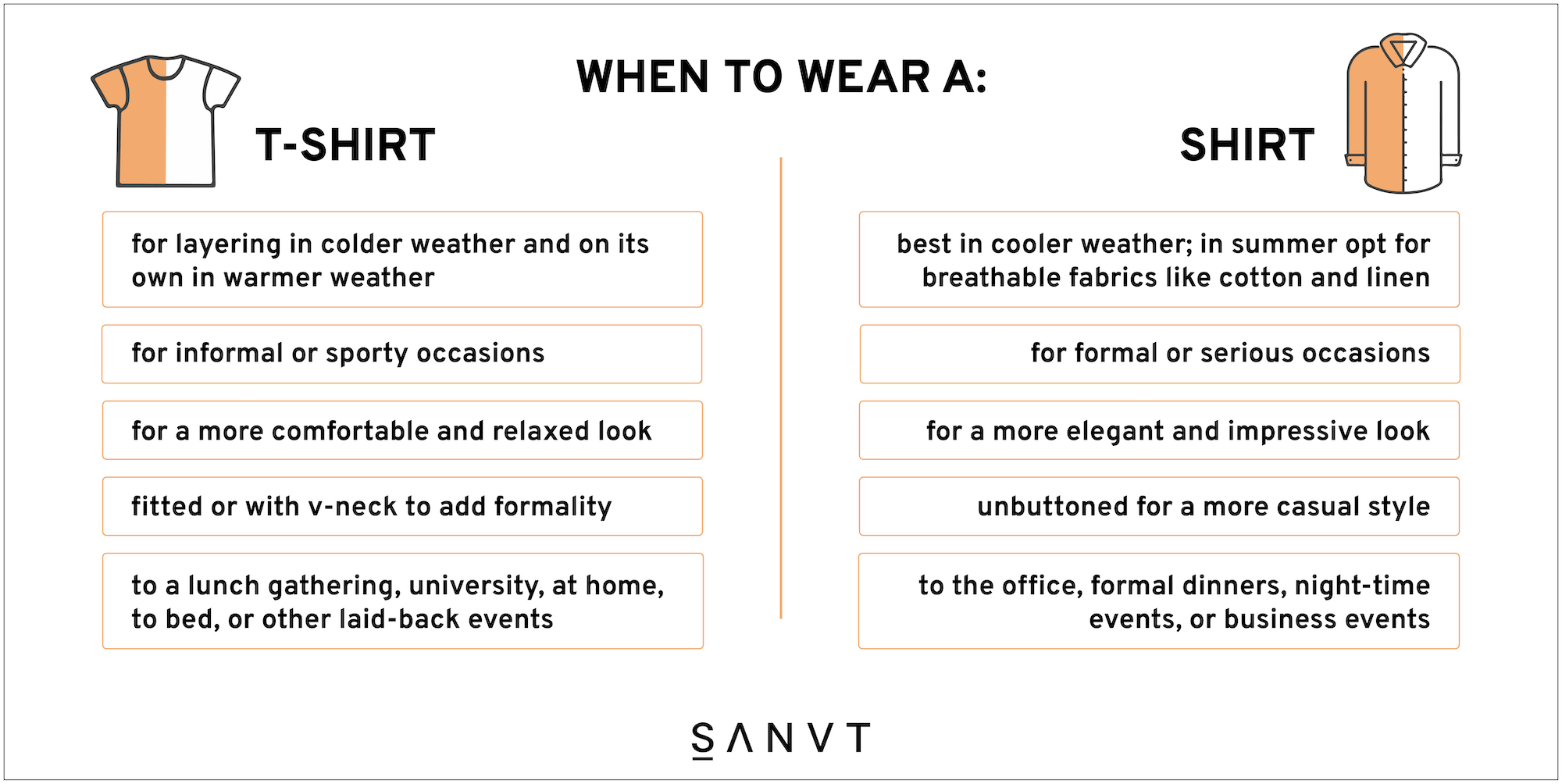
Credit: sanvt.com
Comparing Shirts And T-shirts
It’s easy to think shirts and t-shirts are almost the same, but the differences matter. Let’s look at how they compare in some important ways.
| Feature | Shirt | T-shirt |
|---|---|---|
| Structure | Collar, buttons, cuffs | No collar, no buttons (usually) |
| Fabric Type | Woven (less stretchy) | Knit (more stretchy) |
| Occasion | Formal and business | Casual and sports |
| Layering | Over t-shirts or as outer layer | Mainly as inner layer |
| Fit | More structured, can be tailored | Relaxed, fits close to body |
When To Choose A Shirt
Pick a shirt when you want to look polished, smart, or professional. For example, a job interview, a date at a nice restaurant, or a family event often calls for a shirt. Shirts are also better for hot weather if you need sun protection, as they cover more and use breathable fabrics.
When To Choose A T-shirt
Choose a t-shirt for comfort and freedom. If you are running errands, meeting friends for coffee, or going to the gym, a t-shirt works best. T-shirts also let you show your interests—music bands, sports teams, or funny quotes.
Shirts: Deep Dive Into Styles
Let’s look closer at some shirt styles and how they fit into modern wardrobes.
Dress Shirts
Dress shirts are the classic choice for business, ceremonies, or anywhere that needs a suit. They are made from high-quality cotton or blends and are usually plain or have subtle stripes. The cuffs can be buttoned or use cufflinks for added style.
Oxford Shirts
Oxford shirts have a thicker feel and a special weave that makes them strong but comfortable. They are flexible—you can wear them with jeans for a smart casual look or with a blazer for meetings.
Flannel Shirts
Flannel shirts are perfect for cooler weather. They are soft, warm, and usually have a checkered design. Many people wear them open over t-shirts for a laid-back vibe.
Short Sleeve Shirts
Not all shirts have long sleeves. Short sleeve shirts are great for summer and often come in bright colors or prints. They’re common at beach parties or outdoor events.
Polo Shirts
Polo shirts are a unique mix. They have a collar and short buttons but are made from knit fabric, like t-shirts. This makes them a favorite for sports like golf or tennis and for smart-casual events.
T-shirts: Deep Dive Into Styles
The world of t-shirts is huge. Here’s how some popular styles stand out.
Crew Neck T-shirts
This is the most common t-shirt. The round neckline suits almost everyone and works well alone or as a base layer.
V-neck T-shirts
V-necks are good for people who want a bit more style or want to show off necklaces. They make the neck look longer and are great for layering under shirts.
Graphic T-shirts
These t-shirts have big prints, logos, or art. They are a way to express your personality. Collectors sometimes pay high prices for rare graphic tees.
Henley T-shirts
Henleys have a round neckline with 2–5 buttons but no collar. They are more interesting than plain t-shirts and work well for casual dates or relaxed weekends.
Long Sleeve T-shirts
Great for cooler days, these t-shirts give a bit more coverage but keep the casual feel.
History And Cultural Impact
The Shirt’s Journey
Shirts have been around for centuries. At first, they were worn under other clothes. Over time, shirts became outerwear for men and women. The shape, collar, and cuffs changed as fashion did. Today, shirts are a symbol of professionalism. You see them in schools, offices, and even in uniforms.
The Rise Of The T-shirt
T-shirts started as underwear. Soldiers and workers wore them because they were easy to wash and comfortable. After actors wore t-shirts in movies, they became a fashion statement. Now, t-shirts are everywhere, from streetwear to high fashion.
Social Meaning
Wearing a shirt can show respect for an event or person. Wearing a t-shirt can show comfort, creativity, or even rebellion. In some workplaces, wearing a t-shirt instead of a shirt can be seen as too casual.
Fabric Science: Shirt Vs. T-shirt Materials
What a shirt or t-shirt feels like depends on the fabric.
Shirt Fabrics
- Cotton: Breathable, strong, and easy to iron.
- Linen: Good for hot weather, but wrinkles easily.
- Polyester blends: Resist wrinkles, easy to wash.
- Silk: Rare and expensive, used for luxury shirts.
T-shirt Fabrics
- Cotton jersey: Soft and stretchy, feels good on the skin.
- Polyester: Used in sports t-shirts for moisture-wicking.
- Blends: Mix of cotton and polyester for durability.
| Fabric | Common Use | Comfort Level | Durability |
|---|---|---|---|
| Cotton (woven) | Shirts | High | High |
| Cotton (knit) | T-shirts | Very High | Medium |
| Linen | Shirts | High (in heat) | Low |
| Polyester | T-shirts | Medium | Very High |
How To Care For Shirts And T-shirts
Proper care can make your clothes last longer and look better.
Washing
- Shirts: Wash in cool or warm water. Iron while damp for a crisp look.
- T-shirts: Wash in cold water to prevent shrinking. Hang to dry for best results.
Ironing
- Shirts: Usually need ironing, especially after washing.
- T-shirts: Often do not need ironing if hung to dry quickly.
Storing
- Shirts: Hang on hangers to keep their shape.
- T-shirts: Fold and stack to save space.
Common Mistakes
Many people wash shirts and t-shirts together, which can wear out the fabrics faster. Always check the label. Don’t use high heat in dryers, as it can shrink t-shirts and weaken shirt fabrics.
Choosing The Right Fit And Size
Fit is the key to looking good. A shirt or t-shirt that fits well will always look better than an expensive one that doesn’t.
How To Check Shirt Fit
- The shoulder seam should sit at the edge of your shoulder.
- Sleeves should end just past your wrist bone.
- The shirt should tuck in without extra fabric bunching up.
How To Check T-shirt Fit
- The sleeve should end around the middle of your upper arm.
- The t-shirt should not be too tight or too loose.
- The bottom should cover your waistband but not much more.
Non-obvious Insight
Many beginners don’t realize that shirt and t-shirt sizes differ between brands and countries. Always try clothes on or check the size chart before buying.
Style Tips: Combining Shirts And T-shirts
Mixing shirts and t-shirts can create many looks.
Smart Casual
Wear a button-down shirt over a plain t-shirt, keep the shirt open, and pair with jeans or chinos. This look is perfect for relaxed offices or weekend outings.
Layering For Weather
In cold weather, wear a long-sleeve t-shirt under a flannel or denim shirt. Add a jacket or hoodie for extra warmth.
Accessorize
Add a simple watch or bracelet. For shirts, try a tie or scarf. For t-shirts, a cool cap or sunglasses works well.
Two Surprising Tips
- Shirts with patterns (like checks or stripes) look better over plain t-shirts, not graphic ones.
- Rolling up shirt sleeves can make you look more relaxed and approachable, without looking sloppy.

Credit: sanvt.com
Sustainability And Cost
Price Range
- Shirts: Range from budget to luxury. Materials and brand affect price.
- T-shirts: Usually cheaper, unless they are from designer brands or have special prints.
Sustainability
T-shirts are often made in huge numbers. Buying fewer, better-quality t-shirts and shirts helps the planet. Look for brands that use organic cotton or recycled fabrics.
Non-obvious Insight
A well-made shirt can last for years if cared for. T-shirts, especially cheap ones, may lose shape or color quickly.
Popular Brands Around The World
Some brands are famous for shirts, others for t-shirts.
- Shirt favorites: Ralph Lauren, Brooks Brothers, Uniqlo, Arrow, Van Heusen
- T-shirt favorites: H&M, Zara, Hanes, Gildan, Supreme
Each brand has its own style and price range. Do not choose only by brand—fit and comfort are more important.
Shirt And T-shirt Trends
Fashion changes, but some trends stay strong.
- Oversized t-shirts are popular in streetwear.
- Slim-fit shirts are common in business wear.
- Bold prints on t-shirts show personality.
- Classic white shirts never go out of style.
- Layered looks—shirts over t-shirts—work for both men and women.
Fashion is about experimenting, so don’t be afraid to try new combinations.
Frequently Asked Questions
What Is The Main Difference Between A Shirt And A T-shirt?
The main difference is structure. Shirts have collars, buttons, and are made from woven fabric. T-shirts have no collar, usually no buttons, and are made from soft, stretchy knit fabric.
Can I Wear A T-shirt Under A Shirt?
Yes, many people wear a plain t-shirt under an open shirt for a relaxed, smart-casual look. This also helps keep the shirt clean for longer.
Which Is Better For Hot Weather: Shirt Or T-shirt?
It depends on the fabric and fit. Light cotton or linen shirts are good for hot weather and provide sun protection. Thin cotton t-shirts are also cool, but may not protect from the sun as much.
How Do I Know If A Shirt Or T-shirt Fits Me Well?
A good fit means the seams sit on your shoulders, and there is no extra fabric bunching up. For t-shirts, the sleeve should end mid-arm and the body should not be too loose or too tight.
Are There Any Rules For Wearing Shirts And T-shirts Together?
For best style, wear a plain t-shirt under patterned shirts. Avoid mixing bold graphics and patterns. Make sure both fit well and are clean.
If you want to learn more about the history and types of shirts and t-shirts, check out this Wikipedia page.
Shirts and t-shirts are simple but powerful. By knowing their differences and how to wear them, you can create many looks for any occasion, stay comfortable, and even save money. Start with what feels best to you, and build your wardrobe with confidence.

Credit: sewguide.com
