

What Affirmation Does: Unlocking the Power of Positive Thinking
What Affirmation Does
Imagine waking up and telling yourself, “I am strong. I am capable. I can handle today.” These simple words can change how you feel, think, and act. This is the power of affirmation—a tool for shaping your mind and influencing your life. Many people talk about affirmation, but not everyone understands what it truly does. In this article, you will discover how affirmation works, how it affects your brain, and why it matters in daily life. You will also learn the science behind it, practical ways to use it, and common mistakes people make. By the end, you will see affirmation as more than just positive talk; you will see it as a force for real change.
What Is Affirmation?
Affirmation means saying positive statements about yourself or your life. These statements can be spoken, written, or even thought quietly. The main goal is to focus your mind on beliefs that help you grow and feel confident. Some examples of affirmations are:
- “I am worthy of happiness.”
- “I can learn new things.”
- “I am getting stronger every day.”
Affirmations are not magic. They do not change your life overnight. But when you repeat them often, they can slowly shift your thoughts, feelings, and actions. Many cultures and traditions use affirmation in some form, from ancient mantras to modern self-help.
How Affirmation Works In The Brain
When you say an affirmation, your brain pays attention. Your mind starts to process the words as if they are true, especially if you repeat them regularly. Scientists call this self-affirmation theory. This theory says that when you affirm your values or strengths, you protect your self-worth.
Brain Pathways And Affirmation
Research using brain scans has shown that positive statements activate the brain’s reward centers. The ventromedial prefrontal cortex, a part of your brain linked to self-reflection and value, lights up when you say things that align with your beliefs. Over time, repeating affirmations can build new brain pathways. This process is called neuroplasticity. It means your brain can change and learn, even as an adult.
Emotional Impact
Affirmation can also lower stress. When you face a challenge, your brain sometimes goes into “threat mode,” making you anxious or afraid. If you use affirmations like “I am able to handle this,” your brain can switch from fear to calm.
This does not make problems disappear, but it helps you deal with them in a better way.

Credit: www.cheservices.com
The Power Of Repetition
One of the most important things about affirmation is repetition. The more you repeat an idea, the more your mind accepts it. This is why advertising works—hearing the same message again and again makes it feel true.
How Many Times To Repeat?
There is no exact number, but most experts suggest repeating your affirmation at least 10 times, twice a day. Some people write their affirmations in a journal, others say them in front of a mirror. The key is to make it a habit, just like brushing your teeth.
Building A Routine
If you want affirmation to work, link it to something you already do. For example, say your affirmation while making coffee or before going to bed. This routine helps your brain expect and accept the positive message.
Real-life Effects Of Affirmation
Affirmations are not just “feel good” words. There are real effects you can see and measure. Here are some ways affirmation changes lives:
1. Boosts Self-esteem
Many people struggle with low self-esteem. Affirmations like “I am enough” or “I deserve respect” help break the habit of negative self-talk. Over time, you start to believe in your own value.
2. Improves Performance
Athletes, musicians, and public speakers often use affirmation before a big event. Saying “I am prepared” or “I am focused” helps the brain get ready for action. Studies show that people who use positive self-talk perform better under pressure.
3. Reduces Stress
When you are stressed, your mind can spiral into worry. Affirmations help anchor you. For example, saying “I can manage my stress” can lower your heart rate and calm your thoughts.
4. Supports Healing
Some research suggests that affirmation helps with physical healing. Patients who use positive statements during recovery often feel less pain and heal faster. This does not replace medicine, but it adds to the healing process.
5. Improves Relationships
Affirming your own worth can make you a better friend, partner, or parent. When you feel good about yourself, you are more patient and understanding with others.
The Science Behind Affirmation
Many people wonder if affirmation is just wishful thinking. But science says it can work—if done the right way.
Studies On Self-affirmation
A famous study found that students who wrote about their strengths before a big test did better than those who did not. This effect was even stronger for students who felt most at risk. The reason? Affirmation helps you see yourself as capable, which reduces fear and boosts motivation.
Brain Imaging Research
Brain scans show that positive self-talk activates the same areas of the brain as rewards like food or praise. This means your brain reacts to affirmations as if something good is happening, even before you see results.
Long-term Effects
Affirmation does not work instantly. Like exercise, it takes time to build results. People who practice affirmation for months often report feeling happier, more confident, and less stressed.
How To Create Effective Affirmations
Not all affirmations work the same. Some are more powerful than others. Here’s how to make affirmations that really help:
1. Keep It Positive
Always use positive language. Instead of saying “I am not weak,” say “I am strong. ” The brain focuses on the main idea, so keep it uplifting.
2. Use Present Tense
Say your affirmation as if it is true right now. For example, “I am successful” is better than “I will be successful. ” This helps your mind believe it sooner.
3. Make It Personal
Use “I” statements. Your affirmation should feel true for you, not just a general idea.
4. Be Specific
Vague affirmations are less powerful. “I handle stress well at work” is better than “I am okay. ”
5. Feel The Words
Say your affirmation with emotion. If you just repeat words without feeling, your brain might ignore them.
Examples Of Affirmations For Different Areas
People use affirmation for many reasons. Here are examples for different parts of life:
Confidence
- “I believe in myself.”
- “I am proud of who I am.”
Health
- “I am healthy and strong.”
- “My body heals quickly.”
Work
- “I am skilled at my job.”
- “I handle challenges well.”
Relationships
- “I am a loving friend.”
- “I deserve respect.”
Stress
- “I am calm and focused.”
- “I trust myself to handle problems.”
Common Mistakes With Affirmation
Many people start using affirmations but give up or see no results. Here are common mistakes to avoid:
1. Being Too Unrealistic
If you say, “I am a millionaire” but do not believe it, your mind will reject the idea. Start with believable statements and grow from there.
2. Lack Of Repetition
Repeating an affirmation once is not enough. You need to make it a daily habit for it to work.
3. Ignoring Emotions
If you say your affirmation without feeling, it does not reach your deeper mind. Connect with the words emotionally.
4. Negative Language
Avoid affirmations that focus on what you do not want. For example, “I am not afraid” focuses on fear. Instead, use “I am confident. ”
5. Not Taking Action
Affirmation is not magic. You still need to work towards your goals. Use affirmation to boost your motivation, but also take steps in real life.
Comparing Affirmation With Other Self-help Tools
Affirmation is one tool among many. Here’s a look at how it compares with other popular methods:
| Method | Main Focus | How It Works | Best For |
|---|---|---|---|
| Affirmation | Positive Self-Talk | Repeats positive statements to shape beliefs | Building confidence, reducing stress |
| Meditation | Mindfulness | Focuses on breathing and awareness | Calming the mind, reducing anxiety |
| Visualization | Imagining Goals | Pictures positive outcomes in the mind | Sports, public speaking, goal-setting |
| Gratitude Practice | Thankfulness | Lists things you are grateful for | Improving mood, seeing the good in life |
How Affirmation Helps In Different Life Situations
Affirmation is not just for one kind of person. It helps in many life situations:
During Change
If you are moving to a new city, starting a new job, or facing a big change, affirmation can steady your mind. Saying “I adapt well to new situations” helps you stay positive.
When Facing Failure
Everyone fails sometimes. Affirmation does not erase mistakes, but it helps you bounce back. “I learn from my mistakes” is a powerful way to shift your thinking.
Building New Habits
Trying to exercise, eat better, or learn a new skill? Affirmation like “I enjoy making healthy choices” can boost your willpower.
Overcoming Fear
Fear often stops people from trying new things. Affirmation like “I am brave in the face of fear” supports courage.
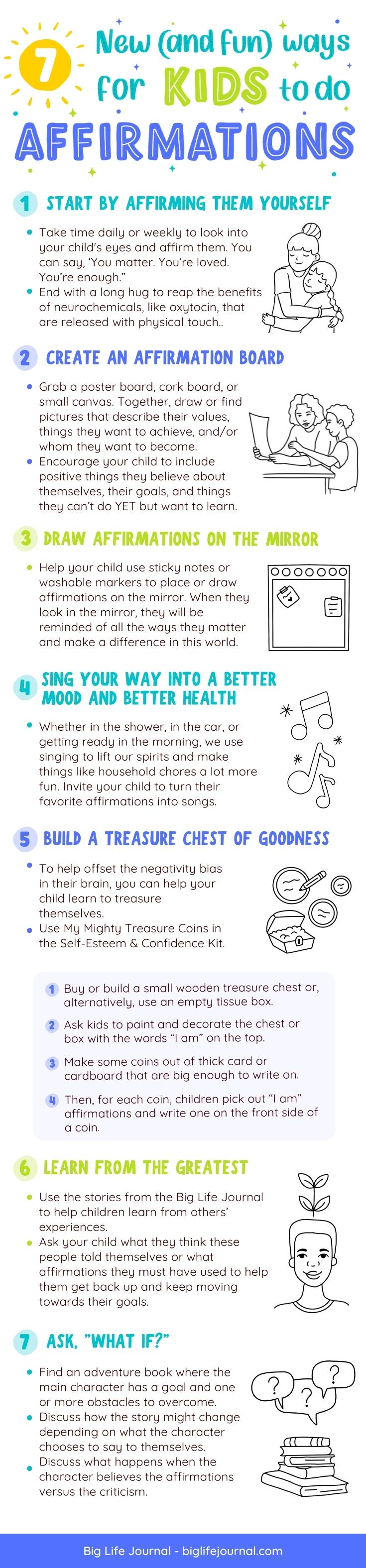
Credit: biglifejournal.com
Affirmation For Children And Teens
Young people can benefit from affirmation, but it needs to be simple and clear. For children, statements like “I am a good friend” or “I can try again” work well. For teens, affirmations can focus on self-worth and resilience, such as “I handle challenges with strength.
”
Studies show that children who use affirmation are less likely to feel anxious and more likely to try new things. Teaching kids to use affirmation early gives them a tool for life.
Affirmation In Therapy
Many therapists use affirmation with clients. It is often part of cognitive-behavioral therapy (CBT), a method that helps people change negative thinking patterns. Clients might be asked to write or say affirmations that challenge their doubts.
Therapists warn, though, that affirmation is not a cure for deep emotional pain. For serious issues, affirmation is only one part of healing.
The Role Of Affirmation In Success Stories
Many well-known people credit affirmation for their success. Athletes often repeat phrases like “I am ready to win. ” Entrepreneurs use statements such as “I am building something great. ” These stories show that affirmation is not just for feeling good—it is also for achieving big goals.
One non-obvious insight is that success stories often start with small, believable affirmations. Instead of aiming for huge changes, they build confidence step by step.
Affirmation And The Law Of Attraction
Some people link affirmation with the Law of Attraction—the idea that thinking positive thoughts brings positive things into your life. While affirmation can help you focus on your goals, it is not magic. You also need effort, planning, and action.
It is important to know that affirmation is not about ignoring problems or pretending everything is perfect. It is about choosing what you focus on and building a mindset that supports growth.
Data On Affirmation Effectiveness
There is growing research on how well affirmation works. Here is a summary of findings from different studies:
| Area | Effect of Affirmation | Notes |
|---|---|---|
| Academic Performance | Improves test scores and reduces stress | Especially strong for students facing pressure |
| Health | Reduces physical pain and speeds recovery | Works best with medical treatment |
| Workplace | Increases confidence and performance | Helps with public speaking and leadership |
| Mental Health | Lowers anxiety and depression symptoms | Should be combined with therapy if needed |
Practical Ways To Use Affirmation Every Day
Affirmation works best when it is part of your daily life. Here are some practical ways to use it:
- Mirror Practice: Stand in front of a mirror and say your affirmation out loud. Look into your own eyes. This adds power to your words.
- Write It Down: Keep a notebook or sticky notes with your favorite affirmations. Read them every morning and night.
- Record and Listen: Record yourself saying your affirmation and listen to it during a walk or before sleep.
- Combine with Breathing: Say your affirmation while taking slow, deep breaths. This relaxes your body and mind.
- Set Reminders: Use your phone to set reminders that pop up with your affirmation during the day.
Some people find it helpful to create a “power statement”—a short, strong affirmation they use in tough moments.
When Affirmation Does Not Work
Affirmation is not perfect. Sometimes it does not seem to work, and that is normal. Here are reasons why:
- Deep-rooted Beliefs: If you have believed something negative for a long time, it takes longer to change.
- Serious Problems: For deep trauma or mental illness, affirmation alone is not enough. Professional help is needed.
- Lack of Emotion: If you say your affirmation without feeling, it may not reach your subconscious mind.
One insight many people miss is that affirmation works best when paired with other tools, like therapy, support from friends, and real-life action.
Affirmation And Culture
Different cultures use affirmation in their own ways. In some Asian traditions, people repeat mantras. In Western self-help, people use positive self-talk. The words may change, but the idea is the same: shape your mind with intention.
Some cultures focus on community affirmations—groups saying positive words together. This adds a feeling of support and connection.
Myths And Facts About Affirmation
There are many myths about affirmation. Let’s clear up some common misunderstandings:
- Myth: Affirmation is just lying to yourself.
- Fact: Affirmation is about focusing on strengths and possibilities, not ignoring reality.
- Myth: You must believe your affirmation 100% for it to work.
- Fact: Many people start out doubtful. Over time, belief grows.
- Myth: Affirmation replaces hard work.
- Fact: Affirmation boosts motivation, but you still need to act.
- Myth: Affirmation works for everyone, always.
- Fact: Everyone is different. Some people need other tools as well.
Affirmation And Technology
Today, there are many apps and online tools for affirmation. Some apps send daily reminders or let you record your own voice. Others connect you with groups who share affirmations. If you like technology, these tools can make affirmation more fun and consistent.
For more research and information, you can visit Wikipedia’s page on affirmations.
Two Advanced Insights About Affirmation
- Affirmation Is a Skill: Like learning a language or playing an instrument, affirmation gets better with practice. Your first attempt might feel strange, but over time, your brain adapts.
- Affirmation Can Reveal Hidden Beliefs: Sometimes, saying a positive statement makes you notice inner doubts. This is useful—it shows what you need to work on.
Frequently Asked Questions
What Is The Best Time To Use Affirmation?
The best time is when your mind is calm—often in the morning after waking up, or at night before sleep. These are moments when your subconscious is most open to new ideas.
Can Affirmation Help With Anxiety?
Affirmation can help lower anxiety by shifting focus from worry to strength. It works best when combined with breathing exercises, mindfulness, or therapy for deeper issues.
How Long Does It Take For Affirmation To Work?
Results vary. Some people notice changes in a few days, but most see real shifts in a few weeks or months. Consistency is key—make it a daily habit.
Should Affirmations Be Said Out Loud Or In Your Mind?
Both work, but saying them out loud can be more powerful. Hearing your own voice makes the message stronger. Writing affirmations also helps.
What If I Do Not Believe My Affirmation?
It is normal to feel doubt at first. Start with statements that are believable and close to your current reality. As you practice, your belief will grow.
Affirmation is not just a trend or a quick fix. It is a way to shape your thoughts, build confidence, and move toward a better life. By understanding what affirmation does and how to use it well, you can unlock new possibilities for growth and happiness.

Credit: innerbalanceaz.com
