

Positive Affirmations for Women at Work: Boost Confidence Daily
Positive Affirmations For Women At Work
Every day, women around the world step into workplaces full of opportunities and challenges. Whether in an office, a lab, a hospital, or a remote team, women often face unique pressures. From the subtle doubts about their abilities to the loud expectations to “do it all,” the workplace can sometimes feel like a test of self-belief. Many women find themselves juggling roles, pushing through glass ceilings, and managing both work and life responsibilities. In these moments, positive affirmations can become a powerful tool—not just for motivation, but for real change in confidence and performance.
Affirmations are simple, positive statements you repeat to yourself to challenge and control negative thoughts. Over time, they can help reshape your thinking, boost your confidence, and empower you to reach higher. But affirmations are not magic words—they work best when they connect to your true goals and values.
When used regularly, they can help you manage stress, improve your focus, and strengthen your resilience.
This guide explains how and why positive affirmations matter for women at work. You’ll discover practical ways to use them, science-backed benefits, and the best affirmations for different workplace situations. Whether you’re looking for more confidence in meetings, support during tough days, or tools to lead your team, this article will give you clear answers and strategies to thrive.
Why Positive Affirmations Matter At Work
The workplace is more than just a place to earn a living. For many women, it’s a space for growth, connection, and ambition. However, it’s also a place where self-doubt and comparison can sneak in. Research shows that women are more likely than men to experience imposter syndrome—the feeling that you don’t deserve your success or that you’re “faking it.” This can hold women back from speaking up, asking for promotions, or taking on new challenges.
Positive affirmations help break this cycle. By repeating affirmations, you can:
- Reframe negative thoughts: Instead of focusing on fears or past mistakes, you train your mind to see possibilities and strengths.
- Build self-worth: Regular affirmations reinforce your value and remind you of your abilities, even when others doubt you.
- Reduce stress: Encouraging words can calm your mind, especially before difficult conversations or presentations.
- Improve performance: Believing in your skills makes it more likely you’ll perform well and achieve your goals.
A study published in the journal “Social Cognitive and Affective Neuroscience” found that self-affirmation actually changes brain activity, helping people respond better to stress and criticism. In simple terms: what you say to yourself matters.
The Science Behind Affirmations
Affirmations are not just wishful thinking. They are grounded in psychology and neuroscience. When you repeat positive statements, your brain creates new pathways—making it easier to believe and act on those thoughts. This process is called neuroplasticity.
For example, if you often think “I am not good enough,” your brain gets used to that pattern. But when you start repeating, “I am capable and prepared,” you slowly build a new habit of self-belief.
Research highlights several key benefits of affirmations:
- Lower stress: People who use affirmations before stressful events show less anxiety and better outcomes.
- Stronger motivation: Affirmations linked to personal values make it easier to stay focused on long-term goals.
- Greater resilience: Affirmations can help you bounce back from setbacks and keep trying even after failure.
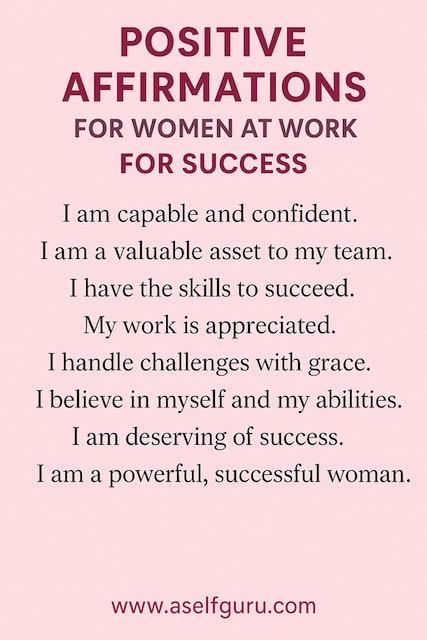
Another interesting finding is that affirmations work best when they are believable and specific. Telling yourself “I will be the CEO tomorrow” may not help—but “I am developing strong leadership skills” is powerful, because it connects to real actions and growth.
Credit: aselfguru.com
Common Challenges Women Face At Work
To understand why affirmations are so important, it helps to look at some challenges women often face in the workplace:
- Imposter Syndrome: Many women feel they are not as competent as others think. This can stop them from taking risks or celebrating achievements.
- Gender Bias: Women may be interrupted more often in meetings or judged more harshly for mistakes.
- Work-Life Balance: Juggling career and family responsibilities can cause guilt and stress.
- Lack of Role Models: In some fields, there are few women leaders to look up to, making it harder to imagine success.
- Pay Gaps and Promotion Barriers: Women often have to work harder for the same recognition or salary as men.
While affirmations don’t solve these problems alone, they give women a strong foundation to face them with confidence. They help you speak up, set boundaries, and pursue your goals even when the path is difficult.
How To Create Effective Affirmations
Not all affirmations work equally well. For the best results, your affirmations should be:
- Positive: Focus on what you want, not what you fear. For example, “I am calm and prepared,” not “I will not be nervous.”
- Present tense: Say “I am” instead of “I will be.” This tells your mind it’s true now.
- Personal and specific: Use words that connect to your real experiences and goals.
- Believable: Choose statements you can accept, even if they stretch your comfort zone.
Here’s a step-by-step way to create your own affirmations:
- Identify a challenge: What do you struggle with at work? (Example: Speaking up in meetings.)
- Find a positive quality: What do you want to feel or become? (Example: Confidence.)
- Write a simple, clear statement: “I speak clearly and confidently in meetings.”
- Repeat daily: Say your affirmation each morning, or before you face a challenge.
To make it more powerful, write your affirmation on a sticky note, set it as a phone reminder, or say it out loud in front of a mirror.
50 Positive Affirmations For Women At Work
Below are 50 affirmations tailored for different workplace situations. You can use them as they are or adapt them to fit your needs.
Confidence And Self-worth
- I am skilled and valuable to my team.
- I trust my knowledge and abilities.
- My ideas matter and deserve to be heard.
- I handle challenges with strength and grace.
- I am confident in my decisions.
- My voice brings value to every meeting.
- I am worthy of success and recognition.
- I am proud of what I have achieved.
- I learn quickly and adapt easily.
- I deserve to be here and to grow.
Leadership And Ambition
- I am a natural leader.
- My leadership inspires others.
- I handle responsibility with care and focus.
- I have the power to create positive change.
- I support and uplift my team.
- I am open to new opportunities.
- I make strong, thoughtful decisions.
- I lead with confidence and kindness.
- I am prepared for the next step in my career.
- I am building a legacy through my work.
Overcoming Stress And Setbacks
- I remain calm under pressure.
- I control my response to stress.
- Every challenge helps me grow.
- I bounce back quickly from setbacks.
- I learn from mistakes without judgment.
- I am patient with myself and others.
- I let go of what I cannot control.
- I am strong enough to face any difficulty.
- I handle criticism with an open mind.
- I trust that solutions will come.
Work-life Balance
- I give myself permission to rest.
- I set healthy boundaries at work.
- My well-being matters as much as my work.
- I balance my roles with care and respect.
- I am present in each moment.
- I ask for help when I need it.
- I honor my time and energy.
- I am enough, just as I am.
- I celebrate my progress, not just perfection.
- I prioritize my happiness and health.
Motivation And Progress
- I am focused and productive today.
- I welcome new ideas and growth.
- I celebrate my small wins every day.
- I am moving forward, step by step.
- I turn challenges into opportunities.
- I trust the process of my career.
- I create value through my work.
- I am open to feedback and learning.
- I am committed to my goals.
- I believe in my future success.
How To Use Affirmations In Your Workday
Affirmations are most powerful when they become a habit. Here are practical ways to fit them into your busy work life:
Morning Routine
Start your day with 1–3 affirmations. Say them while you get ready, during your commute, or as you review your calendar. This sets a positive tone for the hours ahead.
Before Meetings Or Presentations
If you feel nervous before speaking, quietly repeat an affirmation. For example, “My ideas are clear and valuable. ” This can help calm your nerves and boost your presence.
During Breaks
Take a moment during lunch or a coffee break to remind yourself of your strengths. Even a quick affirmation can reset your mindset.
When Facing Challenges
If you receive criticism or face a setback, pause and repeat an affirmation that addresses resilience or learning. This helps you stay focused and not take negative feedback personally.
Written Reminders
Write affirmations on sticky notes, or set them as reminders on your phone or computer. Place them where you’ll see them—your desk, notebook, or even your water bottle.
Affirmation Journal
Keep a small notebook where you write your daily affirmations and reflect on your progress. Over time, you’ll see how your self-talk shifts and your confidence grows.
Visualization
As you say your affirmation, picture yourself succeeding. For example, if your affirmation is “I speak with confidence,” imagine yourself delivering a strong presentation.
Comparing Affirmations To Other Mindset Tools
Affirmations are just one tool for building confidence and a positive mindset. How do they compare to other strategies like visualization or goal-setting? Here’s a simple comparison:
| Tool | Main Benefit | Best For | How to Use |
|---|---|---|---|
| Affirmations | Positive self-talk and confidence | Daily encouragement, overcoming self-doubt | Repeat positive statements about yourself |
| Visualization | Clarity and motivation | Preparing for big events or goals | Picture yourself succeeding in detail |
| Goal Setting | Clear action steps | Tracking progress, staying focused | Write and review your goals regularly |
| Gratitude Practice | Improved mood, less stress | Reducing negativity, finding joy | List things you’re thankful for each day |
You don’t have to choose just one. Many women find that combining affirmations with other tools makes each one more effective.
Affirmations For Different Career Stages
The workplace journey is different for everyone. Here’s how affirmations can support you at various stages:
Starting A New Job
- “I learn quickly and adapt easily.”
- “I am open to new experiences.”
- “I trust myself to handle new challenges.”
New jobs can be stressful, but affirmations remind you that you have succeeded before and can do it again.
Seeking Promotion Or Leadership
- “I am ready for more responsibility.”
- “My leadership inspires others.”
- “I am prepared for the next step.”
Affirmations help you stay focused and confident when aiming for a higher role.
Returning To Work After A Break
- “I bring valuable skills to my team.”
- “I am ready to contribute and grow.”
- “I am confident in my abilities.”
Returning after time away can feel intimidating. Affirmations can ease the transition and counter any doubts.
Leading A Team
- “I support and uplift my team.”
- “I make strong, thoughtful decisions.”
- “I lead with confidence and kindness.”
Leadership requires both strength and empathy—affirmations can reinforce both.
Navigating Difficult Work Environments
- “I set healthy boundaries at work.”
- “I control my response to stress.”
- “I am strong enough to face any difficulty.”
When the workplace is tough, affirmations provide inner support and remind you of your values.
Examples Of Affirmations In Action
Sometimes, real-life examples make the power of affirmations clearer. Here are a few scenarios showing how women have used affirmations at work:
Scenario 1: Overcoming Fear Of Public Speaking
Maria, a project manager, always felt nervous before speaking in meetings. She started using the affirmation, “My ideas matter and deserve to be heard. ” She repeated it before each meeting for a month. Gradually, she found herself speaking up more often—and colleagues began to notice her contributions.
Scenario 2: Handling Criticism
Jasmine, a graphic designer, sometimes took feedback personally and lost confidence. She began repeating, “I learn from mistakes without judgment. ” This helped her separate her self-worth from her work, leading to less stress and better results.
Scenario 3: Balancing Work And Family
Priya, a mother and entrepreneur, struggled with guilt about balancing work and home life. She chose the affirmation, “My well-being matters as much as my work. ” This gentle reminder helped her set boundaries and prioritize self-care, improving both her mood and her productivity.
Scenario 4: Seeking Promotion
Lina wanted to apply for a leadership role but doubted her readiness. She used, “I am prepared for the next step in my career,” each morning. Over time, she felt more confident and submitted her application, leading to an interview and eventually a promotion.
These examples show that affirmations are not just words—they can spark real action and change, especially when repeated with intention and belief.
Common Mistakes When Using Affirmations
While affirmations are simple, there are a few common mistakes that can limit their power:
- Choosing statements you don’t believe: If your affirmation feels false, your mind will resist it. Start with something you can accept, even if it’s a small step forward.
- Being too vague: “I want to be successful” is less helpful than “I am building strong communication skills.”
- Saying them only once: Affirmations work best when used regularly, not just during hard times.
- Ignoring action: Affirmations support your goals, but they don’t replace hard work. Pair your words with real steps.
- Focusing only on weaknesses: Affirmations are about strengths and growth, not just fixing problems.
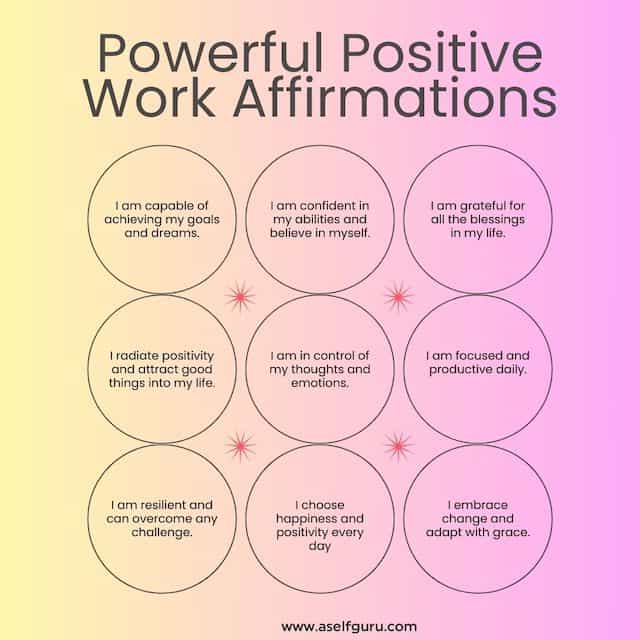
One non-obvious insight: It’s normal to feel awkward at first. Like any new habit, affirmations take practice. Stick with it for a few weeks, and you’ll notice your self-talk becoming more positive.
Credit: aselfguru.com
Power Of Community And Support
Affirmations are even more powerful when shared with others. Many women create small groups or “accountability buddies” at work to encourage each other. Sharing your affirmation with a trusted friend or mentor can add support and motivation.
Some companies offer workshops on positive psychology or women’s leadership. If your workplace has resources like these, consider joining. You’ll not only learn new tools but also connect with others facing similar challenges.
If you prefer privacy, you can still find community through online forums or groups focused on women’s empowerment. For more ideas and support, the Lean In Foundation offers resources and stories from women at every stage of their careers.
Measuring The Impact Of Affirmations
Many women wonder, “How do I know if affirmations are working?” Here are a few ways to track your progress:
Keep A Confidence Journal
Write down your affirmation each day and note how you feel before and after. After a few weeks, look back to see changes in your mood, confidence, or actions.
Notice Small Wins
Pay attention to moments when you speak up, handle stress better, or recover from setbacks more quickly. These small wins add up over time.
Ask For Feedback
Sometimes, others notice your growth before you do. Ask a colleague or mentor if they see changes in your confidence or leadership.
Compare Before And After
Reflect on how you responded to challenges before using affirmations, and how you react now. Even small improvements mean your efforts are working.
Here’s a simple way to rate your confidence or stress levels over time:
| Week | Confidence (1-10) | Stress (1-10) | Notes |
|---|---|---|---|
| Week 1 | 4 | 8 | Nervous before meetings |
| Week 2 | 5 | 7 | Spoke up once in team call |
| Week 3 | 6 | 6 | Handled feedback calmly |
| Week 4 | 7 | 5 | Led a small project |
Tracking your journey helps keep you motivated and shows that small steps lead to real change.
When Affirmations Are Not Enough
Affirmations are a helpful tool, but sometimes deeper issues require more support. If you feel overwhelmed by stress, anxiety, or workplace challenges, consider speaking to a counselor or mental health professional. There is no weakness in seeking help.
In some cases, workplace problems like harassment or discrimination need action from HR or leadership. Affirmations can help you stay strong, but practical steps and support from others are also necessary.
Practical Tips To Strengthen Your Affirmation Practice
- Pair with action: After saying your affirmation, list one small step you’ll take today.
- Use sensory cues: Attach affirmations to daily habits (like brushing your teeth or starting your computer).
- Celebrate progress: Reward yourself for using affirmations regularly, even if the changes are small.
- Change them as you grow: Update your affirmations as your goals or challenges shift.
- Share with others: Teaching a friend or colleague about affirmations can reinforce your own practice.
One more non-obvious tip: Use your own voice. Record yourself saying your affirmations and listen during your commute or workout. Hearing your own words can make the message more powerful.
Credit: healing-hands.us
Frequently Asked Questions
What Are Positive Affirmations And Why Are They Important For Women At Work?
Positive affirmations are short, encouraging statements you repeat to yourself. They help change negative self-talk into positive beliefs. For women at work, affirmations are important because they boost confidence, reduce self-doubt, and help manage stress—especially in environments where women face unique challenges.
How Often Should I Use Affirmations To See Results?
For best results, use affirmations daily. Consistency matters more than how many times you repeat them. Start with once in the morning and once before difficult situations. Most women notice changes in mood and confidence after a few weeks of regular practice.
Can Affirmations Really Change How I Feel Or Perform At Work?
Yes, studies show that regular use of affirmations can reduce stress, improve performance, and increase motivation. They help you focus on your strengths and build new habits of positive thinking. However, affirmations are most effective when paired with action and realistic goals.
What If I Feel Silly Or Uncomfortable Saying Affirmations?
It’s normal to feel awkward at first. Many women worry that affirmations are not “realistic” or feel strange. Start with statements you believe, and try writing or listening to them instead of saying them out loud. Over time, the practice becomes more natural.
Are There Situations Where Affirmations Are Not Enough?
Affirmations are a helpful tool, but they don’t solve every problem. If you face serious issues like harassment, discrimination, or mental health struggles, seek support from HR or a mental health professional. Affirmations can support your confidence, but some situations require outside help.
Believing in yourself is not just about luck or personality—it’s a skill you can build every day. Positive affirmations are one of the simplest, most effective tools to help women thrive at work. With regular practice, you can boost your confidence, handle challenges with strength, and achieve your goals.
Let your words become the foundation for your success—because you deserve it.
