

Most Powerful Affirmations for Success to Transform Your Life
Most Powerful Affirmations For Success
Success often starts in the mind. People who achieve their dreams usually have a strong belief in themselves and their goals. But building this mindset can be hard, especially in a world full of distractions and doubts. That’s where affirmations come in. Affirmations are positive statements you repeat to yourself to shape your thoughts and actions. They work by changing your self-talk, helping you focus on what you want instead of what you fear.
Many top athletes, business leaders, and artists use affirmations. Science also supports their benefits. Studies show that repeating positive statements can increase motivation, improve mental health, and help you handle stress better. But not all affirmations are created equal. Some are much more effective for building success—in your career, studies, relationships, or health. This article will guide you through the most powerful affirmations for success, explain how and why they work, and show you how to make them part of your daily life.
Why Affirmations Work For Success
Affirmations are more than just words. When you repeat them regularly, they start to shape how you see yourself and what you believe is possible. The brain is flexible—it can create new thought patterns and break old ones. This is called neuroplasticity. When you use affirmations, you’re training your brain to expect success and act with confidence.
Research shows that self-affirmation can reduce stress, help you recover from setbacks, and even improve your problem-solving skills. For example, a study published in the journal *Social Cognitive and Affective Neuroscience* found that people who practiced self-affirmation activated reward centers in the brain. This means affirmations can actually make you feel good and motivated. Another study in *Psychological Science* showed that students who used affirmations did better on tests and felt less anxious.
But why do they work so well for success? Here are the main reasons:
- Change in Self-Belief: Affirmations help you replace negative thoughts (“I can’t do this”) with positive ones (“I have what it takes”).
- Focus on Goals: They remind you of what you want to achieve, keeping your mind on your targets.
- Emotional Strength: Affirmations can calm fears and build emotional resilience, making it easier to bounce back from failure.
- Consistent Action: When you believe you can succeed, you’re more likely to take the steps needed to get there.
What Makes An Affirmation Powerful?
Not every affirmation works the same way. Some are too vague or unrealistic. The best affirmations for success share a few important traits:
- Positive Language: They focus on what you want, not what you want to avoid.
- Present Tense: They use “I am” or “I have,” as if the success is already happening. This helps your mind accept them as true.
- Specificity: The more clear and detailed the affirmation, the more powerful it is.
- Believability: It should feel possible. If you don’t believe it at all, your brain will reject it.
- Emotion: Great affirmations stir feelings—confidence, excitement, or gratitude.
Here’s an example. Compare these two statements:
- “I will be rich someday.” (Weak: Future-focused and vague)
- “I am attracting wealth and opportunity every day.” (Powerful: Present tense, positive, and specific)
25 Most Powerful Affirmations For Success
These affirmations are designed to help you build confidence, focus, and a winner’s mindset. You can use them as they are, or adjust them to fit your life and dreams.
- I am worthy of success and happiness.
- I believe in my abilities and express my true self with ease.
- I am focused, persistent, and will never give up.
- Every day, I am getting closer to my goals.
- I attract positive opportunities and people into my life.
- Challenges make me stronger and wiser.
- I am confident in my decisions and actions.
- Success comes naturally to me because I work hard.
- I learn from failure and use it to grow.
- My mind is clear, sharp, and creative.
- I am grateful for all I have and all I will achieve.
- I turn my dreams into achievable goals.
- I deserve to be successful in my career and personal life.
- I am open to new ideas and opportunities.
- I handle stress with calm and clarity.
- I am committed to constant growth and learning.
- I trust myself to make the right choices.
- I am resilient and can overcome any obstacle.
- My actions create consistent results.
- I am a magnet for success and abundance.
- I inspire others by my example.
- I am in control of my future.
- I celebrate every step forward, no matter how small.
- I am surrounded by support and encouragement.
- I am already successful, and more is coming.
If you use even a few of these daily, you’ll start to notice shifts in your thinking and actions.
How To Use Affirmations Effectively
Simply reading an affirmation once won’t change your life. The real power comes from repetition and belief. Here’s how to make affirmations work for you:
1. Repeat Daily
Set aside time each morning and evening to say your affirmations out loud or write them down. Consistency is key. Even just five minutes a day can make a big difference.
2. Visualize As You Say Them
Picture yourself living your affirmation. For example, if you say, “I am confident in my decisions,” imagine yourself making choices with ease. This makes the words feel real and activates your brain’s reward centers.
3. Feel The Emotion
Don’t just say the words—feel them. Let yourself experience the confidence, joy, or excitement your affirmation brings. Emotion helps your brain accept new beliefs.
4. Place Affirmations Where You’ll See Them
Write your favorite affirmations on sticky notes and put them on your mirror, desk, or phone background. Visual reminders keep you focused on your goals.
5. Adjust As Needed
If an affirmation feels fake or impossible, change it. For example, instead of “I am a millionaire,” try “I am learning to manage my money well. ” As your belief grows, you can use stronger affirmations.
6. Combine With Action
Affirmations are powerful, but they must be paired with real action. Use them to boost your motivation and take steps every day toward your goals.
7. Track Your Progress
Keep a journal of your daily affirmations and any changes you notice—better mood, more confidence, or new opportunities. This keeps you inspired and helps you see results over time.
Common Affirmation Mistakes (and How To Avoid Them)
Even though affirmations are simple, many people don’t get the results they want. Here are some common mistakes to watch for:
- Repeating Without Belief: If you don’t believe what you’re saying, your mind won’t accept it. Start with affirmations you can accept, even a little.
- Being Too Vague: “I want success” is too general. Be specific about what success means for you.
- Inconsistent Practice: Skipping days breaks the habit. Make affirmations part of your daily routine.
- Ignoring Emotion: Flat, emotionless repetition has little power. Always try to feel the words.
- Using Only Words: Affirmations work best with action. Take real steps, even small ones, toward your goals.
If you notice you’re making any of these mistakes, don’t worry. Just adjust your approach and keep going.
Science And Statistics: Do Affirmations Really Help?
Skeptics sometimes doubt the power of affirmations. But scientific studies show real benefits. Here are some key findings:
- In one study, students who practiced self-affirmation before a test scored 10-15% higher than those who did not.
- A survey from the American Psychological Association found that people who used positive self-talk felt less stressed and more motivated.
- Brain imaging research shows that affirmations activate the ventromedial prefrontal cortex—an area linked to self-worth and reward.
- According to a report in Personality and Social Psychology Bulletin, people who used affirmations for two weeks reported higher life satisfactionand lower anxiety**.
Let’s compare the effects of affirmation practice with no practice, based on several research reviews:
| Group | Motivation Level | Stress Level | Reported Success |
|---|---|---|---|
| Used Affirmations | High | Low | More likely |
| No Affirmations | Lower | Higher | Less likely |
These numbers show that affirmations aren’t just positive thinking—they lead to measurable improvements.
Real-life Examples: Affirmations In Action
Many successful people credit affirmations with helping them reach their goals. Here are a few stories that show their real-world power:
- Jim Carrey, the actor, wrote himself a $10 million check for “acting services rendered” and visualized cashing it. Years later, he was paid that exact amount for a movie.
- Oprah Winfrey often talks about using affirmations to overcome poverty and build confidence. She repeats statements like, “I am worthy of success.”
- Olympic athletes use affirmations to boost their confidence before competitions. For example, Michael Phelps visualizes winning and repeats positive statements during training.
These stories are inspiring, but affirmations help regular people too. For example, a study followed a group of job seekers. The ones who used daily affirmations found jobs twice as fast as those who did not.
Here’s a side-by-side look at common negative thoughts and their affirmation replacements:
| Negative Thought | Powerful Affirmation |
|---|---|
| I always fail. | I learn and grow from every experience. |
| I am not good enough. | I am capable and worthy of success. |
| I can’t handle stress. | I face challenges with calm and strength. |
| Opportunities never come to me. | I attract positive opportunities every day. |
Replacing negative beliefs with positive affirmations can change your outlook and results.
Customizing Affirmations For Your Own Success
The best affirmations are personal. While general statements work, creating your own makes them even more effective. Here’s how to build custom affirmations:
- Identify Your Goal: What do you want to achieve? Be specific—get a promotion, start a business, improve your health.
- Notice Negative Self-Talk: Write down common doubts or fears you have about this goal.
- Flip the Script: Turn each negative thought into a positive, present-tense statement.
- Add Emotion: Use words that inspire you—excited, grateful, confident.
- Keep It Short and Clear: The best affirmations are easy to remember.
For example, if your goal is to start a business but you fear failure, your affirmation could be: “I am confident in my ability to build a successful business and learn from every challenge.”
If you want to improve your health but feel unmotivated, try: “I enjoy taking care of my body and feel energized every day.”
Remember, your mind responds best to what feels real and meaningful to you.
Advanced Tips: Taking Affirmations To The Next Level
Once you’re comfortable with basic affirmations, you can make them even more powerful with these techniques:
1. Pair With Visualization
Spend a few minutes each day picturing your success as if it’s already happened. See, hear, and feel the details. This makes your mind believe the outcome is possible and helps you act with confidence.
2. Use Affirmation Recordings
Record yourself saying your affirmations and listen to them during your commute, workout, or before bed. Hearing your own voice makes the words more believable.
3. Practice In Groups
Affirmations are even stronger when shared. Find a friend or join a group where you can say affirmations together. This builds community and keeps you accountable.
4. Link To Triggers
Attach affirmations to habits you already have—like brushing your teeth or making coffee. This makes it easy to remember them every day.
5. Combine With Gratitude
Pair your affirmations with a gratitude practice. For example, say, “I am grateful for my skills and the opportunities ahead. ” This boosts positive feelings and helps you notice progress.
6. Track Long-term Progress
Once a month, review your journal or notes. What changes have you noticed? Are you thinking more positively, acting more confidently, or seeing better results? This reflection keeps you motivated to continue.
When Affirmations May Not Work (and What To Do)
Affirmations are powerful, but they’re not magic. There are times when they might not seem to help:
- Deep-Rooted Trauma or Negative Beliefs: If your doubts are strong or based on past pain, affirmations alone may not be enough. In these cases, therapy or coaching can help.
- Lack of Action: If you only say affirmations but never take steps toward your goals, you’ll feel stuck. Always combine words with action.
- Unrealistic Statements: If your affirmation feels completely false, your brain will resist. Start with smaller, more believable statements and build up as your confidence grows.
If you hit a wall, don’t give up. Adjust your approach. Sometimes, working with a therapist or coach can help you unlock the full power of affirmations.
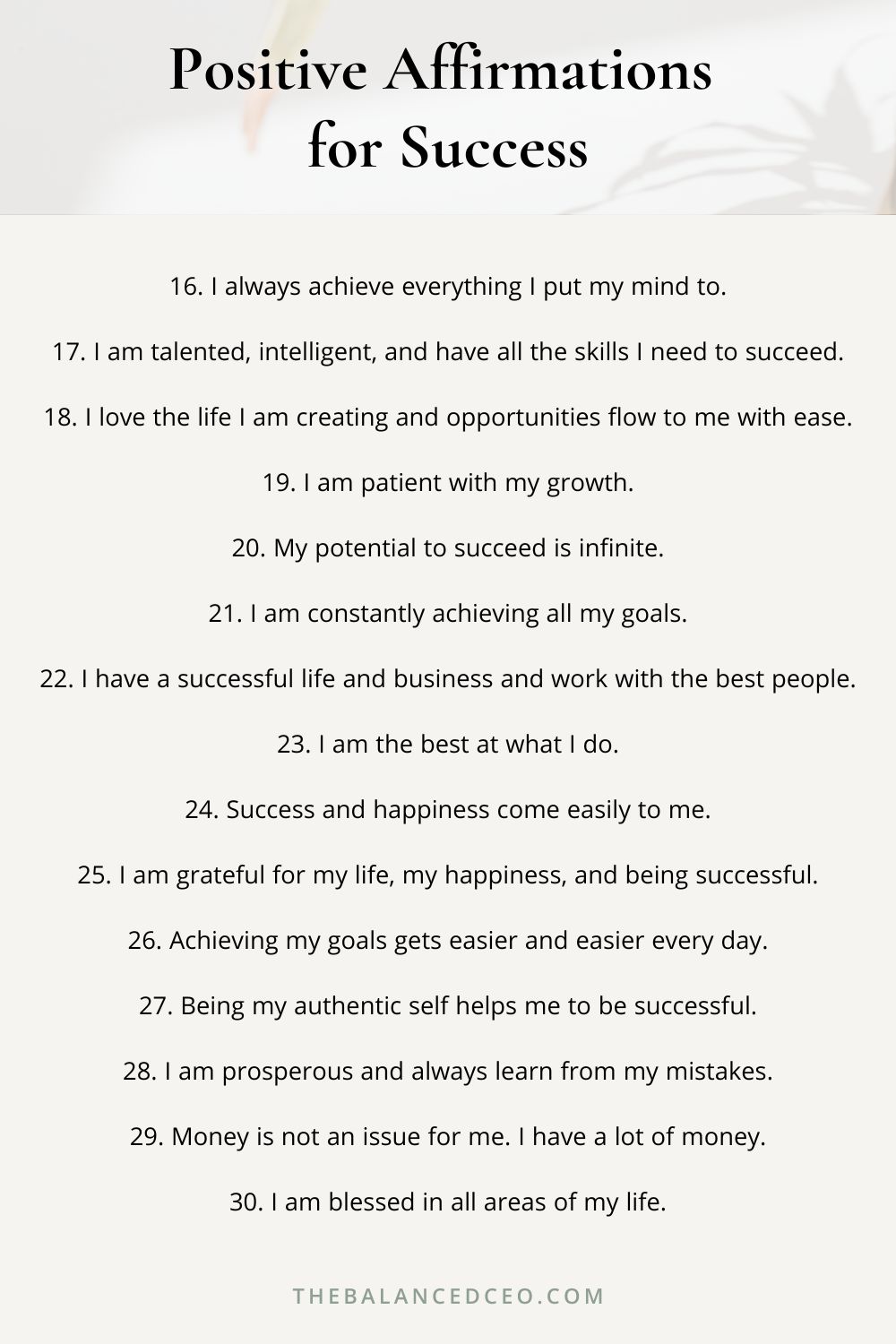
Credit: thebalancedceo.com
Affirmations For Different Types Of Success
Success looks different for everyone. Here are some sample affirmations for various areas:
Career Success
- “I am valued and respected at work.”
- “I am open to learning and growing in my field.”
- “My hard work leads to new opportunities.”
Academic Success
- “I am focused and disciplined in my studies.”
- “I understand new information easily.”
- “I am confident in my ability to succeed in exams.”
Financial Success
- “I am attracting wealth and abundance.”
- “I make wise financial decisions.”
- “Money flows to me through multiple sources.”
Health And Fitness
- “I enjoy taking care of my body.”
- “I am strong, healthy, and full of energy.”
- “Every day, I make choices that support my well-being.”
Relationships
- “I attract positive, supportive people into my life.”
- “I communicate clearly and kindly.”
- “I am worthy of love and respect.”
Customizing your affirmations for specific goals makes them even more impactful.
Practical Examples: Affirmations In Daily Life
Let’s see how affirmations can fit into different routines:
- Morning Routine: Start your day by saying three affirmations while looking in the mirror. For example, “I am ready for a productive day,” “I handle challenges with confidence,” “I make a difference today.”
- During Stress: When you feel anxious, repeat an affirmation to calm yourself, such as, “I am calm and in control,” or “I trust myself to handle this.”
- Before Big Events: If you have a presentation or exam, use affirmations like, “I am prepared and confident,” or “I perform at my best under pressure.”
- Winding Down: End the day with affirmations of gratitude and self-acceptance, such as, “I am proud of what I achieved today,” or “I am grateful for every lesson.”
These small habits can create big results over time.

Credit: zannakeithley.com
Comparing Affirmation Styles: Which Is Most Effective?
There are different ways to use affirmations—spoken, written, listened to, or visualized. Each has its own strengths.
| Affirmation Style | Best For | Benefits |
|---|---|---|
| Spoken | Building confidence, quick motivation | Engages emotion, easy to remember |
| Written | Deep reflection, building belief | Helps clarify thoughts, creates commitment |
| Audio Recordings | Busy schedules, on-the-go repetition | Reinforces beliefs, easy to fit into daily life |
| Visualization | Goal achievement, big changes | Makes results feel real, boosts motivation |
Try different styles to see what feels best for you. Many people get the most benefit by combining two or more.
Frequently Asked Questions
How Long Does It Take To See Results From Affirmations?
The time it takes to notice results depends on your consistency and belief. Some people feel more positive after a few days. For bigger changes, it often takes a few weeks of daily practice. Remember, the more emotion and action you add, the faster you’ll see results.
Can Affirmations Help With Anxiety Or Stress?
Yes, affirmations can help calm anxiety and reduce stress. By repeating calming statements like, “I am safe and in control,” you can train your mind to respond to challenges with more calm. For severe anxiety, it’s best to combine affirmations with other strategies, such as therapy or mindfulness.
Are Affirmations Backed By Science?
Yes, research supports the benefits of affirmations. Studies show they can improve motivation, reduce stress, and increase performance. For example, research published by the American Psychological Association highlights how positive self-talk boosts well-being.
Do I Have To Say Affirmations Out Loud, Or Can I Write Them?
You can use affirmations in many ways—spoken, written, or even listened to as recordings. The key is repetition and emotion. Some people find speaking them out loud more powerful, while others prefer writing or listening. Try different methods to find what works best for you.
What If I Don’t Believe My Affirmation At First?
It’s normal to feel doubtful at first, especially if your affirmation is very different from your current beliefs. Start with statements that feel possible. As your confidence grows, you can use stronger affirmations. Remember, small, believable steps work best.
Success is not just about luck, talent, or hard work. It’s also about mindset. Using powerful affirmations can help you build the inner confidence, focus, and resilience needed to achieve your goals. Start today with a few simple statements and watch how your thoughts—and your life—begin to change for the better.

Credit: vishakablone.com
