

Is Affirmation a Love Language? Understanding Its True Impact
Is Affirmation A Love Language
Feeling loved can change the way we see ourselves and connect with others. Many people have heard of the idea of “love languages,” a concept that helps us understand how different people express and receive love. But where does affirmation fit into this?
Is affirmation a love language on its own, or is it just a part of something bigger? This question opens the door to a deeper look at how words, actions, and feelings shape our relationships.
Affirmation often means giving positive words, encouragement, or praise. For some, hearing supportive words is the most powerful way to feel loved. For others, love comes through actions or time spent together. But does affirmation stand alone as a love language, or is it simply one way we show care?
Understanding this can help us become better friends, partners, or family members.
This article explores the truth about affirmation and its place in love languages. We will break down the classic love languages, explain what affirmation really means, and discuss whether it should be its own category. We will also share real examples, common misunderstandings, and practical tips for using affirmation to create stronger bonds.
What Are Love Languages?
The term love languages was popularized by Dr. Gary Chapman, a relationship counselor. He identified five main ways people give and receive love. These are:
- Words of Affirmation
- Acts of Service
- Receiving Gifts
- Quality Time
- Physical Touch
Each person has one or two main love languages. Knowing your own and your loved ones’ preferences can help you connect better.
Let’s look at each love language to see how they work:
Words Of Affirmation
This is all about using positive, loving words. Compliments, praise, and kind remarks make a person feel valued. For example, “I appreciate you,” “You did a great job,” or “You make my day brighter. ” For some, these words are as important as air.
Acts Of Service
Here, actions speak louder than words. Doing helpful things—like making breakfast, fixing something, or running errands—shows love. The key is doing these things with care and without expecting something in return.
Receiving Gifts
Small or big, gifts can be a symbol of love. It’s not about the price, but the thought behind it. A favorite snack or a handmade card can mean a lot.
Quality Time
Spending focused, undistracted time together is the heart of this language. Deep talks, shared experiences, or just being present shows love.
Physical Touch
A hug, a pat on the back, or holding hands. For some, touch is the deepest way to feel loved and safe.
Where Does Affirmation Fit?
When people talk about affirmation, they usually mean words of affirmation—one of the five love languages. But some believe affirmation is bigger than this. It can be part of actions, gifts, or even touch. So, is affirmation really its own love language?
Let’s look at the meaning and role of affirmation.
Defining Affirmation
Affirmation means expressing support, encouragement, or positive truth. It can be as simple as saying, “I believe in you.” It can also mean reassuring someone, recognizing their effort, or reminding them of their value.
Affirmation can happen through:
- Words (spoken or written)
- Gestures or actions
- Small gifts with encouraging notes
Is Affirmation More Than Words?
While “words of affirmation” focus on spoken or written praise, affirmation can show up in other love languages too. For example:
- A gift with a special message is both a gift and an affirmation.
- Acts of service, when done with a supportive attitude, can feel affirming.
- A caring touch combined with kind words can multiply the impact.
This is why some people argue that affirmation is not just a single love language, but a quality that can exist in all expressions of love.
The Power Of Words Of Affirmation
Still, words of affirmation have a special place. Research shows that positive words can:
- Boost self-esteem
- Build trust in relationships
- Reduce stress and anxiety
For example, a study found that people who receive regular praise at work are more productive and happier. The same applies in families and friendships. Hearing “I’m proud of you” or “I love you” can fill emotional needs that actions or gifts alone may not.
Examples Of Words Of Affirmation
Here are some ways people use words to affirm their loved ones:
- “I appreciate all you do for our family.”
- “You are so talented.”
- “Thank you for being there for me.”
- “I love the way you make me laugh.”
- “Your hard work inspires me.”
Even short, simple statements can make someone feel seen and valued.
Is Affirmation Its Own Love Language?
The classic love languages list “words of affirmation” as one type. But as we’ve seen, affirmation can come in many forms. So, is it correct to call affirmation a love language by itself?
Arguments For Affirmation As A Love Language
- Universal Need: Almost everyone needs affirmation, not just those who prefer “words of affirmation.” Encouragement is like emotional fuel.
- Foundational Role: Affirmation can make other love languages feel more meaningful. For example, a gift with a kind note can have a bigger impact.
- Different Forms: Some people respond more to written words, others to actions that affirm their worth. This suggests affirmation is broader than just words.
Arguments Against Affirmation As A Separate Love Language
- Overlap: Affirmation is present in all love languages to some degree. If everything is affirmation, the concept loses clarity.
- Original Model: The classic five love languages already include affirmation in “words of affirmation.”
- Practicality: Having too many categories can confuse rather than help people understand their needs.
Real-world Perspective
In daily life, it’s helpful to see affirmation as a quality that makes any love language stronger. For example, a hug feels more loving when it’s given with a kind word. A helpful act means more when you know it comes from genuine care.
How To Use Affirmation In Relationships
No matter your love language, learning to give and receive affirmation can make relationships stronger. Here’s how to use affirmation well:
Be Specific
Instead of just saying “good job,” explain what you appreciate. For example, “I noticed how patient you were with the kids today. That means a lot to me. ”
Be Timely
Share your positive words when they matter most—after a challenge, during a tough day, or when someone feels unsure.
Match The Person’s Style
Some people like spoken words, others prefer notes or texts. Find out what your loved one prefers.
Combine Affirmation With Other Love Languages
Pairing affirmation with acts, gifts, or time can make your message even stronger.
Be Genuine
Say what you truly mean. Fake praise can do more harm than good.
Common Myths About Affirmation
There are some misunderstandings about affirmation and love languages. Let’s clear them up.
Myth 1: Affirmation Is Just Flattery
Real affirmation is about truth. Flattery is empty or exaggerated praise. Affirmation should be honest and based on real qualities or actions.
Myth 2: Only “sensitive” People Need Affirmation
Everyone needs encouragement at times. It’s not a sign of weakness. In fact, even confident leaders thrive on positive feedback.
Myth 3: Affirmation Should Be Constant
Too much praise can feel forced or fake. It’s better to give meaningful affirmation at the right moments.
Myth 4: Affirmation Is Always Verbal
As discussed, affirmation can be shared through actions, gifts, or gestures—not just words.
Affirmation Across Cultures
How affirmation is given and received can vary in different cultures. In some places, open praise is common. In others, people show support through actions rather than words.
For example:
- In many Western cultures, direct compliments are normal.
- In some Asian cultures, indirect praise or nonverbal support is more common.
Understanding these differences helps avoid misunderstandings. If your partner or friend is from a different background, it’s good to ask what makes them feel valued.
Data: The Impact Of Words Of Affirmation
To understand how powerful affirmation can be, let’s look at some data from relationship studies.
| Survey Group | % Who Value Words of Affirmation Most | Reported Relationship Satisfaction |
|---|---|---|
| Couples | 23% | Higher than average |
| Friends | 18% | Moderately high |
| Work Colleagues | 12% | Linked to better teamwork |
This shows that affirmation is important in many relationships—not just romantic ones.

Credit: www.simplypsychology.org
When Affirmation Is Missing
Lack of affirmation can hurt. People who rarely hear positive words may feel invisible, unappreciated, or unloved. Over time, this can lead to distance, resentment, or insecurity.
Common signs affirmation is missing:
- Feeling taken for granted
- Doubting your worth in the relationship
- Withdrawing or becoming defensive
- Increased arguments or misunderstandings
A simple “thank you” or “I’m proud of you” can help rebuild trust and connection.
How To Find Out If Affirmation Is Your Love Language
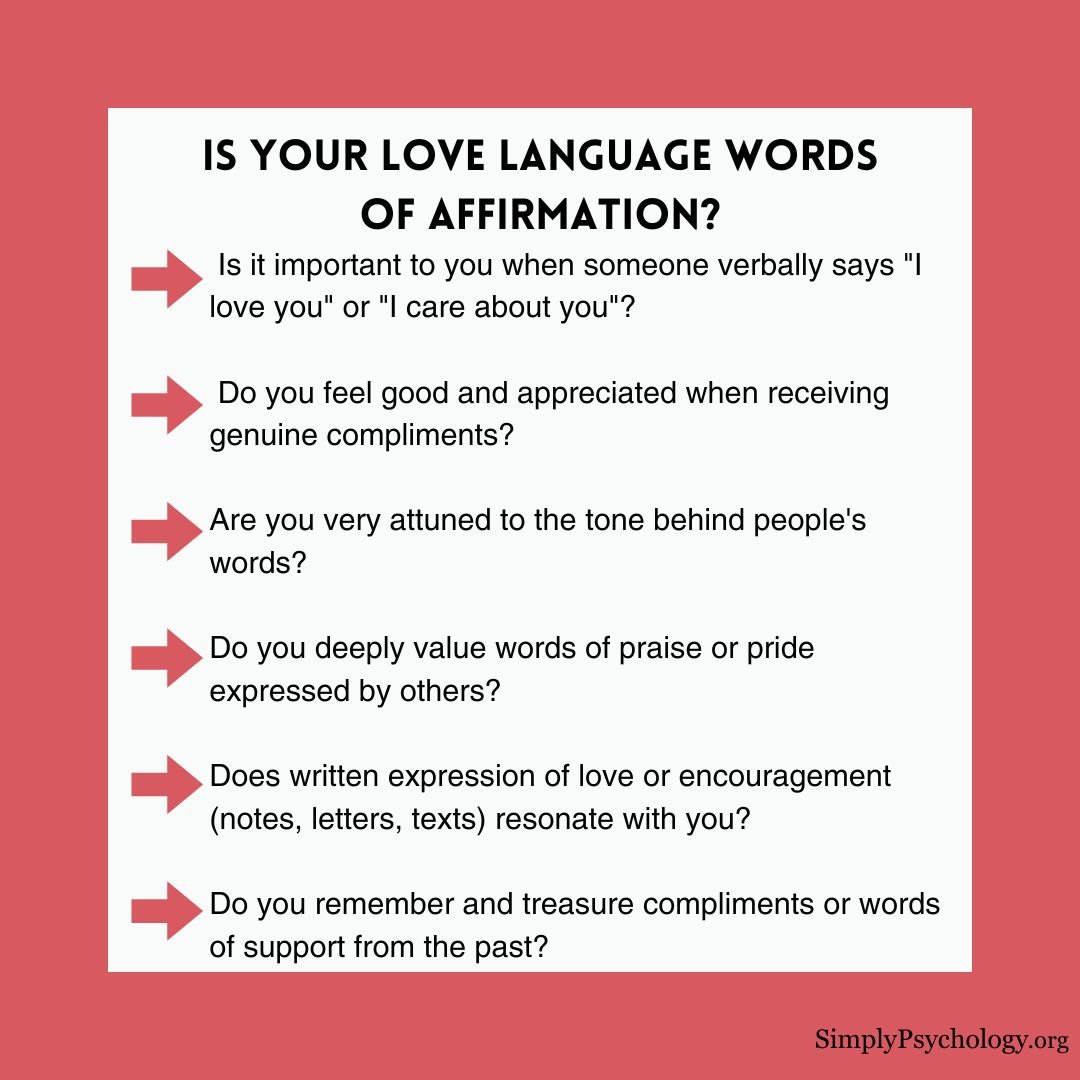
Not sure if affirmation is your main love language? Here are a few questions to consider:
- Do you feel happiest when someone praises or encourages you?
- Do kind words mean more to you than gifts or actions?
- Do negative or critical words hurt you deeply?
- Do you often give compliments to others?
If you answered “yes” to most, words of affirmation may be your top love language.
Comparison: Affirmation Vs. Other Love Languages
To see how affirmation compares with other love languages, here is a simple breakdown:
| Love Language | Main Feature | How Affirmation Can Be Included |
|---|---|---|
| Words of Affirmation | Verbal praise or support | Directly through spoken or written words |
| Acts of Service | Helpful actions | Explaining the care behind the action |
| Receiving Gifts | Tangible items | Adding a meaningful note |
| Quality Time | Focused attention | Expressing appreciation during shared moments |
| Physical Touch | Contact like hugs | Pairing touch with supportive words |
This shows affirmation can enhance any love language, making it more personal.
Real-life Stories: How Affirmation Changes Relationships
Hearing from real people shows the power of affirmation.
Story 1: From Strangers To Close Friends
Two colleagues, Maria and Sam, worked together for years but rarely talked. One day, Maria praised Sam’s problem-solving during a tough project. Sam said it was the first time anyone noticed his effort at work. They began sharing more positive feedback.
Their teamwork improved, and they became close friends.
Story 2: Healing A Marriage
A couple, tired from busy lives, felt distant. The wife started writing daily notes of appreciation for her husband—simple things like “thanks for making coffee. ” He felt more seen and responded with his own affirmations. Their connection grew stronger, and arguments lessened.
Story 3: Building A Child’s Confidence
A shy child struggled at school. Her teacher began giving her specific praise: “I like how you shared your crayons.” The child’s confidence grew. She became more social and did better in class.
These stories show how affirmation—when sincere—can change lives.

Credit: sawdustcityllc.com
Mistakes To Avoid With Affirmation
To make affirmation work, avoid these common errors:
- Generic Praise: “You’re great” is less powerful than “I appreciate how you listen.”
- Overdoing It: Too much praise can seem fake. Be honest and balanced.
- Ignoring Other Love Languages: Even if affirmation is important, don’t forget other needs.
- Forgetting to Listen: Sometimes, affirmation means listening and understanding before speaking.
Practical Tips For Giving Affirmation
Here’s how to use affirmation in everyday life:
- Notice the Small Things: Point out effort or kindness, not just big achievements.
- Use Notes or Messages: A text or sticky note can brighten someone’s day.
- Ask How They Like to Receive Praise: Some prefer public praise, others private.
- Balance Praise With Growth: Encourage while also helping others improve.
- Show Consistency: Make affirmation a regular habit, not just for special moments.
Credit: www.simplypsychology.org
When Affirmation Feels Uncomfortable
Some people struggle to give or receive affirmation. Reasons may include:
- Past experiences of criticism or neglect
- Fear of vulnerability
- Not knowing how to express feelings
If affirmation feels hard, start small. Try a simple “thank you” or “I appreciate you. ” Practice makes it easier over time. If you find it very difficult, talking with a counselor can help.
Affirmation In Digital Communication
In today’s world, much of our talking happens online. Affirmation is still possible—even powerful—through digital messages.
Tips for digital affirmation:
- Use clear, positive language in texts or emails.
- Add emojis to show warmth.
- Send voice notes for a personal touch.
- Be careful with sarcasm, which can be misunderstood.
Digital affirmation is a simple way to stay connected, especially across distance.
The Science Behind Affirmation
Research shows that positive affirmation does more than just make us feel good. It can:
- Reduce stress hormones
- Improve mental health
- Strengthen motivation
For example, studies found that people who use self-affirmation before a stressful event perform better and feel less anxious. The same applies to relationships—affirmation helps us feel safe, valued, and ready to face challenges together.
For more on the science, you can read about affirmation’s benefits on the Wikipedia love languages page.
How To Create An Affirming Environment
To make affirmation a natural part of your life, try these ideas:
- Model Affirmation: Show others how to give and receive praise.
- Encourage Group Affirmation: In families, teams, or classes, create a “praise wall” or sharing time.
- Celebrate Milestones: Recognize effort as well as success.
- Teach Children Early: Help kids learn to give and receive affirmation kindly.
Data: Effects Of Regular Affirmation In Groups
Let’s look at how regular affirmation affects group dynamics:
| Group Type | Affirmation Frequency | Reported Positivity | Conflict Level |
|---|---|---|---|
| Work Teams | Weekly | High | Low |
| Families | Daily | Very High | Very Low |
| Classrooms | Monthly | Moderate | Moderate |
This data shows that more frequent affirmation leads to better moods and fewer arguments.
Two Non-obvious Insights About Affirmation
- Affirmation Can Be Silent: Sometimes, a supportive look, a nod, or a gentle touch says “I believe in you” without words. Nonverbal affirmation is powerful, especially when words feel difficult.
- Self-Affirmation Prepares You for Love: People who practice affirming themselves find it easier to give and receive love from others. Learning to appreciate your own strengths helps you accept compliments and encouragement.
The Role Of Affirmation In Self-love
Affirmation isn’t just about others. It’s also a tool for self-love. Positive self-talk—reminding yourself of your strengths and achievements—builds resilience. People who practice self-affirmation are less affected by criticism and more open to growth.
If you struggle with self-criticism, start each day with one positive statement about yourself. Over time, this changes how you see yourself and helps you accept love from others.
Should We Add Affirmation As A Sixth Love Language?
There is ongoing debate among relationship experts. Some say affirmation deserves its own category, while others believe it’s already covered.
What matters most is understanding what makes you and your loved ones feel valued. Whether you call it a love language or an ingredient, affirmation is essential for healthy, happy relationships.
Frequently Asked Questions
What Is The Difference Between Affirmation And Flattery?
Affirmation is sincere and based on real qualities or actions. Flattery is often exaggerated or dishonest. Affirmation builds trust, while flattery can feel manipulative.
Can Affirmation Be Nonverbal?
Yes. Nonverbal affirmation includes supportive gestures, a warm smile, a thumbs-up, or a caring touch. These actions can say “I believe in you” without words.
How Do I Know If Words Of Affirmation Are My Love Language?
Ask yourself if positive words mean more to you than gifts or actions. If praise deeply lifts your mood and criticism hurts, words of affirmation may be your main love language.
Is It Possible To Overuse Affirmation?
Yes. Giving too much or insincere praise can feel fake and lose meaning. It’s best to offer genuine, balanced affirmation when it matters most.
How Can I Give Better Affirmation To Someone From A Different Culture?
Learn about their culture’s way of showing appreciation. Some prefer indirect or private praise, while others enjoy open compliments. When unsure, ask what makes them feel valued.
Feeling loved is a basic human need, and affirmation—whether spoken, written, or shown through actions—makes relationships richer. Whether you see affirmation as its own love language or a special quality of all love, what matters most is using it sincerely and thoughtfully.
By understanding affirmation’s role, you can help yourself and those around you feel truly valued and connected.
