

How Words of Affirmation Works: Boost Confidence and Connection
How Words Of Affirmation Works
When someone tells you “I’m proud of you,” or “You matter to me,” how do you feel? For many people, these simple words can mean more than gifts or actions. They lift your mood, build your confidence, and make you feel loved. This is the heart of words of affirmation—one of the five love languages. But how does this work in real life? And why do some people crave these words more than others? Let’s explore the science, psychology, and practical impact behind words of affirmation, and see how they can truly change relationships.
What Are Words Of Affirmation?
Words of affirmation are positive, supportive statements you say or write to someone. These words express love, appreciation, encouragement, or respect. It can be as simple as “Thank you for your help,” or as deep as “I believe in you.
” The main goal is to make the other person feel valued and loved.
The concept became popular through Dr. Gary Chapman’s book about the five love languages: words of affirmation, acts of service, receiving gifts, quality time, and physical touch. For some people, words of affirmation are the main way they feel loved. If you or your partner connect most deeply with kind words, understanding this love language can help you grow closer.
The Science Behind Words Of Affirmation
Why do words matter so much? Our brains respond to positive words in powerful ways. Hearing kind words releases feel-good chemicals like dopamine and oxytocin, which can reduce stress and increase happiness. When someone praises you, your brain lights up—especially in areas linked to reward and motivation.
Studies show that children who receive regular positive feedback from parents tend to develop higher self-esteem. Adults, too, perform better at work and feel more satisfied in relationships when they get verbal encouragement. Words can heal old wounds, boost confidence, and even improve mental health.
Some researchers believe that humans are “wired” for connection. Kind words signal safety and acceptance, which our brains crave. This is why insults or criticism can hurt so much—the brain reacts to them as threats.
Why Words Of Affirmation Matter In Relationships
It’s easy to forget how much words shape our lives. In romantic relationships, words of affirmation can:
- Build trust and intimacy
- Help partners feel secure
- Encourage healthy communication
- Soothe conflicts before they grow
When partners use kind words regularly, they feel more connected and less lonely. Even in friendships or family relationships, affirming words can bridge misunderstandings and deepen bonds.
But not everyone values words of affirmation equally. For some, actions speak louder. For others, a single “I love you” means the world. Knowing your own and your loved ones’ preferences helps you speak the right language.
Examples Of Words Of Affirmation
You don’t have to be a poet to use words of affirmation. Here are some examples that work in daily life:
- “I appreciate everything you do.”
- “You make my life better.”
- “You handled that situation really well.”
- “I’m lucky to know you.”
- “Thank you for being patient.”
- “I trust your judgment.”
- “You inspire me.”
- “I’m grateful for your support.”
- “You did a great job.”
- “You are enough.”
The key is to be sincere. Empty praise can feel fake, but honest words touch the heart.

Credit: www.cultureally.com
How To Use Words Of Affirmation Effectively
Not all affirmations work the same way. Here are tips to make your words count:
Focus On Specifics
Instead of general praise like “You’re great,” try, “You did an amazing job leading that meeting. ” Specific words show you notice their unique efforts.
Be Consistent
A single compliment is nice, but regular affirmations build trust. Try to share kind words every day, even if they’re small.
Match Their Needs
Some people love public praise; others prefer private words. Notice what makes your partner or friend light up, and use affirmations that fit their style.
Mix It Up
Use spoken words, texts, notes, or even voice messages. Surprise affirmations can mean even more.
Speak From The Heart
Authentic words work best. If you don’t mean it, don’t say it. Even a simple “Thank you for listening” can be powerful when honest.
Common Mistakes With Words Of Affirmation
Even with good intentions, it’s easy to make mistakes. Here are common problems and how to avoid them:
- Overusing generic praise: If every compliment sounds the same, it loses meaning. Personalize your words.
- Affirming only when things are good: People need kind words even during tough times, maybe even more.
- Saying what you think they want to hear: Flattery can feel empty. Focus on real qualities or actions.
- Ignoring nonverbal cues: If someone seems uncomfortable, ask what kind of affirmation they like.
- Forgetting to listen: Sometimes affirmation is also about hearing what the other person needs.
Words Of Affirmation Across Different Relationships
Romantic Partners
For couples, words of affirmation can increase closeness and satisfaction. Saying “I love you” is important, but so is recognizing your partner’s efforts or growth. Couples who affirm each other often handle conflict better and recover faster from arguments.
Friends
Friendships thrive on support. Telling a friend “You’re a great listener” or “You always cheer me up” can strengthen your bond. Friends may not expect affirmations as much as partners, so a kind word can really stand out.
Family
Family relationships are complex. Affirmations can heal old wounds or break cycles of criticism. Telling a parent, “You did your best,” or a child, “I’m proud of you,” can change family dynamics.
Workplace
In the workplace, words of affirmation help build teamwork and motivation. Simple phrases like “Thanks for your hard work” or “Your idea really improved the project” can boost morale and productivity.
Here’s a comparison of how words of affirmation may look in different relationships:
| Relationship | Example Affirmation | Impact |
|---|---|---|
| Romantic Partner | "I love how thoughtful you are." | Builds intimacy |
| Friend | "You always make me laugh." | Strengthens connection |
| Family | "I'm proud to be your sibling." | Improves trust |
| Work Colleague | "Your input was valuable." | Boosts motivation |
The Psychology Behind Words Of Affirmation
Why do some people need affirming words more than others? It starts in childhood. If you grew up in a home where praise was common, you may crave it as an adult. If praise was rare, you may either seek it out or feel uncomfortable with it.
Personality also plays a role. People who are more sensitive to rejection or have low self-esteem often need more reassurance. Others may feel loved through actions, not words.
Cultural background matters too. In some cultures, direct praise is common; in others, it’s seen as unnecessary or even rude. Understanding these differences helps avoid misunderstandings.
A key insight: Some people who seem “cold” or “distant” may actually be protecting themselves from disappointment. They may need affirmation but feel unsure how to ask for it.

Credit: calmerry.com
Words Of Affirmation And Self-esteem
Words of affirmation can shape how we see ourselves. Regular positive feedback helps us believe in our own worth. This is especially true for children and teens, but adults benefit too.
However, relying only on others for affirmation can be risky. It’s important to also practice self-affirmation—using positive words to build your own confidence. For example, saying to yourself, “I handled that problem well” can help you grow stronger from within.
Studies suggest that people who use self-affirmation bounce back faster from setbacks and handle stress better. It’s not about ignoring problems, but about remembering your strengths.
When Words Of Affirmation Are Missing
The absence of kind words can hurt as much as negative words. Partners who never hear “I love you” or “I appreciate you” may feel unloved, even if other needs are met. Over time, this can lead to distance, resentment, or even breakups.
In families, the lack of affirmation can cause children to doubt their abilities. At work, it can lead to low morale. Remember, it’s not just what you say—but what you don’t say—that shapes relationships.
How To Discover Your Love Language
Not sure if words of affirmation are your main love language? Ask yourself:
- Do compliments mean a lot to me?
- Do I feel hurt when people ignore my efforts?
- Do I enjoy writing or receiving notes, messages, or cards?
- Do I often praise others?
If you answered yes to most of these, words of affirmation may be your primary love language. You can also take a quiz or talk with your partner or friends to explore what makes you feel most loved.
Powerful Ways To Give Words Of Affirmation
There are countless ways to share affirming words. Here are some creative ideas:
Verbal Affirmations
- Start the day with a compliment: “You look ready to take on the world.”
- Acknowledge effort, not just results: “I saw how hard you worked.”
- Share what you admire: “I love your creativity.”
Written Notes
- Leave a sticky note on the mirror: “You’re amazing.”
- Send a text in the middle of the day: “Thinking of you and grateful for you.”
- Write a letter expressing appreciation.
Public Praise
- Compliment someone in front of friends or colleagues.
- Share positive feedback in a meeting.
- Toast to someone’s achievement.
Affirmation For Difficult Times
- “I believe in your ability to get through this.”
- “No matter what, I’m here for you.”
- “You’ve faced tough challenges before and succeeded.”
Celebrating Small Wins
- “That was a smart solution.”
- “You stayed calm under pressure—impressive!”
- “Every step forward counts.”
Words Of Affirmation Vs. Other Love Languages
While words of affirmation are powerful, they are just one part of the love language system. Let’s compare them to the other four:
| Love Language | How It Feels Loved | Example |
|---|---|---|
| Words of Affirmation | Hearing positive, supportive words | "You mean so much to me." |
| Acts of Service | When someone helps or does things for you | Cooking a meal |
| Receiving Gifts | Thoughtful presents or gestures | Giving a favorite book |
| Quality Time | Spending focused time together | Going for a walk |
| Physical Touch | Hugs, holding hands, or gentle touches | A warm embrace |
It’s common to enjoy more than one language, but knowing your primary one helps you ask for what you need.
The Impact Of Words Of Affirmation In Different Cultures
How people use and value words of affirmation can differ by culture. In some countries, open praise is common, and people expect regular compliments. In others, it may be rare or indirect, with actions carrying more meaning than words.
For example, in some Asian cultures, modesty is valued and praise may be given quietly or not at all. In Western cultures, people may give more direct affirmations. When working with people from different backgrounds, it’s important to ask what makes them feel appreciated.
A helpful insight: In global teams, written affirmations (like emails or notes) are often safer than public praise, which can embarrass some people.
How To Receive Words Of Affirmation
If your love language is words of affirmation, it’s important to accept compliments graciously. Many people deflect kind words, saying “It was nothing” or “Anyone could do it. ” This can actually discourage others from giving more affirmation.
Try these tips:
- Say “Thank you” and smile.
- Let the words sink in—don’t rush to downplay them.
- If a compliment feels awkward, practice in the mirror.
It’s also helpful to tell friends or partners that affirming words are important to you. They may not realize how much they matter.
Words Of Affirmation In Digital Communication
With so much of our communication happening online, words of affirmation have changed too. Texts, emails, and social media are now common ways to share kind words.
Benefits:
- Easy to send quick notes of appreciation.
- Can save or revisit positive messages.
- Reaches people across distances.
Challenges:
- Tone can be misunderstood—be clear and specific.
- Emojis can help show feeling, but words matter most.
- Avoid generic or copy-paste messages; personalize whenever possible.
A study on digital workplaces found that teams who regularly used affirming words in emails or chats had higher trust and lower turnover rates. A simple “Great job on the report!” can go a long way.
How To Build A Habit Of Giving Words Of Affirmation
Building a habit takes practice. Here are some steps:
- Set a daily reminder: Each morning, think of one person to affirm.
- Keep a list: Write down positive things you notice about others.
- Use prompts: “Today I appreciated…” or “You impressed me when…”
- Practice with yourself: Give yourself an affirmation every day.
- Reflect on the impact: Notice how people respond and how you feel after giving affirmation.
Over time, affirming words become a natural part of your relationships.
When Words Of Affirmation Don’t Work
Sometimes, affirming words fall flat or even backfire. This can happen if:
- The person values another love language more.
- Your words seem insincere or forced.
- There’s a history of broken trust.
- Cultural or personal differences get in the way.
If this happens, ask the person what helps them feel loved or appreciated. Respect their needs and be willing to adjust.
Words Of Affirmation For Self-improvement
Affirming words aren’t just for others. Using positive self-talk can help you overcome challenges, set goals, and recover from mistakes. For example, saying “I can learn from this” after a setback builds resilience.
Research shows that students who use self-affirmation perform better on tests and feel less anxious. Athletes, leaders, and artists often use affirming statements to stay focused and motivated.
Try starting your day with a positive statement about yourself, such as “I am capable of handling today’s challenges. ” Over time, this can change how you see yourself and your abilities.
Real-life Examples And Success Stories
Consider the story of a manager who started ending every meeting by thanking team members for their specific contributions. Within a few months, the team reported higher job satisfaction and productivity.
Or the couple who wrote daily notes to each other, even during stressful times. They found that small affirmations helped them stay connected and overcome problems faster.
In schools, teachers who regularly affirm students’ efforts see better classroom behavior and higher grades. The effect is even stronger for students who struggle academically.
One non-obvious insight: Sometimes, the people who seem least in need of affirmation are actually craving it the most. A confident friend or colleague may be holding back doubts that a kind word could ease.
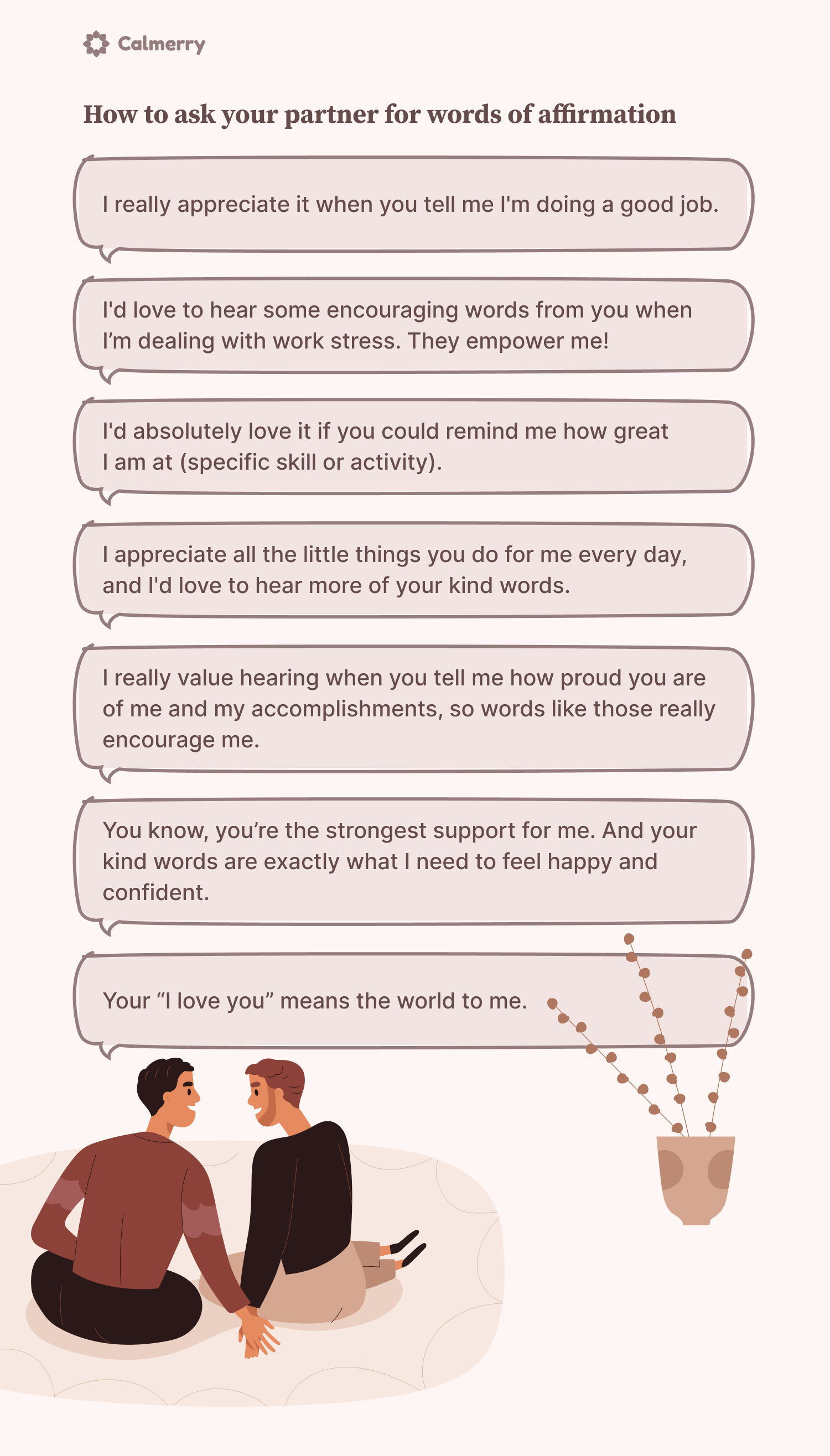
Credit: calmerry.com
Practical Challenges And How To Overcome Them
Feeling Awkward
If you’re not used to giving affirmations, it can feel strange at first. Start with written notes if speaking feels too direct. Practice with yourself to build confidence.
Forgetting To Affirm
Life gets busy. Set reminders or connect affirming words to daily habits (like after meals or before bed).
Fear Of Rejection
Some worry that affirming words will be misunderstood or unwanted. Remember, most people appreciate kind words—even if they don’t show it right away.
Dealing With Criticism
If you receive negative feedback, balance it with affirmation. Acknowledge what went wrong, but also recognize effort or intention.
Words Of Affirmation For Children
Children thrive on positive feedback. Regular affirmations help them develop self-worth and motivation. Instead of only praising results (“Good grade!”), focus on effort and character (“You worked hard on your homework” or “I admire your curiosity”).
Avoid comparisons with other children. Each child has unique strengths. Affirming those helps them grow into confident adults.
Here’s a quick comparison of effective vs. less effective affirmations for kids:
| Less Effective | More Effective |
|---|---|
| "You’re so smart." | "You kept trying, even when it was hard." |
| "Good job." | "I noticed you shared your toys today." |
| "You’re the best." | "I love your creativity." |
The Long-term Impact Of Words Of Affirmation
When people receive regular, sincere affirmations over time, the effects are lasting. They tend to:
- Have higher self-esteem
- Build stronger, healthier relationships
- Bounce back faster from setbacks
- Communicate more openly
- Feel happier and more secure
It’s not about flattery or saying what people want to hear. Real affirmation is about seeing and naming the good in others—and yourself.
Frequently Asked Questions
What If My Partner Doesn’t Respond To Words Of Affirmation?
Some people value other love languages more. Ask your partner what makes them feel loved and respected. Be willing to use their preferred language, not just your own.
How Can I Avoid Sounding Fake When Giving Affirmations?
Focus on specific qualities or actions. Speak from the heart and only give praise you truly mean. Sincerity is more important than fancy words.
Can Words Of Affirmation Help At Work?
Yes, affirming colleagues and employees boosts morale, trust, and productivity. Even a short thank-you note can have a big impact.
Are Words Of Affirmation Helpful For Children?
Absolutely. Regular, honest affirmation helps children develop confidence and motivation. Focus on effort and character, not just results.
Where Can I Learn More About Love Languages?
You can visit the official website of Dr. Gary Chapman or read more about the love languages concept from Psychology Today.
Words of affirmation are a simple, powerful way to connect with others and build lasting happiness. By noticing what’s good in people and telling them, you help create a kinder, more connected world. Whether spoken, written, or typed, the right words can truly change lives—one affirmation at a time.
