

How to Write Your Own Affirmations: Unlock Your Positive Potential
How To Write Your Own Affirmations
Affirmations are simple yet powerful sentences you repeat to yourself. They help build confidence, focus your mind, and change your habits. Many people use affirmations to improve their mood, reach goals, or create positive changes in their life. But not all affirmations work the same.
The most effective affirmations are personal and meaningful. When you write your own, you make them fit your needs, your personality, and your dreams. This article guides you step-by-step on how to create affirmations that truly work for you. You’ll learn what makes an affirmation effective, how to avoid common mistakes, and how to practice affirmations for real results.
What Are Affirmations?
Affirmations are positive statements you say or think repeatedly. They are designed to help you overcome negative thoughts, boost self-esteem, and focus on what you want in life. The main idea is simple: the more you repeat a positive belief, the more your mind accepts it. Over time, affirmations can influence your feelings, actions, and outcomes.
For example, saying “I am confident” can help you feel more confident. Saying “I am healthy” can help motivate you to make healthier choices. Affirmations are not magic, but they help change your mindset.
How Affirmations Work
Affirmations work by:
- Rewiring your brain: Repeated positive statements change how you think.
- Replacing negative thoughts: Affirmations help push out doubts and fears.
- Building new habits: Positive beliefs lead to positive actions.
Scientific studies show that affirmations can reduce stress, improve performance, and help you stick to your goals. The key is consistency and belief.
Where People Use Affirmations
- Personal growth: Building confidence and self-worth
- Career: Staying motivated and focused at work
- Health: Encouraging healthy habits
- Relationships: Improving communication and trust
- Learning: Boosting memory and focus
Why Write Your Own Affirmations?
Many people use affirmations they find online or in books. But writing your own is much more powerful. Personal affirmations are tailored to your challenges, goals, and values. They speak directly to your mind and heart.
Benefits Of Personalized Affirmations
- Relevant to your life: They match your real needs and feelings.
- More believable: You trust them because you wrote them.
- Stronger impact: Personal statements stick better in your mind.
- Flexible: You can update or change them as your life changes.
For example, if you struggle with public speaking, a generic affirmation like “I am strong” may not help much. But “I speak clearly and confidently” is more specific and useful.
Common Mistakes With Generic Affirmations
- Too broad or vague
- Not connected to your real goals
- Hard to believe
- No emotional impact
By writing your own, you avoid these mistakes and create affirmations that truly work.
Principles Of Effective Affirmations
Not every positive sentence is an affirmation. To make your affirmations effective, follow these principles:
1. Use Present Tense
Write affirmations as if they are true right now. For example, “I am calm” instead of “I will be calm. ” This helps your brain accept the statement as reality.
2. Be Positive
Always focus on what you want, not what you don’t want. Avoid negative words like “not” or “never. ” Instead of “I am not afraid,” use “I am brave. ”
3. Keep It Simple And Clear
Simple sentences are easier to remember and repeat. Avoid complex language or long statements.
4. Make It Personal
Use “I” or “my” to make the affirmation about you. For example, “I manage stress well. ”
5. Be Specific
Clear and specific affirmations are more powerful. Instead of “I am successful,” try “I complete my work on time. ”
6. Make It Believable
Choose words that feel true or possible for you. If you don’t believe the statement, it won’t work. You can adjust the strength, for example, “I am becoming more confident” instead of “I am confident. ”
7. Add Emotion
Feelings make affirmations stronger. Add words like “joy,” “peace,” “excited,” or “grateful. ” For example, “I am joyful about my progress. ”
8. Focus On Action
If you want to change a behavior, use action words. For example, “I eat healthy foods every day. ”
Step-by-step Guide To Writing Your Own Affirmations
Writing affirmations is easy when you follow clear steps. Here’s a simple process:
Step 1: Identify Your Goal Or Challenge
Think about what you want to change or improve. It could be confidence, health, relationships, or career. Ask yourself:
- What do I struggle with?
- What do I want to achieve?
- What do I want to feel?
Write down your answers.
Step 2: Choose Positive Outcomes
Focus on the positive side of your goal. If your challenge is “I feel anxious,” the outcome could be “I feel calm. ”
Step 3: Write In Present Tense
Create a simple statement as if it is true now. For example, “I am calm and relaxed. ”
Step 4: Make It Personal
Use “I” or “my” to make the affirmation about you.
Step 5: Add Specific Details
Make the statement clear and relevant. For example, “I speak confidently in meetings. ”
Step 6: Include Emotion
Add a feeling word to make it stronger. For example, “I feel proud of my achievements. ”
Step 7: Test For Believability
Read your affirmation out loud. Does it feel possible? If not, adjust the wording. Instead of “I am rich,” use “I am improving my finances. ”
Step 8: Repeat And Refine
Try your affirmation for a few days. If it doesn’t feel right, change the words.
Example Process
Suppose you want to improve your confidence at work:
- Goal: “I want to feel confident at work.”
- Positive outcome: “I am confident at work.”
- Present tense: “I am confident at work.”
- Personal: “I am confident in my abilities at work.”
- Specific: “I am confident when speaking in meetings.”
- Emotion: “I feel proud when I share my ideas.”
- Believability: “I am becoming more confident in meetings.”
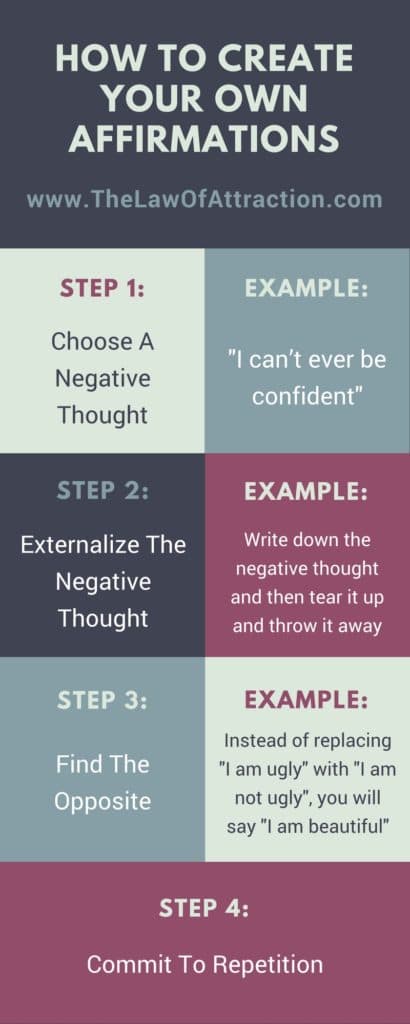
Credit: thelawofattraction.com
Examples Of Effective Affirmations
Here are examples for different situations. Notice how each follows the principles above.
Confidence
- “I am confident when I speak.”
- “I trust myself to make good decisions.”
- “I feel strong and capable.”
Health
- “I enjoy eating healthy food.”
- “I exercise regularly and feel energized.”
- “I am grateful for my healthy body.”
Career
- “I am focused and productive at work.”
- “I handle challenges with a calm mind.”
- “I am proud of my progress.”
Relationships
- “I communicate clearly and kindly.”
- “I listen to others with respect.”
- “I am loving and supportive.”
Personal Growth
- “I learn from my mistakes and grow.”
- “I am open to new ideas.”
- “I am patient with myself.”
Comparing Generic Vs. Personal Affirmations
To show the difference, here’s a table comparing generic affirmations with personalized ones:
| Generic Affirmation | Personal Affirmation |
|---|---|
| I am successful. | I finish my daily tasks with focus and pride. |
| I am healthy. | I choose healthy meals and enjoy exercise. |
| I am confident. | I share my ideas in meetings with confidence. |
| I am happy. | I find joy in small moments every day. |
| I am strong. | I stay calm and strong during stressful times. |
Personal affirmations are more likely to help you because they match your real needs.
Practical Tips To Make Affirmations Work
Writing a good affirmation is only the first step. How you use them is just as important.
1. Repeat Regularly
Consistency is key. Repeat your affirmations daily, preferably in the morning or before bed. This builds a habit and makes the statements stick.
2. Say Them Out Loud
Hearing your own voice makes affirmations stronger. Speak clearly and with emotion.
3. Write Them Down
Writing helps your brain remember. Keep a notebook and write your affirmations each day.
4. Visualize
Picture yourself living your affirmation. For example, imagine speaking confidently in a meeting.
5. Use Reminders
Place your affirmation where you see it often: on your desk, mirror, or phone. This keeps it fresh in your mind.
6. Practice Gratitude
Combine your affirmation with gratitude. For example, “I am grateful for my growing confidence. ”
7. Review And Update
As you progress, update your affirmations to match your new goals.
Common Mistakes To Avoid
Many people struggle with affirmations because of simple mistakes. Here’s what to watch out for:
1. Too Negative
Avoid negative words or focusing on what you don’t want. Stay positive.
2. Too Vague
Generic statements like “I am happy” may not work. Be specific.
3. Unrealistic Statements
If you don’t believe your affirmation, it won’t help. Adjust the wording to make it feel possible.
4. Inconsistent Practice
Repeating affirmations once or twice is not enough. Make it a daily habit.
5. Ignoring Emotions
Affirmations without feelings are weak. Add emotion for more impact.
6. Forgetting Action
If you want to change a habit, use action words.
Real-life Examples Of Affirmations In Action
Many people have changed their lives with affirmations. Here are some real stories:
Example 1: Overcoming Anxiety
Maria felt anxious before job interviews. She wrote, “I am calm and confident in interviews. ” After repeating it daily for two weeks, she felt less nervous and performed better.
Example 2: Building Healthy Habits
James wanted to eat healthier. His affirmation was, “I enjoy making healthy choices. ” By repeating it every morning, he found it easier to resist junk food.
Example 3: Improving Relationships
Linda struggled with communication. Her affirmation: “I listen and speak with kindness.” Over time, her relationships became stronger and more positive.
Data On Affirmations And Mindset
Research shows that affirmations can help change thinking and behavior. According to a study published in the journal Social Cognitive and Affective Neuroscience, affirmations can:
- Activate reward centers in the brain
- Reduce stress levels
- Improve self-control
Another survey found that 80% of people who practice daily affirmations feel more positive and focused after two weeks. However, only 30% of people stick with affirmations long-term. The most common reason for quitting: not believing in the statement or forgetting to practice.

Credit: www.education.com
How To Overcome Doubts About Affirmations
If you feel silly or doubtful about affirmations, you are not alone. Many people struggle at first. Here are ways to overcome doubts:
1. Start Small
Begin with simple, believable statements. For example, “I am learning to be more confident. ”
2. Use Evidence
Remind yourself of times you succeeded. “I spoke confidently last week” can help you believe “I am confident. ”
3. Be Patient
Change takes time. Keep repeating your affirmation, even if you don’t see results right away.
4. Combine With Action
Pair your affirmation with real steps. If you want to be healthier, say your affirmation and plan a healthy meal.
Advanced Techniques For Writing Affirmations
If you are ready to go deeper, try these advanced tips:
1. Use Questions
Turn your affirmation into a positive question. For example, “Why am I so confident in meetings? ” This makes your brain search for answers and proof.
2. Create A Story
Write a short story about yourself living your affirmation. This helps you visualize and believe the statement.
3. Use Multiple Affirmations
Mix several affirmations for different goals. For example, one for confidence, one for health, and one for relationships.
4. Record And Listen
Record your affirmations and listen to them during your commute or before bed.
5. Use Visual Aids
Create a vision board with images and your affirmations. This combines words and pictures for stronger impact.

Credit: www.selfloverainbow.com
Comparing Affirmation Practices
Different ways to practice affirmations suit different people. Here’s a comparison of common methods:
| Method | How It Works | Best For |
|---|---|---|
| Speaking Out Loud | Say affirmations each morning and night. | Building confidence, emotional impact |
| Writing Down | Write affirmations in a notebook daily. | Memory, focus, creating habits |
| Listening | Record affirmations and play them. | Busy schedules, auditory learners |
| Visualizing | Picture yourself living the affirmation. | Goal setting, motivation |
| Vision Board | Combine images with affirmations. | Creative thinkers, motivation |
Try different methods to see what works best for you.
How Long To See Results From Affirmations
Results depend on several factors:
- Frequency: Daily practice works best
- Belief: Strong belief speeds up results
- Action: Combining affirmations with actions creates change faster
Some people notice changes in a week. For others, it takes longer. Most experts recommend at least 21 days of daily practice to form a new habit.
The Science Behind Affirmations
Affirmations are not just wishful thinking. Studies show they can change your brain and behavior. For example, research from Psych Central explains that positive self-talk activates parts of the brain linked to reward and motivation. This makes you feel good and helps you take action.
Other studies show affirmations:
- Lower stress by reducing cortisol levels
- Improve problem-solving under pressure
- Support mental health
However, affirmations alone are not enough. They work best when combined with real actions and positive habits.
How To Measure Progress With Affirmations
Tracking your progress helps you stay motivated. Here’s how:
1. Keep A Journal
Write your affirmations and note how you feel each day. Track changes in mood, confidence, or habits.
2. Set Small Goals
Break big goals into smaller steps. For example, “Speak up once in every meeting. ”
3. Notice Changes
Pay attention to your actions. Are you behaving differently? Feeling better? Write it down.
4. Ask For Feedback
Sometimes others notice changes before you do. Ask friends or coworkers for feedback.
When To Change Your Affirmations
As you grow, your needs and goals change. Update your affirmations when:
- You achieve your goal
- Your focus shifts
- The statement no longer feels right
This keeps your affirmations fresh and effective.
Comparing Affirmations And Other Self-help Techniques
Affirmations are one tool among many. Here’s a comparison of affirmations, meditation, and journaling:
| Technique | Main Benefit | Best Use |
|---|---|---|
| Affirmations | Change mindset, boost confidence | Building positive beliefs |
| Meditation | Reduce stress, increase focus | Calming mind, emotional balance |
| Journaling | Self-reflection, track progress | Understanding feelings, setting goals |
Combining these techniques can make your self-help practice stronger.
How Affirmations Can Help In Different Life Stages
Affirmations are useful at any age or stage of life.
- Students: “I learn quickly and remember easily.”
- Parents: “I am patient and loving with my children.”
- Professionals: “I handle challenges calmly and efficiently.”
- Retirees: “I enjoy my free time and stay active.”
Personalized affirmations make the most difference.
Non-obvious Insights Most Beginners Miss
- Affirmations work best when linked to real actions. For example, saying “I am healthy” and planning a healthy meal together is more effective than words alone.
- Adjusting strength boosts believability. If you feel resistance, use softer wording like “I am learning to be confident” instead of “I am confident.”
- Visual reminders increase consistency. Placing affirmations where you see them daily (mirror, fridge, phone) helps build the habit.
- Tracking mood changes reveals hidden progress. Sometimes, you feel better before you notice big changes. Keeping a journal helps you see small wins.
Frequently Asked Questions
How Many Affirmations Should I Use At Once?
Start with 2 to 5 affirmations. Too many can be confusing. Focus on your most important goals. As you grow comfortable, you can add more.
What If I Don’t Believe My Affirmation?
Make the statement softer. Use words like “I am learning” or “I am becoming. ” Over time, as you see progress, your belief will grow.
How Long Does It Take For Affirmations To Work?
Most people notice changes in mood or behavior within 1 to 3 weeks. Full results depend on your consistency, belief, and actions.
Can Affirmations Help With Anxiety Or Stress?
Yes. Many studies show affirmations reduce stress and anxiety by changing negative thoughts. Pair affirmations with breathing exercises or meditation for best results.
Should I Write, Speak, Or Listen To My Affirmations?
Choose what feels best for you. Speaking out loud is powerful, but writing and listening work too. Some people combine methods. The key is regular practice.
Writing your own affirmations is a simple way to build a positive mindset and reach your goals. Personalized affirmations help you believe in yourself, change habits, and stay focused. When you write clear, specific, and believable statements, and practice them daily, you unlock real change.
Start small, track your progress, and adjust as you grow. Remember, affirmations are not magic words—they are tools to help you shape your thoughts and actions. Use them with patience and intention, and you’ll see real results in your life.
