

How to Write Affirmations for Manifestation: A Step-by-Step Guide
How To Write Affirmations For Manifestation
Imagine waking up each morning feeling confident, positive, and ready to create the life you dream about. This is not magic—it’s the power of affirmations for manifestation. Affirmations are short, positive statements that help shape your thoughts and beliefs. When you use them correctly, they can change how you see yourself and what you attract in life. But many people struggle to write affirmations that actually work. They use vague words, focus on negative ideas, or simply repeat statements without real meaning. The truth is, writing effective affirmations is a skill you can learn. In this article, you’ll discover how to write affirmations for manifestation, why they matter, and ways to make them truly powerful for your goals.
What Are Affirmations And Why Do They Matter?
Affirmations are simple, positive phrases you repeat to yourself to encourage belief in your abilities, desires, or dreams. They help you focus on what you want, not what you fear. The science behind affirmations is clear: research shows that positive self-talk can improve mindset, reduce stress, and boost motivation. When you use affirmations for manifestation, you are training your mind to notice opportunities, take action, and stay positive even when challenges arise.
For example, instead of thinking “I am not good enough,” you might say “I am confident and capable. ” This small change can have a big impact. Studies suggest that people who use affirmations regularly are more likely to achieve their goals, feel less anxious, and build resilience.
The key is consistency and belief—affirmations are most effective when you repeat them daily and truly believe in their message.
The Connection Between Affirmations And Manifestation
Manifestation means bringing something you want into your life by focusing your thoughts, beliefs, and actions. Affirmations are a tool for this process. When you write and repeat affirmations, you are telling your brain what to focus on. This creates a mental filter called the reticular activating system. It helps you notice opportunities, ideas, and solutions related to your goals.
For example, if your affirmation is “I attract new clients easily,” your mind starts looking for ways to meet people, improve your skills, and create opportunities. This is not just wishful thinking—it’s using psychology to change your behavior and outcomes.
Affirmations work best when paired with action. If you repeat “I am healthy and strong,” you are more likely to exercise, eat well, and make choices that support your health.
Key Elements Of Powerful Affirmations
Writing affirmations for manifestation is not about repeating random phrases. There are clear rules and elements you need to include to make them effective:
- Present Tense: Always write affirmations as if the goal is happening now. For example, “I am successful,” not “I will be successful.”
- Positive Words: Focus on what you want, not what you want to avoid. Say “I am calm and relaxed,” instead of “I am not stressed.”
- Personal: Use “I” or “my” to make the affirmation about you.
- Specific: Be clear about your goal. Instead of “I am rich,” say “I am earning $5,000 per month.”
- Emotion: Add feeling. “I am joyfully creating my dream career” is stronger than “I have a job.”
- Believable: Choose statements you can accept. If your goal feels too big, start smaller. For example, “I am improving my skills every day.”
- Action-Oriented: Use words that inspire movement, like “create,” “build,” “attract,” or “enjoy.”
These seven elements form the foundation of effective affirmations. Missing any of them can weaken your statement and reduce its impact.
Common Mistakes In Writing Affirmations
Many beginners make mistakes that stop affirmations from working. Here are some of the most common errors:
- Using negative words: Saying “I am not sad” focuses your mind on sadness.
- Being too vague: “I want to be happy” doesn’t give your brain a clear goal.
- Ignoring belief: If you don’t believe your affirmation, your mind will resist it.
- Repeating too many at once: Using 20 affirmations can feel overwhelming. Start with 3–5.
- Forgetting emotion: Flat statements lack power. Add feeling for stronger results.
A simple comparison can help you spot mistakes:
| Weak Affirmation | Strong Affirmation |
|---|---|
| I am not sick | I am healthy and energetic |
| I wish I had money | I am grateful for abundance flowing to me |
| I want to be confident | I am confident and self-assured |
Notice how strong affirmations use positive, present tense, and specific language.
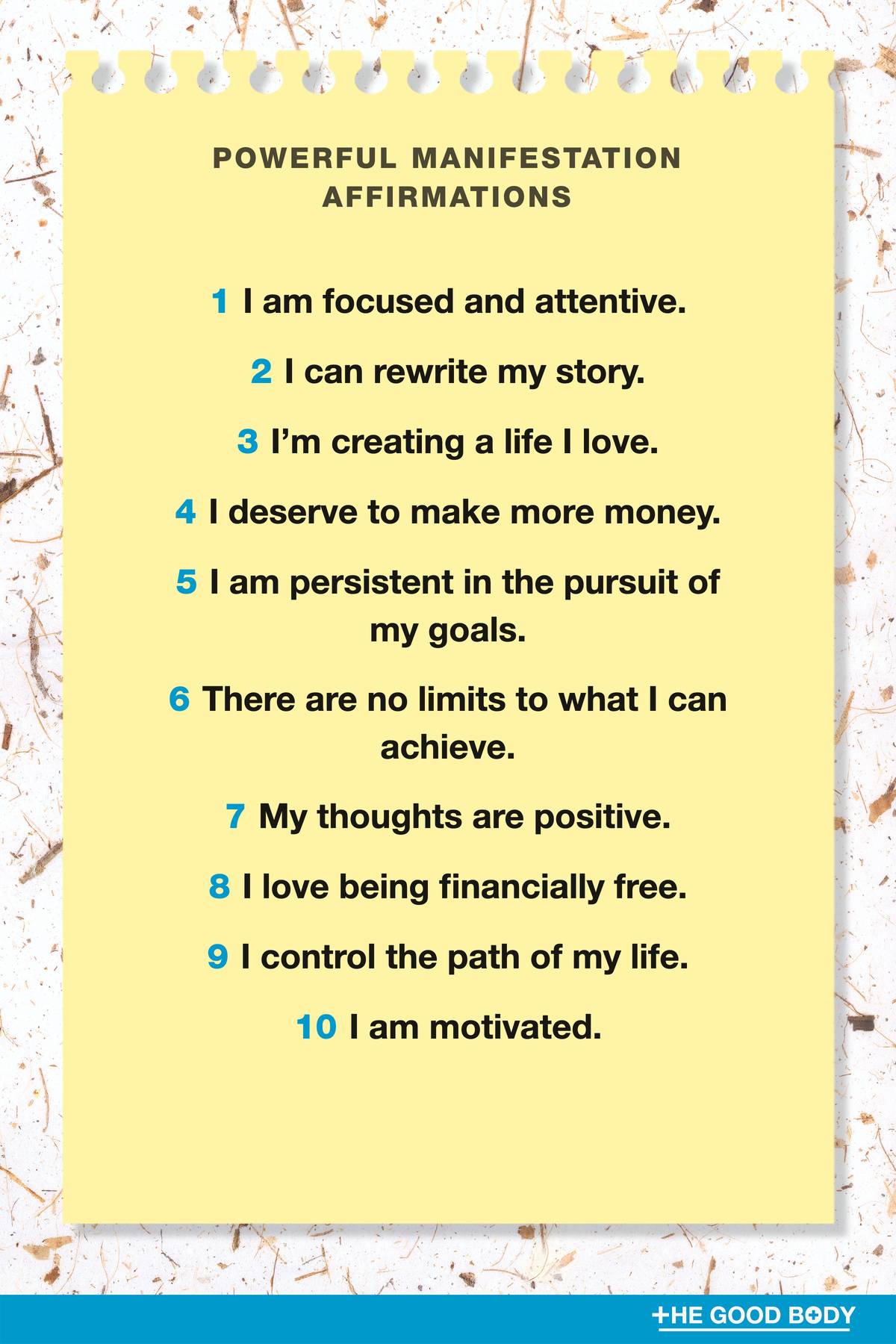
Credit: www.thegoodbody.com
Step-by-step Guide To Writing Affirmations
Writing your own affirmations is easy once you know the steps. Here’s a practical process you can follow:
1. Clarify Your Goal
Decide what you want to manifest. Is it a new job, better health, more confidence, or loving relationships? Be specific.
2. Identify Limiting Beliefs
Think about negative thoughts that hold you back. For example, “I can’t succeed” or “I’m not attractive. ” These are the beliefs you want to change.
3. Flip The Belief
Turn the negative statement into a positive one. “I can’t succeed” becomes “I am capable and successful. ”
4. Use Present Tense
Write your affirmation as if it’s happening now. “I am” is better than “I will be. ”
5. Add Emotion
Include words that describe how you feel. “I am excited about my new opportunities. ”
6. Make It Believable
If your affirmation feels too big, adjust it. “I am getting better every day” is easier to accept than “I am perfect. ”
7. Keep It Short
Your affirmation should be easy to remember. Aim for one sentence.
8. Repeat And Refine
Say your affirmation daily. Adjust as needed to make it feel powerful.
Here’s an example of the process:
- Goal: Find a new job
- Limiting belief: “I never get chosen”
- Positive flip: “I am valued and in demand”
- Present tense: “I am successfully attracting job offers”
- Emotion: “I am excited and grateful for new opportunities”
- Believable: “I am improving my skills and attracting offers”
Final affirmation: “I am excited and grateful as I attract new job offers with my growing skills.”
Examples Of Effective Manifestation Affirmations
To help you get started, here are some examples for different goals:
Wealth and Abundance:
- “I am grateful for the abundance flowing into my life.”
- “I am confidently creating financial freedom.”
- “I attract prosperous opportunities every day.”
Health and Wellness:
- “I am strong, healthy, and full of energy.”
- “I enjoy nourishing my body and mind.”
- “I am healing and thriving.”
Love and Relationships:
- “I am worthy of loving and supportive relationships.”
- “I attract kindness and respect.”
- “I am open to receiving love.”
Career and Success:
- “I am successful and fulfilled in my work.”
- “I confidently create opportunities for growth.”
- “I am valued and respected.”
Self-Esteem and Confidence:
- “I am confident in my abilities.”
- “I trust myself to make good decisions.”
- “I am proud of who I am.”
Notice how each affirmation uses present tense, positive words, and emotion.
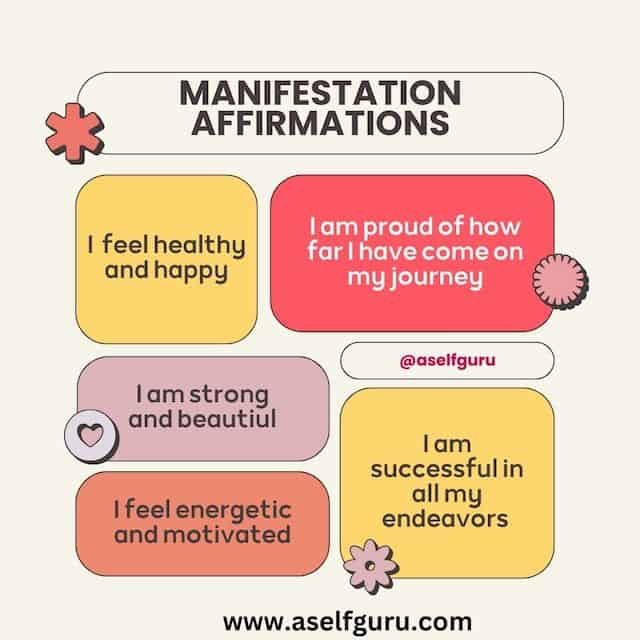
Credit: aselfguru.com
How To Use Affirmations For Best Results
Writing affirmations is only the first step. To get results, you need to use them daily and with intention.
- Repeat daily: Say your affirmations in the morning, before bed, or during quiet moments. Consistency is key.
- Speak out loud: Hearing your own voice makes the affirmation more powerful.
- Write them down: Journaling your affirmations helps you focus and remember.
- Visualize: Imagine the feeling and outcome as you say your affirmation.
- Feel the emotion: Let yourself experience the positive emotion of your statement.
- Display reminders: Place your affirmations where you can see them—mirror, desk, phone background.
- Pair with action: Take small steps toward your goal. Affirmations work best with real effort.
Many people miss a key insight: it’s better to use fewer affirmations with real feeling than many with no emotion. Another tip is to update your affirmations as your goals change. Don’t stick to old statements if you have new dreams.
Affirmation Writing Tips For Beginners
If you’re new to affirmations, start simple and build confidence. Here are practical tips:
- Choose 1–3 affirmations that matter most to you.
- Make each statement short and easy to remember.
- Practice saying them with feeling, not just words.
- If you feel resistance, try softer statements like “I am willing to believe in myself.”
- Track your progress by writing down changes in your mood, confidence, or actions.
One advanced tip many overlook: use future-based visualization while repeating present tense affirmations. For example, as you say “I am confident,” picture yourself speaking in public or solving a problem. This combines mental rehearsal with positive self-talk.
How Affirmations Change Your Brain
Affirmations are not just words—they change your brain. When you repeat positive statements, you create new neural pathways. This is called neuroplasticity. Your brain starts to expect success, happiness, and abundance. Over time, these new pathways become stronger, and old negative beliefs fade.
Studies show that regular affirmation use can reduce stress, improve performance, and boost self-esteem. One research paper found that people who used affirmations before stressful tasks performed better and felt less anxious.
This process takes time. You might notice small changes in a few days, but real transformation comes with weeks or months of practice. The most important part is consistency—daily use makes affirmations part of your natural thinking.
Comparing Types Of Affirmations
There are many ways to use affirmations. Some people prefer short, simple statements. Others use longer, detailed phrases. Here’s a comparison of common types:
| Type | Example | Best For |
|---|---|---|
| Short | I am confident | Quick daily use |
| Detailed | I am joyfully creating a successful business | Specific goals |
| Visual | I see myself achieving my dream | Creative visualization |
| Gratitude | I am grateful for my health | Building thankfulness |
Choose the style that fits your personality and needs.
Using Affirmations With Other Manifestation Tools
Affirmations are most effective when combined with other manifestation techniques. Here are a few ways to strengthen your practice:
- Vision boards: Create a collage of pictures that represent your goals. Place your affirmations near your board.
- Meditation: Use affirmations during meditation to deepen focus and relaxation.
- Journaling: Write your affirmations and track progress. Note feelings, actions, and results.
- Visualization: Imagine your goal as already achieved while repeating your affirmation.
One insight many overlook is the power of combining affirmation with gratitude. Saying “I am grateful for abundance flowing into my life” mixes positive expectation with thankfulness, which amplifies results.
Data And Statistics On Affirmation Effectiveness
Affirmations have been studied in psychology and neuroscience. Here are some important findings:
- A survey found that 76% of people who use affirmations regularly report increased self-confidence.
- Brain imaging studies show that positive self-talk activates the reward centers in the brain.
- People who use affirmations before stressful events score higher on performance tests.
- Affirmations can reduce anxiety and depression symptoms when used consistently.
These statistics show that affirmations are not just wishful thinking—they have real effects on mood, performance, and well-being.
Real-life Examples Of Manifestation Success
Many people have used affirmations to achieve big goals. Here are a few stories:
- Sarah, a teacher, used daily affirmations to overcome fear of public speaking. Within months, she led workshops and felt confident in front of groups.
- Tom, an entrepreneur, repeated “I am attracting successful partnerships.” He noticed new networking opportunities and grew his business.
- Leah, struggling with health issues, used “I am healing and strong.” She felt motivated to exercise, eat well, and saw improvements in her energy.
These examples show how affirmations can change thinking and action, leading to real results.
How To Make Your Affirmations Unique
Generic affirmations can feel flat. Personalizing your statements makes them stronger. Here’s how to make affirmations fit your life:
- Add your name: “I, John, am confident and successful.”
- Include specific details: “I am enjoying my new job at a creative company.”
- Mention time or place: “I am feeling energized every morning.”
- Use your own words: Avoid copying others—write statements that match your style.
- Connect to your values: “I am creating abundance with honesty and kindness.”
Personal affirmations are easier to believe and more motivating.
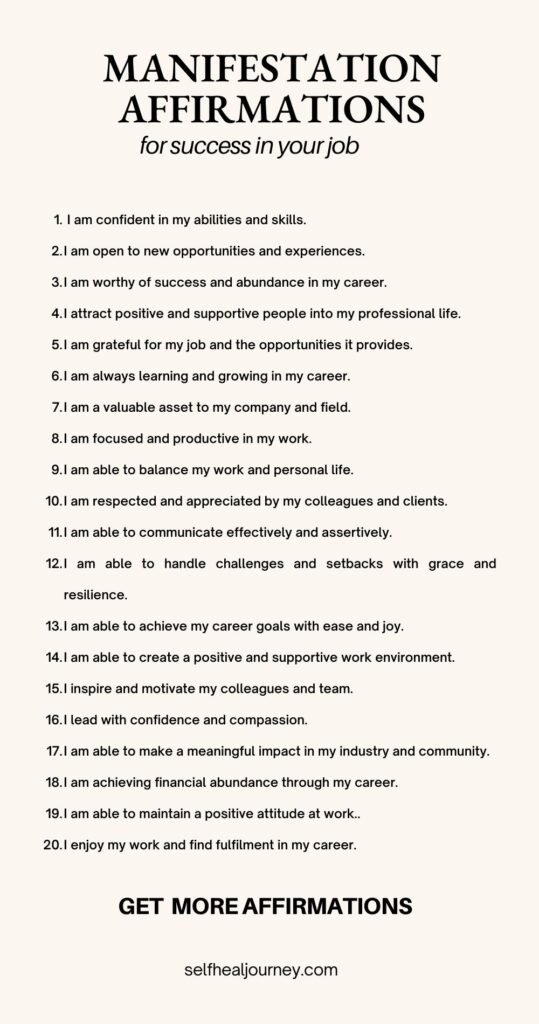
Credit: selfhealjourney.com
Tracking Your Affirmation Progress
It’s important to measure your results. Here’s a simple tracking method:
| Date | Affirmation Used | Feeling Before | Feeling After | Action Taken |
|---|---|---|---|---|
| Day 1 | I am confident | Nervous | Calm | Spoke in meeting |
| Day 2 | I am attracting success | Unsure | Motivated | Applied for job |
| Day 3 | I am healthy | Tired | Energetic | Went for walk |
Tracking helps you notice progress and stay motivated.
Affirmation Practices For Advanced Manifestation
As you get comfortable with affirmations, try advanced practices:
- Mirror work: Say your affirmations while looking into your eyes in the mirror. This increases self-acceptance.
- Record and listen: Record your affirmations and play them during the day.
- Combine with movement: Repeat affirmations while walking or exercising.
- Group practice: Share affirmations with friends or a support group.
These techniques deepen the impact and make affirmations part of your daily routine.
Overcoming Resistance And Doubt
Sometimes, repeating affirmations feels strange or you face mental resistance. This is normal. Here’s how to overcome it:
- Start with softer statements: “I am willing to believe in myself.”
- Use evidence: Remind yourself of past successes.
- Pair affirmation with action: Small steps boost belief.
- Visualize success: Imagine the positive outcome.
- Be patient: Change takes time. Keep going even if results are slow.
Another insight: if you face strong resistance, try writing about your doubts, then create new affirmations to address them. For example, if you doubt “I am successful,” write “I am learning and growing every day.”
The Role Of Consistency And Patience
Manifestation is a process. Affirmations take time to work. Many people quit after a few days because they don’t see instant results. But change happens slowly. Consistency is more important than speed. Repeat your affirmations daily, even if you don’t feel different at first.
Over weeks and months, you’ll notice changes in your thoughts, feelings, and actions.
Patience is key. Trust the process and keep going. Real transformation comes from daily practice and belief.
Affirmations For Different Life Areas
Affirmations can help in many parts of life. Here are examples for common areas:
- Money: “I am open to new sources of income.”
- Relationships: “I am attracting supportive friends.”
- Health: “I am caring for my body with love.”
- Career: “I am growing and learning in my job.”
- Self-love: “I am worthy of love and respect.”
Choose affirmations that fit your current needs and adjust as your goals change.
Frequently Asked Questions
How Many Affirmations Should I Use At Once?
It’s best to start with 1–3 affirmations. Using too many can feel overwhelming and reduce focus. As you get comfortable, you can add more, but always choose statements that matter most to you.
How Often Should I Repeat My Affirmations?
Repeat your affirmations at least once a day. Morning and evening are good times. Some people repeat them during quiet moments or before important events. Consistency is more important than frequency.
What If I Don’t Believe My Affirmation?
If you feel doubt, try softer statements like “I am willing to believe in myself. ” Pair your affirmation with small actions that build confidence. Over time, belief will grow.
Can Affirmations Help With Mental Health?
Yes, affirmations can support mental health by reducing negative self-talk and building positive beliefs. They are not a replacement for professional help, but they can be a helpful tool for improving mood and self-esteem.
Where Can I Learn More About Affirmation Science?
For more details on the science behind affirmations and manifestation, visit Psychology Today.
Manifestation affirmations are a powerful tool to shape your thoughts and attract what you want in life. When you write and use them correctly, they can change your mindset, boost your confidence, and help you reach your goals. Remember to keep your statements positive, personal, and believable.
Use them daily, track your progress, and be patient. With consistent practice, you’ll notice real changes in your thoughts, feelings, and actions. Start today and see how affirmations for manifestation can create a brighter, more confident future.
