

How to Write Affirmations Examples That Truly Work
How To Write Affirmations Examples
Feeling stuck, stressed, or unsure of yourself is common. But what if you could change your mindset and improve your life simply by changing your words? That’s the power of affirmations—short, positive statements that help you focus, believe, and take action. Many successful people, from athletes to business leaders, use affirmations daily to build confidence and achieve their goals. But writing effective affirmations is more than repeating “I am happy” or “I am rich” in front of the mirror. There’s an art and science to creating affirmations that actually work.
This guide will show you how to write affirmations that fit your life, goals, and personality. You’ll learn what makes affirmations powerful, how to avoid common mistakes, and see real examples for different situations. By the end, you’ll know how to turn your thoughts into tools for success.
What Are Affirmations And Why Do They Matter?
Affirmations are positive statements you say to yourself to challenge negative thoughts and encourage new beliefs. They can help you develop a stronger mindset, reduce stress, and improve your actions.
For example, if you often think, “I always make mistakes,” an affirmation could be, “I learn and grow from every experience. ” This changes your focus from failure to learning.
Research shows that positive self-talk can boost performance and well-being. For example, a study published in the journal *Social Cognitive and Affective Neuroscience* found that self-affirmation activates the brain’s reward centers, making it easier to accept positive change.
But not all affirmations are equal. Some work better than others, depending on how you write and use them.
Key Elements Of Effective Affirmations
Writing a strong affirmation is not about magic words. It’s about understanding how your mind works and choosing statements that feel real and powerful.
1. Present Tense
Good affirmations use the present tense. Instead of saying, “I will be confident,” say, “I am confident.” This helps your mind believe the change is happening now, not someday in the future.
2. Positive Language
Focus on what you want, not what you’re avoiding. Instead of, “I am not afraid,” use, “I am brave. ” The mind responds better to positive images.
3. Personal And Specific
Make it about you and your unique situation. “I am healthy and full of energy” is more powerful than, “People are healthy.”
4. Emotion And Action
Add feeling words or actions. “I am calmly speaking my truth” is stronger than, “I am confident. ” Emotion makes the affirmation stick.
5. Believability
If your affirmation feels fake, your mind may reject it. Adjust the words until it feels possible. For example, “I am learning to be confident” can work better than “I am confident” if you’re just starting.
6. Repetition
Say your affirmations often. The more you repeat, the deeper they go into your thoughts and habits.
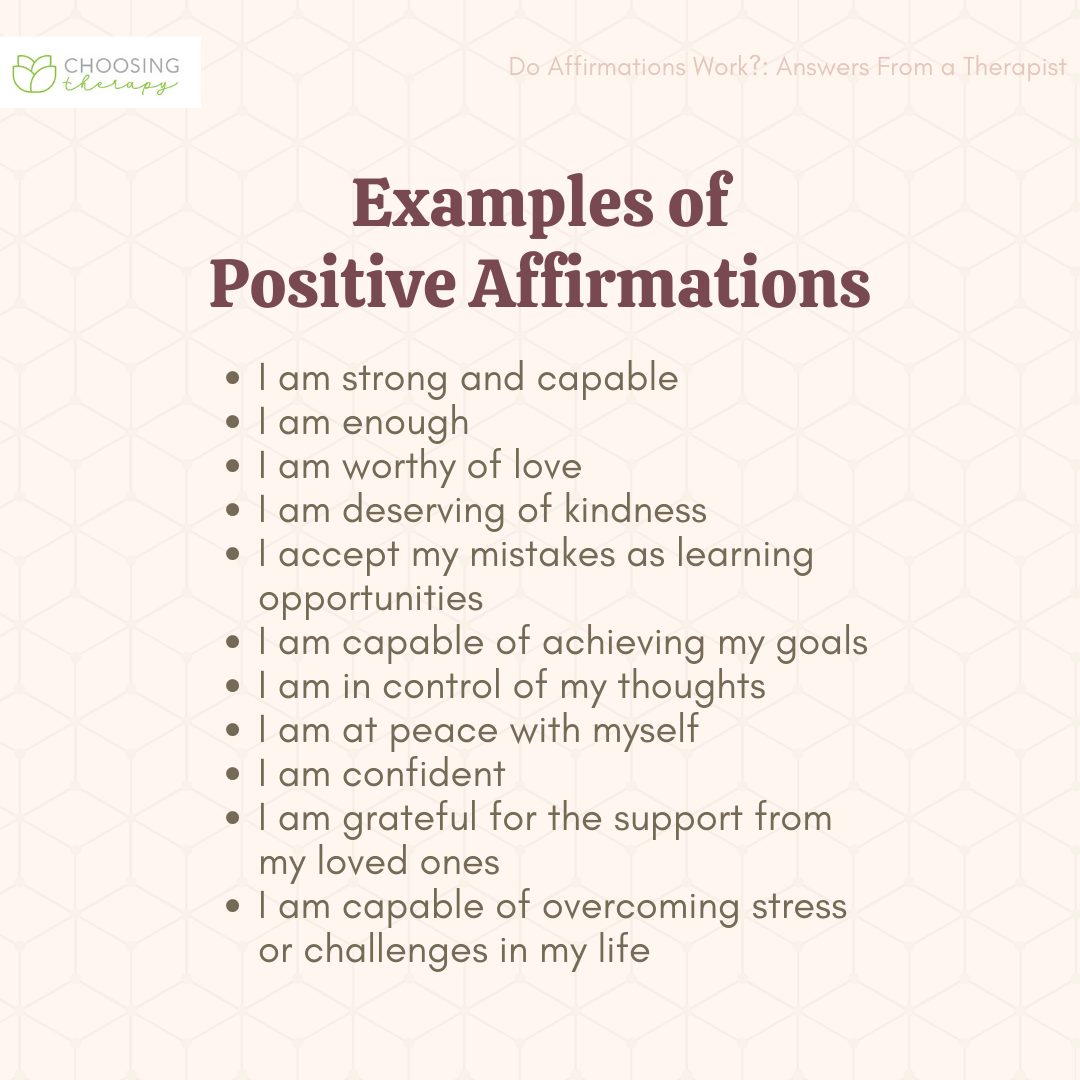
Credit: www.choosingtherapy.com
Common Mistakes When Writing Affirmations
Many people try affirmations but give up because they don’t see results. Usually, it’s because of these common mistakes:
- Using vague language: “I want to be better” isn’t clear.
- Focusing on the negative: “I am not stressed” still keeps “stressed” in your mind.
- Making them too long: Short, clear statements are easier to remember and believe.
- Choosing impossible goals: “I am a millionaire” may feel fake if you’re struggling financially. Start with, “I am improving my finances every day.”
- Skipping repetition: Saying an affirmation once or twice rarely works. Consistency is key.
How To Write Your Own Affirmations: Step-by-step
Creating your own affirmations is simple, but it works best if you follow a process. Here’s a practical guide:
Step 1: Identify The Area You Want To Change
Pick one area of your life: confidence, health, relationships, money, work, or stress. Focus on one at a time for best results.
Step 2: Notice Negative Thoughts
Write down the common negative thoughts you have about this area. For example: “I’m always tired,” “I can’t lose weight,” or “I’m not good enough.”
Step 3: Flip The Thought
Change the negative statement to its positive opposite. “I’m always tired” becomes “I am full of energy. ”
Step 4: Add Emotion And Action
Make your new statement stronger by adding feelings or actions. “I am full of energy and ready for the day. ”
Step 5: Check Believability
Read your affirmation out loud. Does it feel true or possible? If it feels fake, adjust the words until you feel a small sense of agreement. For example, “I am learning to feel confident” may work better than “I am perfectly confident.
”
Step 6: Make It Short And Clear
Keep your affirmation easy to remember. If it’s too long, you won’t use it.
Step 7: Repeat And Use Daily
Say your affirmation every morning, before bed, or during stressful moments. You can write it, say it out loud, or even record it and listen.
Real-life Examples: Affirmations For Different Goals
Let’s look at specific affirmations for common areas people want to improve. You can use these as they are or change them to fit your needs.
Confidence
- I am confident in who I am.
- I trust myself and my choices.
- I speak up with courage and clarity.
- I am proud of my progress.
- I believe in my ability to succeed.
Stress And Anxiety
- I am calm and relaxed.
- I let go of what I cannot control.
- I breathe deeply and feel peace.
- I handle challenges with a clear mind.
- I choose to feel safe and secure.
Health And Wellness
- I am strong and healthy.
- I make choices that support my well-being.
- My body is full of energy.
- I enjoy taking care of myself.
- I am grateful for my healthy body.
Success And Career
- I am focused and motivated.
- Every day, I get closer to my goals.
- I am skilled and valuable at work.
- I attract new opportunities.
- I am open to learning and growth.
Relationships
- I am surrounded by love and support.
- I give and receive kindness.
- I communicate with respect and honesty.
- I attract positive and caring people.
- I am worthy of healthy relationships.
Money And Abundance
- I am open to wealth and success.
- Money flows to me easily and often.
- I manage my finances with confidence.
- I attract new sources of income.
- I am grateful for all that I have.
Self-love And Acceptance
- I love and accept myself as I am.
- I am worthy of happiness and respect.
- I forgive myself for past mistakes.
- I honor my needs and feelings.
- I celebrate my unique qualities.
Advanced Tips For Powerful Affirmations
Once you’ve mastered the basics, you can make your affirmations even more effective with these strategies.
Use “i Am Becoming”
If “I am” feels too strong, try “I am becoming” or “I am learning to. ” This helps your mind accept the change as a process.
Examples:
- I am becoming more confident each day.
- I am learning to handle stress calmly.
Add Visualization
When you say your affirmation, picture yourself living it. Imagine the feelings, sights, and sounds. This makes your brain believe it’s real.
Write, Speak, And Listen
Use different senses. Write your affirmation in a journal, say it out loud in the mirror, or record yourself and listen during your day.
Pair With Action
Affirmations work best with action. If you affirm, “I am organized,” also take small steps to organize your space.
Track Progress
Notice small changes in your thoughts, feelings, and actions. Celebrate wins, even if they’re small.

Credit: www.lomyrick.com
How Affirmations Compare To Other Positive Practices
Affirmations are one way to improve your mindset, but they’re not the only way. Other tools include visualization, gratitude journaling, and meditation. Sometimes people mix these practices for better results.
Here’s a comparison to help you see the differences and benefits:
| Practice | Main Focus | How to Use | Best For |
|---|---|---|---|
| Affirmations | Changing beliefs with words | Repeat positive statements daily | Building confidence, shifting mindset |
| Visualization | Imagining success or goals | Picture desired outcome in detail | Motivation, goal achievement |
| Gratitude Journaling | Focusing on what you appreciate | Write things you’re thankful for | Happiness, reducing stress |
| Meditation | Calming and focusing the mind | Sit quietly and focus on breath/thoughts | Stress relief, mindfulness |
Many people find that combining two or more methods works best. For example, you might meditate, then say affirmations, then write in a gratitude journal.
Real-world Data: Do Affirmations Really Work?
Some people wonder if affirmations are just “wishful thinking. ” But research and real-life examples show they can work—especially when used correctly.
- A study in the journal Psychological Science found that self-affirmation can reduce stress and improve academic performance in students.
- Athletes often use affirmations to boost focus and confidence before competitions.
- In therapy, affirmations help people recover from negative self-image and build new habits.
However, affirmations work best when combined with action. They are not a magic solution, but they can change how you think, which often changes what you do.
Here’s a simple comparison of how people feel before and after using affirmations regularly:
| Before Affirmations | After 30 Days of Affirmations |
|---|---|
| Low confidence, negative self-talk | Improved self-talk, higher confidence |
| Stress, anxiety about challenges | More calm, better stress management |
| Lack of motivation | Increased motivation to act |
| Focusing on failure | Focusing on growth and progress |
Of course, results may vary. But most people notice some improvement in mindset, even if their situation doesn’t change overnight.

Credit: mycreativelife.blog
How To Use Affirmations In Daily Life
Writing affirmations is just the start. Using them well takes a little practice and routine. Here are ways to make affirmations part of your day:
Morning Routine
Start your day by saying your affirmations out loud. This sets a positive tone for the day. Try looking in the mirror for more impact.
During Stressful Moments
When you feel anxious or doubtful, repeat your affirmation. This helps replace the negative thought with a positive one.
Before Sleep
End your day with affirmations. This can improve your mood and help you sleep better.
Written Reminders
Write your affirmation on sticky notes, your phone, or a journal. Place them where you’ll see them often—on your desk, fridge, or bathroom mirror.
Digital Tools
Use apps that remind you to say your affirmations. Some apps let you record your voice or send notifications.
Pair With Physical Actions
Link your affirmation to a physical act. For example, every time you wash your hands or tie your shoes, repeat your statement.
Examples Of Affirmations In Different Situations
Sometimes, you might want an affirmation for a specific event or feeling. Here are tailored examples:
For Job Interviews
- I am prepared and ready to share my strengths.
- I am calm, confident, and focused.
- I trust in my skills and experience.
For Fitness Goals
- I enjoy moving my body and getting stronger.
- I am dedicated to my health and fitness.
- Every workout makes me better.
For Public Speaking
- I am clear, calm, and confident on stage.
- My words inspire and connect with others.
- I enjoy sharing my message.
For Difficult Conversations
- I communicate with honesty and kindness.
- I listen and speak with respect.
- I can handle this conversation calmly.
For Breaking Bad Habits
- I am free from old habits that no longer serve me.
- I make choices that support my well-being.
- Every day, I am stronger and more in control.
Non-obvious Insights For Writing Affirmations
Many guides focus on the basics, but here are two powerful insights that beginners usually miss:
1. Small, Personal Wins Matter More Than Big, Generic Goals
If you focus only on huge changes (“I am a millionaire,” “I am always happy”), your mind may reject the statement. Instead, use affirmations that celebrate small wins or specific moments. For example, “I am proud of my effort today,” or “I am learning to enjoy speaking up.
” Over time, these small wins build bigger change.
2. Timing And Environment Can Boost Effectiveness
Where and when you say your affirmations can matter. Saying them in a relaxed state (after meditation, before sleep, or in nature) can help your mind accept them more easily. Repeating affirmations when stressed or distracted may be less effective.
Try to find a quiet, positive space for your practice.
Making Affirmations Stick: Tracking And Adjusting
Affirmations are not “set it and forget it. ” To see real change, you need to notice what works and adjust as needed.
Keep An Affirmation Journal
Write your affirmations and note any changes in your mood, actions, or results. This helps you see progress and spot patterns.
Adjust As You Grow
As you achieve goals or your feelings change, update your affirmations. For example, once you feel more confident, you might shift your focus to new challenges.
Share With Supportive People
Sometimes, sharing your affirmation with a friend, coach, or group can give you extra motivation and accountability.
Frequently Asked Questions
What If My Affirmation Feels Fake Or Forced?
It’s normal for affirmations to feel awkward at first, especially if they are very different from your usual thoughts. Try changing the words to make them more believable. For example, instead of “I am successful,” say, “I am learning and growing every day.
” Over time, as you see small changes, the affirmation will feel more natural.
How Many Affirmations Should I Use At Once?
Start with 2-3 affirmations focused on your top priorities. Using too many can be overwhelming and less effective. Once you feel progress, you can add or change affirmations as needed.
Can I Write My Affirmations In Another Language?
Yes! Affirmations work best in the language you think and feel in. Using your native language can make the statement feel more real and personal.
How Long Does It Take To See Results From Affirmations?
Results vary for everyone. Some people notice a change in a few days, others may take weeks or months. Consistency matters more than speed. Combine affirmations with action for best results.
Where Can I Learn More About Affirmations And Positive Thinking?
For deeper insights, you can explore resources like PositivePsychology.com, which offers research-backed tips and examples.
Final Thoughts
Learning how to write affirmations is a simple but powerful way to shift your mindset and move toward your goals. The key is to make your statements positive, specific, and believable. Repeat them often, pair them with action, and adjust as you grow.
Affirmations are not magic, but with practice, they help you focus on the good, build confidence, and create real change in your life. Start small, be patient, and watch how your words can shape your world.
