

How to Use Affirmations: Transform Your Mindset Instantly
How To Use Affirmations: A Complete Guide
Imagine waking up each day feeling confident, calm, and ready to face challenges. Many people want this, but few know how to achieve it. One simple, powerful tool is using affirmations. These are positive statements you repeat to yourself to change your mindset, build new habits, and reach your goals. If you are new to affirmations, or if you have tried them before but never felt much change, this guide will show you exactly how to use affirmations for real results.
You will learn what affirmations are, how they work, and the science behind them. You will also discover practical steps to create your own affirmations, mistakes to avoid, and ways to make them truly effective. By the end, you will be ready to use affirmations every day to improve your confidence, happiness, and success.
What Are Affirmations?
Affirmations are short, positive statements you repeat to yourself. Their main goal is to help you believe something good about yourself or your life. For example, saying “I am confident” or “I can handle challenges” can help you feel stronger and more positive.
These statements are not just random words. They are carefully chosen to help you change your thoughts and feelings. When you repeat affirmations, your brain starts to accept them as truth. This can change the way you see yourself and your world.
People use affirmations for many reasons:
- To improve self-esteem
- To reduce stress
- To build confidence
- To reach personal or professional goals
- To break bad habits
Affirmations are used by athletes, business leaders, and people from all walks of life. They are a simple but powerful tool for personal growth.
The Science Behind Affirmations
Many people wonder if affirmations really work. The answer is yes, but there are important details to understand.
How Affirmations Affect The Brain
Your brain is like a computer. It takes in information, processes it, and creates beliefs. When you repeat positive statements, your brain starts to build new connections. These connections can change the way you think and feel.
Research shows that self-affirmation can reduce stress, improve performance, and help people make better choices. For example, one study found that repeating affirmations helped students perform better on tests. Another study showed that affirmations can help people recover faster from negative experiences.
Here is a simple way to understand the science:
- Your thoughts influence your feelings.
- Your feelings influence your actions.
- Changing your thoughts with affirmations can change your actions and results.
Why Some Affirmations Work Better Than Others
Not all affirmations are equally effective. For an affirmation to work, it must be:
- Personal: It should fit your own goals and values.
- Positive: It should focus on what you want, not what you fear.
- Present tense: It should be stated as if it is already true.
If you repeat a statement that does not feel believable, your mind may resist it. This is why choosing the right words matters.
Data And Statistics
Studies show that people who use affirmations regularly can experience:
- Up to 20% less stress in daily life
- Up to 30% more motivation to reach goals
- Higher self-confidence scores compared to those who do not use affirmations
These numbers show that affirmations are not just wishful thinking—they can create real change.
How To Create Powerful Affirmations
Making your own affirmations is simple, but there are important steps to follow. If you skip these steps, your affirmations may not work as well.
Step 1: Identify Your Goal
Start by asking yourself, “What do I want to change or improve?” This could be:
- Confidence
- Focus
- Health
- Relationships
- Career
Be clear and specific. For example, instead of “I want to be happy,” try “I want to feel confident at work. ”
Step 2: Write In The Present Tense
Affirmations work best when they are in the present tense. Say “I am strong” instead of “I will be strong. ” This makes your brain accept the statement as true now.
Step 3: Use Positive Words
Focus on what you want, not what you want to avoid. Say “I am healthy” instead of “I am not sick. ” Positive language helps your mind move toward your goal.
Step 4: Make It Personal
Use words like “I” and “my. ” Make the affirmation about you. For example, “I am confident in my abilities. ”
Step 5: Keep It Short And Simple
Short statements are easier to remember and repeat. Try to keep your affirmation to one sentence.
Step 6: Add Emotion
If possible, include a feeling. For example, “I am excited about my future. ” Emotion makes the affirmation more powerful.
Examples Of Good Affirmations
- “I am confident in my skills.”
- “I am calm and focused.”
- “I am proud of my progress.”
- “I am worthy of love and respect.”
- “I handle challenges with strength.”
Each statement is positive, personal, and in the present tense.
Common Mistakes When Using Affirmations
Many beginners make mistakes that can limit the power of affirmations. Here are some of the most common:
- Being too vague: Statements like “I am happy” can be unclear. Be specific about what you want.
- Using negative words: Avoid words like “not” or “don’t.” These focus on what you want to avoid, not what you want to achieve.
- Repeating too many affirmations: Focus on two or three important statements. Too many can make it hard to remember and believe them.
- Ignoring your feelings: If an affirmation feels false, change the words. Make it believable for you.
- Skipping repetition: Affirmations work best with regular practice. Saying them once is not enough.
- Using future tense: Avoid “I will be” or “I’m going to.” Use present tense to make it feel real.
If you avoid these mistakes, your affirmations will be much more effective.

Credit: www.lomyrick.com
How To Use Affirmations Daily
To get the most from affirmations, you need to use them daily. Here is a practical routine you can follow:
Morning Routine
Start your day with affirmations. This sets a positive tone for everything you do.
- Find a quiet place.
- Repeat your affirmations out loud or silently.
- Visualize yourself living your affirmation.
- Spend 3–5 minutes focusing on your statements.
Throughout The Day
You can use affirmations any time you feel stressed or unsure.
- Before a big meeting or exam
- When you feel anxious or upset
- While commuting or walking
Repeating affirmations in these moments can calm your mind and boost confidence.
Evening Routine
End your day with affirmations. This helps you reflect and prepare for tomorrow.
- Repeat your affirmations before sleep.
- Focus on the positive feelings they bring.
- Write your affirmations in a journal.
Tracking Your Progress
Keep a record of your affirmations and how you feel. This helps you see your progress and make changes if needed.
| Date | Affirmation Used | Emotional Response | Change Noticed |
|---|---|---|---|
| Day 1 | I am confident | Felt calm | Less anxious at work |
| Day 2 | I am focused | Motivated | Finished tasks faster |
| Day 3 | I am worthy | Happy | Improved relationships |
This simple table helps you see which affirmations work best and how your feelings change over time.
Choosing The Right Affirmations For Your Goals
The best affirmations are those that match your goals. Here is how to choose them based on your needs:
For Confidence
- “I believe in myself.”
- “I am strong and capable.”
For Stress Relief
- “I am calm and relaxed.”
- “I handle stress with ease.”
For Success
- “I am successful in my work.”
- “I reach my goals every day.”
For Health
- “I am healthy and energetic.”
- “I take care of my body.”
For Relationships
- “I am loved and respected.”
- “I build strong connections.”
If you are not sure which affirmation to use, write down your main goal and create a statement that fits.

Credit: sproutingzen.com
How Affirmations Compare To Other Mindset Tools
Affirmations are just one tool for building a positive mindset. Here is how they compare to other methods like visualization, meditation, and journaling.
| Tool | Main Purpose | Best For | How to Use |
|---|---|---|---|
| Affirmations | Change beliefs | Building confidence, reducing stress | Repeat positive statements daily |
| Visualization | Imagine success | Goal achievement | Picture yourself reaching your goal |
| Meditation | Calm the mind | Reducing anxiety | Focus on breath or a mantra |
| Journaling | Self-reflection | Understanding emotions | Write thoughts and feelings |
Affirmations can be combined with these methods for even better results. For example, you can use affirmations during meditation, or write them in your journal.
Making Affirmations More Effective
Many people repeat affirmations but do not see much change. Here are two powerful insights that beginners often miss:
Insight 1: Pair Affirmations With Action
Affirmations are not magic words. They help your mind, but you must also take action. For example, if your affirmation is “I am productive,” make a plan to finish your tasks. When you act in line with your affirmation, your belief grows stronger.
Insight 2: Use Visualization Together
When you say your affirmation, imagine yourself living it. See yourself feeling confident, calm, or successful. Visualization makes your affirmation feel real and helps your brain accept it faster.
Try Affirmations With Habit Stacking
You can make affirmations a habit by linking them to another routine. For example:
- Repeat affirmations while brushing your teeth.
- Say them during your morning walk.
- Write them at the end of your workday.
This makes affirmations easier to remember and use.
Real-life Examples And Success Stories
Many people have changed their lives with affirmations. Here are a few examples:
Example 1: Boosting Confidence
Maria felt shy and nervous at work. She started repeating “I am confident in my abilities” every morning. After a few weeks, she noticed she spoke more in meetings and felt less anxious. Her manager praised her for her ideas.
Example 2: Reducing Stress
David struggled with stress before exams. He used the affirmation “I am calm and prepared. ” He repeated it before study sessions and tests. This helped him focus and reduced his anxiety. He scored higher than before.
Example 3: Improving Relationships
Sara wanted better connections with her friends. She used “I am open and caring. ” She practiced listening and being kind. Her friendships grew stronger, and she felt happier.
These stories show that affirmations can work for many goals. The key is regular practice and believing in your statements.
Measuring The Impact Of Affirmations
How do you know if your affirmations are working? There are clear signs:
- Change in feelings: You feel more positive, calm, or confident.
- Change in behavior: You act in ways that match your affirmation.
- Improved results: You reach your goals more easily.
You can measure progress by keeping a journal or using a simple rating scale.
| Week | Confidence Level (1–10) | Stress Level (1–10) | Goal Progress |
|---|---|---|---|
| 1 | 4 | 7 | Started using affirmations |
| 2 | 6 | 5 | More positive feelings |
| 3 | 8 | 3 | Reached small goals |
This helps you see the effect over time and adjust your affirmations if needed.
Affirmations For Different Life Stages
Affirmations can be helpful at any stage of life. Here are examples for different ages and situations:
For Students
- “I learn new things easily.”
- “I am focused on my studies.”
For Professionals
- “I am successful in my work.”
- “I handle challenges with skill.”
For Parents
- “I am patient and caring.”
- “I create a loving home.”
For Older Adults
- “I am wise and strong.”
- “I enjoy each day.”
Affirmations can be adapted for any goal or situation. The key is to make them personal and meaningful.
How To Overcome Doubt And Resistance
Sometimes, your mind may resist affirmations, especially if you do not believe them at first. Here are ways to overcome this:
- Start with simple, believable statements. For example, “I am learning to be confident.”
- Use “progress” affirmations: “I am getting better every day.”
- Pair affirmations with small actions. Each time you act, your belief grows.
Over time, as you see small changes, your mind will accept bigger affirmations.
Using Affirmations In Groups
Affirmations are not just for individuals. They can also be used in groups, teams, or families.
- In schools, teachers use affirmations to help students feel confident.
- In workplaces, teams use affirmations to improve performance.
- In families, parents and children use affirmations to build trust and support.
Group affirmations create a positive environment and help everyone move toward a shared goal.
How To Write Affirmations That Stick
If you want your affirmations to stick, try these tips:
- Write them on sticky notes and place them where you see them often.
- Record your affirmations and listen to them during your day.
- Share your affirmations with a friend for support.
The more you see, hear, and repeat your affirmations, the more your mind accepts them.
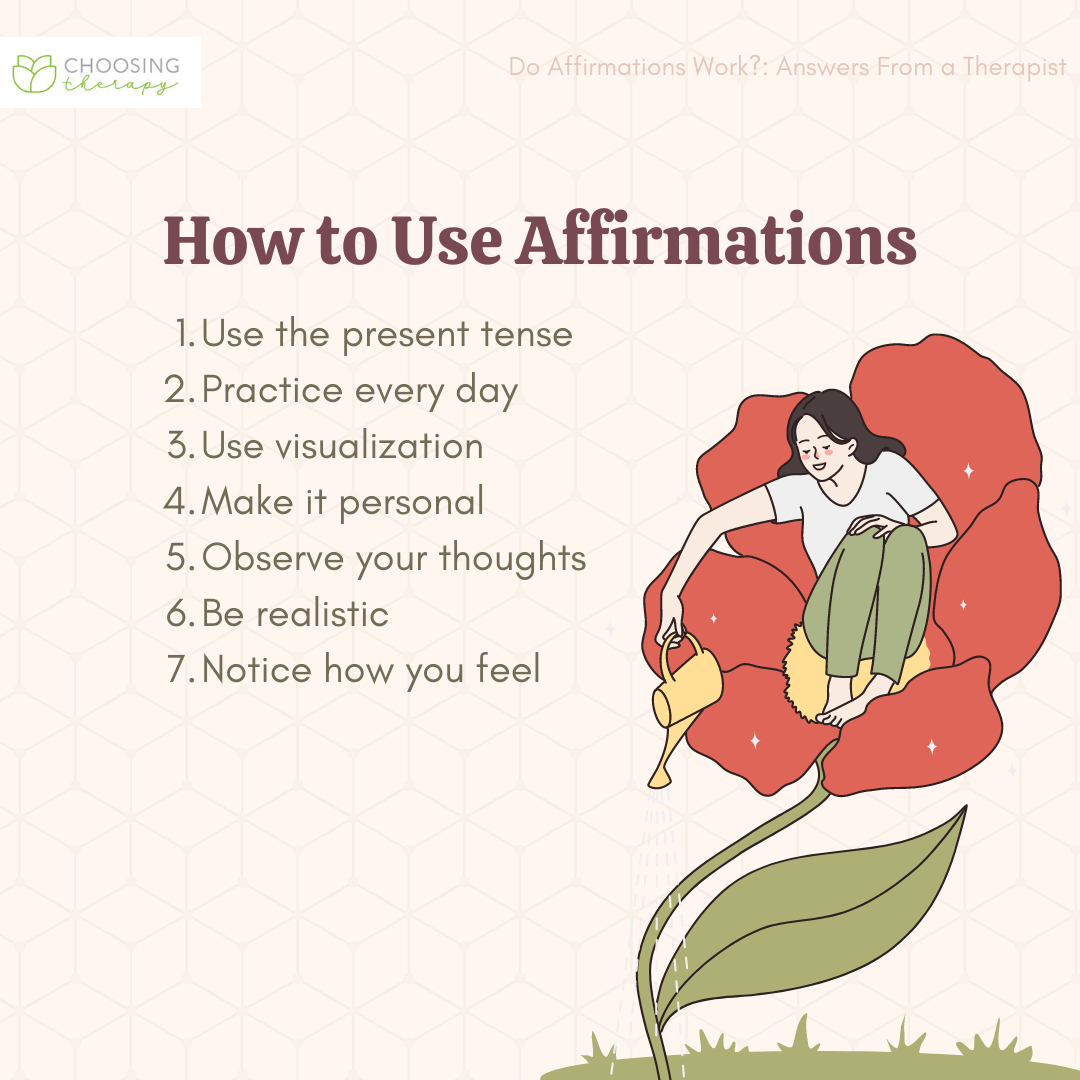
Credit: www.choosingtherapy.com
Frequently Asked Questions
What Are The Best Times To Use Affirmations?
The best times are in the morning, before important events, and before sleep. You can also use them any time you need motivation or calm.
How Long Does It Take For Affirmations To Work?
Most people see changes in feelings and actions in a few weeks. The key is regular practice and believing in your statements.
Can Affirmations Help With Anxiety?
Yes, affirmations can help reduce anxiety by changing negative thoughts. Use statements like “I am calm and safe” and repeat them during stressful moments.
How Many Affirmations Should I Use Daily?
It is best to use two or three affirmations. This keeps your focus clear and makes them easier to remember.
Are Affirmations Scientifically Proven?
Research shows that affirmations can reduce stress, improve performance, and boost confidence. For more information, see Wikipedia.
Affirmations are a simple, effective tool for changing your mindset and reaching your goals. If you use them regularly, make them personal, and pair them with action, you will see real changes in your life. Start today, and discover the power of your words.
