

How to Use Affirmations for Daily Success and Positive Change
How to Use Affirmations: A Complete Guide for Beginners and Beyond
For many people, life feels busy, stressful, and sometimes out of control. In these moments, our thoughts can quickly turn negative. We may tell ourselves, “I’m not good enough,” “I can’t do this,” or “Things never go my way.” These thoughts can make us feel stuck. But what if you could change your thinking and start believing in yourself? This is where affirmations come in.
Affirmations are simple, positive statements you repeat to yourself. They help you focus on what you want, build confidence, and change negative beliefs. Many successful people use affirmations daily—from athletes to business leaders and even mental health experts. But using affirmations is more than just saying a few words.
There is an art and science to it.
This guide will show you how to use affirmations step by step. You’ll learn the basics, see real examples, understand common mistakes, and discover tips for making affirmations work for you. Whether you’re new to affirmations or want to improve your results, you’ll find everything you need right here.
What Are Affirmations?
Affirmations are short, positive phrases that you say or think repeatedly. Their purpose is to help change the way you see yourself and the world. Instead of focusing on problems, you focus on solutions and strengths.
For example:
- “I am confident in my abilities.”
- “Every day, I am getting healthier.”
- “I attract positive opportunities.”
Research shows that what we say to ourselves matters. Our brains respond to repeated messages, even if they start as simple words. Over time, affirmations can help change habits, improve self-esteem, and even lower stress levels.
Why Do Affirmations Work?
Affirmations may sound simple, but science supports their power. When you repeat positive statements, you create new neural pathways in your brain. This is called neuroplasticity—the brain’s ability to change and adapt.
A study published by the National Institutes of Health found that self-affirmation can reduce stress and improve problem-solving under pressure. Another research review from the University of Pennsylvania highlights that positive self-talk can boost motivation and mental health.
Here’s why affirmations work:
- Focus shift: They make you notice good things instead of negative ones.
- Repetition effect: Your brain starts to believe what you say, especially with regular practice.
- Emotional impact: Positive words can change your mood, energy, and outlook.
But affirmations are not magic. They help best when combined with real action and healthy habits.
How To Write Effective Affirmations
Not all affirmations are equal. The way you write them is important for success. Here are key points to create affirmations that truly work:
- Be positive: Focus on what you want, not what you don’t want. Say “I am calm” instead of “I am not stressed.”
- Use the present tense: Write as if it’s happening now. For example, “I am strong,” not “I will be strong.”
- Keep it short: Simple phrases are easier to remember and repeat.
- Make it specific: The more clear and personal, the better. “I enjoy speaking in meetings” is stronger than “I am good.”
- Add emotion: Words like “happy,” “grateful,” or “proud” make your affirmation feel real.
- Believe it’s possible: Start with statements you can accept. If “I am rich” feels false, try “I am improving my financial situation.”
Example: Weak Vs. Strong Affirmations
| Weak Affirmation | Why It's Weak | Improved Affirmation | Why It's Strong |
|---|---|---|---|
| I will not be sad | Focuses on sadness, future tense | I am feeling happier each day | Positive, present tense, gradual improvement |
| I want to be confident | Expresses desire, not reality | I am confident when I speak | States confidence as current fact |
| I am not afraid | Mentions fear, negative focus | I am calm and at peace | Focuses on calmness, positive |
When And How Often To Use Affirmations
Timing and consistency make a big difference. The best times to use affirmations are:
- Morning: Start your day with a positive mindset.
- Before sleep: Let positive thoughts shape your dreams.
- During stress: Calm yourself with uplifting words.
How often? Experts suggest repeating affirmations at least twice a day. But the key is regular practice. Some people say their affirmations 10 times each session. Others write them in a journal. Find what works for you.
Sample Daily Affirmation Routine
- Wake up and say your main affirmation out loud.
- Write it in your journal 5–10 times.
- Repeat it silently during daily activities—like brushing your teeth or walking.
- Before bed, say it once more, either in your head or out loud.
Consistency matters more than perfect timing. Over time, your brain will start to expect and accept these positive messages.
Different Ways To Use Affirmations
Affirmations are flexible. You can use them in many ways, depending on your lifestyle and preferences. Here are some of the most popular methods:
1. Speaking Aloud
Saying affirmations out loud makes them more powerful. Your brain hears your voice and feels the emotion behind your words. Stand in front of a mirror for extra impact—this is called mirror work. It may feel strange at first, but it gets easier with practice.
2. Writing By Hand
Writing helps you focus and remember. Use a dedicated notebook or journal. Some people enjoy writing the same affirmation 5–10 times each day. This method can be especially helpful if you learn best by doing or seeing.
3. Silent Repetition
You can repeat affirmations in your mind, especially when you are in public or feeling anxious. Silent repetition works well during meditation or relaxation.
4. Using Digital Tools
There are many apps and websites that send you daily affirmation reminders. You can also set your phone background or alarm with your favorite affirmation.
5. Visual Reminders
Place sticky notes or cards with affirmations on your mirror, desk, or fridge. Seeing these messages throughout the day keeps you focused.
6. Listening To Recordings
Record yourself saying your affirmations and listen to them during the day, especially while commuting or before bed.
Comparison: Affirmation Delivery Methods
Here is a comparison of common ways people use affirmations:
| Method | Best For | Level of Engagement | Privacy |
|---|---|---|---|
| Speaking Aloud | Building confidence, emotional impact | High | Private spaces |
| Writing by Hand | Visual learners, memory improvement | Medium | Private or public |
| Silent Repetition | Anxiety relief, meditation | Low | Anywhere |
| Digital Tools | Busy people, reminders | Medium | Anytime |
| Visual Reminders | Constant awareness | Low | Home or office |
| Audio Recordings | Auditory learners | Medium | Anywhere with headphones |
Common Mistakes When Using Affirmations
Affirmations are simple, but some mistakes can stop them from working. If you have tried affirmations before and saw little change, check if you are making one of these errors:
1. Choosing Unrealistic Statements
If you pick an affirmation that feels impossible, your brain may reject it. For example, saying “I am a millionaire” when you struggle with bills can feel fake. Instead, try “I am taking steps to improve my finances. ” As your belief grows, you can adjust your affirmation.
2. Not Using Present Tense
Affirmations work best when stated as if they are true now. Avoid phrases like “I will be” or “I want to. ” Use “I am,” “I have,” or “I feel. ”
3. Lack Of Consistency
Repeating an affirmation once or twice won’t create change. Make it a daily habit, just like brushing your teeth.
4. Forgetting Emotion
Saying words without feeling does little. Try to connect emotionally with your affirmation. Imagine how it feels if it were true.
5. Ignoring Actions
Affirmations are powerful, but they work best when combined with real effort. If your affirmation is “I am healthy,” make choices that support this—like eating well or exercising.
6. Negative Phrasing
Don’t focus on what you want to avoid (“I am not lazy”). Instead, focus on what you want (“I am motivated and active”).

Credit: www.lomyrick.com
Examples Of Affirmations For Different Goals
Affirmations can be used for almost any purpose. Here are some examples by topic:
For Self-confidence
- “I trust myself to make good decisions.”
- “I am proud of who I am becoming.”
- “I handle challenges with strength.”
For Stress And Anxiety
- “I am calm and relaxed.”
- “I breathe in peace and exhale tension.”
- “I trust that things will work out.”
For Health
- “I treat my body with kindness and respect.”
- “Every cell in my body is healthy and strong.”
- “I choose foods that nourish me.”
For Success At Work Or School
- “I am focused and productive.”
- “I learn quickly and easily.”
- “Opportunities come to me at the right time.”
For Relationships
- “I am loved and appreciated.”
- “I communicate openly and honestly.”
- “I attract positive and supportive people.”
For Money And Abundance
- “I am open to new sources of income.”
- “Money flows to me easily.”
- “I am grateful for what I have and what is coming.”
For Personal Growth
- “I welcome change and growth.”
- “I am becoming the best version of myself.”
- “I let go of what no longer serves me.”
How Long Does It Take For Affirmations To Work?
People often wonder how quickly affirmations will change their lives. There is no single answer. Some people feel better almost immediately, while others take weeks or months to notice real change.
A study by the University of California showed that it can take 21 to 66 days to create a new habit or belief. The key is to keep going, even if you don’t see results right away.
Two important things beginners often miss:
- Micro-shifts matter: Small changes in mood or confidence are signs that affirmations are working. Notice these tiny improvements.
- Belief grows over time: At first, affirmations may feel strange or untrue. With repetition and real-life actions, belief gets stronger.
How To Make Affirmations More Powerful
If you want faster or deeper results, try these advanced techniques:
1. Use Visualization
After saying your affirmation, close your eyes and imagine it as real. Picture the sights, sounds, and feelings. For example, if your affirmation is “I am confident on stage,” imagine yourself speaking, smiling, and feeling strong.
2. Combine With Deep Breathing
Take a slow, deep breath as you say your affirmation. This calms your body and makes the message stronger.
3. Pair With Physical Movement
Stand tall, stretch, or make a fist while repeating your affirmation. Movement can help anchor the feeling in your body.
4. Use Scent Or Music
Light a candle with a relaxing scent or play soft music while practicing affirmations. These sensory cues help your brain link positive feelings to your words.
5. Anchor To Habits
Attach affirmations to daily routines—like while brushing your teeth or during your commute. This makes it easier to remember and repeat.
Real-life Affirmation Success Stories
Many people have changed their lives using affirmations. Here are a few examples to inspire you:
- A student who felt anxious about exams started saying, “I am prepared and confident.” After a month, her test scores improved and her anxiety dropped.
- A new parent repeated, “I am patient and loving.” Over time, he noticed he reacted more calmly, even on stressful days.
- An athlete recovering from injury used, “My body heals quickly and fully.” This positive focus helped her stay motivated during tough rehabilitation.
These stories show that affirmations work best when you practice regularly and take real-life steps toward your goals.
Data: The Impact Of Affirmations
Let’s look at how people benefit from affirmations, based on surveys and studies:
| Area of Life | Reported Improvement (%) | Common Benefits |
|---|---|---|
| Self-confidence | 72 | More positive self-image, willingness to try new things |
| Stress levels | 65 | Calmer mood, better focus |
| Motivation | 60 | Higher productivity, more energy for goals |
| Relationships | 55 | Improved communication, less conflict |
These numbers come from people who used affirmations consistently for at least one month.
How To Track Your Progress
Sometimes, it’s hard to see the effects of affirmations day by day. Tracking your progress helps you notice changes over time. Here’s how:
- Keep a journal: Write your main affirmation and how you feel before and after saying it.
- Use a habit tracker: Mark each day you practice affirmations.
- Reflect weekly: Every week, note any small changes in mood, confidence, or actions.
- Ask for feedback: Trusted friends or family can sometimes notice positive changes before you do.
You can also score your feelings on a scale from 1 (very negative) to 10 (very positive) each day. Over time, you should see these numbers improve.
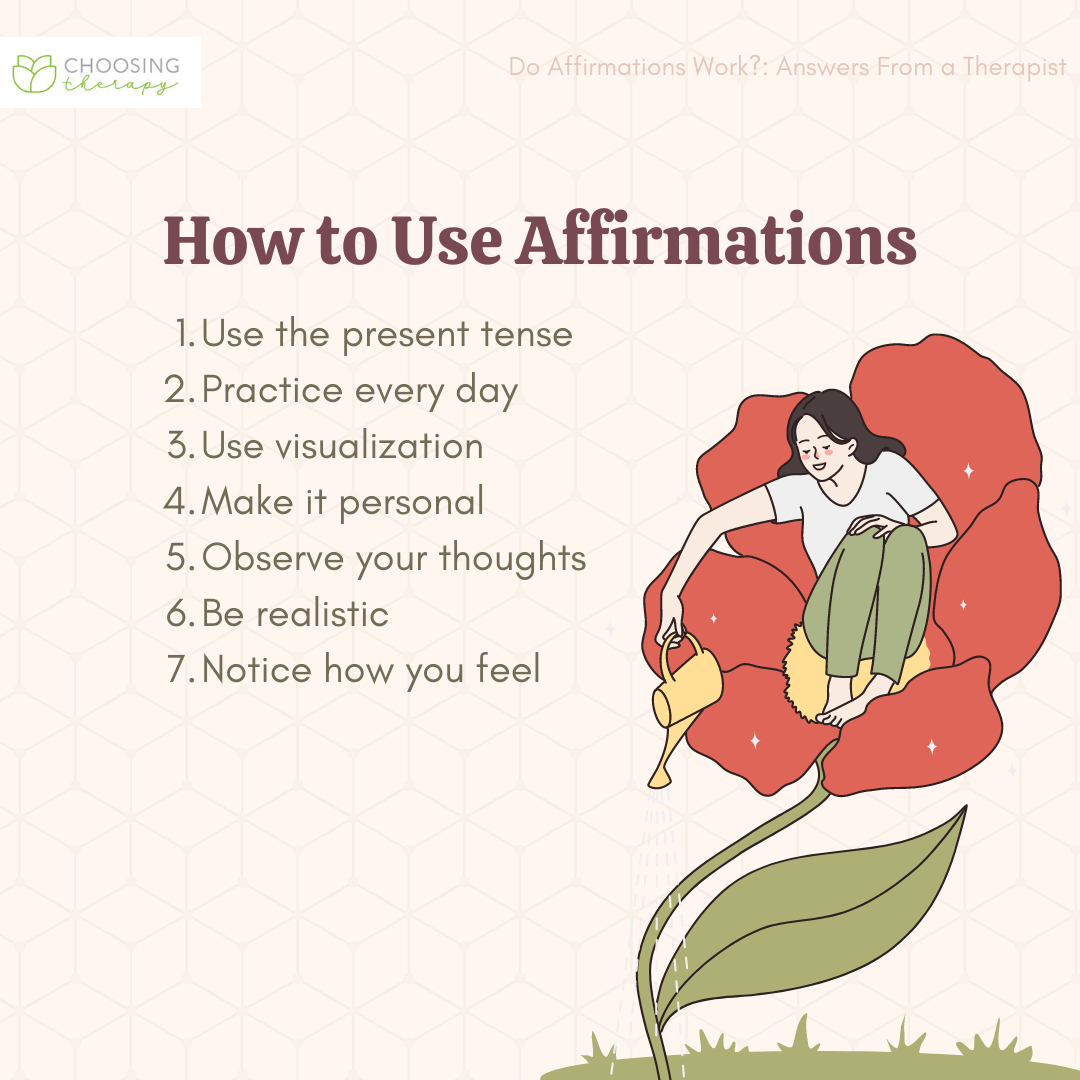
Credit: www.choosingtherapy.com
Tips For Sticking With Affirmations
Staying consistent can be hard, especially at first. Here are some ways to make affirmations a lasting habit:
- Start small: Begin with one or two affirmations and build from there.
- Set reminders: Use your phone or sticky notes to remind yourself.
- Pair with routines: Attach affirmations to habits you already have.
- Celebrate wins: Notice and reward small improvements.
- Be patient: Change takes time. Don’t quit if you don’t see results right away.
Two more insights many people miss:
- Change your affirmation as you grow: As you meet your goals or beliefs shift, update your affirmations.
- Use group support: Practicing affirmations with a friend or group can boost motivation and accountability.
When Affirmations Might Not Be Enough
Affirmations are helpful, but they are not a cure-all. If you have deep emotional pain, serious anxiety, or depression, affirmations alone may not solve these problems. In such cases, it’s important to seek help from a therapist or counselor. Affirmations can be a useful tool alongside professional support, but not a replacement.
For more on how positive thinking fits with mental health, see this American Psychological Association resource.

Credit: sproutingzen.com
Frequently Asked Questions
What If I Don’t Believe My Affirmations At First?
This is very common. At first, your mind may resist new statements, especially if they are far from your current reality. Start with small, believable affirmations. As you repeat them and see small changes, your belief will grow. Over time, you can use stronger affirmations.
Can Affirmations Replace Real Action?
No. Affirmations work best when you also take real steps toward your goals. Think of them as fuel for your actions, not a replacement. For example, saying “I am healthy” is most effective when combined with healthy eating and exercise.
How Many Affirmations Should I Use At Once?
It’s best to start with one to three main affirmations. This helps you focus and remember them. As you get used to the practice, you can add more if you like. Too many at once can be overwhelming or less effective.
Should I Say Affirmations Out Loud Or In My Head?
Both methods can work. Saying them out loud often has a stronger impact because you hear your own voice and feel the emotion. However, silent repetition is useful in public or during meditation. Try both and see which feels better for you.
What If I Miss A Day?
Missing a day is normal. Don’t feel guilty or give up. Just restart the next day. The most important thing is to keep going over time. Consistency is key, but perfection is not required.
Using affirmations is a simple but powerful way to change your thoughts and life. With patience, the right technique, and real action, you can build confidence, reduce stress, and create positive change. Remember, every big improvement starts with a single thought—so why not make it a positive one?
