

How to Use Affirmation: Unlock Your Potential Today
The words you say to yourself matter. In daily life, your inner voice is always talking. Sometimes it lifts you up; sometimes, it pulls you down. This is where affirmations come in. People around the world use affirmations to change negative thinking and build a stronger mindset. But not everyone knows how to use them in the right way. In this article, you will discover what affirmations really are, how they work, and how you can use them to improve your life. You’ll also learn common mistakes, see practical examples, and find research-backed insights that help you get real results.
What Are Affirmations?
Affirmations are positive statements you repeat to yourself, usually about who you are or what you want to become. They help you focus on your strengths and goals. The main idea is simple: by repeating positive words, you can shift your mindset, boost self-confidence, and change your behavior over time.
For example, saying, "I am confident in social situations," helps your mind believe it, especially if you repeat it often. Affirmations work best when they are short, specific, and personal. They are not magic, but they do help rewire your thoughts if you use them regularly.
How Affirmations Work In The Brain
The science behind affirmations is fascinating. When you repeat a statement, your brain starts to accept it as true. This is called neuroplasticity—the brain’s ability to form new connections and habits. Research shows that positive self-talk can reduce stress, improve problem-solving, and even lower anxiety.
A small change in thinking can lead to bigger changes in your actions. For example, if you often say, "I can’t do this," your brain believes it. But, if you tell yourself, "I can handle new challenges," your brain starts looking for ways to succeed.
Here's a simple comparison of how negative and positive affirmations can affect your mindset:
| Type of Self-Talk | Common Thought | Effect on Mood |
|---|---|---|
| Negative | "I always fail" | Low confidence, stress |
| Positive (Affirmation) | "I learn from mistakes" | Hopeful, motivated |
Benefits Of Using Affirmations
Many people start using affirmations to feel better, but they discover even more benefits:
- Improved self-esteem: Repeating positive statements helps you believe in your own value.
- Reduced stress: Affirmations can calm your mind during hard times.
- Motivation: They push you to keep going, even when things get tough.
- Focus on goals: Affirmations remind you of what is important.
- Better decision-making: A positive mindset leads to better choices.
Studies also show that people who use affirmations are more likely to stick with healthy habits, such as regular exercise or eating well.
How To Create Powerful Affirmations
Not all affirmations work the same way. The best ones are clear, personal, and easy to remember. Here is how you can create your own:
- Start with “I am” or “I can.” These words make the statement about you.
- Be specific. Instead of "I am happy," try "I am calm and happy in the morning."
- Use the present tense. Say what you want as if it is happening now.
- Keep it short. A few words are easier to repeat and remember.
- Make it positive. Focus on what you want, not what you don’t want.
Here are a few examples:
- "I am confident when speaking in meetings."
- "I choose to see the good in people."
- "I am strong and healthy."
When And How Often To Use Affirmations
Timing matters. The best times to use affirmations are:
- In the morning: This sets a positive tone for your day.
- Before a stressful event: Like a job interview or exam.
- At night: To clear negative thoughts and relax.
- During a routine: Such as while brushing teeth or commuting.
How often should you repeat them? Most experts suggest repeating each affirmation 5–10 times in a session, at least twice a day. The key is consistency. Like any habit, the more you do it, the more natural it becomes.
Techniques For Practicing Affirmations
There are many ways to use affirmations. Find the method that feels right for you.
1. Speaking Aloud
Say your affirmation out loud, clearly and with feeling. This makes the words more real and powerful. If you are shy, you can start in a quiet place.
2. Writing By Hand
Write your affirmation in a notebook every day. Writing helps fix the words in your mind. Some people write the same line 10–20 times to make it stick.
3. Visual Reminders
Place sticky notes with your affirmation on your mirror, fridge, or computer. Seeing the words often keeps your mind focused.
4. Digital Tools
Use your phone to set reminders or alarms with your affirmation. There are also apps that help you track your progress and send daily motivation.
5. Meditation And Visualization
Sit quietly, close your eyes, and repeat your affirmation. Imagine what your life looks like when the statement is true. This adds emotion and makes the practice stronger.
Here’s a quick look at the different methods:
| Method | How It Works | Best For |
|---|---|---|
| Speaking Aloud | Say affirmations out loud with emotion | Building confidence, public speaking |
| Writing by Hand | Write affirmations repeatedly in a notebook | Memory, daily routines |
| Visual Reminders | Place notes or cards in visible places | Frequent reminders, busy people |
| Digital Tools | Set reminders or use apps | Tech lovers, on-the-go |
| Meditation | Repeat silently during quiet time | Stress relief, mindfulness |
Common Mistakes When Using Affirmations
Many people try affirmations but give up because they don’t see results. Here are common mistakes to avoid:
- Using vague statements: "I am rich" is too general. Try "I am improving my money skills every day."
- Not believing the words: If you feel your affirmation is a lie, change it to something more believable.
- Skipping days: Consistency is key. Missing days weakens the effect.
- Focusing on negatives: Avoid words like "not" or "never." Say what you want, not what you fear.
- Expecting instant results: Affirmations work over time, not overnight.
A non-obvious insight: Your emotions matter. If you just repeat the words without any feeling, your brain is less likely to accept them. Try to connect with the meaning behind the affirmation.
Practical Examples For Different Life Areas
Affirmations are not just for self-esteem. You can use them for almost any goal:
Confidence And Self-esteem
- "I trust myself to make good decisions."
- "I am worthy of love and respect."
Career And Work
- "I am focused and productive at work."
- "I handle challenges with a clear mind."
Health And Wellness
- "I care for my body and mind every day."
- "I am strong, healthy, and full of energy."
Relationships
- "I communicate honestly and kindly."
- "I attract positive and caring people."
Money And Success
- "I manage my money wisely."
- "Opportunities for success come to me every day."
If you want to create your own, just think about what you want to change or improve. Make the statement personal and positive.
Credit: www.boldtuesday.com
Affirmations Vs. Other Self-help Tools
People often ask how affirmations compare to other tools like visualization, goal setting, or meditation. Here’s a quick side-by-side look:
| Tool | Main Purpose | How It Works | Best Used For |
|---|---|---|---|
| Affirmation | Change self-talk | Repeat positive statements | Mindset, self-esteem |
| Visualization | Imagine success | Picture achieving goals | Performance, confidence |
| Goal Setting | Plan action steps | Set specific targets | Productivity, results |
| Meditation | Calm the mind | Focus on breathing or thoughts | Stress, awareness |
Affirmations work even better when you combine them with these tools. For example, you can visualize your goal while repeating your affirmation.
Real-world Research And Success Stories
Affirmations are not just popular—they are backed by studies. Research in psychology journals shows that affirmations:
- Lower stress levels before big challenges.
- Help students perform better on tests.
- Boost motivation to stick with exercise or diets.
One study found that people who practiced daily affirmations were less likely to feel nervous before giving a speech. Another found that writing affirmations about personal values reduced the effects of stress.
Famous athletes and business leaders also use affirmations. For example, Olympic athletes often repeat statements like, "I am ready and strong," before competitions. Many CEOs use affirmations to stay focused and confident during busy days.
It’s important to remember that affirmations help you build resilience. They may not remove all difficulties, but they make you more ready to face them.
Non-obvious Insights For Stronger Results
Most beginners focus only on words. But, to get the best results:
- Pair affirmations with action. If you say, "I am organized," also take small steps to organize your desk or schedule. This proves the affirmation to your mind.
- Adjust as you grow. As you change, update your affirmations. What you need today may be different in the future.
- Use affirmations to shape habits. Choose an affirmation that supports a new routine, like, "I enjoy moving my body each day," to help with exercise.
Another overlooked point: Environment matters. If you are in a negative or stressful place, affirmations are harder to believe. Try to practice in a calm, safe space, even if it’s just for a few minutes.
Mistakes Beginners Usually Miss
Many people don’t realize that:
- Repeating too many affirmations at once can make you feel overwhelmed. Start with one or two.
- Copying affirmations from others without making them personal can feel empty. Tailor them to your own needs and feelings.

Credit: www.blogthelamare.com
How Long Does It Take To See Results?
Affirmations are not a quick fix. For most people, it takes a few weeks of daily practice to notice changes in thinking. Some feel better after a few days, while others need a month or more. The key is patience.
If you feel stuck, try changing your approach. For example, add emotion, or say your affirmation in a new place. Small tweaks can make a big difference.
How To Measure Your Progress
It’s hard to know if affirmations are working unless you track your progress. Here are some ways:
- Journaling: Write down your thoughts and feelings before and after using affirmations.
- Mood tracking apps: There are many free apps that let you track daily mood or stress levels.
- Feedback from others: Sometimes, friends or family notice changes before you do.
Look for signs like:
- Feeling more hopeful or calm
- Noticing negative thoughts less often
- Taking positive actions more easily
Affirmations For Special Situations
Affirmations can help in unique situations, too:
Public Speaking
People often fear speaking in front of others. Use affirmations like, "I speak clearly and confidently," before your presentation.
Exams And Studying
Students can repeat, "I remember what I study," or, "I am prepared and calm during exams," to reduce anxiety.
Job Interviews
Before an interview, try, "I am the right person for this job," or, "I show my skills with confidence. "
Difficult Conversations
If you need to talk about something hard, use, "I communicate honestly and listen with respect. "
These specific affirmations help you focus and reduce fear in stressful moments.
Affirmations And Culture
Different cultures have their own ways of using affirmations. In some places, people use traditional sayings or prayers. In others, modern self-help language is more common. What matters is finding words that feel true and comfortable for you.
Some cultures focus more on community and togetherness. In these cases, affirmations may use "we" instead of "I. " For example, "We support each other and grow together. "
Technology And Affirmations
Modern technology makes it easier to practice affirmations:
- Apps: There are dozens of apps that help you create, schedule, and track affirmations.
- Podcasts and videos: Listen to guided affirmations for extra support.
- Smart devices: Set your smart speaker to play your favorite affirmation each morning.
Technology can help you stay on track and remind you to practice, even on busy days.
Choosing The Right Affirmation App
If you want to try an app, look for these features:
- Customizable affirmations
- Reminders and notifications
- Progress tracking
- Audio or video support
Some popular apps also connect you with a community for extra motivation. Always pick an app that feels easy and enjoyable to use.
Myths And Misunderstandings About Affirmations
There are many myths about affirmations. Here are the most common:
- "Affirmations are just wishful thinking." In reality, they help change your mindset, which leads to real action.
- "You have to believe every word at first." It’s normal to feel doubt in the beginning. Belief grows with practice.
- "Affirmations fix everything." They are a tool, not a cure-all. Use them with other healthy habits.
If you want to see more about the science behind affirmations, check this Wikipedia article on Affirmations.
Making Affirmations A Lifelong Habit
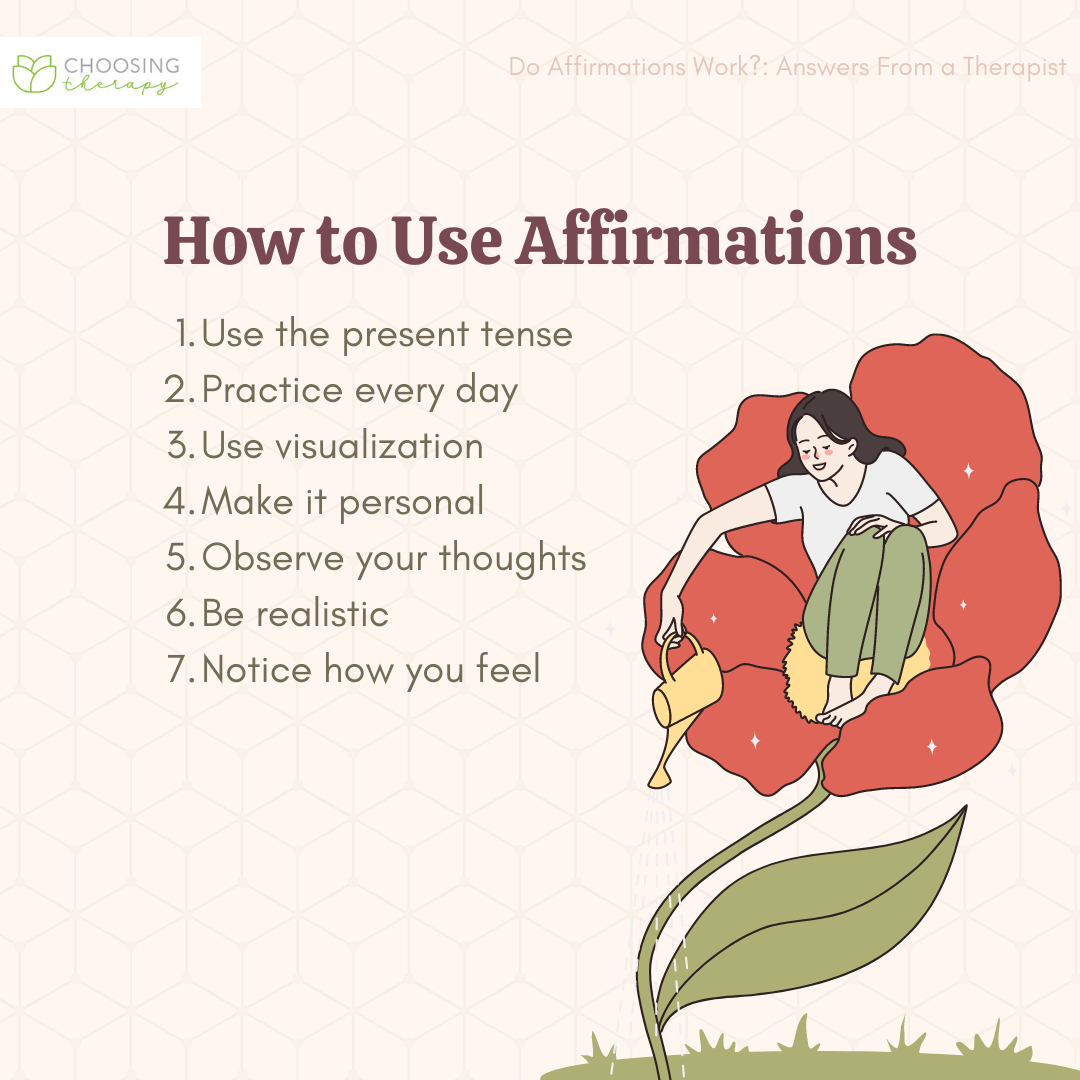
To make affirmations part of your life:
- Attach them to daily routines, like brushing your teeth or making coffee.
- Share them with a friend or group for support.
- Update them as your goals and needs change.
Remember, affirmations are about building a better relationship with yourself. It’s not about being perfect, but about making progress.
Credit: www.choosingtherapy.com
Frequently Asked Questions
What Is The Best Time To Use Affirmations?
The best times are in the morning to start your day right, and at night to calm your mind before sleep. You can also use them before stressful events or during breaks.
How Long Should I Use The Same Affirmation?
Use the same affirmation until you start to feel a change in your thoughts or feelings. This could take a few weeks. When you feel ready, you can change or update your affirmation to match new goals.
Can Affirmations Help With Anxiety?
Yes, affirmations can reduce anxiety by replacing negative thoughts with positive ones. They work best when combined with other coping strategies, like deep breathing or talking to a friend.
Do I Have To Say Affirmations Out Loud?
No, you can repeat affirmations silently in your mind, write them down, or listen to recordings. Saying them out loud adds power, but is not required for results.
How Do I Know If Affirmations Are Working?
You will notice small changes in your mood, confidence, or actions. You may feel calmer, more positive, or take steps toward your goals more easily. Keeping a journal helps track these changes.
Building a new mindset with affirmations takes time, but the rewards are real. With patience and daily practice, you can use affirmations to create a stronger, more positive life.
