

How Many Times Write Affirmations
Imagine waking up every morning and feeling more confident, positive, and ready to face the day. Many people experience this change by using affirmations—short, positive statements you repeat to yourself. But one question confuses most beginners: How many times should you write affirmations? If you’ve ever wondered about the right number, frequency, or method, you’re not alone. This article gives you clear, practical guidance based on science, psychology, and real-life examples. You’ll learn how repetition works, what experts recommend, and how to build a routine that actually fits your life.
What Are Affirmations?
Affirmations are simple, positive sentences you say or write to yourself. Their purpose is to change your thinking and build self-belief. For example, you might write, “I am confident,” or “I can handle challenges.” When repeated regularly, these statements may help shift your mindset, reduce stress, and improve performance.
Most people use affirmations for:
- Boosting self-confidence
- Improving focus and motivation
- Reducing anxiety
- Achieving personal goals
Unlike just thinking positive thoughts, writing affirmations adds a physical step. It can feel more real and intentional. This is why many coaches and psychologists recommend writing them by hand.
Why Repetition Matters
Repeating affirmations is not just tradition. Science backs it up. The brain learns by repetition. When you repeat a message enough times, it becomes familiar and believable. This is called neuroplasticity—the brain’s ability to change its patterns.
Think about learning a new skill, like driving or typing. Practice makes you better. The same principle works for affirmations. When you say or write them repeatedly, your mind starts to accept the new belief.
How Many Repetitions Are Enough?
There is no single magic number. But most experts agree that consistency is more important than perfection. Different studies and traditions suggest:
- 3–5 times for a quick boost
- 10–20 times for deeper change
- 21–40 times for habits and big goals
Some popular methods, like the 369 method, recommend writing affirmations 3 times in the morning, 6 times in the afternoon, and 9 times at night.
The Science Behind Writing Affirmations
Writing, rather than just saying, boosts your focus. When you write, you slow down and think about the words. This process helps your brain remember and accept the message. Research shows writing by hand is more effective for memory and learning.
A study from the University of California found that writing down goals and affirmations increased success rates by 42%. Another research paper from the National Institute of Mental Health suggests that repetition helps reduce anxiety and build positive habits.
So, writing affirmations is not just a feel-good exercise. It’s supported by science.
Popular Affirmation Methods
Different cultures and traditions use various methods for affirmations. Here are some of the most common:
The 369 Method
This method is simple and popular on social media. You write your affirmation:
- 3 times in the morning
- 6 times in the afternoon
- 9 times in the evening
The idea is to keep your mind focused throughout the day. Many users report feeling more positive and focused after a week.
The 55x5 Method
In this approach, you write your affirmation 55 times each day for 5 days. It is intense but said to help with big goals. People often use it for money, success, or love.
The 21-day Challenge
You write your affirmation 10–20 times every day for 21 days. This method is based on the idea that it takes about three weeks to form a new habit.
Simple Daily Repetition
Some people prefer writing their affirmation 5–10 times each morning or night. This fits easily into most routines and still offers benefits.
How To Choose Your Affirmation Frequency
Deciding how many times to write affirmations depends on your goals and lifestyle. Here are some factors to consider:
Your Goal
- For small goals (like feeling confident before a meeting), 3–5 repetitions may be enough.
- For bigger goals (like changing your mindset), aim for 10–20 repetitions.
- For deep changes (like overcoming trauma), use more intense methods, such as 369 or 55x5.
Your Time
If you have only five minutes, writing your affirmation 3–5 times is realistic. If you can spend more time, increase to 10–20 times.
Your Motivation
Some days you will feel motivated, other days less so. Start with a small number and build up as you feel comfortable.
Your Writing Style
- Writing by hand is more effective.
- Typing or speaking can work, but is less powerful.
Comparison Of Affirmation Methods
To help you decide, here’s a comparison of common affirmation routines.
| Method | Repetitions per day | Duration | Best for |
|---|---|---|---|
| 369 Method | 18 (3+6+9) | As long as desired | Daily focus, balance |
| 55x5 Method | 55 | 5 days | Big goals, deep change |
| 21-Day Challenge | 10–20 | 21 days | Habit formation |
| Simple Daily | 5–10 | Ongoing | Quick boost, routine |
How Often Should You Write Affirmations?
Frequency is as important as the number. Writing every day is better than writing a lot on one day and stopping.
Most experts suggest:
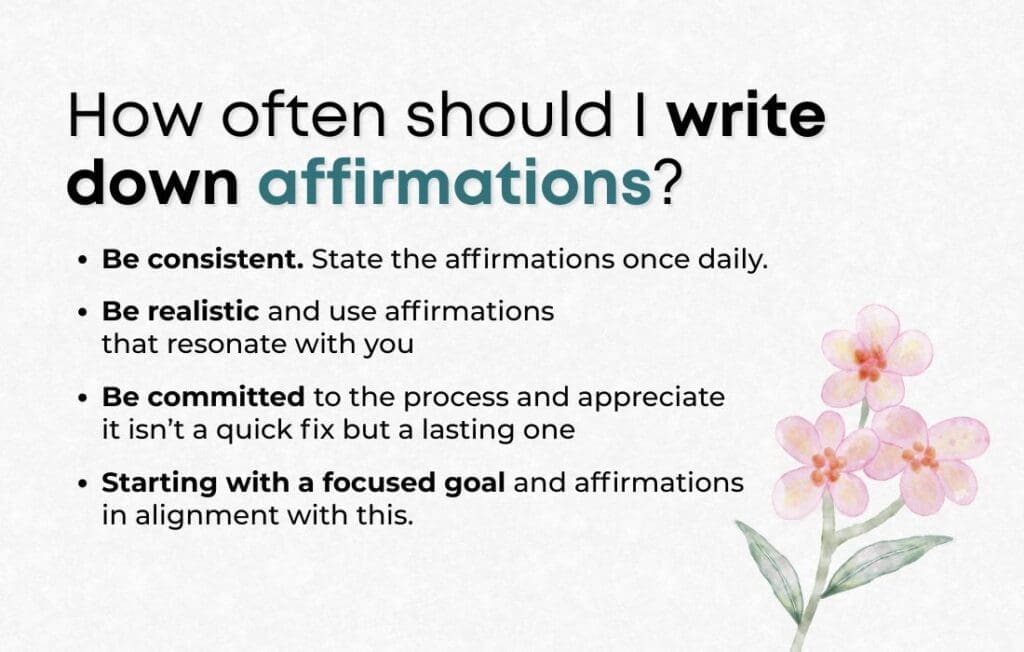
- Daily writing for best results
- Morning and night for extra impact
If possible, write at the same time every day. This builds a habit and trains your mind.
Weekly And Monthly Schedules
Some people prefer to write affirmations weekly or monthly. For example, you might write your main affirmation every Sunday and repeat it daily in your mind.
Here’s a comparison of daily vs weekly practice:
| Schedule | Consistency | Effort | Results |
|---|---|---|---|
| Daily | High | Moderate | Fast |
| Weekly | Medium | Low | Slow |
| Monthly | Low | Minimal | Very slow |
Common Mistakes When Writing Affirmations
Even if you write your affirmations many times, mistakes can block your progress. Avoid these common pitfalls:
- Choosing vague affirmations (“I want to be happy”) instead of clear ones (“I am happy and grateful for today”).
- Writing negative statements (“I am not anxious”) instead of positive (“I am calm”).
- Skipping days—consistency matters more than volume.
- Using too many affirmations at once. Focus on 1–3 at a time.
- Not believing in your affirmation. It’s okay if it feels strange at first, but try to choose statements you can accept.
How To Write Effective Affirmations
To get the most from your affirmation practice, follow these simple steps:
1. Keep It Positive
Always use positive words. Instead of “I will not fail,” write “I am successful. ”
2. Make It Present Tense
Write as if your goal is happening now. “I am confident,” not “I will be confident. ”
3. Be Specific
Focus on clear, personal goals. “I am calm during meetings,” not just “I am calm. ”
4. Add Emotion
Include feelings. “I am excited about my new job,” is stronger than “I have a new job. ”
5. Repeat Consistently
Choose a number and stick to it. Whether it’s 5 or 55, consistency is key.
Real-life Examples
Let’s look at how different people use affirmations in their daily lives:
- Student: Writes “I am focused and ready for exams” 10 times every morning during exam week.
- Business owner: Uses “I attract loyal customers” 5 times at night, every day for a month.
- Athlete: Writes “I am strong and determined” 20 times before big competitions.
- Parent: Repeats “I am patient and loving” 3 times each morning.
These simple routines fit into busy lives and help build positive habits.

Credit: tiffanywoodfield.com
Data On Affirmation Success Rates
Surveys and studies show that writing affirmations can improve mood and performance. According to a report from Psychology Today, 80% of people who use affirmations daily notice positive changes in their mindset within two weeks.
Another survey found:
- 65% felt more confident after writing affirmations regularly
- 58% improved their work performance
- 72% reduced stress
Here’s a summary:
| Benefit | Success Rate |
|---|---|
| Confidence | 65% |
| Work performance | 58% |
| Stress reduction | 72% |
How Long Does It Take To See Results?
Most people notice changes in their mood or confidence within 7–21 days. However, deeper changes—like improved self-esteem or success—can take longer. It depends on your goal and how often you write affirmations.
If you skip days or feel skeptical, it might take more time. Staying consistent is the key.
Building Your Affirmation Routine
Want to start writing affirmations? Here’s a practical routine:
- Choose your affirmation (one clear, positive statement)
- Decide your frequency (for example, 10 times each morning)
- Write by hand for better impact
- Add emotion (think about the feeling as you write)
- Repeat daily for at least three weeks
- Review your progress—notice any changes in mood or behavior
If you want to try a popular method, use the 369 approach or the 21-day challenge.
Non-obvious Insights For Beginners
Most beginners miss these points:
- Writing slowly is powerful: Don’t rush. When you write slowly, your brain processes the message more deeply. Try to spend a few seconds on each repetition.
- Link affirmations to action: Don’t just write. Take small actions that fit your affirmation. If you write “I am confident,” try to speak up once daily.
- Change your affirmation as you grow: When your mindset shifts, update your affirmation. This keeps it fresh and meaningful.
- Track your feelings: Keep a journal. Write down how you feel before and after your practice. This helps you see real progress.
Using Technology For Affirmations
Some people use apps or computer reminders to practice affirmations. While writing by hand is best, technology can help keep you consistent.
- Use calendar alerts for daily reminders
- Try affirmation apps that guide your practice
- Record your affirmation as a voice memo and listen daily
However, don’t rely only on technology. Physical writing is still the most effective.
How Affirmations Fit Into Your Daily Life
Affirmations work best when they become a habit. Here are some ways to fit them in:
- Morning routine: Write your affirmation before breakfast.
- Lunch break: Repeat your affirmation during lunch.
- Evening wind-down: Write before bed to calm your mind.
- After exercise: Use affirmations to boost motivation.
Pick a time that feels natural. The goal is to make it easy and enjoyable.
The Power Of Group Affirmations
Some people join groups or online communities to share affirmations. Group practice can boost motivation and help you stay accountable. You might:
- Share your daily affirmation in a group chat
- Join an online challenge
- Practice with family or friends
Group support can make the practice more fun and effective.
When To Change Your Affirmation
If your affirmation no longer feels exciting or true, change it. For example, if “I am confident” starts feeling real, try “I am successful in my work. ” Refreshing your statement keeps your mind engaged.
What If You Don’t See Results?
If you don’t notice changes after a few weeks, ask yourself:
- Am I writing regularly?
- Is my affirmation specific and positive?
- Do I feel the emotion as I write?
- Am I linking it to actions?
You might need to adjust your routine. Also, some mental blocks take longer to shift. Be patient.
Affirmations For Different Goals
Different goals require different affirmations and repetition:
Confidence
Write “I am confident” 10 times daily for at least 21 days.
Stress
Write “I am calm and relaxed” 5–10 times during stressful moments.
Success
Write “I am successful in my job” 20 times before big tasks.
Health
Write “I am healthy and strong” 15 times each morning.
Advanced Affirmation Techniques
If you feel ready, try combining affirmations with other tools:
- Visualization: Imagine your goal as you write
- Meditation: Repeat your affirmation during meditation
- Gratitude: Add “I am grateful for…” to your affirmation
These methods deepen the impact and help you believe your statement.
Faqs About Writing Affirmations
Credit: tiffanywoodfield.com
Frequently Asked Questions
How Many Times Should I Write My Affirmation Each Day?
Most experts suggest 5–20 times daily, depending on your goal and time. For quick motivation, 3–5 times is enough. For deeper change, aim for 10–20 repetitions. Some methods recommend higher numbers, like 55, but consistency is more important than volume.
Is It Better To Write Affirmations By Hand Or Type Them?
Writing by hand is more effective because it engages your brain more deeply. Studies show that handwriting improves memory and belief. Typing or speaking can work, but hand-written affirmations offer the best results.
Can I Use More Than One Affirmation At A Time?
Yes, but keep it simple. Focus on 1–3 affirmations at a time. Using too many can dilute your focus. When one affirmation feels real, switch to a new one.
How Long Does It Take For Affirmations To Work?
Most people notice changes in mood or confidence within 7–21 days. Bigger changes, like improved self-esteem or success, may take longer. Consistency and belief speed up the process.
Do Affirmations Work For Everyone?
Affirmations can help most people, but results vary. If you have deep doubts, it may take longer. Combining affirmations with action and other tools, like visualization, increases their effectiveness. For more on the science behind affirmations, visit Psychology Today.
Final Thoughts
There is no single answer to how many times to write affirmations. The key is consistency, belief, and choosing a number that fits your lifestyle. Whether you write your affirmation 3 times or 55 times, daily practice builds positive habits and helps change your mindset. Start small, adjust as you grow, and stay patient. Affirmations are a simple tool, but with regular use, they can make a big difference in your life.
Credit: www.reddit.com
