

How Many Times Should I Write Affirmations for Best Results?
How Many Times Should I Write Affirmations
Many people use affirmations to change their mindset, boost confidence, or reach goals. You might see advice online about writing affirmations “100 times a day” or “just once in the morning.” But what is the right number for you? If you’re searching for clarity, you are not alone. The truth is, there’s no simple answer that fits everyone. The number of times you should write affirmations depends on your goals, habits, lifestyle, and how your mind responds. In this article, you’ll discover how repetition shapes results, practical advice for deciding your own routine, and surprising facts most beginners miss. Whether you’re new to affirmations or want to improve your practice, you’ll find clear guidance to help you get the most from this powerful habit.
What Are Affirmations?
Affirmations are positive statements you repeat to yourself. Their purpose is to change your thoughts, beliefs, and actions. For example, someone might write “I am confident and strong” to encourage self-esteem. By writing or saying affirmations, you can train your brain to focus on what you want, not what you fear.
Many people use affirmations for:
- Personal growth: Improving self-confidence and motivation
- Health: Supporting healing and wellness
- Career: Achieving goals and boosting performance
- Relationships: Attracting love or building trust
Research shows that repeated positive statements can help rewire neural pathways in the brain, making it easier to adopt new beliefs. However, repetition alone is not enough. The way you use affirmations matters just as much as how often.
Why Repetition Matters
Your brain learns by repetition. When you write an affirmation again and again, you reinforce the message. This process is similar to learning a new skill or language. But simply repeating words without meaning does not create change.
The Science Behind Repetition
Studies in psychology and neuroscience show that neural plasticity—the brain’s ability to change—depends on repeated action. For example, if you tell yourself “I am confident” every day, your mind starts to build new connections that support confidence. Over time, these connections become stronger, making the affirmation feel more natural.
One study found that repeating affirmations can reduce stress and increase motivation. However, the effect is stronger when people believe in the statement and connect emotionally. Writing an affirmation once a day may not be enough for deep change, but writing it too many times can lead to boredom or resistance.
Repetition Vs. Engagement
Repeating an affirmation is important, but how you feel while writing matters even more. If you write “I am successful” 100 times without believing it, your mind may reject the statement. On the other hand, writing it with emotion and focus—even a few times—can have a bigger impact.

Credit: sproutingzen.com
How Many Times Should You Write Affirmations?
There is no magic number that works for everyone. Some people write their affirmations once a day, while others prefer to repeat them 10, 20, or even 50 times. The right amount depends on your goals, schedule, and how you respond emotionally.
Common Approaches
Here are some popular routines people use:
- Once a day: Simple, easy to maintain, good for beginners
- Three times daily: Morning, afternoon, and evening for steady reinforcement
- 5-10 times per session: Helps deepen focus and emotion
- 50-100 times daily: Used for intense change, but may feel tiring or forced
Some coaches suggest writing an affirmation until you feel a shift inside, rather than counting repetitions. Others recommend a fixed number to build discipline.
Personalizing Your Routine
The best way to decide is to experiment. Ask yourself:
- How much time can I spend each day?
- Do I feel energized or bored after writing?
- Does the affirmation feel stronger with repetition?
If you are new to affirmations, start with 5-10 repetitions. Pay attention to your feelings. If you notice positive change, increase or decrease the number as needed.
Data Table: Common Affirmation Frequencies
Here is a comparison of common routines and their effects.
| Repetitions per Session | Time Needed | Best For | Potential Drawbacks |
|---|---|---|---|
| 1 | 1 min | Beginners, busy people | May lack impact |
| 5-10 | 5-10 min | Building focus, daily habit | Easy to maintain |
| 20-50 | 15-30 min | Deep transformation | May feel repetitive |
| 100+ | 45+ min | Intense change | Tiring, risk of resistance |
Factors That Influence How Often You Should Write
Different situations call for different routines. Here are key factors to consider:
1. Your Goal
If your affirmation is for a simple goal (like “I am calm”), you might not need many repetitions. For big changes (like “I am confident in public speaking”), more repetition may help.
2. Emotional Connection
Writing affirmations with feeling is more important than the number. If you connect emotionally, fewer repetitions can be powerful.
3. Time And Energy
Choose a routine that fits your lifestyle. For busy days, write less. On weekends or during stressful times, write more if you can.
4. Mindset And Resistance
If you notice resistance (“this feels fake”), try fewer repetitions but more focus. If your mind accepts the affirmation easily, increase the number.
5. Type Of Affirmation
Some affirmations need more repetition to sink in, especially if they challenge deep beliefs. Others, like gratitude statements, may need less.
Comparison Table: Factors Vs. Repetition Needs
| Factor | Low Repetition | High Repetition |
|---|---|---|
| Simple Goal | 1-5 times | 10-20 times |
| Deep Change | 10-20 times | 50+ times |
| Strong Emotion | 1-5 times | 10-20 times |
| Resistance | 3-5 times | 10-50 times (with caution) |
Credit: www.reddit.com
How To Write Affirmations For Maximum Effect
Writing affirmations is not just about repetition. Here are ways to make them work better:
1. Use Present Tense
Write as if your goal is happening now. For example, “I am confident” instead of “I will be confident. ”
2. Keep It Positive
Focus on what you want, not what you don’t. Write “I am healthy” rather than “I am not sick. ”
3. Be Specific
Clear statements are more powerful. “I am calm when speaking to groups” is better than “I am calm. ”
4. Add Emotion
Include Feelings: “i Am Joyful And Confident When Speaking.”
5. Write By Hand
Handwriting engages your brain more deeply than typing. This increases focus and memory.
6. Visualize While Writing
Imagine yourself living the affirmation. See, hear, and feel the change.
Example: How To Write An Affirmation
If your goal is to overcome fear of public speaking:
- Write: “I am calm and confident when speaking to groups.”
- Repeat: 10 times in the morning, 10 times in the evening.
- Visualize: Picture yourself speaking easily, feeling relaxed.
Mistakes To Avoid
Many beginners miss these common mistakes:
- Writing too many times without feeling the words
- Using negative language (“I am not afraid”)
- Forgetting to personalize the affirmation
- Changing affirmations too often
A less obvious mistake is writing affirmations mechanically. If you rush or multitask, your brain does not absorb the message. Slow down and focus on each word.
How Long Should You Continue Writing Affirmations?
Repetition is important, but so is consistency. You might wonder, “How many days should I write my affirmation? ” Experts suggest continuing until you notice real change in your thoughts or actions.
Typical Timeframes
- 21 days: Many habits form in about three weeks, but this is not a rule.
- 30-60 days: For deep changes, longer practice may be needed.
- Until change feels natural: Some people continue for months or years.
The key is to observe your progress. If you feel your affirmation working, you can reduce repetitions or switch to a new goal.
Combining Writing With Other Techniques
Writing is powerful, but combining it with other methods can speed up results.
1. Speaking Affirmations
Say your affirmation aloud after writing. Hearing your own voice increases belief.
2. Visualization
After writing, close your eyes and imagine your goal. This engages your senses and brain.
3. Meditation
Write your affirmation, then meditate on it for a few minutes. This brings calm and focus.
4. Journaling
After writing, note any feelings or changes. Tracking progress keeps you motivated.
5. Audio Recording
Record yourself speaking affirmations and listen during the day. This adds repetition without extra effort.
Example Routine
- Write affirmation 10 times in the morning
- Say it aloud after writing
- Visualize for 2 minutes
- Journal any thoughts or feelings
Combining techniques multiplies the effect and keeps your practice fresh.
How Many Affirmations Should You Write Each Day?
Along with frequency, consider how many different affirmations you use. Writing too many can dilute focus. Choose 1-3 main affirmations for best results.
Why Fewer Is Better
If you write 10 different affirmations, your mind may struggle to absorb each one. Focus on your biggest goal or challenge. When that changes, switch to a new affirmation.
Example: Choosing Your Affirmations
- Main goal: “I am confident when speaking to groups”
- Secondary goal: “I am calm and relaxed every day”
- Gratitude statement: “I am thankful for my skills”
Writing these three, 10 times each, is more effective than writing 10 affirmations once.
Tracking Progress With Affirmations
It’s easy to forget whether affirmations are working. Tracking your progress can help.
How To Track
- Use a notebook or app to record your daily practice
- Write down feelings before and after writing
- Note any changes in behavior or mood
What To Look For
- Increased confidence or calm
- Reduced stress or anxiety
- Positive thoughts replacing negative ones
- Achievements related to your affirmation
If you see change, your affirmation is working. If not, adjust your routine.
Data Table: Tracking Affirmation Effectiveness
| Tracking Method | What to Record | Benefit |
|---|---|---|
| Notebook | Daily practice, feelings, changes | Easy to review progress |
| App | Reminders, mood tracking | Convenient, visual stats |
| Audio journal | Voice notes, emotions | Captures tone and feeling |
Real-life Examples And Surprising Insights
Many people wonder if affirmations really work. Here are real-life examples and insights most beginners miss.
Example 1: Career Confidence
Sarah, a marketing professional, wrote “I am confident in meetings” 10 times every morning for 30 days. She combined writing with visualization. After two weeks, she noticed she spoke up more often and felt less nervous.
Example 2: Health Support
John, recovering from illness, wrote “I am healthy and strong” 20 times a day. He added meditation after writing. Over three months, he felt more positive and noticed faster recovery.
Example 3: Overcoming Anxiety
Maria struggled with anxiety. She started with “I am calm and peaceful” 5 times daily. As her confidence grew, she increased repetitions to 15. She also tracked her feelings in a journal. After a month, her anxiety reduced by half.
Non-obvious Insight 1: Quality Over Quantity
Many beginners believe more repetition always brings faster results. But studies show that emotional engagement is a bigger factor than quantity. If you feel the affirmation deeply, even a few repetitions can create change.
Non-obvious Insight 2: Changing Affirmations Too Often
Another common mistake is switching affirmations before they “sink in. ” It’s better to stay with one main affirmation for at least 2-3 weeks, even if progress feels slow.
Adjusting Your Routine Over Time
As you practice, your needs may change. Here’s how to adjust:
- If you feel bored or forced, reduce repetitions or add emotion
- If you see progress, keep your routine steady or try new affirmations
- If resistance grows, try writing fewer times with more focus
Remember, flexibility is key. Your mind changes over time, so your routine should too.
The Role Of Belief And Sincerity
Affirmations work best when you believe them. If your affirmation feels impossible, start with a softer version. For example, “I am becoming confident” may be easier than “I am confident. ” Sincerity matters more than repetition.
Credit: tiffanywoodfield.com
The Best Times To Write Affirmations
Timing can influence effectiveness. Here are common options:
- Morning: Sets a positive tone for the day
- Evening: Helps review progress and prepare for tomorrow
- During breaks: Useful for stress relief at work or school
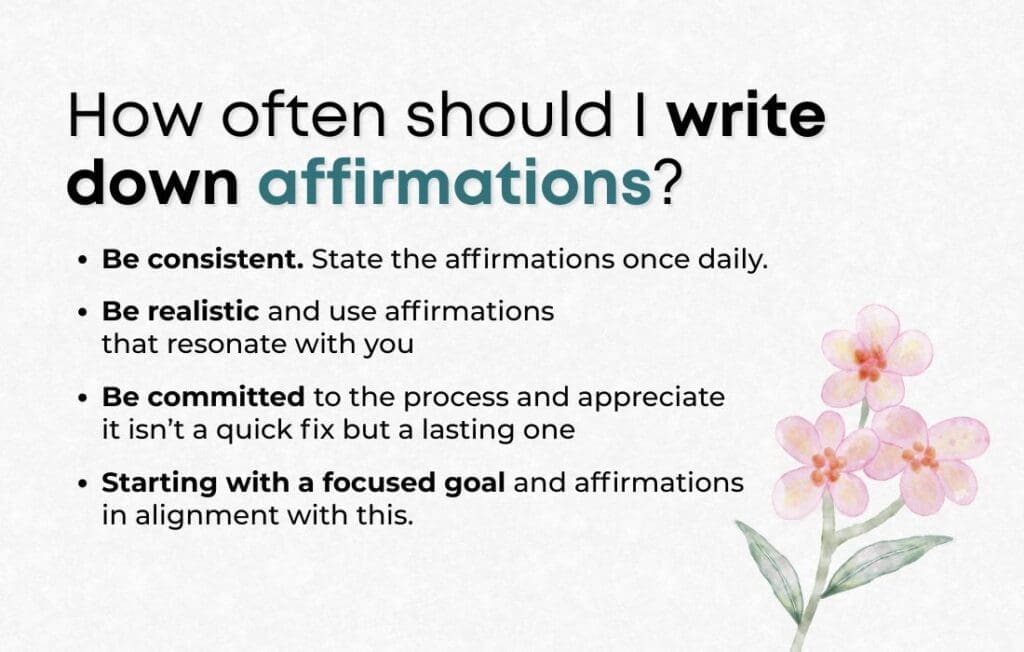
Choose a time when you feel relaxed and focused. Consistency is more important than exact timing.
Should You Write Or Say Affirmations?
Both writing and speaking have benefits. Writing engages your brain and body, while speaking builds confidence. Combining both is ideal, but if you must choose, start with writing.
How Affirmations Compare With Other Mindset Tools
Affirmations are just one tool for changing beliefs. Here’s how they compare with other methods:
Data Table: Affirmations Vs. Other Mindset Tools
| Method | Main Benefit | Best For | Drawback |
|---|---|---|---|
| Writing Affirmations | Builds new beliefs | Self-confidence, focus | Needs consistency |
| Visualization | Strengthens imagination | Goal-setting, motivation | Can feel abstract |
| Meditation | Reduces stress | Calm, mindfulness | Takes time to learn |
| Journaling | Tracks progress | Self-awareness | Requires honesty |
Each method supports change in different ways. Combining them brings the best results.
Supporting Evidence And Further Reading
Scientific research supports the use of affirmations. For example, studies at Stanford University show that self-affirmation can reduce stress and improve performance. If you want more detail, visit Wikipedia’s page on affirmations.
Frequently Asked Questions
How Many Times Should I Write Affirmations Each Day?
There is no fixed rule. Most people start with 5-10 times per day. Adjust the number based on your feelings and progress. If you notice positive change, increase or decrease as needed.
Can Writing Affirmations Too Often Be Harmful?
Writing too many times can cause boredom or resistance. If you feel tired or annoyed, reduce repetitions. Quality and emotional engagement matter more than quantity.
Should I Write The Same Affirmation Every Day?
Yes, repeating the same affirmation helps it “sink in. ” Keep your main affirmation for at least 2-3 weeks before switching. Changing too often can dilute progress.
Is It Better To Write Or Say Affirmations?
Both methods are effective. Writing engages your brain, while speaking builds confidence. Combining both brings the best results, but writing is a good starting point.
How Long Before Affirmations Show Results?
Results vary. Some people see change in a few days, others need weeks or months. Track your progress and stay consistent. If you notice positive changes in feelings or behavior, your affirmation is working.
Affirmations are a simple but powerful tool for changing your mindset. The right number of repetitions depends on your goals, emotions, and daily life. Start small, focus on quality, and adjust your routine as you grow. Whether you write your affirmation once or 50 times, the key is sincere, focused practice.
Stay consistent, track your progress, and enjoy the journey.
