

How Many Affirmation Techniques Boost Success Daily?
How Many Affirmations Should You Use? A Deep Dive Into Affirmation Practice
Affirmations are powerful tools for shaping your mindset and changing the direction of your life. Many people use them to boost confidence, reduce anxiety, and reach their goals. But one question often puzzles both beginners and experienced users: How many affirmations should you use each day? Is more always better, or is there a perfect number for real results? Understanding the right amount can make your affirmation practice much more effective.
This article explores everything you need to know about the ideal number of affirmations, how to choose them, and how to build a routine that truly works. Whether you’re just starting or want to optimize your current approach, you’ll find practical advice, expert insights, and real examples here.
Let’s uncover what science and experience say about the best way to use affirmations.
What Are Affirmations And Why Do They Matter?
Affirmations are short, positive statements you repeat to yourself, either aloud or silently. The goal is to influence your thinking, change your beliefs, and create new habits. For example, saying I am confident and capable can help you feel stronger before a big presentation.
These statements work by targeting your subconscious mind. Over time, regularly repeating affirmations can replace negative thoughts with positive ones. Research suggests that affirmations can:
- Lower stress and anxiety
- Improve self-esteem
- Boost motivation
- Support recovery from setbacks
A key point many people miss is that affirmations are most powerful when they feel believable and connected to your real-life goals. Simply repeating random phrases may not bring the results you want.
The Ideal Number Of Affirmations: Is There A Magic Number?
If you search online, you’ll find people suggesting one affirmation per day while others recommend dozens. The truth is, there is no universal number. The right amount depends on your personal goals, daily routine, and how much focus you can give to each statement.
However, most experts agree on a few guiding principles:
- Quality over quantity: Fewer, meaningful affirmations work better than many vague ones.
- Clarity matters: Each affirmation should be clear, specific, and relevant to your current needs.
- Consistency is key: Repeating the same affirmations every day increases their power.
Common Ranges Used By Successful People
Let’s look at how many affirmations people typically use:
- One to three affirmations: Ideal for beginners or those wanting deep focus. You can give each statement your full attention.
- Four to seven affirmations: Offers variety without feeling overwhelming. Good for people with multiple goals.
- Eight or more affirmations: Useful for advanced users or those tackling several life areas, but it can dilute your focus if you’re not careful.
Most people find their sweet spot between three and seven affirmations per day. This range lets you address different areas (like health, confidence, relationships) while still giving each one enough mental energy.
Factors That Affect How Many Affirmations You Should Use
Deciding on the right number is not just about picking a random figure. Several important factors come into play:
1. Your Personal Goals
Are you focusing on one big challenge, such as finding a new job or overcoming anxiety? In this case, one or two strong affirmations can be very effective. If you have broader goals—like improving health, career, and relationships at the same time—you may choose more.
2. Time And Attention
Affirmations only work if you repeat them with intention. If you have a busy schedule, you might not have time for 10 different statements each morning. It’s better to choose a smaller number you can truly focus on.
3. Emotional Impact
Some affirmations are deeply personal and can trigger strong feelings. If your statements bring up powerful emotions, you may want to limit yourself to a few at a time to avoid feeling overwhelmed.
4. Level Of Experience
Beginners often start with fewer affirmations to avoid confusion. As you get more comfortable, you can add more or rotate them as your needs change.
5. Type Of Affirmation
General affirmations (like I am worthy) can be used more often, but very specific ones (such as I am a confident public speaker at work) require more mental focus and may be best in smaller numbers.
How To Select The Right Affirmations For You
Choosing the right affirmations is as important as deciding how many to use. Here’s a step-by-step approach that works well for most people:
- Identify your main challenges or goals. Be honest about what you want to change or achieve.
- Write clear, positive statements. Use present tense and keep your language simple.
- Make them personal. Start with “I am,” “I have,” or “I can.”
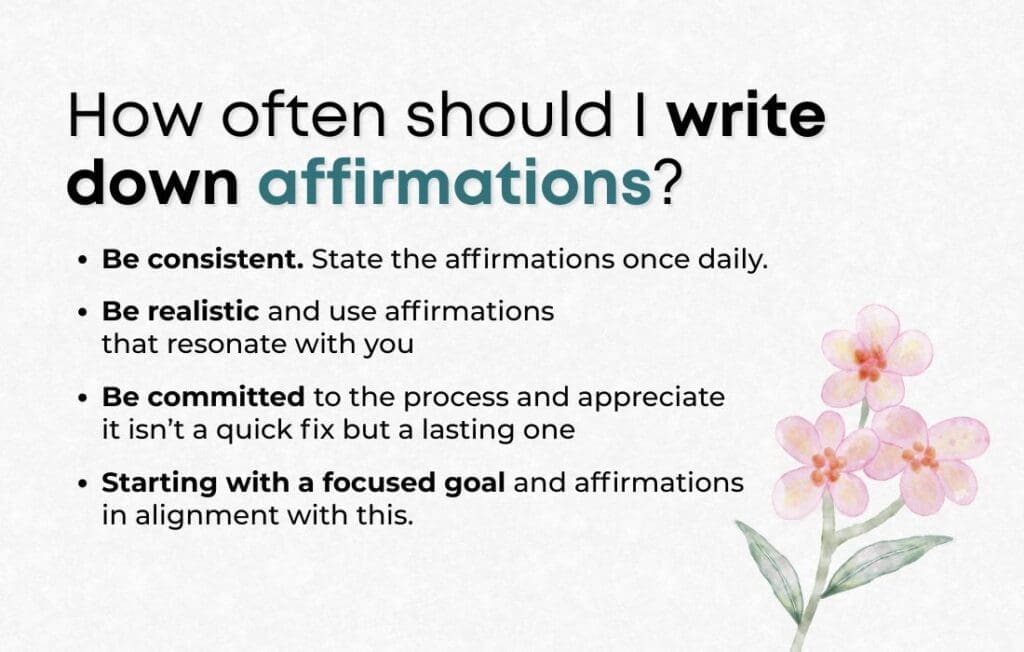
- Test for believability. If an affirmation feels fake or impossible, adjust it until it feels right.
- Limit your list. Pick three to seven affirmations that matter most to you. You can always change them as your needs evolve.
Example Affirmations For Different Goals
- Confidence: I am confident in my abilities.
- Health: I care for my body and make healthy choices.
- Success: I achieve my goals through hard work and focus.
- Anxiety: I am calm and in control of my emotions.
- Relationships: I attract positive and loving people.
How To Structure Your Daily Affirmation Practice
Having the right number of affirmations is just part of the picture. How you use them each day makes a big difference. Here’s a simple, effective routine to follow:
Morning Routine
Start your day with your chosen affirmations. Say them out loud, write them down, or repeat them silently while looking in the mirror. This sets a positive tone for your day.
Midday Check-in
Take a short break during the day to revisit your affirmations. This helps you stay focused, especially during stressful times.
Evening Reflection
End your day by repeating your affirmations again. This reinforces positive beliefs and helps you relax before sleep.
Tips For Maximum Impact
- Use emotion: Feel the words as you say them.
- Visualize success: Picture yourself living the affirmation.
- Stay consistent: Repeat your affirmations daily for best results.
Data And Research: What Science Says About Affirmation Quantity
Studies on affirmations show mixed results, but some clear trends have emerged. Research from psychology suggests that fewer, well-chosen affirmations are easier for the brain to process and accept. Overloading yourself with too many can make the practice feel like a chore, which reduces its effectiveness.
A study on self-affirmation showed that regular practice improved performance and lowered stress, but only when participants used a manageable number of statements. Another finding: affirmations that are too general or excessive can lose their power and feel meaningless.
Here’s a comparison of affirmation practices based on research findings:
| Number of Affirmations | Common Outcomes | Best For |
|---|---|---|
| 1–3 | Deep focus, strong emotional impact | Beginners, single goal |
| 4–7 | Balanced variety, sustained attention | Intermediate, multiple goals |
| 8+ | Risk of dilution, harder to maintain | Advanced users, many areas |
Real-life Examples: How People Use Affirmations
Hearing how others structure their affirmation routines can give you practical ideas for your own practice. Here are three real-world examples:
Example 1: Busy Professional
Maria, a manager, uses three affirmations every morning:
- I communicate clearly and confidently.
- I handle challenges with calm.
- I lead my team to success.
She repeats these while getting ready for work. Keeping the list short helps her remember and focus.
Example 2: Student Balancing Many Goals
Ajay, a university student, chooses five affirmations:
- I learn new things easily.
- I manage my time well.
- I am healthy and energetic.
- I make good friends.
- I am proud of my progress.
He writes them in his journal each day and repeats them before sleep.
Example 3: Personal Growth Enthusiast
Leah, who loves self-improvement, rotates between 10 affirmations but only focuses on five per day. She switches them every week to keep her practice fresh and relevant.
These examples show that there is no one-size-fits-all answer. The number and type of affirmations depend on your lifestyle and needs.
Common Mistakes When Using Affirmations
Even with the right number, some mistakes can limit the effectiveness of your practice. Watch out for these common pitfalls:
1. Using Too Many At Once
Trying to cover every area of your life with a long list of affirmations often leads to shallow focus. It’s better to go deep than wide.
2. Choosing Vague Or Generic Statements
Affirmations like “I am happy” can feel flat and lack impact. Make your statements specific to your situation for better results.
3. Not Believing In Your Affirmations
If your statements feel unbelievable, your subconscious will resist them. Start with affirmations that feel possible, then build up as your confidence grows.
4. Inconsistency
Saying your affirmations only once a week won’t create lasting change. Make them a daily habit.
5. Ignoring Emotional Connection
If you repeat affirmations without feeling anything, they won’t make much difference. Try to connect emotionally as you say them.

Credit: tiffanywoodfield.com
How To Track And Adjust Your Affirmation Practice
Affirmations are not a “set and forget” tool. Over time, your needs and goals will change. It’s important to review your practice regularly.
Steps For Tracking Progress
- Keep a journal: Write your affirmations and note how you feel after each session.
- Set small goals: Track specific changes you hope to see, such as feeling more confident or sleeping better.
- Review monthly: Every few weeks, check your progress. Are your affirmations still relevant? Are you seeing results?
- Make adjustments: If certain affirmations don’t resonate anymore, replace them with new ones.
When To Change Your Affirmations
- When you achieve a goal
- When your priorities change
- If you feel bored or disconnected from your current statements
Being flexible helps you get the most benefit from your affirmation practice.
The Role Of Repetition: Why Fewer Affirmations Can Be More Powerful
Repeating a small number of affirmations every day helps to build new thought patterns. Think of it like learning a new skill. Practice and repetition are what make affirmations stick. If you use too many, you can’t give enough attention to each one.
Some psychologists suggest that repeating each affirmation at least 10 times per session helps to reinforce the message. This is much easier with a shorter list. Over time, repetition turns new beliefs into automatic thoughts.
Here’s a quick comparison to show how repetition and number of affirmations interact:
| Number of Affirmations | Repetitions Per Affirmation | Total Time Needed | Effectiveness |
|---|---|---|---|
| 3 | 10 | 5–10 minutes | High |
| 7 | 10 | 15–20 minutes | Moderate |
| 12 | 5 | 15–20 minutes | Low |
Notice how a smaller number allows for deeper focus and better results in less time.
Advanced Tips For Experienced Users
If you have been practicing affirmations for a while and want to take things further, consider these advanced ideas:
1. Themed Affirmation Days
Assign each day of the week a theme (e. g. , Monday for confidence, Tuesday for health). Focus on affirmations that match the day’s theme. This keeps your practice fresh and targeted.
2. Layering Affirmations
Start with a general affirmation, then add a specific one that supports it. For example:
- General: I am successful.
- Specific: I complete my projects with confidence and skill.
This approach helps your mind connect broad goals to real-life actions.
3. Using Affirmations In Different Formats
Try recording your affirmations and listening to them, or writing them in different places (sticky notes, phone reminders). This keeps your brain engaged and boosts the impact.
4. Combining Affirmations With Visualization
As you repeat each statement, imagine yourself living it. Visualization increases the emotional power of affirmations and can speed up change.
Non-obvious Insights Most Beginners Miss
Many people are surprised to learn that affirmations work best when they are believable but slightly challenging. If your statement is too easy, it won’t inspire change. If it feels impossible, your mind will reject it. Aim for a “stretch” that feels exciting but realistic.
Another insight: Affirmations are not magic spells. They are tools for changing your mindset, but you still need to take action toward your goals. Use affirmations as motivation, not as a substitute for effort.
When To Seek Professional Guidance
If you struggle with negative self-talk or feel stuck despite using affirmations, consider talking to a coach or therapist. Professionals can help you design powerful, personalized affirmations and address deeper issues that might be blocking your progress.
For more on the science behind affirmations and self-talk, you can visit the Wikipedia page on Affirmations.
Frequently Asked Questions
What Is The Best Time Of Day To Use Affirmations?
Morning Is Often The Best Time Because Your Mind Is Fresh And Open To New Ideas. Repeating Affirmations In The Morning Can Set A Positive Tone For The Rest Of The Day. However, Some People Find It Helpful To Repeat Them Before Sleep Or During Quiet Moments Throughout The Day. Choose A Time When You Can Focus And Feel Relaxed.
Can I Use Different Affirmations For Different Goals?
Yes, You Can Use Different Affirmations For Different Areas Of Your Life, Such As Career, Health, Or Relationships. Just Be Careful Not To Choose Too Many At Once. Focus On Three To Seven Affirmations That Support Your Most Important Goals.
Credit: tiffanywoodfield.com
How Long Does It Take To See Results From Affirmations?
Results Vary From Person To Person. Some People Notice Changes In Their Mindset Within A Few Days, While For Others It May Take Several Weeks. Consistency Is Key—repeat Your Affirmations Daily And Give Yourself Time To See Progress.
Should I Write Or Say My Affirmations?
Both Methods Are Effective. Saying Your Affirmations Out Loud Can Help You Feel Them More Strongly, While Writing Them Can Reinforce The Message In Your Mind. Many People Do Both—say Them Aloud And Write Them In A Journal Each Day.
Credit: www.globalpositivenewsnetwork.com
What If My Affirmations Don’t Feel True?
If Your Affirmations Feel Unbelievable, Adjust Them So They Feel More Realistic But Still Positive. For Example, Instead Of “i Am Rich,” Try “i Am Creating More Financial Stability Every Day.” As Your Confidence Grows, You Can Gradually Use Stronger Statements.
Affirmations can be life-changing tools when used correctly. By choosing the right number, crafting meaningful statements, and practicing regularly, you set yourself on the path to a more positive and empowered life. Remember, the best affirmation practice is the one that feels right for you and fits your goals and lifestyle.
