

How Long Should I Do Affirmations for Maximum Results?
How Long Should I Do Affirmations
Affirmations are simple, positive statements you repeat to yourself to shape your thinking and beliefs. Many people use affirmations to build confidence, reduce stress, or help achieve goals. But one question comes up often: How long should I do affirmations to see real results? The answer is not always straightforward. Some people notice changes quickly, while others need more time and patience. Understanding how long to practice affirmations, what factors influence your progress, and how to maximize their effect can help you stay committed and get the most benefit from this powerful tool.
Let’s explore the science, psychology, and practical details behind affirmations. You’ll learn how to set a routine, how to know if your affirmations are working, and how to avoid common mistakes. By the end, you’ll have a clear, personalized answer to the question: how long should I do affirmations?
What Are Affirmations?
Affirmations are short, positive phrases you say or think to yourself. The goal is to encourage a positive mindset and influence your subconscious beliefs. Examples include, “I am confident,” “I attract success,” or “I am worthy of love. ” By repeating these statements regularly, you aim to change negative thinking patterns and support healthy self-esteem.
Many people use affirmations for different reasons, such as:
- Building self-confidence
- Reducing anxiety or stress
- Improving focus and motivation
- Supporting healing and well-being
Affirmations are often used in self-help, therapy, and personal development. While the words seem simple, their power comes from repetition and consistency.
The Science Behind Affirmations
You may wonder if affirmations are just wishful thinking. But research in psychology and neuroscience supports their impact on the brain. When you repeat positive statements, you activate specific brain regions associated with self-processing and reward.
One well-known study found that self-affirmation can increase activity in parts of the brain linked to self-value and positive emotions. This brain activity can help you become more open to change and better handle stress. Over time, repeating affirmations may even help rewire negative beliefs and boost your mental resilience.
However, not all studies show the same results for everyone. Factors like your starting beliefs, how realistic the statements feel, and how often you practice all play a role. The key is consistency and choosing affirmations that truly matter to you.
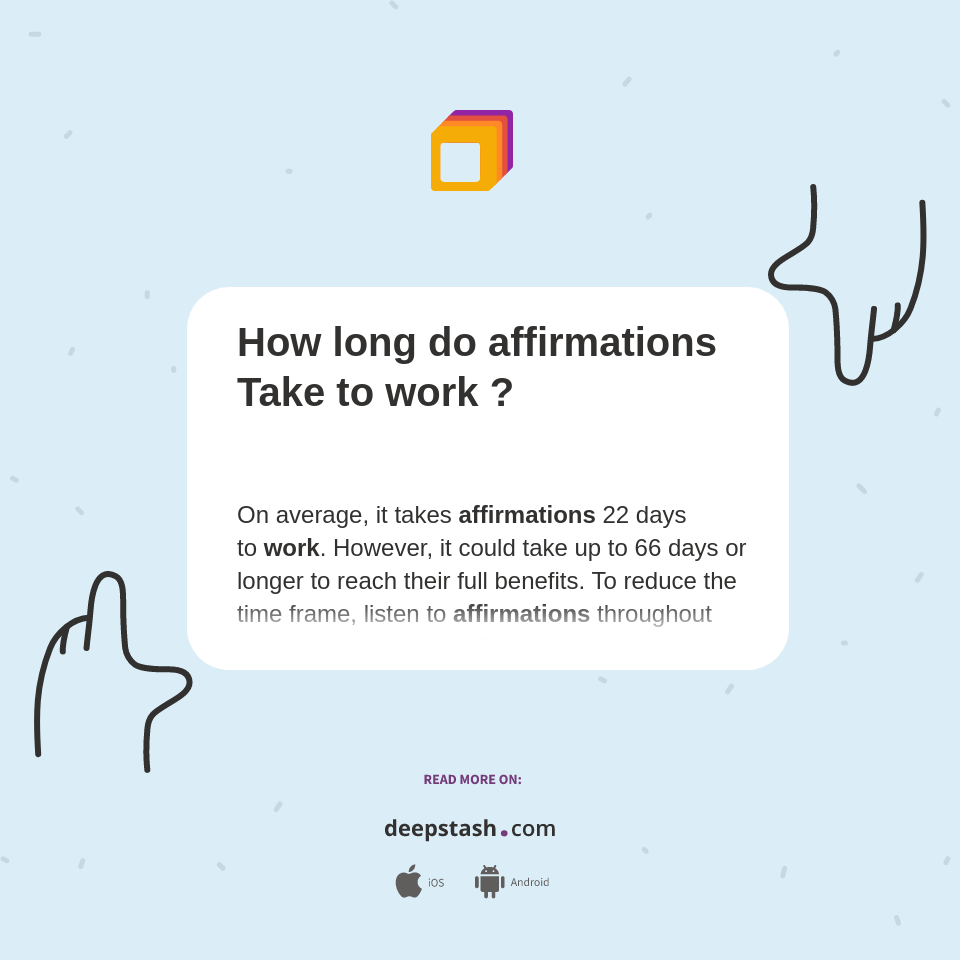
Credit: deepstash.com
Typical Timeframes For Affirmation Practice
One of the most common questions is: How long should I keep doing affirmations before I see results? The answer depends on several factors, but here are some general guidelines based on research and experience.
| Timeframe | What to Expect |
|---|---|
| First few days | Feel awkward or silly; little change in mood or beliefs |
| 1-2 weeks | Statements feel easier; small shifts in thinking |
| 3-4 weeks | Noticeable changes in mood or behavior; affirmations feel more natural |
| 1-3 months | Deep changes in self-talk; new habits form; stronger self-belief |
| 3+ months | Affirmations become part of your identity; long-lasting mindset shift |
Most experts recommend doing affirmations at least 21 to 30 days in a row. This matches what we know about habit formation: it often takes three to four weeks of daily practice to start seeing real changes. However, some people need more time, especially if they have strong negative beliefs or if the affirmation feels very new.
Daily Duration: How Much Time To Spend Each Day
Besides the number of days or weeks, you might wonder how much time to spend on affirmations each day. There is no single rule, but here are some common approaches:
- Short Sessions: 2-5 minutes, twice a day (morning and evening)
- Longer Sessions: 10-15 minutes, once a day (usually morning)
- Micro-Affirmations: 30 seconds to 1 minute, several times throughout the day
The key is quality over quantity. Ten minutes of focused, heartfelt affirmations are more effective than twenty minutes of distracted repetition. Choose a routine that fits your lifestyle, and remember: even a few minutes can make a big difference if you truly pay attention.
Factors That Influence How Long You Should Do Affirmations
There is no one-size-fits-all answer. Several factors influence how long you’ll need to practice affirmations before noticing results:
1. Your Starting Beliefs
If you have deep-rooted negative beliefs, it may take longer to shift your mindset. For example, if you’ve felt unworthy for years, the affirmation “I am worthy” might feel untrue at first. In this case, patience and persistence are key.
2. The Specific Affirmation
Some affirmations are easier to accept than others. Statements that feel realistic and relevant to your life will work faster. If the affirmation feels too far from your current experience, it may take more time to accept and believe it.
3. Consistency Of Practice
Repeating your affirmations every day is essential. Skipping days or being inconsistent slows down the process. For best results, set a reminder or build affirmations into your daily routine.
4. Emotional Involvement
Saying affirmations without emotion is less effective. Try to feel the meaning of the words as you say them. The more you connect emotionally, the faster your mind will accept the new belief.
5. Method Of Delivery
Are you speaking out loud, writing them down, or listening to recordings? Some methods work better for certain people. Experiment to find what feels most powerful for you.
6. Environment
A quiet, relaxed environment helps you focus. Doing affirmations while stressed or distracted can reduce their impact.
7. Support From Other Practices
Combining affirmations with meditation, visualization, or journaling can speed up results. When you engage multiple senses and reinforce the message in different ways, your brain learns faster.
Signs Your Affirmations Are Working
How do you know if your affirmation practice is actually helping? Here are some signs to watch for:
- Your self-talk changes: You catch yourself thinking more positively or supporting yourself during challenges.
- You feel better emotionally: There is less anxiety, self-doubt, or stress in daily life.
- You notice small wins: You take actions that match your affirmations, such as speaking up or setting boundaries.
- People notice changes: Friends or family comment on your attitude or confidence.
- Your affirmations feel more believable: What felt awkward before now feels natural.
These signs may appear slowly. Don’t expect dramatic change overnight. Keep a journal to track progress and celebrate even small improvements.

Credit: tiffanywoodfield.com
How To Structure Your Affirmation Practice
To get the most from affirmations, it helps to have a clear routine. Here’s a simple, effective way to build affirmations into your day:
Morning Routine
Start your day with a positive mindset. After waking up, take a few minutes to repeat your affirmations out loud or quietly in your mind. You can do this while looking in the mirror, sitting quietly, or even during a walk.
Evening Routine
Before bed, repeat your affirmations again. This helps your mind process positive thoughts while you sleep. Some people also write their affirmations in a journal at night.
Throughout The Day
If you notice negative thoughts, use your affirmation as a counter-message. Repeat it silently whenever you feel stressed or doubtful.
Example Daily Affirmation Routine
- Morning (5 minutes):
- Stand in front of a mirror.
- Repeat 3-5 affirmations, saying each one 5 times.
- Try to feel the truth of each statement.
- Daytime (as needed):
- Use affirmations when you feel nervous or negative.
- Evening (5 minutes):
- Write your affirmations in a notebook.
- Reflect on any changes you noticed that day.
Practical Tips To Make Affirmations More Effective
Some people try affirmations but give up quickly, thinking they don’t work. Here are practical tips to help you get better results and avoid common mistakes:
- Keep affirmations short and clear. Simple statements are easier to remember and repeat.
- Use present tense. Say “I am confident,” not “I will be confident.”
- Make them personal. Tailor affirmations to your own needs and goals.
- Add emotion. Feel excitement, gratitude, or pride as you say the words.
- Be patient. Deep change takes time. Trust the process, even if results are slow.
- Combine with action. Use affirmations to inspire real steps toward your goals.
- Visualize. Picture yourself living the truth of your affirmation.
- Record yourself. Listen to your own voice saying affirmations during the day.
- Avoid unrealistic statements. If an affirmation feels too far from reality, adjust it to something more believable.
- Track your progress. Write down changes in your mood or behavior.
Common Mistakes That Slow Down Results
Many beginners make mistakes that slow their progress. Here’s what to avoid:
- Inconsistent practice: Skipping days or being irregular weakens the effect.
- Lack of belief: Saying affirmations you don’t believe can feel fake. Start with statements you can accept, even if they are small steps.
- Saying too many affirmations: Focus on 3-5 key statements, not a long list.
- Being distracted: Multitasking or rushing through affirmations reduces their impact.
- Expecting instant results: Deep beliefs take time to change. Stay patient.
Should You Do Affirmations Forever?
Once you see positive changes, you might wonder if you should keep doing affirmations. Many people find that ongoing practice helps them maintain a positive mindset. Just like exercise keeps your body healthy, affirmations keep your mind strong.
Some people reduce the frequency over time, doing affirmations only when needed. Others make them a daily habit for life. Listen to your needs and adjust your routine as you grow.
How To Know When To Change Or Stop Your Affirmations
Affirmations are not set in stone. As you grow, your needs and goals change. Here’s how to know if it’s time to update or stop your affirmations:
- You’ve achieved your goal. If you no longer need to build confidence in one area, choose a new focus.
- The affirmation feels boring. If you feel no emotion or excitement, it might be time for a change.
- You want to grow in a new direction. Adjust your affirmations to match new dreams or challenges.
- You feel confident without them. If positive self-talk is natural, you can reduce or pause your practice.
Case Studies: Real-life Experiences With Affirmations
To understand how long affirmations take to work, it helps to look at real examples. Here are three stories that highlight different journeys:
Case 1: Overcoming Public Speaking Fear
Maria struggled with anxiety before presentations. She used the affirmation, “I speak with clarity and confidence,” every morning and evening. At first, she felt silly and doubted the process. After about three weeks, she noticed less nervousness and more focus.
By the second month, she volunteered for a big meeting and got positive feedback. She continues using affirmations, but now adds new statements as she grows.
Case 2: Building Self-worth
David battled negative self-talk for years. He chose the affirmation, “I am worthy of love and respect. ” For the first month, he felt little change and almost quit. But after journaling his feelings and saying the affirmation with more emotion, he started noticing subtle shifts in his relationships.
After three months, he felt more comfortable setting boundaries and asking for help. Now, he uses affirmations as needed, especially during stressful times.
Case 3: Achieving Fitness Goals
Lina wanted to stick with exercise but struggled with motivation. Her affirmation was, “I am strong and enjoy moving my body. ” She repeated it during morning walks and before workouts. After two weeks, she started looking forward to exercise.
By six weeks, she noticed more energy and less self-criticism. She still uses affirmations to stay on track and update them as her goals change.
These stories show that affirmation timelines vary. The key is to stay consistent, adjust as needed, and celebrate progress—no matter how small.
Comparing Affirmation Methods: Speaking, Writing, And Listening
Different people find different methods more effective. Here’s a comparison of the three most popular techniques:
| Method | Strengths | Weaknesses |
|---|---|---|
| Speaking out loud | Engages voice and hearing; builds confidence | May feel awkward; less private in shared spaces |
| Writing down | Deepens focus; good for reflection and journaling | Time-consuming; less emotional if rushed |
| Listening to recordings | Easy to do anytime; can reinforce messages | Less active engagement; easy to tune out |
You can combine methods for even better results. For example, say your affirmations out loud in the morning, write them at night, and listen to recordings during the day.
How Many Affirmations Should You Do At Once?
A common question is how many affirmations to practice at the same time. Too many can be overwhelming and less effective. Experts suggest focusing on three to five key affirmations that match your main goals or challenges.
Here’s why a focused approach works better:
- You give each statement enough attention and emotion.
- It’s easier to remember and repeat them throughout the day.
- You can track progress more clearly.
If you reach your goal with one affirmation, you can replace it with a new one. This way, your practice stays fresh and motivating.

Credit: www.affirmations.online
Affirmations And The Power Of Habit
Affirmations work best when they become a habit. Habits form through regular repetition and reward. Here’s how you can build affirmations into your daily life:
- Attach affirmations to existing habits. For example, say your affirmations while brushing your teeth or during your morning coffee.
- Use reminders. Set an alarm or put sticky notes where you’ll see them.
- Celebrate small wins. Reward yourself when you notice progress.
Studies show that habits take about three weeks to become automatic, but sticking with affirmations for longer makes the changes last.
Two Insights Many Beginners Miss
- Affirmations are not magic; they work best when combined with real action. Telling yourself “I am confident” can help, but real change happens when you act confidently—even if it feels difficult at first. Use affirmations to inspire small, bold steps in daily life.
- Adjust your affirmations as you grow. Many people repeat the same statement for months, even after it stops feeling meaningful. Update your affirmations to match your current goals and challenges. This keeps your practice fresh and effective.
What To Do If Affirmations Aren’t Working
If you’ve been practicing affirmations for weeks and see little change, don’t give up. Here’s what you can try:
- Make your statements more believable. Change “I am a millionaire” to “I am open to new opportunities.”
- Add emotion. Try saying your affirmation with more feeling or visualize the result.
- Switch your method. If saying them out loud isn’t working, try writing or listening.
- Combine with action. Take small steps that support your affirmation.
- Seek support. Share your affirmation practice with a friend or join a group for encouragement.
If you still struggle, consider talking with a coach or therapist for personalized help.
How Affirmations Compare To Other Mindset Tools
Affirmations are one of many ways to shape your mindset. Here’s how they compare to other popular techniques:
| Technique | Main Benefit | Best For |
|---|---|---|
| Affirmations | Change self-talk and beliefs | Building confidence, motivation, self-worth |
| Visualization | Create mental images of success | Goal achievement, performance, creativity |
| Gratitude journaling | Focus on positives; improve mood | Reducing stress, increasing happiness |
| Meditation | Calm the mind; increase awareness | Reducing anxiety, improving focus |
You can combine these tools for even greater effect. For example, pair affirmations with visualization or gratitude journaling for a more powerful daily routine.
The Role Of Self-awareness
A non-obvious insight is that self-awareness makes affirmations more effective. Before you start, take time to notice your current beliefs and self-talk. Ask yourself:
- What negative beliefs do I want to change?
- When do I feel most self-critical or doubtful?
- Which situations trigger negative thinking?
By understanding your patterns, you can create affirmations that target your real challenges.
Resources And Further Reading
If you want to learn more about the science of affirmations and mindset, check out this helpful overview from the Positive Psychology website.
Frequently Asked Questions
How Many Times A Day Should I Repeat My Affirmations?
Most experts recommend repeating your affirmations twice a day, in the morning and evening. You can also repeat them whenever you need a confidence boost or face a challenge. The most important thing is to stay consistent and focused.
Can I Do Too Many Affirmations At Once?
Yes, doing too many at once can overwhelm your mind and reduce the impact. It’s best to choose three to five key affirmations that match your main goals. Once you achieve progress in one area, you can add or change affirmations as needed.
What If My Affirmation Feels Untrue?
If your affirmation feels unbelievable, adjust it to something more realistic. For example, instead of “I love public speaking,” try “I am learning to feel comfortable when I speak in public. ” Gradually update your affirmation as your belief grows.
How Long Before I Notice Results From Affirmations?
Most people start to notice small changes after three to four weeks of daily practice. Deep, lasting changes in self-belief may take one to three months or more. Stay patient, and remember that progress can be slow but steady.
Do I Need To Say Affirmations Out Loud, Or Is Thinking Them Enough?
Both methods can work. Saying affirmations out loud engages your voice and hearing, making them more powerful for some people. Thinking or writing them also works, especially if you add emotion and focus. Try different methods to see what feels best for you.
Affirmations are a simple but powerful way to shape your thoughts, beliefs, and actions. The key to success is consistency, emotional involvement, and patience. By sticking with your practice, tracking your progress, and adjusting as you grow, you’ll find the answer to how long you should do affirmations—until your mind, and life, reflect the positive change you desire.
