

How Does Writing Affirmations Work to Rewire Your Mind?
How Does Writing Affirmations Work
Many people talk about affirmations as a tool for changing their lives. You may have heard someone say, “Just write down positive statements every day, and your life will improve.” But how does writing affirmations actually work? Is there real science behind it, or is it just wishful thinking? If you want to understand why this simple practice can feel so powerful — and when it doesn’t work — you’re in the right place.
This article takes a deep look at how writing affirmations affects the mind and behavior. You’ll discover how affirmations are different from just thinking positive thoughts, how they interact with the brain, and what common mistakes to avoid. We’ll also explore the best ways to write affirmations for real results.
Whether you’re new to affirmations or want to go deeper, you’ll finish with a clear understanding of what works and why.
What Are Affirmations?
Affirmations are positive statements about yourself or your life that you repeat to influence your thoughts, feelings, or actions. People often use them to boost confidence, change habits, or reach goals. For example, someone might write, “I am confident and capable,” or “Every day, I am getting healthier.”
These statements are usually written in the present tense, even if the goal hasn’t happened yet. This helps the mind to start believing that the change is already real. The idea is that by repeating affirmations, you can shape your beliefs and actions over time.
How Affirmations Are Different From Positive Thinking
Affirmations are not just positive thinking. Positive thinking is an overall attitude or way of looking at life. Affirmations are specific tools you use to direct your mind. Think of positive thinking as the “sunshine,” while affirmations are “seeds” you plant in your mind.
Writing affirmations creates a focused message for your brain. Instead of a general hope, you give your mind a clear direction.
Why Writing Works Better Than Speaking Or Thinking
Many people wonder if it’s enough to just think or say affirmations aloud. Research and experience show that writing affirmations by hand is more powerful for several reasons:
- Physical Action: When you write something, your brain pays more attention. The movement of your hand helps your mind “record” the message.
- Visual Input: You see the words as you write them, which makes the statement more real.
- Slower Process: Writing is slower than thinking. This gives your brain more time to absorb the meaning.
- Memory Link: Studies show that writing by hand improves memory, making the affirmation stick better.
Science Behind Handwriting And Memory
When you write affirmations, you activate several parts of your brain. The reticular activating system (RAS) is a filter in your mind that decides what information to notice. Writing helps the RAS focus on your chosen message. Over time, this can change what you notice and how you react to situations.
A famous study on handwriting and memory showed that students who took notes by hand remembered information better than those who typed. This happens because handwriting slows you down and makes you process the meaning.
How Affirmations Influence Your Brain
Affirmations work by rewiring neural pathways. Every thought you repeat creates a “path” in your brain. If you keep repeating the same thought, the path gets stronger. This is called neuroplasticity — your brain’s ability to change and adapt.
The Power Of Repetition
Repeating affirmations every day tells your brain, “This is important. ” Over time, your mind starts to look for ways to make the affirmation true. For example, if you write, “I am a person who exercises regularly,” your brain becomes more open to exercise opportunities.
Self-perception Theory
Self-perception theory says that people learn about themselves by watching their own behavior. When you write affirmations, you send a signal: “This is who I am.” If you keep writing, your mind starts to accept this new identity.
Cognitive Dissonance
If your affirmation is very different from what you believe, you may feel cognitive dissonance — a mental discomfort. This is actually a good sign! It means your mind is paying attention. Over time, the discomfort can push you to change your behavior or beliefs to match the new statement.
What Happens In The Brain During Affirmation Writing
When you write an affirmation, your brain does several things at once:
- Language Areas: These help you understand and form sentences.
- Motor Areas: These control your hand movements.
- Visual Cortex: This processes the words you see.
- Reward Center: If the affirmation feels good, your brain releases dopamine, a “feel good” chemical.
Your reticular activating system then helps you notice things that support your affirmation. For example, if you write “I am calm under pressure,” you may start to notice moments when you stay calm, even if they are small.
Example: The “lucky” Person
Imagine someone who writes, “Good things always happen to me. ” At first, they may not believe it. But after weeks of writing, they start to notice small good things — a found dollar, a friendly smile — and count these as signs of luck.
Their brain is now looking for evidence to support the affirmation.
Real-life Benefits Of Writing Affirmations
People use affirmations for many reasons. Here are some common benefits, with examples:
- Increased Confidence: Writing “I am confident in meetings” can help you speak up more.
- Better Focus: An affirmation like “I stay on task” can reduce distractions.
- Less Stress: “I handle stress with ease” can train your mind to stay calm.
- More Motivation: “I finish what I start” can push you to complete tasks.
- Improved Health Habits: “I choose healthy foods” can help change eating patterns.
Common Myths About Affirmations
It’s easy to find myths about affirmations online. Let’s clear up some confusion.
Myth 1: Affirmations Are Just Wishful Thinking
Some people believe affirmations are just empty wishes. In reality, affirmations only work if they lead to real change in thinking and behavior. If you write, “I am a millionaire,” but take no action, nothing will happen.
Myth 2: Affirmations Always Work Instantly
Change takes time. You can’t expect to write an affirmation once and see results the next day. Real shifts often take weeks or months.
Myth 3: Anyone Can Use Any Affirmation
Not every affirmation works for every person. If an affirmation feels fake or impossible, your mind will resist it. The best statements are believable, even if they push you out of your comfort zone.
Myth 4: You Must Repeat Hundreds Of Times
Quality matters more than quantity. Ten focused, meaningful repetitions are better than a hundred empty ones.
How To Write Effective Affirmations
Writing a good affirmation is a skill. Use these tips to get the most from your practice.
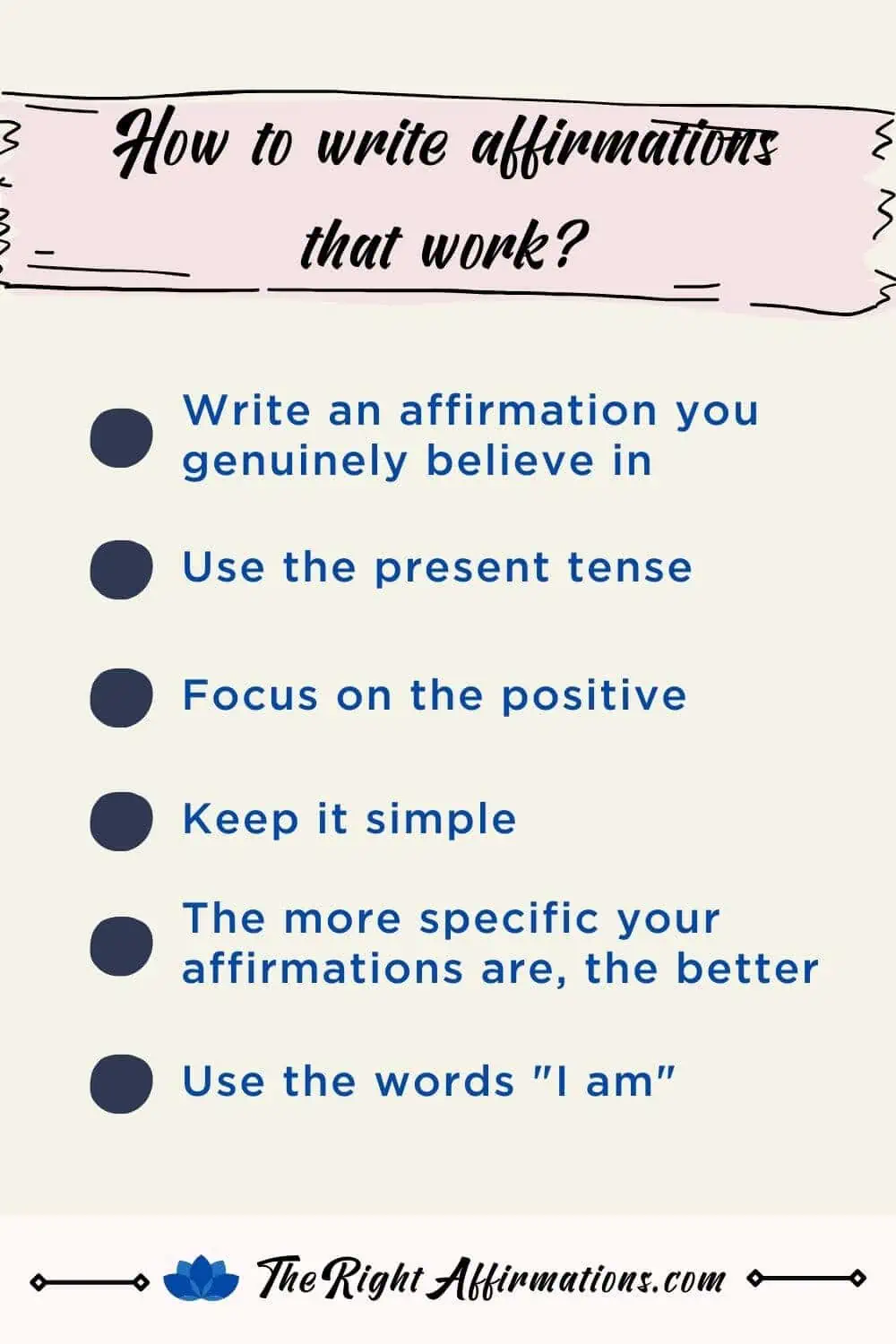
1. Use Present Tense
Write as if the change is happening now. For example: “I am organized and calm.”
2. Keep It Positive
Focus on what you want, not what you fear. Instead of “I am not anxious,” write “I am relaxed and confident. ”
3. Make It Personal
Use “I” statements. This makes the affirmation about you, not others.
4. Be Specific
Clear, concrete statements work better than vague ones. “I finish my work by 6 PM” is stronger than “I am productive. ”
5. Include Emotion
Add feelings to make the affirmation more powerful. “I enjoy speaking in public” works better than “I am a public speaker. ”
6. Start Small
If a big change feels fake, start with a smaller step. For example, “I am learning to be confident. ”
7. Write By Hand
Handwriting is more effective than typing or just thinking.
8. Repeat Regularly
Set a daily time to write your affirmations. Consistency matters.
9. Connect To Action
Link your affirmation to a small action. For example, after writing “I eat healthy,” choose a fruit for your next snack.
10. Review And Update
Change your affirmations as you grow. If one stops feeling right, adjust it.
Examples Of Effective Affirmations
Here are some affirmations that follow the best practices above:
- “I am calm and focused, even under pressure.”
- “I enjoy learning new things every day.”
- “I treat my body with kindness and respect.”
- “I handle challenges with courage.”
- “I am proud of my progress.”
Real Data: Does Writing Affirmations Work?
Research shows that affirmations can change behavior and feelings, but not always in the way people expect. Let’s look at a few studies.
Self-affirmation And Stress
In one experiment, people wrote about their most important values before a stressful task. The group who wrote affirmations showed less anxiety and did better on the task.
Academic Performance
A study in schools found that students who wrote affirmations about their abilities had higher grades, especially if they had doubts about themselves before.
Health Habits
People who wrote affirmations about being healthy were more likely to exercise and eat well.
A Comparison: Affirmations Vs. No Affirmations
Here’s a simple comparison of outcomes for people who use affirmations versus those who don’t.
| Outcome | With Affirmations | Without Affirmations |
|---|---|---|
| Confidence Level | Higher | Lower |
| Stress Response | Calmer | More anxious |
| Goal Achievement | More likely | Less likely |
| Habit Change | More success | Less success |
Common Mistakes When Writing Affirmations
Even with the best intentions, people sometimes make mistakes that reduce the power of affirmations. Here are the most common errors:
1. Being Too Vague
Statements like “I am happy” are too broad. Your brain needs a clear message.
2. Using Negative Words
“I am not nervous” still focuses your mind on “nervous. ” Always keep your words positive.
3. Picking Unrealistic Goals
If you write something you can’t believe at all, your mind will reject it.
4. Inconsistent Practice
Writing affirmations once in a while doesn’t create change. Make it a daily habit.
5. Ignoring Feelings
If the affirmation feels empty or forced, adjust it. Your emotions are a guide.
How To Measure Progress With Affirmations
It’s important to see if your affirmations are working. Here’s how to track your growth:
- Keep a Journal: Write your affirmations and note any changes in your feelings, actions, or results.
- Set Small Goals: Break big changes into steps and celebrate small wins.
- Ask for Feedback: Sometimes others notice your growth before you do.
- Review Regularly: Every week, look back and see what has improved.
Example Progress Tracker
You can use a simple table to track your affirmation practice:
| Date | Affirmation Written | Feeling After Writing | Noticed Changes |
|---|---|---|---|
| Monday | I am focused at work | Motivated | Finished tasks early |
| Tuesday | I am focused at work | Neutral | No change |
| Wednesday | I am focused at work | Confident | Handled a difficult call calmly |
This simple tracking helps you see patterns and adjust your affirmations as needed.
When Affirmations Do Not Work
Affirmations don’t always bring fast results. Here are a few reasons why they may not work:
- Too Much Disbelief: If the affirmation feels impossible, your mind may push back.
- Lack of Action: Writing must be linked with real actions.
- No Emotional Connection: If you feel nothing, the statement won’t stick.
- Inconsistent Use: Skipping days breaks the habit and reduces results.
What To Do When You’re Stuck
If you aren’t seeing change, try these steps:
- Make your affirmation smaller and more believable.
- Add a simple action to your day.
- Focus on feelings, not just words.
- Talk with someone about your goals for fresh ideas.

Credit: kaast22.com
The Role Of Visualization In Affirmation Writing
Combining visualization with writing can make affirmations even stronger. When you write an affirmation, pause and picture it in your mind. Imagine how it feels, what you see, and what you hear if it were true.
For example, after writing “I am confident at work,” close your eyes. Picture yourself walking into your office, speaking clearly, and feeling relaxed. This links your affirmation to real emotions and memories.
The Science Of Visualization
Brain scans show that imagining an action can activate the same areas as doing the action. This means that visualization helps your mind “practice” being the new version of yourself.
Affirmations And Habits: How They Work Together
Affirmations are more powerful when they are tied to habits. A habit is something you do regularly, often without thinking.
For example, you could write your affirmation every morning after brushing your teeth. This creates a strong link between your new belief and your daily routine.
Building An Affirmation Habit
Here are steps to connect affirmations with habits:
- Pick a time and place for writing (like after breakfast).
- Use the same notebook or paper each day.
- Repeat your affirmation as you do a routine task.
- Celebrate small wins as your habit grows.

Credit: psychcentral.com
Comparing Affirmations To Other Self-help Techniques
How do affirmations compare to other tools for self-growth, like meditation, journaling, or goal-setting? Here’s a look at the differences and benefits:
| Technique | Main Purpose | How It Works | Best For |
|---|---|---|---|
| Affirmations | Change self-beliefs | Repeat positive statements | Shifting mindset |
| Meditation | Calm the mind | Focus on breath/thoughts | Reducing stress |
| Journaling | Understand thoughts | Write feelings/ideas | Self-reflection |
| Goal Setting | Plan actions | Define clear steps | Achieving specific results |
Each tool has its place. Many people find that using affirmations with other methods gives the best results.
Two Insights Most Beginners Miss
Many new users of affirmations overlook two important ideas:
- Personal Meaning Matters Most: The more your affirmation matches your real values and dreams, the stronger it works. Copying someone else’s words rarely has the same power as statements you create yourself.
- Small Shifts Add Up: Big changes start with small, daily adjustments. An affirmation that feels “almost true” is often better than one that feels totally unbelievable. Over time, you can raise the bar as your self-belief grows.
The Limits Of Affirmation Writing
Affirmations are powerful, but they are not magic. They cannot fix every problem or replace therapy for deep issues. Sometimes, a negative belief is rooted in past trauma or mental health challenges. In these cases, affirmations can be a helpful support, but professional help may also be needed.
It’s also important to remember that affirmations can’t change things outside your control. For example, writing “I am always safe” cannot guarantee safety, but it can help reduce anxiety and improve your reaction to stress.
Practical Tips For Lasting Success
To get the best results from affirmation writing, try these practical tips:
- Start with One or Two: Focus on one or two affirmations at a time.
- Write Daily: Make it a habit, even if just for five minutes.
- Speak and Write: Say your affirmation out loud as you write it.
- Use Visual Aids: Add pictures or symbols to your notebook.
- Pair with Action: Do one small thing that matches your affirmation.
- Celebrate Progress: Notice and reward your growth, even small steps.
When To Seek More Support
If you feel stuck or frustrated, you are not alone. Sometimes, deeper fears or beliefs block progress. Talking to a coach, counselor, or therapist can help you discover hidden blocks and find new ways forward.
For more on the science of affirmations and self-belief, see this Wikipedia page on self-affirmation.
Frequently Asked Questions
What Is The Best Time To Write Affirmations?
The best time is when you can focus without distractions. Many people prefer the morning, right after waking up, to set a positive tone for the day. Others like writing at night to reflect on the day and prepare for tomorrow.
The key is consistency — choose a time you can keep every day.
How Long Does It Take For Affirmations To Work?
There’s no fixed time. Some people notice changes in a week, while others need several months. It depends on how deeply the old belief is rooted and how often you write and act on your affirmation. Patience and regular practice are important.
Can Affirmations Help With Anxiety Or Stress?
Yes, affirmations can reduce anxiety and stress by changing your thoughts and reactions. For example, writing “I am calm under pressure” can help your mind find calm moments. However, affirmations alone may not be enough for severe anxiety — professional support may also be helpful.
Is It Better To Write Or Say Affirmations?
Writing by hand is often more powerful because it involves your mind and body. You can also say affirmations out loud for extra impact. Many people find that writing and speaking together works best.
Should I Use The Same Affirmation Every Day?
You can use the same affirmation for as long as it feels helpful. When you start to believe it or see changes, update or create new affirmations to match your growth. The most important thing is that your affirmation feels meaningful to you.
Everyone can use affirmations to shape their thinking and actions. With regular writing, clear intent, and a positive mindset, change is not only possible — it’s likely. Affirmations are a simple tool, but when used well, they can be a powerful force for growth.
Credit: unfinishedsuccess.com
