

Best Way to Write Affirmations: Proven Techniques for Success
Best Way To Write Affirmations
Affirmations are simple but powerful sentences you repeat to yourself to shape your thoughts and beliefs. Many people use affirmations to boost confidence, improve their mood, and achieve goals. But just writing any positive sentence is not enough. The way you write affirmations can decide if they actually work for you.
Have you ever repeated an affirmation and felt nothing change? You are not alone. Most beginners miss key steps, making their affirmations weak and less effective. In this article, you will discover the best way to write affirmations, with practical advice and proven examples.
You will also learn mistakes to avoid, and how to make affirmations a daily habit. Whether you want to build self-esteem, reduce stress, or succeed in your career, you will find clear guidance here. Let’s explore how to write affirmations that truly work.
What Are Affirmations?
Affirmations are short, positive statements that help you focus on what you want to achieve or feel. They are used to reprogram your mind, so you start believing in your abilities and goals. For example, saying “I am confident” every day can help you feel more sure about yourself over time.
Affirmations are not magic. They don’t create instant results. Instead, they help you change your mindset, which influences your actions and decisions. Many therapists, coaches, and successful people use affirmations to improve their mental health and performance.
How Affirmations Influence The Mind
When you repeat an affirmation, you send a positive message to your brain. Over time, your brain starts to accept this message as true. This process is known as neuroplasticity. Your thoughts shape your behavior, so positive affirmations can lead to positive actions.
Studies show that affirmations can reduce stress, boost self-worth, and help people handle challenges better. For example, a research study found that people who used self-affirmations felt less stressed before a big test. This effect happens because affirmations change the way you see yourself and your abilities.
Common Uses Of Affirmations
People use affirmations for many reasons, including:
- Building self-esteem
- Reducing anxiety
- Improving focus
- Achieving goals
- Creating new habits
- Overcoming negative thoughts
You can use affirmations for personal growth, work success, relationships, health, or any area where you want improvement.
Key Principles For Writing Effective Affirmations
Writing affirmations is not just about creating positive sentences. The way you write and use them matters. Follow these principles to make your affirmations powerful and effective.
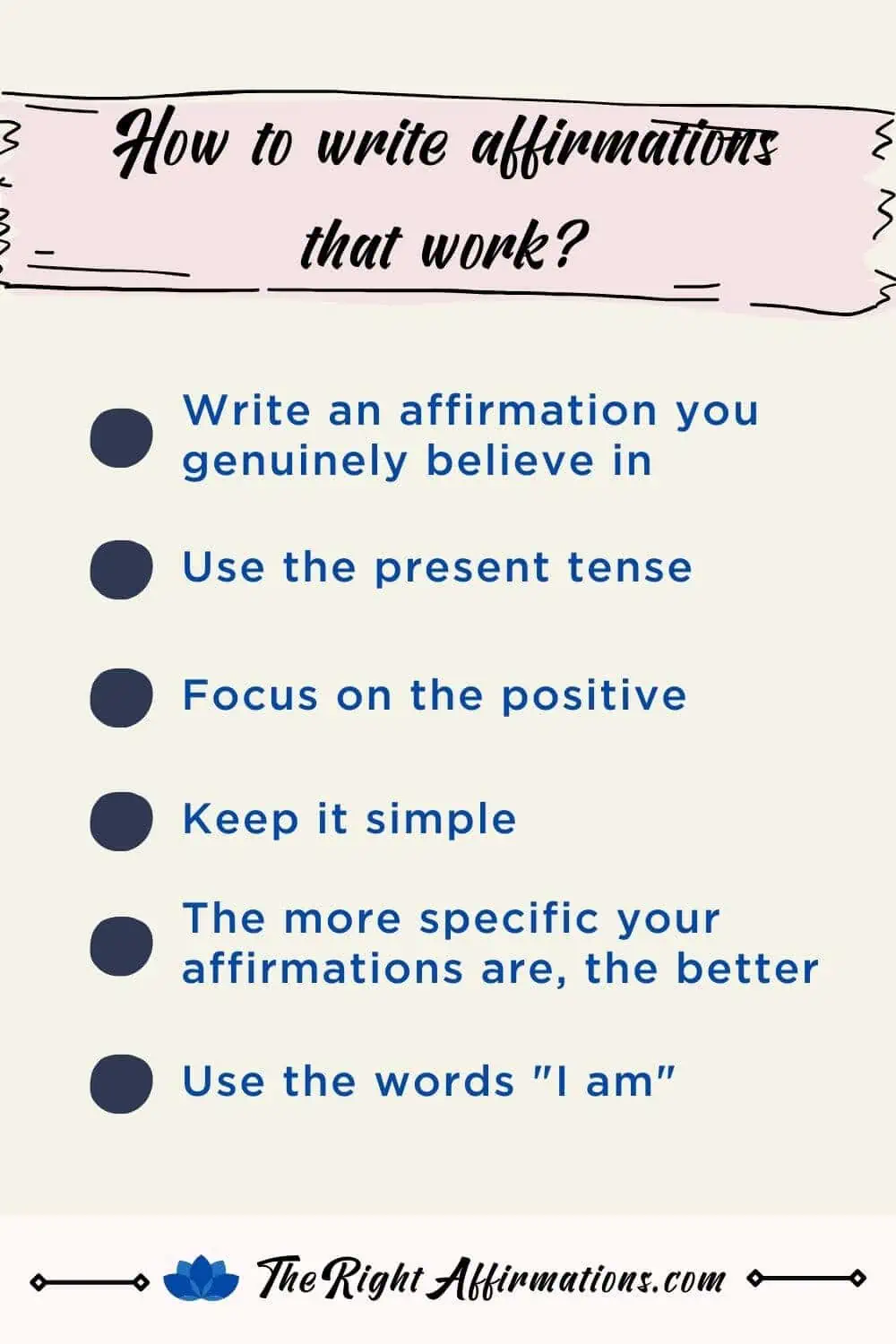
1. Use Present Tense
Affirmations work best when written in the present tense. This means you write as if the statement is already true. For example, “I am healthy” is stronger than “I will be healthy.” Present tense helps your mind accept the affirmation as reality.
2. Be Positive
Always use positive words. Avoid negatives like “not,” “don’t,” or “never.” Instead of “I am not afraid,” write “I am courageous.” Positive language helps your brain focus on what you want, not what you want to avoid.
3. Make It Personal
Affirmations should be personal. Use “I” or “my” to make them about you. For example, “I am creative” or “My confidence grows every day.” Personal statements connect better with your mind.
4. Keep It Simple
Simple sentences are easier to remember and repeat. Avoid complex words or long phrases. A good affirmation is clear and direct, like “I am calm. ”
5. Be Specific
The more specific your affirmation, the stronger it is. Instead of “I am successful,” try “I am confident in my job interviews.” Specific affirmations give your mind a clear target.
6. Use Emotion
Add emotion to your affirmations. Words like “excited,” “grateful,” or “proud” make the statement more powerful. For example, “I am excited about my progress.”
7. Focus On What You Want
Write affirmations about what you want to experience or achieve, not what you want to avoid. This helps your brain move toward positive goals.

Credit: jackcanfield.com
Step-by-step Guide To Writing Affirmations
Now that you know the principles, follow these steps to write your own affirmations.
Step 1: Identify Your Goal
Start by thinking about what you want to change or achieve. It could be:
- Feeling more confident
- Managing stress
- Improving focus
- Building better habits
Write down your goal in simple words.
Step 2: Find Negative Beliefs
Notice any negative thoughts or beliefs related to your goal. For example, you may think, “I’m not good enough” or “I always fail. ” These negative beliefs are what you want to change.
Step 3: Write A Positive Statement
Turn your negative belief into a positive, present-tense statement. For example:
- Negative: “I can’t speak in public.”
- Affirmation: “I am comfortable speaking in public.”
Step 4: Add Emotion And Personalization
Make the affirmation personal and emotional. For example, “I am proud of my ability to speak in public. ”
Step 5: Make It Specific And Simple
Check your affirmation. Is it clear, simple, and specific? If not, rewrite it. For example, “I am confident when presenting my ideas in meetings. ”
Step 6: Repeat And Test
Say your affirmation out loud. Does it feel true? If not, adjust the words until it feels natural and believable. Repeat it daily.
Examples Of Powerful Affirmations
Here are examples for different goals. Use them or create your own based on the steps above.
Self-esteem
- “I am worthy of respect and love.”
- “I am proud of who I am.”
- “I trust my decisions.”
Stress Relief
- “I am calm and relaxed.”
- “I handle challenges with ease.”
- “My mind is clear and peaceful.”
Career Success
- “I am confident in my skills.”
- “I am open to new opportunities.”
- “I handle my work with focus and energy.”
Health And Wellness
- “I am healthy and strong.”
- “I make choices that support my well-being.”
- “I enjoy caring for my body.”
Relationships
- “I am loving and kind.”
- “I attract positive people into my life.”
- “I communicate clearly and honestly.”
Credit: unfinishedsuccess.com
Common Mistakes When Writing Affirmations
Many people make mistakes that weaken their affirmations. Avoid these to make yours strong.
1. Using Negative Words
Do not use words like “not,” “never,” or “don’t. ” Negative words focus on what you want to avoid, not what you want to achieve.
2. Being Too Vague
Affirmations like “I am happy” are too general. Make your statements specific, such as “I find joy in my daily activities. ”
3. Writing In Future Tense
Avoid phrases like “I will” or “I want to. ” Write in present tense to help your mind believe it’s already true.
4. Making It Too Long
Long sentences are hard to remember and repeat. Keep affirmations short and clear.
5. Not Believing The Statement
If your affirmation feels false or forced, adjust it. Choose words you can believe, even if it’s small. For example, “I am learning to feel confident. ”
6. Forgetting Personalization
Generic affirmations do not connect as well. Use “I” or “my” to make it personal.
How To Use Affirmations For Best Results
Writing good affirmations is just the first step. Using them correctly makes a big difference.
Best Practices For Repeating Affirmations
- Repeat your affirmations daily. Morning and evening are good times.
- Say them out loud with confidence.
- Use a mirror for extra impact. Look at yourself as you speak.
- Write your affirmations in a journal each day.
- Visualize the meaning as you repeat your affirmation.
Creating A Routine
Make affirmations a habit. Choose a time and place. For example:
- Before bed
- After waking up
- During a break at work
Set reminders or use sticky notes to help you remember.
Mixing Affirmations With Other Practices
Affirmations work well with other self-improvement tools. Try combining them with:
- Meditation
- Breathing exercises
- Visualization
- Gratitude journaling
This combination can make your affirmations even more powerful.
Why Affirmations Work: Scientific Evidence
Many people wonder if affirmations actually work. Science shows they can be effective, especially for mental health and goal achievement.
Psychological Mechanisms
Affirmations help your brain focus on positive outcomes. They reduce stress and negative thinking. When you repeat positive statements, your mind starts to believe them, leading to new behaviors.
Data And Studies
A study published in the journal "Social Cognitive and Affective Neuroscience" found that affirmations activate the brain’s reward centers. This means your brain feels good when you repeat positive statements.
Another research showed that people who used self-affirmations before a stressful event felt less anxious and performed better.
Comparison: Affirmations Vs. Other Techniques
Here is a comparison of affirmations with other common self-help methods:
| Method | Main Benefit | Ease of Use | Best For |
|---|---|---|---|
| Affirmations | Boost self-esteem, reduce stress | Easy | Daily mindset change |
| Meditation | Calm mind, improve focus | Moderate | Stress relief |
| Visualization | Clarify goals, motivate action | Moderate | Goal achievement |
| Gratitude Journaling | Increase happiness, positivity | Easy | Positive mindset |
How To Make Affirmations Feel Real
One common problem is that affirmations feel fake, especially if you don’t believe the words. Here’s how to make them feel more real.
Start Small
If you struggle to believe a big affirmation, start with something smaller. For example, instead of “I am successful,” say “I am learning new skills every day. ”
Use Evidence
Remind yourself of real experiences that support your affirmation. For example, if your affirmation is “I am confident,” remember a time when you spoke up in a meeting.
Combine With Action
Take small actions that match your affirmation. If you say “I am healthy,” try drinking more water or taking a walk. Action makes the affirmation feel true.
Adjust Words
Change the affirmation until it feels right. Instead of “I am fearless,” try “I am becoming more confident each day. ”
Advanced Techniques For Writing Affirmations
If you want to go beyond basic affirmations, try these advanced techniques.
1. Use Visual Affirmations
Write your affirmation and add a picture that matches your goal. For example, if your affirmation is about health, add a photo of healthy food or exercise.
2. Add Anchors
Create a physical anchor, like touching your wrist or taking a deep breath, each time you repeat your affirmation. This helps your brain connect the statement with a positive feeling.
3. Mix Affirmations With Goals
Combine your affirmation with a clear goal. For example, “I am confident in my ability to finish my project on time. ”
4. Use Affirmations In Groups
Join a group where people share their affirmations. Speaking your affirmation in front of others can boost its power.
5. Write Affirmations As Questions
Turn your affirmation into a positive question. For example, instead of “I am productive,” ask “Why am I so productive? ” Your brain will look for answers and evidence.
Real-life Examples And Case Studies
Seeing how affirmations work for others can help you write your own.
Example 1: Overcoming Anxiety
Maria struggled with anxiety before exams. She started using the affirmation, “I am calm and prepared. ” Over weeks, she repeated it daily and visualized herself feeling calm. Her anxiety reduced, and her test scores improved.
Example 2: Building Confidence
John lacked confidence at work. He chose the affirmation, “I am confident in my abilities. ” He wrote it in his journal every morning, said it in front of a mirror, and reminded himself of past successes. After a month, he felt more comfortable speaking up in meetings.
Example 3: Improving Relationships
Sarah wanted to build stronger friendships. She used, “I am open to positive connections. ” She repeated it daily and took small steps to meet new people. Her social life improved, and she made new friends.
Example 4: Health Transformation
Mike wanted to lose weight and get fit. His affirmation was, “I enjoy making healthy choices. ” He said it every morning, and started making better food decisions. Over time, he lost weight and felt better.
How To Track Your Progress
Tracking your progress helps you see if affirmations are working. Here are ways to do it.
Journaling
Keep a journal. Write your affirmation each day, and note any changes in your feelings, actions, or results.
Self-assessment Table
Use a simple table to rate your progress.
| Affirmation | Daily Repeats | Feeling (1-5) | Action Taken |
|---|---|---|---|
| I am confident | 3 | 4 | Spoke in meeting |
| I am calm | 5 | 3 | Meditated |
Reviewing Results
After a few weeks, review your notes. Are you feeling better? Are you acting differently? Adjust your affirmations if needed.
Comparing Different Affirmation Styles
There are many ways to write affirmations. Here’s a comparison of common styles:
| Style | Example | Best For |
|---|---|---|
| Simple Positive | I am happy | Daily mood boost |
| Specific Goal | I am confident in interviews | Career improvement |
| Emotional | I am excited about my progress | Motivation |
| Question Form | Why am I so productive? | Finding evidence |
Try different styles to see what works best for you.

Credit: mycreativelife.blog
Two Insights Beginners Miss
- Believability is key. Many people think affirmations must be bold and dramatic. But if you cannot believe the words, they will not work. Start with small, believable affirmations and build up as your confidence grows.
- Action makes affirmations real. Repeating words is helpful, but pairing them with small actions creates real change. For example, if your affirmation is “I am healthy,” choose one healthy behavior each day. This combination builds new habits and confidence.
Tips For Making Affirmations A Lasting Habit
- Keep your affirmations visible: Use sticky notes, phone reminders, or journals.
- Pair affirmations with daily routines: Repeat them during brushing teeth, driving, or walking.
- Share with a friend: Encourage each other and hold each other accountable.
- Change affirmations as you grow: Update your statements when you reach a goal.
- Celebrate small wins: Notice progress and reward yourself.
Frequently Asked Questions
What Is The Best Time To Say Affirmations?
The best time is when you feel relaxed and focused. Most people use affirmations in the morning or before bed. Choose a time when you can repeat them without distractions.
How Many Affirmations Should I Use?
Start with 2-3 affirmations. Too many can feel overwhelming and reduce focus. Once you are comfortable, you can add more or change them as needed.
Can Affirmations Help With Mental Health?
Yes, affirmations can reduce stress, boost self-esteem, and help manage anxiety. They are not a replacement for therapy but can support your mental health. For more information, check Psychology Today.
How Long Does It Take For Affirmations To Work?
Results vary for each person. Some feel changes in a few days, others need weeks or months. Consistency is important. Repeat your affirmations daily and track your progress.
What If I Don’t Believe My Affirmation?
If your affirmation feels false, change the wording. Start with something small and believable. For example, instead of “I am successful,” try “I am learning new skills. ” As your confidence grows, make your affirmations stronger.
Affirmations are a simple but powerful tool to change your mindset and improve your life. Write them carefully, repeat them daily, and combine them with positive actions. With the right approach, you can make affirmations work for you and see real results.
