

Affirmations on Self Love: Transform Your Mindset Today
Affirmations On Self Love
Everyone wants to feel good about themselves. But in the rush of daily life, it’s easy to forget your own worth. Sometimes, harsh thoughts or old beliefs make you question if you are enough. This is where affirmations on self love can make a real difference. They are simple, powerful statements that help you change negative thoughts into supportive ones. With practice, these positive words can help you accept yourself, grow your confidence, and build a better relationship with who you are.
Learning to love yourself is not selfish. In fact, it’s necessary for a healthy, happy life. When you practice self love, you create a strong foundation for better mental health, stronger relationships, and the courage to pursue your goals. This article explains what self love affirmations are, why they matter, how to use them effectively, and how they can transform the way you see yourself.
You’ll also find practical tips, real examples, and answers to common questions—so you can start your journey with confidence.
What Are Self Love Affirmations?
Self love affirmations are short, positive statements you say to yourself to build self-respect, acceptance, and inner strength. They focus on your value, abilities, and unique qualities. The goal is to shift your mindset from self-criticism to self-support.
For example, instead of thinking, “I’m not good enough,” you can say, “I am worthy of love and respect. ” Over time, these words help rewire your thinking. Your brain starts to accept them as truth, which can change the way you feel and act.
Self love affirmations work best when they are:
- Positive and encouraging
- Present tense (“I am,” not “I will be”)
- Personal and meaningful to you
- Repeated often, especially during challenging moments
It’s important to remember that affirmations are not magic. They work when you use them regularly and combine them with action. Think of them as gentle reminders that help you treat yourself with the kindness you deserve.
Why Self Love Matters
Many people struggle with self-doubt. Social media, past experiences, or other people’s opinions can make you feel less confident. Self love is about accepting yourself as you are, with all your strengths and flaws.
When you practice self love, you:
- Build resilience against criticism
- Improve your mood and outlook
- Strengthen your relationships (because you stop seeking approval)
- Make better choices for your health and well-being
Research shows that people with higher self-esteem are less likely to experience depression or anxiety. They also tend to recover faster from setbacks and handle stress better. Self love doesn’t mean ignoring your faults; it means being honest with yourself, learning from mistakes, and still believing you are worthy.
A key insight: self love is not a destination, but a practice. Even people who seem confident have moments of doubt. The difference is, they know how to support themselves through those times.
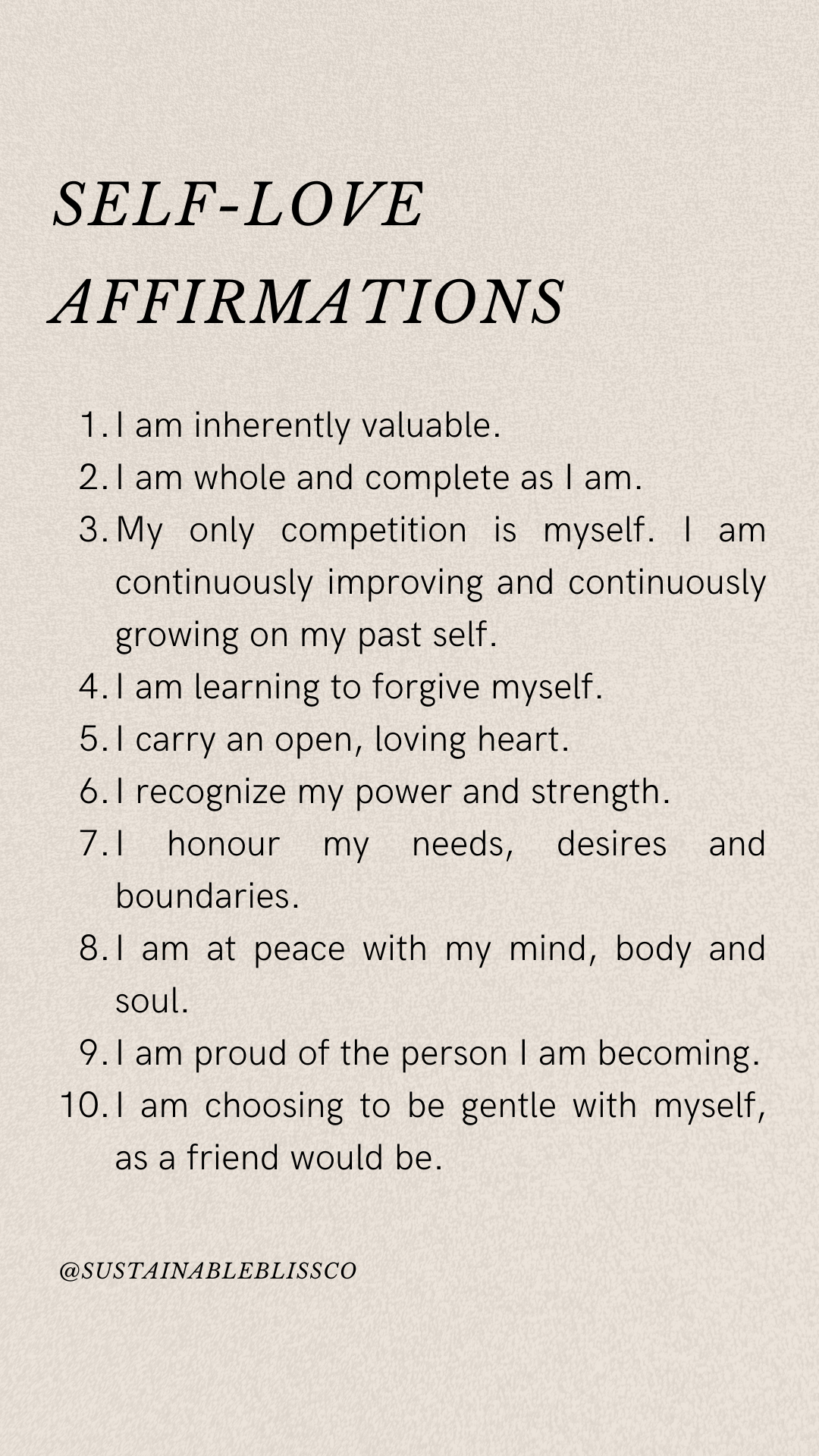
Credit: www.sustainableblissco.com
How Affirmations Change Your Mindset
Your brain is shaped by your thoughts. If you always focus on what you lack, your confidence shrinks. But if you choose to focus on your strengths, your brain builds new pathways that support positive thinking. This is called neuroplasticity.
Affirmations work by:
- Challenging negative beliefs
- Creating new mental habits
- Replacing self-criticism with self-support
For example, if you often think, “I always fail,” your brain gets used to that idea. When you start saying, “I learn and grow from every experience,” you give your brain a new message. Over time, this becomes your default way of thinking.
It’s normal if affirmations feel strange at first. Your mind might resist, especially if you’re used to negative self-talk. This is why consistency is important. The more you repeat affirmations, the more natural they feel.
Here’s a quick comparison of negative self-talk vs. positive affirmations:
| Negative Self-Talk | Positive Self Love Affirmation |
|---|---|
| I’m not good enough. | I am enough just as I am. |
| I always make mistakes. | I learn and grow from every experience. |
| No one likes me. | I am worthy of love and respect. |
| I don’t deserve happiness. | I deserve happiness and joy. |
Notice how the affirmations focus on growth and self-acceptance, not perfection.
Choosing The Right Self Love Affirmations
Not all affirmations work for everyone. The best affirmations are the ones that feel true or possible for you, even if you’re not there yet. If you choose words that feel too far from your reality, your mind might reject them.
Here’s how to pick or create affirmations that fit your needs:
- Identify your struggles: Are you dealing with low confidence, guilt, or body image issues? Your affirmations should address those areas.
- Keep them specific: Instead of “I am awesome,” try “I accept myself even when I make mistakes.”
- Make them positive: Focus on what you want to believe, not what you want to avoid.
- Use present tense: “I am” or “I choose,” not “I will be.”
- Test them out: Say them aloud and notice how you feel. Adjust the wording until it feels right.
Example: If you struggle with body image, “I am grateful for my body and all it does for me” can be more helpful than “I love my body” if you’re not ready for that step.
A non-obvious tip: You can start with bridge affirmations. For example, “I am open to loving myself more each day.” This gentle approach helps your mind accept new beliefs slowly.
50 Powerful Self Love Affirmations
Here are 50 self love affirmations to inspire you. Choose the ones that speak to you, or use them as ideas to create your own.
- I am worthy of love and respect.
- I accept myself as I am.
- I am proud of who I am becoming.
- I forgive myself for past mistakes.
- I trust myself to make good choices.
- I am enough, exactly as I am.
- My feelings and needs matter.
- I am kind to myself, even on tough days.
- I honor my boundaries.
- I let go of self-judgment.
- My body deserves love and care.
- I choose thoughts that support me.
- I am open to receiving love.
- I am grateful for my unique qualities.
- I am in charge of my happiness.
- I treat myself with patience and understanding.
- I am deserving of good things.
- I am strong, inside and out.
- I value my time and energy.
- I am learning and growing every day.
- I celebrate my achievements, big and small.
- I am safe and supported.
- I believe in my worth.
- I am at peace with who I am.
- I am free from the need for approval.
- I trust the journey of my life.
- I am gentle with my inner critic.
- I am allowed to take up space.
- I am capable of creating a life I love.
- I release the pressure to be perfect.
- I am a friend to myself.
- I am more than my mistakes.
- I listen to my body’s needs.
- I am grateful for today.
- I am worthy of self-care.
- I choose to see the good in myself.
- I am patient with my progress.
- I honor my feelings.
- I am proud of my resilience.
- I respect my own boundaries.
- I am creative and resourceful.
- I love who I am becoming.
- I am enough, always.
- I am worthy of kindness.
- I am free to be myself.
- I trust myself to handle challenges.
- I am open to new possibilities.
- I am deserving of rest and joy.
- I am valuable, just as I am.
- I am a work in progress, and that’s okay.
You don’t have to use all of these. Start with a few that feel comfortable and repeat them daily.
How To Practice Self Love Affirmations
Saying affirmations is easy. Making them a habit takes intention. Here’s how you can make affirmations part of your daily life:
- Choose your affirmations: Pick 3-5 that fit your needs right now.
- Set a routine: Say them every morning, before bed, or any time you need support.
- Speak them out loud: Hearing your own voice makes them stronger.
- Write them down: Use a journal, sticky notes, or your phone.
- Look in the mirror: Say them while looking into your eyes. This builds a deeper connection.
- Repeat with emotion: Feel the words as you say them. It’s not just about the words, but the feeling behind them.
- Be patient: Change takes time. Some days will feel easier than others.
A tip many miss: use reminders. Set an alarm, put notes on your bathroom mirror, or use a phone app. Small cues help you remember to practice, especially on busy days.
Overcoming Common Challenges
It’s normal to face resistance when you start using self love affirmations. Here are some common challenges and how to handle them:
- They feel fake or forced: This is common if your inner critic is loud. Start with affirmations that feel believable, like “I am open to being kinder to myself.”
- You forget to practice: Link your affirmations to a daily habit, like brushing your teeth or making coffee.
- Negative thoughts come back: Don’t fight them. Notice the thought, then gently return to your affirmation.
- You feel impatient: Growth takes time. Celebrate small wins, like feeling a little kinder to yourself.
A powerful insight: Consistency matters more than perfection. Even if you miss a day, return to your practice without guilt.
Real Examples: Self Love In Action
Let’s look at how affirmations help in real life. These stories show that self love is a journey, not a quick fix.
Example 1: Building Confidence At Work
Sara struggled with speaking up in meetings. She started using the affirmation, “My voice matters. ” At first, she felt awkward. But after a few weeks, she noticed she felt less nervous and started sharing her ideas. Her manager even praised her input.
Example 2: Healing From Past Mistakes
David often felt stuck in guilt about past choices. He chose, “I forgive myself and move forward. ” Over time, he felt lighter and more willing to try new things. The affirmation didn’t erase his memories, but it helped him stop punishing himself.
Example 3: Improving Body Image
Maya disliked her appearance and avoided mirrors. She began with, “I am grateful for my body’s strength. ” Slowly, she started to see her body as an ally, not an enemy. She began moving more and felt more energetic.
Notice that affirmations didn’t solve every problem overnight. They acted as a gentle support, helping each person make positive changes.
The Science Behind Affirmations
Some people wonder if affirmations really work. Research shows that repeating positive statements can help, especially for people with moderate self-esteem. Studies suggest that affirmations activate the brain’s reward centers, making you more open to positive change.
In one study, people who practiced self-affirmation showed less stress and were better able to solve problems. Another study found that self-affirmations can reduce the effects of negative feedback and improve performance.
However, affirmations are not a cure-all. They work best when combined with action. For example, saying “I am healthy” is more effective when you also make choices that support your health.
A subtle insight: If affirmations make you feel worse, it may be because they feel too far from your current beliefs. Adjust them to something you can accept, like “I am learning to appreciate myself.”
For more on the science, you can visit this Positive Psychology resource.
Self Love Affirmations Vs. Other Positive Statements
Affirmations come in many forms. Some focus on goals, while others support emotional healing. How are self love affirmations different from general positive statements? Let’s compare:
| Self Love Affirmations | General Positive Affirmations |
|---|---|
| Focus on self-worth, acceptance, and kindness toward yourself. | Focus on goals, motivation, or general positivity (e.g., “I am successful”). |
| Address inner critic and self-judgment. | Address outer achievements and future plans. |
| Help build a healthier relationship with yourself. | Help boost mood and motivation for tasks. |
Both types are helpful, but self love affirmations are especially important for healing negative self-talk and building lasting confidence.

Credit: www.amazon.com
Integrating Affirmations Into Your Life
For affirmations to work, they need to become part of your daily routine—not just a one-time activity. Here are practical ways to make affirmations a natural part of your life:
- Morning routine: Start your day with 2-3 affirmations while you get ready.
- Journaling: Write your affirmations as part of a gratitude or self-reflection practice.
- During stress: Repeat affirmations when you feel anxious or down.
- Before sleep: End your day with gentle words to yourself.
- Visual reminders: Use sticky notes, phone wallpapers, or apps to keep affirmations visible.
A practical tip: Pair your affirmation with a small action. For example, after saying, “I am worthy of care,” take a few deep breaths or stretch your body. This helps your mind connect words with real self-care.
Common Mistakes And How To Avoid Them
Even with good intentions, some mistakes can slow your progress with affirmations. Here’s what to watch out for—and how to fix them:
- Being too vague: “I am great” is less effective than “I am proud of how I handled today’s challenges.”
- Ignoring your feelings: If you feel upset, don’t force positivity. Acknowledge your feelings, then use affirmations to support yourself.
- Comparing yourself to others: Affirmations are about your unique journey, not competing with others.
- Giving up too soon: It takes time to see results. Stick with your practice, even if progress feels slow.
- Using affirmations as a band-aid: Affirmations support change, but can’t replace deeper healing if you need it. Consider talking to a therapist if self-criticism is overwhelming.
A key insight: It’s okay to adapt your affirmations as you grow. What works today might change in the future.
The Power Of Written Affirmations
Saying affirmations is powerful, but writing them adds another layer. When you write something, your brain processes it more deeply. This is why many therapists suggest keeping a self love affirmation journal.
Try this:
- Pick one affirmation each day.
- Write it at the top of a page.
- Spend a few minutes reflecting on how it applies to your life.
- Write about small ways you lived that affirmation today.
Over time, you’ll see patterns and progress. You might notice which affirmations help you most, and where you still need support.
A subtle benefit: Your journal becomes a record of your self love journey. On tough days, you can look back and see how far you’ve come.
Affirmations For Different Life Situations
Life is full of change. The affirmations you need may shift depending on what’s happening. Here are examples for different situations:
After A Setback
- “I am resilient and can handle challenges.”
- “Every setback is a setup for a comeback.”
During Stress Or Anxiety
- “I am safe in this moment.”
- “I trust myself to get through difficult times.”
When Feeling Lonely
- “I am enough, even when I am alone.”
- “I am connected to people who care about me.”
When Making A Big Decision
- “I trust myself to make the best choice for me.”
- “I have the wisdom I need within me.”
Personalizing your affirmations to fit your situation makes them more powerful.
Supporting Affirmations With Real Action
Affirmations are most effective when you also take steps to support your self love. Here’s how you can turn words into action:
- Practice self-care: Eat well, rest, and move your body.
- Set boundaries: Say no to things that drain you.
- Celebrate progress: Notice and reward your growth.
- Seek connection: Spend time with supportive people.
- Ask for help: Reaching out is a sign of strength.
For example, if you say, “I am worthy of rest,” actually take a break. If you say, “I honor my needs,” speak up for yourself.
A non-obvious tip: When you act in line with your affirmations, you build trust with yourself. This makes the affirmations even more believable over time.
Tracking Your Progress
Change happens slowly. To stay motivated, track your journey. Here are simple ways to measure progress:
- Rate your confidence or self-love on a scale of 1-10 each week.
- Note any changes in your mood or how you handle challenges.
- Write down compliments or positive feedback you receive.
- Reflect on how your relationships change as you become kinder to yourself.
Here’s a sample progress tracking chart:
| Week | Confidence Level (1-10) | Self Love Wins |
|---|---|---|
| 1 | 3 | Spoke up for myself once |
| 2 | 4 | Practiced daily affirmations, felt calmer |
| 3 | 5 | Set a boundary with a friend |
| 4 | 6 | Accepted a compliment without discomfort |
Small Improvements Add Up. Celebrate Them!

Credit: mblwrites.com
When To Seek Extra Support
Affirmations are a helpful tool, but sometimes they aren’t enough. If you find that negative thoughts are overwhelming, or you struggle with depression or anxiety, it’s okay to ask for help. Therapy, counseling, or support groups can provide deeper healing.
Remember, needing support is not a weakness. In fact, it’s a sign of strength and self-respect to reach out when you need it.
Frequently Asked Questions
What Is The Best Time Of Day To Practice Self Love Affirmations?
You can practice affirmations anytime, but many people find mornings or evenings most effective. Starting your day with positive words sets a supportive tone. Ending your day with affirmations can help you unwind and sleep better. The most important thing is to be consistent—choose a time that fits your routine.
How Long Does It Take For Affirmations To Work?
Everyone is different. Some people notice small changes in a few days, while for others it takes weeks or months. The key is repetition and patience. If you practice daily, you’ll likely start to feel more positive and confident over time.
Remember, affirmations are a practice, not a quick fix.
Can Affirmations Help With Anxiety Or Depression?
Affirmations can support mental health by building self-compassion and reducing negative self-talk. However, they are not a substitute for professional help if you have severe anxiety or depression. Use affirmations as one tool among others, and reach out to a therapist if you need more support.
What If I Don’t Believe My Affirmations?
It’s normal to feel resistance, especially if you’re used to self-criticism. Start with gentle or “bridge” affirmations like, “I am open to loving myself. ” Over time, as you practice and see small positive changes, your belief will grow. Adjust your affirmations to feel as honest and supportive as possible.
Can I Write My Own Self Love Affirmations?
Absolutely! Personal affirmations are often the most powerful. Focus on what you need to hear. Use positive, present tense language. If you’re not sure where to start, look at your struggles and turn them into supportive statements. For example, if you often feel not good enough, try, “I am enough as I am.
”
Loving yourself is a journey, not a destination. By practicing affirmations on self love, you give yourself the support, kindness, and encouragement you deserve. With patience and consistency, these simple words can help you build a stronger, healthier relationship with yourself. Remember, you are worthy—today and always.
