

Affirmations of Self-Love: Transform Your Mindset Today
Affirmations Of Self-love
Self-love can feel confusing or even selfish, especially for those who grew up believing that caring for others always comes first. But the truth is, when you treat yourself with kindness and respect, you build a healthier, happier life. One powerful way to practice self-love is through affirmations—short, positive statements that you repeat to yourself. These words are more than just phrases; they are tools that can shape your mindset, reduce negative thinking, and help you see your own worth.
Many people struggle with negative self-talk, feeling like they're never good enough. This can come from past experiences, harsh criticism, or social pressure. But research shows that practicing positive affirmations can actually change how your brain works. When you use affirmations daily, you start to believe them.
Over time, you can replace self-doubt with self-acceptance and even confidence.
This article will guide you through the world of self-love affirmations. You’ll learn what they are, why they work, and how to use them effectively. You’ll also discover practical examples, common mistakes to avoid, and real-life stories of people who have changed their lives with self-love affirmations.
Whether you're new to this idea or looking to deepen your practice, you’ll find clear steps, helpful tips, and honest answers to common questions. Let’s get started on your journey to stronger self-love.
What Are Self-love Affirmations?
Self-love affirmations are short, positive sentences you say to yourself to build a better relationship with who you are. They focus on acceptance, worth, confidence, and kindness toward yourself. The goal is to quiet the inner critic and remind yourself of your value.
These affirmations are usually simple and direct, like “I am enough” or “I deserve happiness. ” They work best when repeated often, such as in the morning, before bed, or during stressful times. While some people use them out loud, others prefer to write them in a journal or repeat them silently.
Self-love affirmations are not about ignoring problems or pretending life is perfect. Instead, they help you face challenges from a place of strength. When you feel better about yourself, you’re more likely to take care of your needs, set healthy boundaries, and pursue your goals.
How Affirmations Work In The Brain
Science shows that what you say to yourself matters. Your brain is always making new connections, a process called neuroplasticity. When you repeat positive statements, you strengthen the pathways for those beliefs. Over time, your brain starts to see these ideas as true.
A study published in Social Cognitive and Affective Neuroscience found that people who practiced self-affirmations had more activity in areas of the brain linked to self-value and processing reward. This means affirmations can actually help you feel better about yourself, not just in your mind but also in your brain’s structure.
Why Practice Self-love Affirmations?
The world often tells us to be humble or even critical of ourselves. But too much self-criticism can lead to anxiety, depression, and low self-esteem. Practicing self-love through affirmations has several benefits:
- Boosts self-esteem: Repeating positive statements builds your sense of worth.
- Reduces stress: Affirmations help calm negative thoughts and increase emotional balance.
- Improves resilience: When you believe in your own value, you bounce back from setbacks faster.
- Enhances motivation: Self-love fuels the courage to try new things and take care of yourself.
- Strengthens relationships: When you treat yourself well, you set healthier boundaries and attract better connections.
A survey by the American Psychological Association found that people who practice self-affirmation have lower levels of stress and are more likely to make healthy choices.
Common Misconceptions
Some people worry that affirmations are just wishful thinking or “lying to yourself. ” However, self-love affirmations are not about ignoring reality. They are about choosing to focus on your strengths and possibilities rather than your flaws. Over time, these positive statements help you see yourself more clearly and act with more self-respect.
Another myth is that affirmations only work for “positive people.” In fact, anyone can benefit, especially those who struggle with self-criticism. The key is consistency and choosing affirmations that feel meaningful to you.
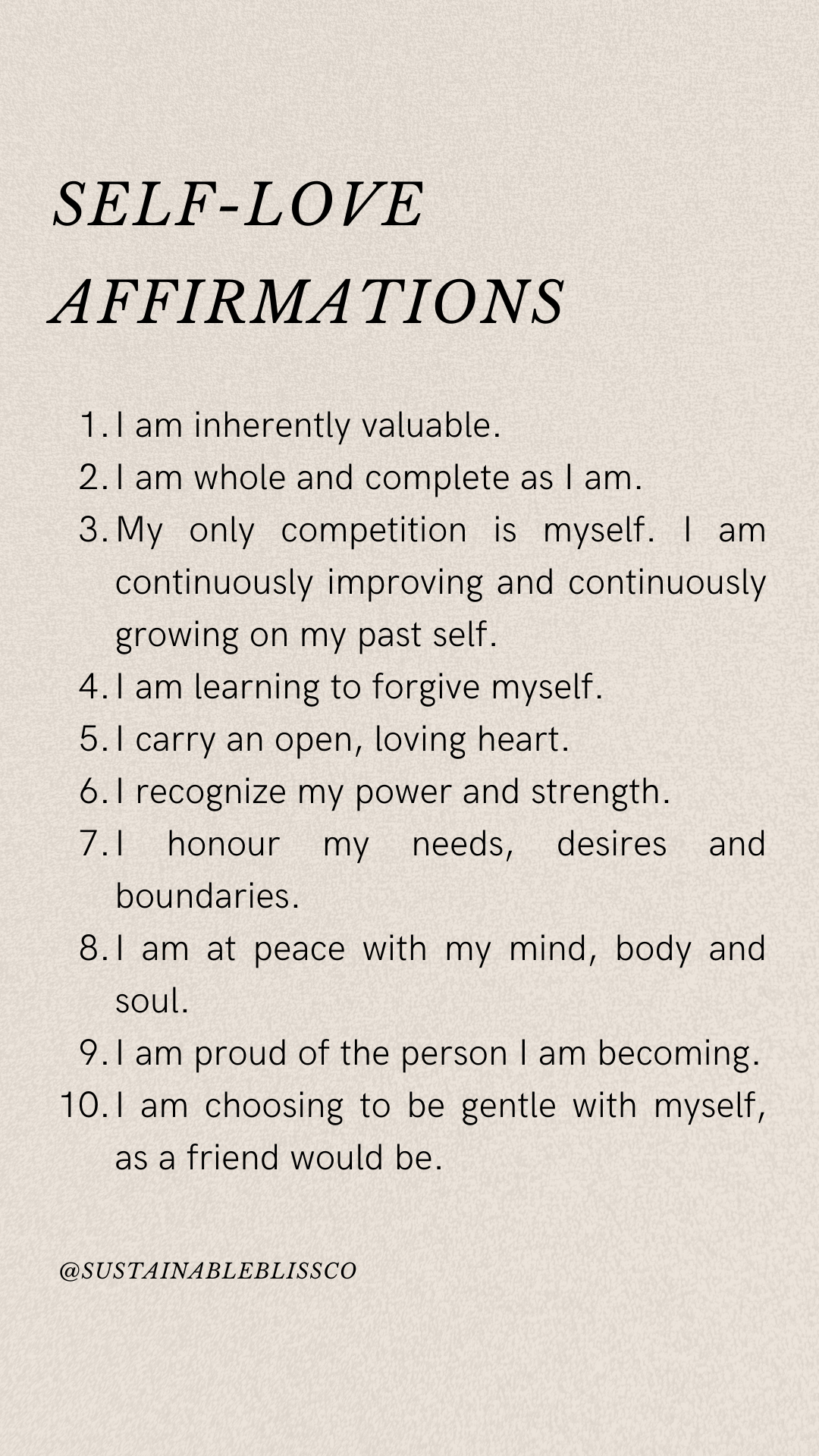
Credit: www.sustainableblissco.com
The Science Behind Affirmations
It’s easy to dismiss affirmations as just feel-good phrases, but there’s solid research behind their power. Studies show that positive self-affirmations can:
- Lower cortisol (the stress hormone) levels
- Increase activity in the brain’s reward centers
- Improve problem-solving under stress
A study published in Psychological Science found that people who repeated self-affirming statements performed better on challenging tasks. Another research article in the journal Health Psychology showed that affirmations can help people stick to health-related goals, such as quitting smoking or exercising more.
Here’s a quick comparison of some key benefits from recent studies:
| Benefit | With Affirmations | Without Affirmations |
|---|---|---|
| Stress Level | Lower | Higher |
| Self-Esteem | Higher | Lower |
| Goal Achievement | More Likely | Less Likely |
Practical Example
Imagine you’re facing a job interview and feel nervous. If you use self-love affirmations like “I am capable and prepared,” research suggests you’ll likely feel calmer, perform better, and recover faster from mistakes. Over time, this new habit can change how you see yourself in stressful situations.
How To Create Effective Self-love Affirmations
Not all affirmations are equally helpful. For the best results, your affirmations should be:
- Personal: Use words that matter to you.
- Present Tense: Say “I am” instead of “I will be.”
- Positive: Focus on what you want, not what you want to avoid.
- Believable: Choose statements you can accept, even if they’re a stretch.
- Short and Simple: Easy to remember and repeat.
Steps To Write Your Own Affirmations
- Identify your needs: What areas of self-love do you struggle with? (Confidence, acceptance, forgiveness, etc.)
- Choose your focus: Decide what you want to feel or believe about yourself.
- Write in first person: Use “I” statements.
- Keep it positive: Focus on growth and possibility.
- Test and adjust: If an affirmation feels false, change it until it feels possible.
Example
If you often feel like you’re not good enough, try changing “I am never good enough” to “I am enough just as I am. ” If that feels hard to believe, adjust to “I am learning to accept myself. ”
Mistakes To Avoid
- Using negative words (“I am not…”)
- Making statements that feel impossible
- Trying to fix too many things at once
- Forgetting to repeat them regularly
One non-obvious insight: Sometimes, softer language like “I am open to loving myself” can feel more believable and effective than bold claims when you’re starting out.

Credit: www.amazon.com
50 Powerful Affirmations For Self-love
Below are examples you can use or adapt. You don’t need to use all of them—choose what speaks to you.
- I am worthy of love and kindness.
- I accept myself unconditionally.
- I am enough just as I am.
- I forgive myself for past mistakes.
- I honor my needs and feelings.
- I am proud of who I am becoming.
- I trust myself to make good choices.
- I am deserving of happiness.
- I am patient with my own growth.
- I let go of what I cannot control.
- I choose to treat myself with respect.
- I am learning to love myself more each day.
- I am grateful for my strengths and weaknesses.
- I am not defined by my struggles.
- I am open to receiving love.
- I listen to my inner voice.
- I am gentle with myself in hard times.
- I celebrate my achievements, big and small.
- I am unique and valuable.
- I honor my boundaries.
- I release the need to compare myself to others.
- I am safe to be myself.
- I trust the journey of my life.
- I am free to express my true self.
- I am confident in my abilities.
- I am worthy of rest and care.
- I am more than my mistakes.
- I am grateful for the person I am.
- I let go of self-judgment.
- I am proud of my progress.
- I am a work in progress, and that’s okay.
- I forgive myself and move forward.
- I am deserving of good things.
- I am in charge of my happiness.
- I am growing every day.
- I am kind to myself and others.
- I am open to new possibilities.
- I am allowed to take up space.
- I am enough, even on tough days.
- I am worthy of respect.
- I am learning from my experiences.
- I am comfortable in my own skin.
- I am loved, even when I feel alone.
- I am at peace with who I am.
- I am grateful for my journey.
- I am strong, even when I feel weak.
- I am committed to self-care.
- I am free to create my own path.
- I am my own best friend.
- I am worthy of all the love I give to others.
How To Use These Affirmations
- Say them aloud in front of a mirror.
- Write them in a journal each morning.
- Set reminders on your phone.
- Repeat them during meditation.
- Use them as mantras in stressful situations.
Making Affirmations Part Of Your Daily Life
Affirmations work best when they become a habit, not just a one-time activity. Here are some effective ways to include self-love affirmations in your routine:
Morning Ritual
Start your day with 2–3 affirmations. Speak them out loud or write them down. This sets a positive tone for the day.
Mirror Practice
Looking at yourself while saying affirmations makes them more powerful. It can feel uncomfortable at first, but it helps you connect the words to your own self-image.
Journaling
Write your favorite affirmations in a notebook. Reflect on what they mean to you. Over time, you’ll notice patterns in your thinking and changes in your mood.
Meditation
Use affirmations as a focus during meditation. Breathe deeply and repeat the phrase quietly. This helps calm your mind and anchor positive thoughts.
Reminders
Set your phone or computer to show an affirmation at certain times. Sticky notes on your mirror or desk work too.
During Difficult Moments
When you feel anxious, sad, or self-critical, pause and repeat an affirmation. This interrupts negative thinking and reminds you of your worth.
Example Routine
| Time | Activity | Affirmation Practice |
|---|---|---|
| Morning | Wake up | Say 3 affirmations in the mirror |
| Lunch | Break at work | Repeat a calming affirmation |
| Evening | Before bed | Write 1 affirmation in journal |

Credit: mblwrites.com
Common Challenges And How To Overcome Them
Even with the best intentions, some people struggle to make affirmations work. Here are common problems and practical solutions:
“i Don’t Believe What I’m Saying”
It’s normal to doubt affirmations at first, especially if you’re used to negative self-talk. Start with softer language, like “I am learning to accept myself” instead of “I love myself completely. ” Over time, your belief will grow.
“i Forget To Practice”
Building a new habit takes time. Pair affirmations with daily routines—like brushing your teeth or making coffee. Use reminders or visual cues to help you remember.
“i Feel Silly Or Embarrassed”
You’re not alone. Many people feel awkward talking to themselves. Remind yourself that practicing self-love is an act of courage, not vanity. If saying them aloud feels strange, try writing them or repeating them silently.
“it’s Not Working Fast Enough”
Change takes time. Affirmations are not instant solutions but tools for long-term growth. Be patient and gentle with yourself. Track your progress by journaling or reflecting on changes in your mood and self-talk.
“i Don’t Know Which Affirmations To Use”
Start with 1–2 statements that feel most important to you. You can always add more later. Personalizing your affirmations makes them more powerful.
One insight that beginners often miss: It’s better to repeat a few meaningful affirmations often than to try to memorize a long list.
Real-life Stories: The Impact Of Self-love Affirmations
Hearing how others have used affirmations can be inspiring. Here are a few real examples:
- Maria, a nurse, struggled with burnout and low self-esteem. She started saying “I am worthy of care and rest” every morning. Over several months, she noticed she was kinder to herself and felt less guilty about taking breaks.
- James used to criticize himself for every small mistake at work. He began repeating “I am growing and learning every day.” Eventually, he became more confident and stopped fearing failure.
- Lina battled body image issues. She posted affirmations like “I am comfortable in my own skin” on her mirror. This daily reminder helped her challenge negative thoughts and build self-acceptance.
These stories show that even simple changes can have a big impact. The key is consistency and choosing affirmations that truly matter to you.
The Role Of Self-compassion In Affirmations
Self-love is closely tied to self-compassion—treating yourself with the same kindness you’d offer a friend. Affirmations can help develop this skill.
According to Dr. Kristin Neff, a leading researcher on self-compassion, people who practice kindness toward themselves have lower levels of anxiety and depression. Self-compassion also helps you recover from setbacks and build resilience.
When using affirmations, try to focus on being gentle with yourself, especially during hard times. This approach can feel more supportive and less forced than pushing for constant positivity.
Comparing Self-love Affirmations To Other Self-help Tools
Many people wonder how affirmations compare to other self-improvement methods like therapy, journaling, or meditation. Here’s a simple comparison:
| Method | Focus | Time Required | Cost | Best For |
|---|---|---|---|---|
| Affirmations | Mindset, self-talk | 1–5 min/day | Free | Daily confidence boost |
| Journaling | Reflection, processing emotions | 10–20 min/day | Low | Deep self-understanding |
| Meditation | Calming mind, present moment | 10–30 min/day | Free–Low | Stress relief |
| Therapy | Personal growth, mental health | 1 hr/week | Medium–High | Serious challenges |
Affirmations are quick and easy, but they can be even more effective when combined with other tools. For example, journaling about your affirmations can help you see progress and spot negative patterns.
Personalizing Your Affirmation Practice
For the best results, make your affirmation routine fit your life and personality. Here are some creative ways to personalize your practice:
- Music: Set your affirmations to a favorite tune and sing them.
- Art: Draw or paint your favorite affirmations and hang them where you’ll see them.
- Technology: Record yourself saying affirmations and play them back.
- Community: Share affirmations with a friend or join a group for support.
One tip that beginners often miss: Changing your environment—even slightly—can make affirmations more effective. For example, saying them outdoors or in a peaceful space can create a stronger connection.
When To Seek Extra Help
Affirmations are a helpful tool, but they are not a replacement for professional support when you need it. If you find that negative self-talk is constant or you struggle with strong feelings of unworthiness, consider reaching out to a therapist or counselor.
Some signs you might need extra support include:
- Ongoing sadness or hopelessness
- Difficulty functioning at work or home
- Intense self-criticism that doesn’t improve with affirmations
- Trouble sleeping, eating, or relating to others
Mental health professionals can help you build self-love and address deeper issues. For more information, visit the National Institute of Mental Health.
Frequently Asked Questions
What Makes An Affirmation Different From Positive Thinking?
Affirmations are specific statements you repeat to yourself to shape your beliefs. Positive thinking is a general attitude of optimism. Affirmations are more focused and actionable, helping you target specific areas of self-love.
How Long Does It Take For Affirmations To Work?
There’s no set timeline, but many people notice changes in a few weeks if they practice daily. Consistency matters more than speed. The more you repeat an affirmation, the more it shapes your thinking.
Can Affirmations Help With Anxiety Or Depression?
Affirmations can be a helpful tool for managing negative thoughts, but they are not a cure for anxiety or depression. They work best when combined with other self-care practices and, if needed, professional support.
Is It Better To Say Affirmations Out Loud Or Silently?
Both methods work. Saying them out loud can make them feel stronger and more real, while repeating them silently can be more private and flexible. Choose what feels most comfortable for you.
What If I Feel Silly Using Affirmations?
It’s normal to feel awkward at first. Remember, affirmations are a form of self-care, not vanity. Over time, many people find the practice becomes more natural and even enjoyable as they see results.
Self-love isn’t always easy, but small steps like daily affirmations can make a big difference. With patience and practice, you can build a kinder, stronger relationship with yourself—and that foundation supports every other part of your life.
