

Affirmations in the Bible: Unlocking Spiritual Strength
Affirmations In The Bible
Sometimes life feels overwhelming. People look for hope, strength, and guidance in many places. For millions, the Bible is more than just a religious text. It is a source of comfort, encouragement, and personal growth. One area where the Bible stands out is in its use of affirmations—positive, faith-filled statements that speak to the heart, mind, and spirit.
You may have heard about affirmations in the context of self-help, psychology, or motivation. But biblical affirmations are different. They are not simply “feel good” phrases. Instead, they are rooted in God’s promises, giving them a deep foundation. This article explores what affirmations in the Bible are, why they matter, and how they work in daily life. We’ll look at examples, practical ways to use them, and clear answers to common questions.
What Are Affirmations In The Bible?
Biblical affirmations are statements taken from Scripture. They declare truth, hope, and identity based on what God says, not just human opinion. These affirmations often:
- Remind us of God’s character
- Confirm our identity as His children
- Encourage faith during hard times
- Replace fear, doubt, or negativity with hope
A biblical affirmation is not “wishful thinking.” It is repeating God’s truth until it shapes your heart and mind. For example, instead of saying “I am strong” with no reason, a biblical affirmation might be: “I am strong in the Lord and in His mighty power.”
How Are Biblical Affirmations Different From Secular Affirmations?
Secular affirmations are usually self-focused. They center on personal abilities, success, or positive thinking. Examples include, “I am confident,” or “I am worthy of love. ” While these statements can be helpful, they depend only on your own resources.
Biblical affirmations are God-focused. They are rooted in God’s promises, character, and actions. This makes them more than motivation—they are declarations of faith.
Here’s a comparison:
| Secular Affirmation | Biblical Affirmation |
|---|---|
| I am strong. | I can do all things through Christ who strengthens me. |
| I am in control of my life. | The Lord directs my steps. |
| I am enough. | God’s grace is sufficient for me. |
Non-obvious insight: Many people mix up positive thinking and faith. Biblical affirmations do not guarantee a certain result—they align your heart with God’s will, not your own desires.
Why Are Affirmations Important In The Christian Life?
Life is full of ups and downs. Doubt, fear, and negative thoughts can easily take over. The Bible recognizes the power of words and thoughts. Proverbs says, “Death and life are in the power of the tongue. ” When you repeat biblical truth, you fill your mind with life-giving words.
Benefits of biblical affirmations include:
- Renewing your mind: Repeating God’s truth helps replace old, negative patterns.
- Building faith: Hearing and speaking Scripture increases trust in God.
- Strength in trials: Affirmations remind you that you are not alone.
- Clear identity: They help you remember who you are in Christ.
A common mistake: Some people see affirmations as a “magic formula.” But saying positive words does not force God to act. The goal is not control, but deeper trust.
Examples Of Powerful Affirmations In The Bible
Many verses in the Bible can be used as affirmations. Here are some of the most powerful, grouped by theme:
Identity In Christ
- “I am a child of God.”
- “I am chosen, holy, and dearly loved.”
- “I am forgiven and set free.”
Strength And Courage
- “The Lord is my strength and my shield.”
- “I can do all things through Christ who strengthens me.”
- “God has not given me a spirit of fear, but of power, love, and self-control.”
Peace And Protection
- “The Lord is my shepherd; I lack nothing.”
- “God’s peace guards my heart and mind.”
- “No weapon formed against me will prosper.”
Hope And Provision
- “God will supply all my needs according to His riches.”
- “His mercies are new every morning.”
- “All things work together for good for those who love God.”
Wisdom And Guidance
- “The Lord gives me wisdom.”
- “He directs my steps.”
- “If I lack wisdom, I ask God, and He gives it generously.”
These are not just statements—they are living truths that shape how you see yourself and the world.
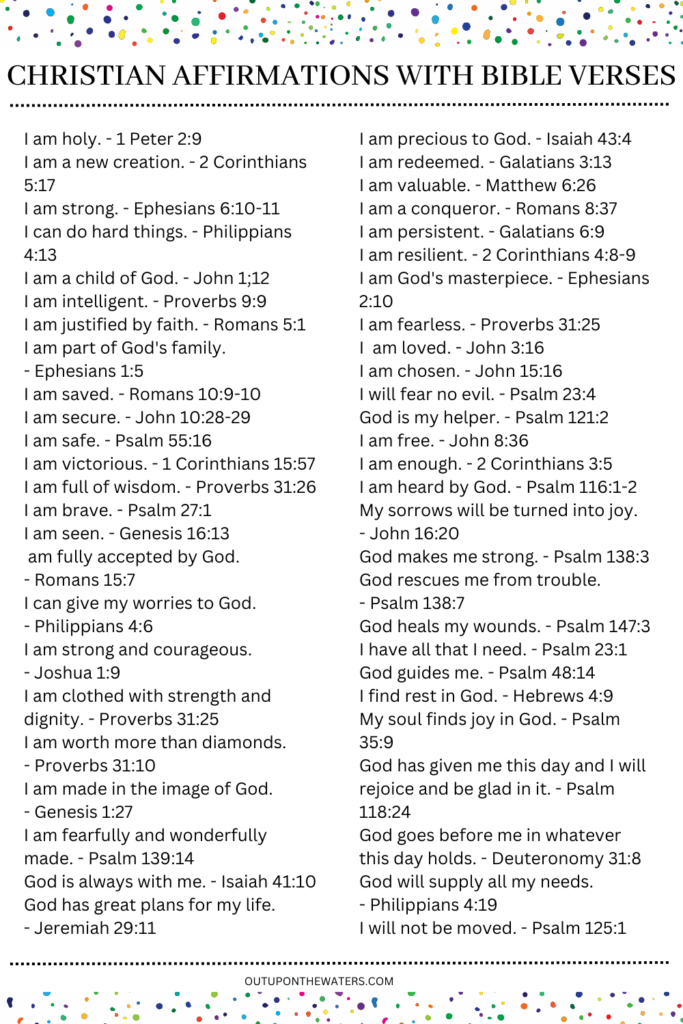
Credit: outuponthewaters.com
The Science Behind Affirmations And The Mind
You might wonder: does repeating affirmations really make a difference? Science says yes—words affect the brain. When you repeat positive statements, your brain creates new pathways. This is called “neuroplasticity.”
Biblical affirmations add another layer. They are not only positive, but rooted in divine truth. Studies show that faith-based meditation and prayer can:
- Lower stress
- Improve mood
- Increase hope
Another non-obvious insight: The more senses you use (speaking, hearing, writing), the stronger the effect. Reading a verse silently is good. Speaking it aloud is better. Writing it in a journal combines both.
How To Use Biblical Affirmations In Daily Life
Knowing affirmations is one thing—using them is another. Here’s a simple way to build them into your routine:
- Choose a verse that speaks to your situation.
- Personalize it. For example, turn “God is my refuge” into “God is my refuge today.”
- Repeat it daily. Morning, night, or during stress.
- Write it out. Stick it on your mirror, phone, or notebook.
- Pray it. Turn the affirmation into a prayer.
Practical tip: Don’t try to memorize too many at once. Start with one or two, and let them sink in.
Affirmations For Different Life Challenges
Everyone faces unique struggles. The Bible has affirmations for every season. Here are examples for common situations:
When You Feel Afraid
- “God is with me; I will not fear.”
- “The Lord is my light and salvation—whom shall I fear?”
When You Feel Unworthy
- “I am God’s workmanship, created for good works.”
- “There is no condemnation for those in Christ Jesus.”
When You Need Healing
- “By His stripes I am healed.”
- “The Lord sustains me on my sickbed.”
When You Face Temptation
- “God is faithful; He will not let me be tempted beyond what I can bear.”
- “Greater is He who is in me than he who is in the world.”
When You Are Discouraged
- “The Lord will fight for me; I need only to be still.”
- “Those who hope in the Lord will renew their strength.”
How Jesus Used Affirmations
Jesus often spoke words of truth—about Himself, God, and others. He declared, “I am the way, the truth, and the life. ” When tempted, He responded with Scripture. This is a model for us.
When Jesus said, “It is written,” He was using affirmations from Scripture to stand firm. He also spoke blessings over people, calling them to see themselves as God saw them.
A practical example: When faced with doubt, Jesus reminded His followers, “With God, all things are possible.” This was not just encouragement—it was a declaration of truth.
Biblical Affirmations In Worship And Prayer
Many psalms are affirmations set to music. “The Lord is my shepherd” is both a prayer and an affirmation. Using affirmations in worship helps focus the heart on God’s character.
You can:
- Sing a verse as a song
- Turn an affirmation into a prayer
- Repeat a promise during quiet time
This is not about empty repetition. It’s about filling your mind with God’s truth, especially when emotions are unstable.
Affirmations For Children And Families
Teaching children biblical affirmations is powerful. Kids face anxiety, fear, and peer pressure too. Simple affirmations give them tools for life.
Try these with children:
- “God loves me no matter what.”
- “I am never alone.”
- “God made me special.”
Families can say affirmations together before school, bedtime, or during challenges. This builds faith and unity.
| Situation | Affirmation for Kids |
|---|---|
| Fear of the dark | God is with me everywhere I go. |
| Feeling left out | I am chosen and loved by God. |
| Making mistakes | God forgives me and helps me grow. |

Credit: wellnessmanifest.wordpress.com
How To Create Your Own Biblical Affirmations
You don’t need to be a Bible expert. Here’s how to make affirmations personal and meaningful:
- Identify a struggle or need. For example: Anxiety, worry, purpose.
- Search Scripture for verses about that topic.
- Rewrite the verse as a present-tense statement.
- Keep it short and clear.
Example: If you struggle with fear, find “God is with you wherever you go,” and say, “God is with me right now.”
Practical tip: Use a Bible app to search by keyword. Write affirmations in your own words for greater impact.
Common Mistakes When Using Affirmations
Many people try affirmations but get frustrated. Here’s what to avoid:
- Using affirmations as magic: Words alone do not change circumstances. They change perspective.
- Ignoring context: Don’t pull a verse out of context. Understand its original meaning.
- Being inconsistent: Occasional use is less effective. Make it a habit.
- Focusing only on self: Biblical affirmations point to God, not just personal ability.
A less-known insight: Sometimes, repeating an affirmation can feel empty. That’s okay. Faith grows through practice, not just feelings.
Top 20 Bible Affirmations With Explanations
Here are twenty affirmations, each with a brief explanation to help you understand and use them:
- I am a child of God. This speaks of identity—you belong to God’s family.
- God is my refuge and strength. In trouble, you have a safe place.
- I am forgiven. No mistake is too big for God’s grace.
- I am never alone. God’s presence goes with you everywhere.
- I am more than a conqueror through Christ. You have victory, even in hard times.
- God’s love never fails. You can always count on His love.
- I have peace that passes understanding. God’s peace is deeper than circumstances.
- I am fearfully and wonderfully made. Your value comes from God’s design.
- God supplies all my needs. You can trust Him for provision.
- The Lord is my shepherd. He cares for you and guides you.
- I am strong in the Lord. Strength comes from God, not just self.
- Nothing can separate me from God’s love. His love is unbreakable.
- I have a future and a hope. God’s plans are good.
- God heals all my diseases. There is hope for healing.
- The Holy Spirit is my helper. You are not left to struggle alone.
- God directs my steps. You can trust His guidance.
- I am chosen and set apart. You have purpose.
- The Lord fights for me. You are not on your own in battles.
- I am a new creation in Christ. Your past does not define you.
- God works all things for my good. Even hard things have purpose.
Affirmations And Spiritual Growth
Using biblical affirmations is not just for comfort. It is a tool for spiritual growth. As you repeat God’s truth, you:
- Deepen your faith
- Learn to trust God more
- Become more resilient
Over time, affirmations become a natural part of your thinking. They shape your reactions, choices, and relationships. This is one reason many spiritual leaders encourage memorizing Scripture—it gives you words for life’s hardest moments.
Practical Ways To Memorize And Practice Affirmations
Making affirmations stick requires practice. Here are some effective strategies:
- Write them on cards. Carry them with you.
- Use sticky notes. Place them where you’ll see them often (mirror, fridge, desk).
- Set reminders on your phone. Let your device nudge you.
- Say them aloud. Speaking reinforces memory.
- Teach them to others. Sharing with friends or family helps them stick.
A surprising tip: Singing affirmations—even quietly—helps memory. Music connects words and emotion.
Affirmations And Mental Health
Biblical affirmations can support mental well-being, but they are not a substitute for medical help. Many Christians find that combining Scripture-based affirmations with counseling or therapy is powerful.
Affirmations can:
- Lower anxiety
- Reduce negative self-talk
- Increase hope
However, if you struggle with depression or other mental health issues, seek professional support. Affirmations are a tool, not a cure-all.
Are Affirmations Biblical? Addressing Common Concerns
Some people worry that affirmations are too close to “self-help” or “positive thinking” movements. The Bible does warn against empty words or trusting in ourselves alone. But using God’s Word as affirmation is different.
Key points:
- Biblical affirmations are grounded in Scripture, not just wishful thinking.
- The focus is on God’s power, not self-reliance.
- Jesus and the apostles often declared truth over themselves and others.
If you are unsure, ask: “Does this affirmation point me to God, or just to myself?”
How Affirmations Have Impacted Lives
Personal stories bring truth to life. Many people report transformation through biblical affirmations. For example:
- A woman battling fear repeated, “God has not given me a spirit of fear.” Over time, her anxiety lessened.
- A teenager facing rejection found hope in, “I am chosen and dearly loved.”
- A man struggling with addiction used, “I am a new creation in Christ” to break old patterns.
A less obvious pattern: People who stick with affirmations during hard times often report more peace, even if their situation doesn’t change right away.

Credit: macorner.co
Affirmations In Church And Community Settings
Churches use affirmations in various ways:
- Responsive readings: The congregation repeats promises together.
- Songs: Many worship songs are set around affirmations (e.g., “I am a child of God”).
- Sermons: Pastors encourage repeating biblical truths.
In small groups, sharing affirmations helps build community and accountability. You can encourage one another with the same truths.
Affirmations And The Power Of The Spoken Word
The Bible highlights the power of words. God created the world by speaking. Jesus healed and forgave with words. James warns that the tongue can bring life or destruction.
When you speak affirmations, you are not just talking to yourself—you are agreeing with what God says. Over time, this changes both your thinking and your actions.
A practical caution: Avoid using affirmations to deny reality. Face difficulties honestly, but speak God’s truth into them.
Comparing Affirmations In Different Christian Traditions
Different Christian groups approach affirmations in unique ways. Some traditions use formal creeds or confessions (like “I believe in God…”). Others prefer spontaneous, personal declarations.
Here’s a summary:
| Tradition | Style of Affirmations |
|---|---|
| Liturgical (Catholic, Orthodox, Anglican) | Creeds, set prayers, responsive readings |
| Evangelical/Protestant | Personalized Scripture affirmations, worship songs |
| Pentecostal/Charismatic | Spoken declarations, prophetic words |
| Children/Youth Ministries | Simple, repetitive affirmations for memory |
Each style has strengths. The key is focusing on God’s truth, not a method.
Addressing Doubts And Dry Seasons
Even with regular use, you may go through times when affirmations feel dry or powerless. This is normal. Faith is not about feelings, but trust. In such times:
- Keep repeating truth, even when it feels routine.
- Share with others. Community helps.
- Ask God for renewed faith.
A surprising insight: Many breakthroughs come after seasons of dryness, not during emotional highs.
Resources For Finding And Using Biblical Affirmations
You can find affirmations in:
- The Bible itself: Start with Psalms, Proverbs, and the letters in the New Testament.
- Devotional books: Many include daily affirmations.
- Apps and websites: Search for “biblical affirmations.”
A helpful resource is BibleGateway, which allows you to search Scripture by keyword or topic.
Frequently Asked Questions
What Is The Difference Between An Affirmation And A Prayer?
An affirmation is a statement of truth, often taken from Scripture, that you repeat to yourself. A prayer is communication with God, where you can use affirmations as part of your conversation with Him. Many biblical affirmations become prayers when spoken to God.
How Often Should I Repeat Biblical Affirmations?
There is no set rule. Many people find it helpful to repeat them in the morning, before bed, or during stressful moments. Consistency is more important than frequency. Start with once or twice a day and adjust as needed.
Can I Use Affirmations If I Am Not A Christian?
Yes. Anyone can benefit from positive, hope-filled words. However, biblical affirmations are rooted in faith in God. If you are not a believer, you may still find them encouraging, but their deepest meaning comes from trust in God’s promises.
Are Affirmations A Replacement For Reading The Bible?
No. Affirmations are a tool to help you remember and apply Scripture, but they do not replace reading the Bible itself. Regular Bible reading gives you context and understanding for the affirmations you use.
Where Can I Find More Biblical Affirmations?
You can find biblical affirmations in devotionals, Christian books, and online resources. One reliable website for exploring more is BibleGateway. You can search by topic or keyword to find verses that fit your situation.
Affirmations in the Bible are more than words—they are a way to align your heart and mind with God’s truth. With practice, they can become a source of strength, hope, and transformation for every season of life.
