

Affirmation Examples for Students: Boost Confidence and Success
Affirmation Examples For Students
Facing new challenges at school is not always easy. Students often experience stress, self-doubt, and pressure from many sides—exams, friends, teachers, and family expectations. It’s normal to feel overwhelmed, but it’s also possible to build a stronger, more positive mindset. One effective way to do this is through affirmations. These are short, powerful statements that you say to yourself. They help change the way you think and feel about yourself and your abilities.
Many students have discovered that using affirmations daily makes a real difference in their motivation and confidence. In this article, you’ll find a wide range of affirmation examples tailored for students. You will also learn how affirmations work, how to create your own, and how to use them in everyday life for the best results.
Whether you are preparing for exams, facing social situations, or just want to feel better about school, these ideas can support you.
Let’s dive in and discover how affirmations can help you become a more confident, focused, and successful student.
What Are Affirmations?
Affirmations are positive statements you repeat to yourself. They are designed to encourage, motivate, and help you believe in your own abilities. When you use affirmations, you are training your mind to focus on what is possible, not just what is difficult.
For example, saying “I am a good learner” may seem simple, but over time, this statement can help you believe in your ability to learn new things. The key is to choose words that feel strong and true for you.
Affirmations work best when you use them regularly and with real intention.
How Affirmations Help Students
Affirmations are more than just “feel good” words. Science has shown that positive self-talk can actually change your brain and help you perform better. Students who use affirmations often feel less stressed, more focused, and more confident when facing challenges.
Here’s why affirmations are powerful for students:
- Boost Confidence: Regular use of affirmations can help build self-belief, making you more willing to try new things and not give up easily.
- Reduce Stress: Positive statements can calm your mind and body, especially before exams or presentations.
- Improve Motivation: When you remind yourself that you can do hard things, you are more likely to keep going, even when things get tough.
- Encourage Growth Mindset: Affirmations support the idea that you can improve with effort, which leads to better learning and problem-solving.
- Help with Focus: Starting your day with affirmations can set a positive tone and help you stay on task.
Many students overlook that affirmations are most effective when you personalize them. Instead of copying someone else’s list, choose or create ones that match your feelings and goals.
How To Use Affirmations Effectively
Repeating affirmations is simple, but there are ways to make them even more powerful. Here are practical tips to get the most from your affirmations:
- Say Them Out Loud: Speaking your affirmation helps your brain believe it more.
- Repeat Daily: Consistency matters. Use your affirmations every day, especially in the morning or before difficult tasks.
- Believe the Words: Try to feel the truth in your statement, even if it feels awkward at first.
- Write Them Down: Keep a list in your notebook or on your phone. Reading and writing your affirmations makes them stronger.
- Visualize Success: While saying the affirmation, imagine yourself succeeding.
- Use Present Tense: Say “I am” or “I can,” not “I will.” This makes your brain think it’s already happening.
One thing beginners often miss is that affirmations should be realistic. If you say something you don’t believe at all, it won’t help. Start with statements that feel possible and positive.
50 Affirmation Examples For Students
Here are 50 affirmations designed for students. You can use these examples as they are or change them to fit your situation.
- I am capable of learning new things every day.
- I believe in my ability to succeed.
- I am focused and ready to study.
- My hard work will pay off.
- I am not afraid to ask questions.
- I learn from my mistakes.
- Every challenge helps me grow.
- I am proud of what I achieve.
- I can handle difficult tasks.
- I am organized and manage my time well.
- I have a strong memory.
- I stay calm during tests.
- I am improving every day.
- I trust myself to make good decisions.
- I am patient with myself and my progress.
- I enjoy learning and discovering new things.
- I am a good listener.
- I work well with others.
- I am confident in my ideas.
- I do my best in every subject.
- I am open to feedback.
- I am creative and think outside the box.
- I am responsible for my actions.
- I am good at solving problems.
- I am kind to myself and others.
- I can stay positive in difficult times.
- I am brave when trying something new.
- I respect myself and others.
- I am grateful for my education.
- I am ready for any challenge.
- I am a valuable member of my class.
- I balance school and fun in my life.
- I am good at managing stress.
- I am excited about my future.
- I am proud of my efforts.
- I am becoming more confident every day.
- I am in control of my emotions.
- I am a fast learner.
- I am determined to reach my goals.
- I am curious and ask questions.
- I am good at making friends.
- I am respectful in class.
- I am grateful for my teachers.
- I am improving my skills every day.
- I am careful with my words and actions.
- I am honest with myself.
- I am strong enough to overcome obstacles.
- I am calm under pressure.
- I am dedicated to my studies.
- I am proud of who I am becoming.
Don’t feel you have to use all of these. Pick the ones that speak to you, or use them as inspiration to write your own.
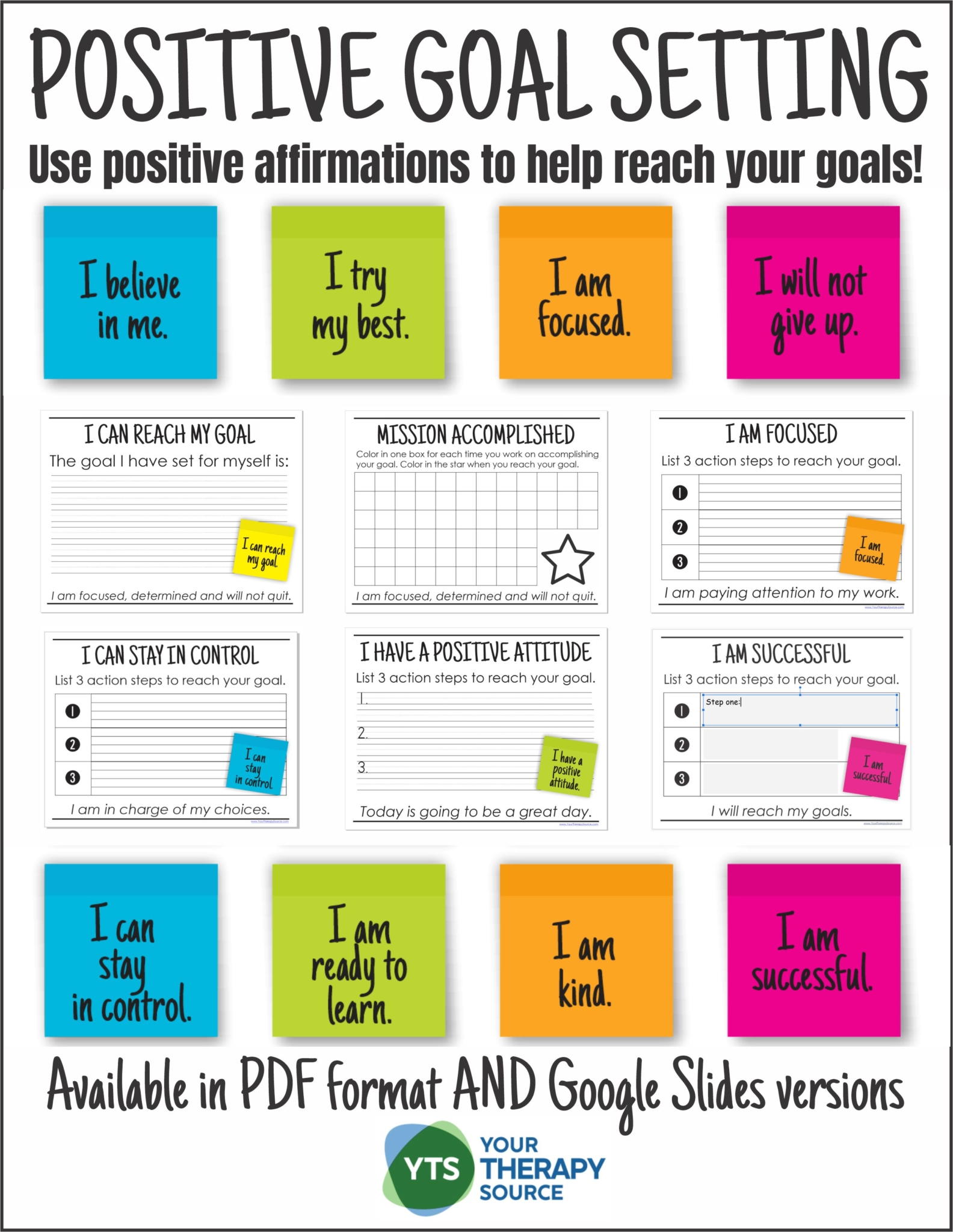
Credit: www.yourtherapysource.com
Creating Your Own Affirmations
Sometimes, the most powerful affirmations are the ones you make yourself. Creating personal affirmations helps you focus on your unique strengths and challenges.
Here’s a simple method:
- Think About Your Goals: What do you want to improve—confidence, focus, grades, or something else?
- Choose Positive Words: Use strong, encouraging language.
- Keep It Short and Simple: One sentence is enough.
- Use Present Tense: “I am” or “I can” are good starts.
- Make It Personal: Use words that mean something to you.
For example, if you want to do better in math, you might say: “I am getting better at math every day.” If you want to be more confident speaking in class: “I am comfortable sharing my ideas.”
A common mistake is making affirmations too general or too hard to believe. Start with something small and build from there.
Affirmations For Different Student Needs
Not every student faces the same challenges. Here are affirmations for different situations you might experience.
Affirmations For Exam Stress
- I am prepared and ready for my exams.
- I stay calm and focused under pressure.
- I remember what I have studied.
- I trust my knowledge and skills.
Affirmations For Motivation
- I am excited to learn new things.
- I finish what I start.
- I am motivated and ready to do my best.
- I can overcome any challenge.
Affirmations For Self-esteem
- I believe in myself.
- I am proud of my achievements.
- I am valuable and important.
- I am enough just as I am.
Affirmations For Focus
- I am focused on my studies.
- I pay attention in class.
- I finish my tasks on time.
- I manage my distractions well.
Affirmations For Making Friends
- I am friendly and approachable.
- I am a good friend to others.
- I enjoy meeting new people.
- I am comfortable in social situations.
Personalizing affirmations for specific needs makes them more effective. Don’t be afraid to mix and match or create your own based on these examples.
How Affirmations Can Change Your Mindset
Your mindset is the way you see yourself and your abilities. Students with a growth mindset believe they can improve with effort, while those with a fixed mindset think their abilities are set. Affirmations help move you toward a growth mindset.
Research shows that students who use positive self-talk are less likely to give up when things get hard. In one study, students who wrote self-affirming statements before tests performed better and felt less stress compared to those who did not.
The key insight here is that affirmations are not magic, but they can change the way you react to challenges. Over time, your brain starts to expect success, not failure.
Practical Ways To Use Affirmations In Daily Life
It’s easy to forget your affirmations when life gets busy. Here are some practical ways to make affirmations a habit:
- Morning Routine: Say your affirmations while brushing your teeth or getting ready for school.
- Sticky Notes: Place notes on your mirror, desk, or in your notebook.
- Phone Reminders: Set reminders to pop up during the day.
- Before Tests or Presentations: Repeat your affirmations to calm nerves.
- Journaling: Write your affirmations every morning or night.
Many students don’t realize that affirmations are more effective when combined with action. For example, if your affirmation is “I am organized,” try setting up a study schedule to support your words.
Common Mistakes Students Make With Affirmations
While affirmations are simple, there are common mistakes that can reduce their power:
- Not believing the words: If you don’t connect with the affirmation, it won’t help.
- Being too general: Specific affirmations are more useful than vague ones.
- Expecting instant results: Affirmations take time to work. Be patient.
- Using negative words: Avoid words like “not” or “never.” Keep it positive.
- Lack of consistency: Use your affirmations daily for best results.
A less obvious mistake is using affirmations as a way to avoid taking action. Remember, affirmations support your efforts—they don’t replace them.
Comparing Affirmations And Negative Self-talk
Students often wonder why positive affirmations matter when negative self-talk is so common. Here’s a comparison to help you see the difference:
| Affirmations | Negative Self-Talk |
|---|---|
| Builds confidence | Lowers self-esteem |
| Encourages effort | Discourages trying |
| Reduces stress | Increases anxiety |
| Improves performance | Leads to giving up |
| Creates growth mindset | Supports fixed mindset |
Understanding this difference helps you see why replacing negative thoughts with affirmations is a smart move.
Affirmations For Different Ages
Affirmations can be adapted for students of any age. Here’s how they might look for younger and older students:
| Age Group | Example Affirmation |
|---|---|
| Primary School | I am a good friend. |
| Middle School | I can learn new things, even if they are hard. |
| High School | I am preparing for a bright future. |
| University | I am confident sharing my ideas in class. |
You can see that as students grow, their affirmations become more focused on independence, responsibility, and future goals.
Real-life Stories: Students Who Use Affirmations
Hearing how others have used affirmations can be motivating. Here are some examples:
- Sarah, a high school student, used to get very nervous before math exams. She started saying, “I am prepared and ready for this test” every morning for two weeks before her exams. She noticed she was calmer and remembered more during the test.
- Ahmed, a university student, felt shy in group projects. His affirmation, “I am comfortable sharing my ideas,” helped him speak up more often. Over time, his classmates started listening to him more.
- Lina, in middle school, struggled with making friends. She repeated, “I am friendly and approachable,” and made an effort to smile and say hello. Soon, she found it easier to join in conversations.
These stories show that affirmations are not just words—they can lead to real changes when used with effort and belief.
Combining Affirmations With Other Study Habits
Affirmations are most effective when they are part of a bigger routine. Here’s how you can combine them with good study habits:
- Set Clear Goals: Use affirmations that match your specific goals, like “I am improving in science.”
- Create a Study Plan: Affirm your ability to follow your plan.
- Take Breaks: Use affirmations during breaks to stay positive.
- Celebrate Progress: Remind yourself of your growth, even if it’s small.
Many students forget that positive thinking and good habits go hand in hand. You can’t just say “I am organized” and expect results without making a schedule or cleaning your desk.
Using Affirmations For Group Work
Working with others is a big part of school life. Affirmations can help you be a better team member. Here are some examples:
- I am a good listener in group work.
- I respect different opinions.
- I am helpful to my classmates.
- I share my ideas with confidence.
If you feel nervous working in groups, start with “I am comfortable working with others. ” Over time, you’ll notice group projects become less stressful.

Credit: www.thepathway2success.com
Affirmations For Public Speaking And Presentations
Speaking in front of others is a common fear for students. Affirmations can help reduce this anxiety:
- I am confident when speaking in front of the class.
- I speak clearly and calmly.
- My ideas are important and worth sharing.
- I am well-prepared for my presentation.
A practical tip: Practice your affirmation before and after you rehearse your speech. Visualize yourself standing confidently in front of your audience.
Affirmations For Dealing With Failure
Every student faces setbacks. The difference is how you handle them. Affirmations for failure help you bounce back:
- I learn from my mistakes.
- I am not defined by one bad result.
- I am getting stronger every day.
- I use failure to grow and improve.
Many students believe that failure means they are not good enough. In reality, failure is part of learning. Affirmations help you remember this important truth.
Tracking Your Progress With Affirmations
It’s easy to lose track of your progress, especially if you are busy. Here’s a simple way to see if affirmations are working for you:
- Journal: Write down your affirmation and how you feel each day.
- Rate Your Mood: Use a scale of 1-5 to track your confidence or stress.
- Review Weekly: Look back and see what has changed.
Here’s a simple example of a tracking table:
| Day | Affirmation Used | How I Felt (1-5) | Notes |
|---|---|---|---|
| Monday | I am focused and ready to study. | 3 | Felt a bit distracted, but tried my best. |
| Tuesday | I am improving every day. | 4 | Finished homework on time. |
| Wednesday | I believe in my ability to succeed. | 5 | Answered questions in class confidently. |
This method helps you see your growth and stay motivated.
The Science Behind Affirmations
Why do affirmations work? Research in psychology shows that self-affirmation can activate parts of the brain that handle positive values and self-worth. This process can reduce stress and improve academic performance.
For example, a study published on Wikipedia explains that self-affirmation helps people respond to threats with less fear and more confidence. This means students who use affirmations are more likely to try again after failure and less likely to give up.
A less obvious insight is that affirmations can also help with physical symptoms of stress—like headaches or trouble sleeping—by calming your mind.
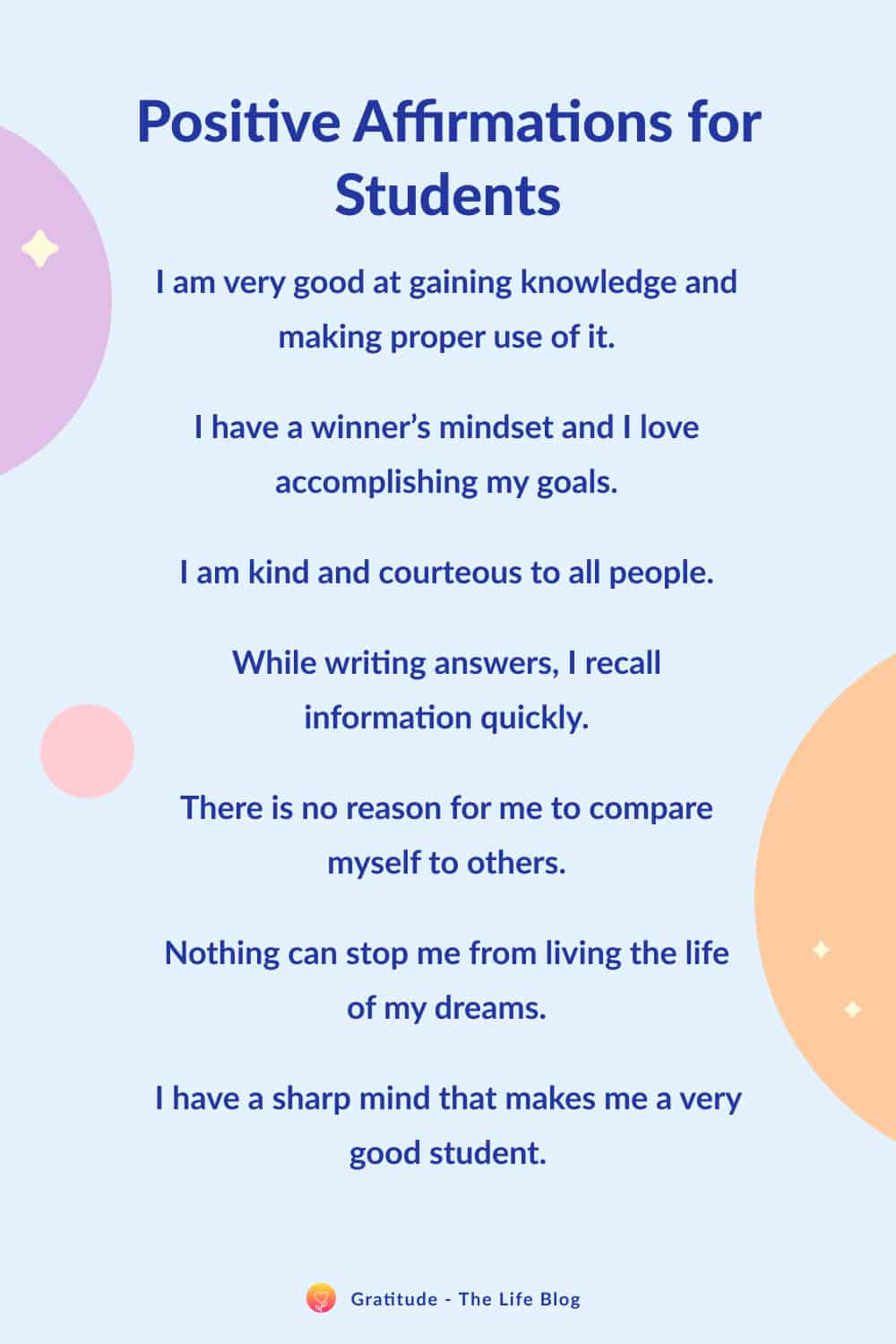
Credit: blog.gratefulness.me
Making Affirmations A Lifelong Skill
Affirmations are not just for school. They are a skill you can use in any part of life—work, sports, relationships, or personal challenges. The earlier you start, the stronger this habit becomes.
Here are some ways to keep affirmations part of your life:
- Teach a friend or family member your favorite affirmation.
- Use affirmations before new experiences, like interviews or travel.
- Create new affirmations as your goals change.
Remember, the real power of affirmations is in helping you see yourself as someone who can grow, learn, and succeed—no matter the situation.
Frequently Asked Questions
What Is The Best Time Of Day To Use Affirmations?
The best time is when you can focus and feel calm. Many students find mornings helpful because it sets a positive mood for the day. Others prefer using affirmations before tests, presentations, or before bed to relax. Try different times and choose what works best for you.
Can Affirmations Really Improve My Grades?
Affirmations support a positive mindset, which can help you study better and handle stress. While affirmations alone will not raise your grades, they make it easier to focus, stay motivated, and keep trying after setbacks. Combine them with good study habits for the best results.
How Long Does It Take For Affirmations To Work?
Results are different for everyone. Some students notice changes in a few days, while others need weeks. The key is to use affirmations regularly and be patient. Over time, your thoughts and actions will start to change in a positive way.
What If I Don’t Believe My Affirmation?
It’s normal to feel doubtful at first. Start with affirmations that feel possible and true for you. As you repeat them and see small successes, your belief will grow. Adjust your affirmations until they feel right.
Can I Write My Own Affirmations?
Absolutely! In fact, personal affirmations are often the most powerful. Think about your goals, challenges, and strengths. Use simple, positive language and speak in the present tense. Make your affirmation something you want to believe and achieve.
Affirmations are a small but powerful tool for any student. When you use them with intention and action, you’ll find yourself growing in confidence, focus, and resilience—not just in school, but in all parts of life.
